From Surf Wiki (app.surf) — the open knowledge base
Boers
Descendants of Afrikaners beyond the Cape Colony frontier

Descendants of Afrikaners beyond the Cape Colony frontier
| Field | Value |
|---|---|
| group | Boers |
| native_name | af |
| image | Boerfamily1886.jpg |
| image_upright | 1.2 |
| caption | Boer family in 1886 |
| pop | |
| languages | Afrikaans |
| religions | Protestant Christianity |
| related |
Boers ( ; ; ) are the descendants of the proto Afrikaans-speaking Free Burghers of the eastern Cape frontier in Southern Africa during the 17th, 18th, and 19th centuries. From 1652 to 1795, the Dutch East India Company controlled the Dutch Cape Colony, which the United Kingdom incorporated into the British Empire in 1806. The name of the group is derived from Trekbœr then later "boer", which means "farmer" in Dutch and Afrikaans.
In addition, the term Boeren also applied to those who left the Cape Colony during the 19th century to colonise the Orange Free State, and the Transvaal (together known as the Boer Republics), and to a lesser extent Natal. They emigrated from the Cape to live beyond the reach of the British colonial administration, with their reasons for doing so primarily being the new Anglophone common law system being introduced into the Cape and the British abolition of slavery in 1833. Compare:
The term Afrikaners or Afrikaans people is generally used in modern-day South Africa for the white Afrikaans-speaking population of South Africa (the largest group of White South Africans) encompassing the descendants of both the Boers, and the Cape Dutch who did not embark on the Great Trek.
According to a genetic study, 4.7% of their DNA is of non-European origin. 1.3% being Khoisan, 1.7% from South Asia, slightly less than 1% from East Asia and 0.8% from East and West Africa.
Origin
European colonists
The Dutch East India Company (; VOC) was formed in the Dutch Republic in 1602, and at this time the Dutch had entered the competition for the colonial and imperial trade of commerce in Southeast Asia. The end of the Thirty Years' War in 1648 saw European soldiers and refugees widely dispersed across Europe. Immigrants from Germany, Scandinavia, and Switzerland traveled to the Netherlands in the hope of finding employment with the VOC. During the same year, one of their ships was stranded in Table Bay near what would eventually become Cape Town, and the shipwrecked crew had to forage for themselves on shore for several months. They were so impressed with the natural resources of the country that on their return to the Dutch Republic, they presented to the VOC directors the advantages to be had for the Dutch Eastern trade from a properly provided for and fortified station at the Cape. In response, the VOC sent a Dutch expedition in 1652 led by Jan van Riebeek, who constructed a fort, laid out vegetable gardens at Table Bay, and took control over Cape Town, which he governed for a decade.
Free Burghers
Main article: Free Burghers
VOC favoured the idea of freemen at the Cape and many workers of VOC requested to be discharged in order to become free burghers (citizens). As a result, Jan van Riebeek approved the notion on favorable conditions and earmarked two areas near the Liesbeek River for the purpose of agricultural development in 1657. The two areas allocated to the freemen were named Greenfield and Dutch Garden. These areas were separated by the Amstel (Liesbeek) River. The best nine applicants were selected to settle the land. The freemen (free burghers, as they were called thereafter) thus became subjects of VOC and were no longer considered servants.
In 1671, the Dutch first purchased land from the indigenous Khoikhoi beyond the limits of the fort built by Van Riebeek; this marked the beginnings of the Dutch Cape Colony. As the result of the investigations of a 1685 commissioner, the government worked to recruit a greater variety of immigrants to develop a stable community. They formed part of the class of vrijlieden, also known as vrijburgers ('free citizens'), former VOC employees who remained at the Cape after serving their contracts. A large number of vrijburgers became independent farmers and applied for grants of land, as well as loans of seed and tools, from VOC administration.
Dutch free immigrants
VOC authorities had been endeavouring to induce gardeners and small farmers to emigrate from Europe to South Africa, but with little success. They were only able to attract a few families through the promise of wealth, but the Cape had little to offer. In October 1670, however, the Chamber of Amsterdam announced that a few families were willing to leave for the Cape and Mauritius the following December. Among the new names of burghers at this time were Jacob and Dirk van Niekerk, Johannes van As, Francois Villion, Jacob Brouwer, Jan van Eden, Hermanus Potgieter, Albertus Gildenhuis, and Jacobus van den Berg.
French Huguenots
During 1688–1689, the colony was greatly strengthened by the arrival of nearly two hundred French Huguenots, who were political refugees from the religious wars in France following the revocation of the Edict of Nantes. They joined colonies at Stellenbosch, Drakenstein, Franschhoek and Paarl. The Huguenots had a marked influence on the character of the colony, leading the VOC in 1701 to mandate that only Dutch be taught in schools. This resulted in the Huguenots assimilating by the middle of the 18th century, with a loss in the use and knowledge of French. The colony gradually spread eastwards, and by 1754 land as far as Algoa Bay was included in the colony.
At this time the European colonists numbered eight to ten thousand. They possessed numerous slaves, grew wheat in sufficient quantity to make it a commodity crop for export, and were famed for the good quality of their wines. But their chief wealth was in cattle. They enjoyed considerable prosperity.
Through the latter half of the 17th and the whole of the 18th century, troubles arose between the colonists and the government as the VOC administration was despotic. Its policies were not directed at development of the colony, but to profit the VOC. The VOC closed the colony against free immigration, kept the whole of the trade in its own hands, combined the administrative, legislative and judicial powers into one body, mandated the cultivation of certain crops, and demanded a large part of their produce as a kind of tax, among other exactions.
Trekboers
Main article: Trekboers
From time to time, indentured VOC servants were endowed with the right of freeburghers but the VOC retained the power to compel them to return into its service whenever they deemed it necessary. This right to force into servitude those who might incur the displeasure of the governor or other high officers was not only exercised with reference to the individuals themselves; it was claimed by the government to be applicable to their children as well.
The tyranny caused many to feel desperate and to flee from oppression, even before the 1700 trekking began. In 1780, Joachim van Plettenberg, the governor, proclaimed the Sneeuberge to be the northern boundary of the colony, expressing "the anxious hope that no more extension should take place, and with heavy penalties forbidding the rambling peasants to wander beyond". In 1789, so strong had feelings amongst the burghers become that delegates were sent from the Cape to interview the authorities at Amsterdam. After this deputation, some nominal reforms were granted.
Image:Burchell02.jpg|Descending from the Sneeuberge, a scene near Graaff-Reinet, by Burchell Image:Charles Michell03.jpg|Passing Cradock Pass, Outeniqua Mountains, by Charles Collier Michell Image:Daniell Trekboer.jpg|An aquatint by Samuel Daniell of Trekboers making camp Image:TrekBoers crossing the Karoo.jpg|Trekboers crossing the Karoo by Charles Davidson Bell
It was largely to escape oppression that the farmers trekked farther and farther from the seat of government. VOC, to control the emigrants, established a magistracy at Swellendam in 1745 and another at Graaff Reinet in 1786. The Gamtoos River had been declared, , the eastern frontier of the colony but it was soon passed. In 1780, however, the Dutch, to avoid collision with the Bantu peoples, agreed with them to make the Great Fish River the common boundary. In 1795 the heavily taxed burghers of the frontier districts, who were afforded no protection against the Bantus, expelled the VOC officials, and set up independent governments at Swellendam and Graaff Reinet.
The trekboers of the 19th century were the lineal descendants of the trekboers of the 18th century. The end of the 19th century saw a revival of the same tyrannical monopolist policy as that in the VOC government in the Transvaal. If the formula, "In all things political, purely despotic; in all things commercial, purely monopolist", was true of the VOC government in the 18th century, it was equally true of Kruger's government in the latter part of the 19th.
The underlying fact which made the trek possible is that the Dutch-descended colonists in the eastern and northeastern parts of the colony were not cultivators of the soil, but of purely pastoral and nomadic habits, ever ready to seek new pastures for their flocks and herds, possessing no special affection for any particular locality. These people, thinly scattered over a wide territory, had lived for so long with little restraint from the law that when, in 1815, by the institution of "Commissions of Circuit", justice was brought nearer to their homes, various offences were brought to light, the remedying of which caused much resentment.
The Dutch-descended colonists in the eastern and northeastern parts of the colony, as a result of the Great Trek, had removed themselves from governmental rule and become widely spread out. However, the institution of "Commissions of Circuit" in 1815 allowed the prosecution of crimes, with offences committed by the trekboers—notably including many against people they had enslaved—seeing justice. These prosecutions were very unpopular amongst the trekkers and were seen as interfering with their rights over the enslaved people they viewed as their property.
Image:Trekboer migration map.png|A map of the expansion of the Trekboers (1700–1800) Image:Nederlandse Kaapkolonie.svg|Evolution of the Dutch Cape Colony (1700–1800) Image:Kapkolonie 1795.jpg|Administrative divisions of the Dutch Cape Colony
The Boers were hostile toward indigenous African peoples, with whom they fought frequent range wars, and toward the government of the Cape, which was attempting to control Boer movements and commerce. They overtly compared their way of life to that of the Israel patriarchs of the Bible, developing independent patriarchal communities based upon a mobile pastoralist economy. Staunch Calvinists, they saw themselves as the children of God in the wilderness, a Christian elect divinely ordained to rule the land and the backward natives therein. By the end of the 18th century the cultural links between the Boers and their urban counterparts were diminishing, although both groups continued to speak a type of Flemish.
Invasion of the Cape Colony
Main article: Invasion of the Cape Colony
The Invasion of the Cape Colony was a British military expedition launched in 1795 against the Dutch Cape Colony at the Cape of Good Hope. The Netherlands had fallen under the revolutionary government of France and a British force under General Sir James Henry Craig was sent to Cape Town to secure the colony from the French for the Prince of Orange, a refugee in England. The governor of Cape Town at first refused to obey the instructions from the Prince, but when the British proceeded to land troops to take possession anyway, he capitulated. His action was hastened by the fact that the Khoikhoi, escaping from their former enslavers, flocked to the British standard. The burghers of Graaff Reinet did not surrender until a force had been sent against them; in 1799 and again in 1801 they rose in revolt. In February 1803, as a result of the peace of Amiens (February 1803), the colony was handed over to the Batavian Republic which introduced many reforms, as had the British during their eight years' rule. One of the first acts of General Craig had been to abolish torture in the administration of justice. The country still remained essentially Dutch, and few British citizens were attracted to it. Its cost to the British exchequer during this period was £16,000,000. The Batavian Republic entertained very liberal views as to the administration of the country, but had little opportunity to enact them.
When the War of the Third Coalition broke out in 1803, a British force was once again sent to the Cape. After an engagement (January 1806) on the shores of Table Bay, the Dutch garrison of Castle of Good Hope surrendered to the British under Sir David Baird, and in the 1814 Anglo-Dutch treaty the colony was ceded outright by The Netherlands to the British crown. At that time the colony extended to the line of mountains guarding the vast central plateau, then called Bushmansland (after a name for the San people), and had an area of about sq km and a population of some , of whom were whites, free Khoikhoi and the rest enslaved people, mostly non-indigenous blacks and Malays.
Dislike of British rule
Although the colony was fairly prosperous, many of the Dutch farmers were as dissatisfied with British rule as they had been with that of the VOC, though their grounds for complaint were not the same. In 1792, Moravian missions had been established which targeted the Khoikhoi, and in 1799 the London Missionary Society began work among both Khoikhoi and the Bantu peoples. The missionaries' championing of Khoikhoi grievances caused much dissatisfaction among the majority of the Dutch colonists, whose views temporarily prevailed, for in 1812 an ordinance was issued which empowered magistrates to bind Khoikhoi children as apprentices under conditions which differed little from slavery. Simultaneously, the movement for the abolition of slavery was gaining strength in England, and the missionaries appealed from the colonists to the mother country.
Slachter's Nek
A farmer named Frederick Bezuidenhout refused to obey a summons issued on the complaint of a Khoikhoi, and, firing on the party sent to arrest him, was killed by the return fire. This caused a small rebellion in 1815, known as Slachters Nek, described as "the most insane attempt ever made by a set of men to wage war against their sovereign" by Henry Cloete. Upon its suppression, five ringleaders were publicly hanged at the spot where they had sworn to expel "the English tyrants". The feeling caused by the hanging of these men was deepened by the circumstances of the execution, as the scaffold on which the rebels were simultaneously hanged broke down from their united weight and the men were afterwards hanged one by one. An ordinance was passed in 1827, abolishing the old Dutch courts of landdrost and heemraden (resident magistrates being substituted) and establishing that henceforth all legal proceedings should be conducted in English. The granting in 1828, as a result of the representations of the missionaries, of equal rights with whites to the Khoikhoi and other free coloured people, the imposition (1830) of heavy penalties for harsh treatment of enslaved people, and finally the emancipation of the enslaved people in 1834, were measures which combined to aggravate the farmers' dislike of government. Moreover, what the Boers viewed as the inadequate compensation for the freeing of the slaves, and the suspicions engendered by the method of payment, caused much resentment; and in 1835 the farmers again removed themselves to unknown country to escape the government. While emigration beyond the colonial border had been continuous for 150 years, it now took on larger proportions.
Cape Frontier Wars (1779–1879)
Main article: Xhosa Wars

The migration of the trekboers from the Cape Colony into the Eastern Cape parts of South Africa, where the native Xhosa people had established settlements, gave rise to a series of conflicts between the Boers and the Xhosas. In 1775 the Cape government established a boundary between the trekboers and the Xhosas at the Bushmans and Upper Fish Rivers. The Boers and Xhosas ignored the boundary, with both groups establishing homes on either side of the frontier. Governor van Plettenberg attempted to persuade both groups to respect the boundary line without success. The Xhosas were accused of stealing cattle and in 1779 a series of skirmishes erupted along the border which initiated the 1st Frontier War.
The frontier remained unstable, resulting in the outbreak of the 2nd Frontier War in 1789. Raids carried out by Boers and Xhosas on both sides of the boundary caused much friction in the area which resulted in several groups being drawn into the conflict. In 1795, the British invasion of the Cape Colony resulted in a change of government. After the government takeover the British began to draw up policies with regards to the frontier resulting in a Boer rebellion in Graaff-Reinet. The policies caused the Khoisan tribes to join some Xhosa chiefs in attacks against British forces during the 3rd Frontier War (1799–1803).
Peace was restored to the area when the British, under the Treaty of Amiens, returned the Cape Colony to the Dutch Batavian Republic in 1803. In January 1806 during a second invasion, the British reoccupied the colony after the Battle of Blaauwberg. Tensions in the Zuurveld led the colonial administration and Boer colonists to expel many of the Xhosa tribes from the area, initiating the 4th Frontier War in 1811. Conflicts between the Xhosas on the frontier led to the 5th Frontier War in 1819.
The Xhosas, due to dissatisfaction with vacillating government policies regarding where they were permitted to live, undertook large-scale cattle thefts on the frontier. The Cape government responded with several military expeditions. In 1834 a large Xhosa force moved into the Cape territory, which began the 6th Frontier War. Additional fortifications were built by the government and mounted patrols were not well received by the Xhosas, who continued with raids on farms during the 7th Frontier War (1846–1847). The 8th (1850–1853) and 9th Frontier Wars (1877–1878) continued at the same pace as their predecessors. Eventually the Xhosas were defeated and the territories were brought under British control.
Great Trek
Main article: Great Trek
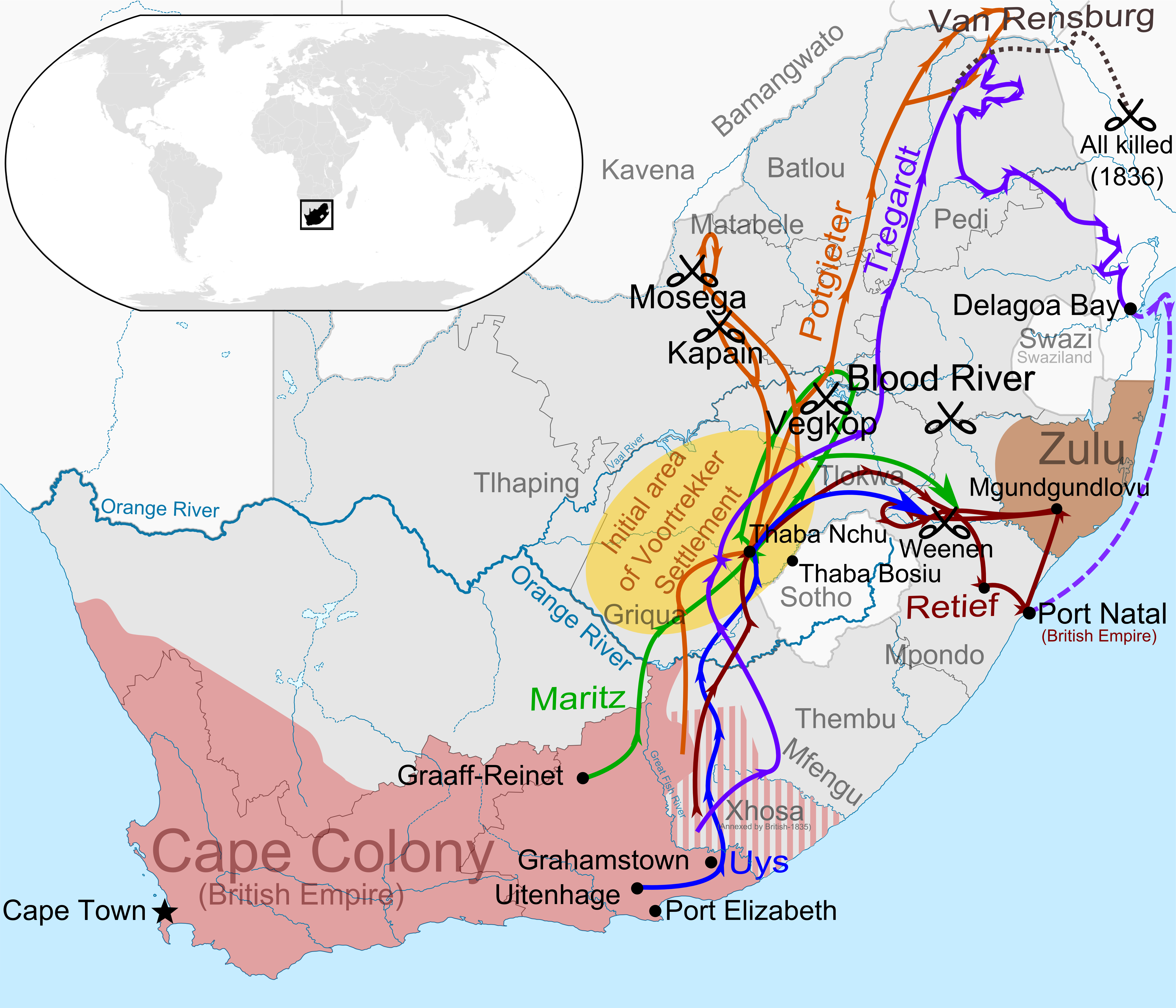
The Great Trek occurred between 1835 and the early 1840s. During that period some 12,000 to 14,000 Boers (including women and children), impatient with British rule, emigrated from Cape Colony into the great plains beyond the Orange River, and across them again into Natal and the vastness of the Zoutspansberg, in the northern part of the Transvaal. Those Trekboers who occupied the eastern Cape were semi-nomadic. A significant number in the eastern Cape frontier later became Grensboere ('border farmers') who were the direct ancestors of the Voortrekkers.
The Boers addressed several correspondence to the British Colonial Government before leaving the Cape Colony as reasons for their departure. Piet Retief, one of the leaders of the Boers during the time, addressed a letter to the government on 22 January 1837 in Grahamstown stating that the Boers did not see any prospect for peace or happiness for their children in a country with such internal commotions. Retief further complained that the severe financial losses had resulted from the emancipation of their enslaved people, for which the Boers considered the compensation provided by the British government to be inadequate. They also felt that the English church system was incompatible with the Dutch Reformed Church. By this time the Boers had already formed a separate code of laws in preparation for the great trek and were aware of the dangerous territory they were about to enter. Retief concluded his letter with "We quit this colony under the full assurance that the English Government has nothing more to require of us, and will allow us to govern ourselves without its interference in future".
Boer states and republics
Main article: Boer republics

As the Voortrekkers progressed further inland, they continued to establish Boer colonies on the interior of South Africa.
| Description | Dates | Area |
|---|---|---|
| Flag of the Netherlands.svg Republic of Swellendam | 17 June – 4 November 1795 | Swellendam, Western Cape |
| Flag of the Netherlands.svg Republic of Graaff-Reinet | 1 February 1795 – November 1796 | Graaff-Reinet, Eastern Cape |
| Voortrekker Flag.svg Zoutpansberg | 1835–1864 | Limpopo |
| Voortrekker Flag.svg Winburg | 1836–1844 | Free State |
| South African Burgers Flag.svg Potchefstroom | 1837–1844 | North West |
| Natalia Republic | 1839–1902 | Eastern Cape |
| South African Burgers Flag.svg Winburg-Potchefstroom | 1844–1843 | Potchefstroom, North West |
| Flag of Natalia Republic.svg Republic of Klip River | 1847–1848 | Ladysmith, KwaZulu-Natal |
| Flag of the Netherlands.svg Lydenburg Republic | 1849–1860 | Lydenburg, Mpumalanga |
| Flag of the Netherlands.svg Utrecht Republic | 1852–1858 | Utrecht, KwaZulu-Natal |
| South African Republic | 1852–1877, 1881–1902 | Gauteng, Limpopo |
| Orange Free State | 1854–1902 | Free State |
| Flag of Transvaal.svg Klein Vrystaat | 1876–1891 | Piet Retief, Mpumalanga |
| Flag of the Republic of Goshen.svg State of Goshen | 1882–1883 | North West |
| Flag of Stellaland (early 1883).svg Republic of Stellaland | 1882–1883 | North West |
| Flag of Stellaland (1883-5).svg United States of Stellaland | 1883–1885 | North West |
| Flag of Nieuwe Republiek.svg New Republic | 1884–1888 | Vryheid, KwaZulu-Natal |
| Flag of the German Empire.svg Republic of Upingtonia/Lijdensrust | 1885–1887 | Namibia |
Anglo-Boer wars
Main article: First Boer War, Second Boer War

Following the British annexation of the Transvaal in 1877, Paul Kruger was a key figure in organizing a Boer resistance which led to expulsion of the British from the Transvaal. The Boers then fought the Second Boer War in the late 19th and early 20th century against the British in order to ensure the republics of the Transvaal (the Zuid-Afrikaansche Republiek) and the Orange Free State, remaining independent, ultimately capitulating in 1902.
Boer War diaspora
After the Second Boer War, a Boer diaspora occurred. Starting in 1903, the largest group emigrated to the Patagonia region of Argentina and to Brazil. Another group emigrated to the British colony of Kenya, from where most returned to South Africa during the 1930s, while a third group under the leadership of General Ben Viljoen emigrated to Mexico and to New Mexico and Texas in the southwestern United States.
1914 Boer Revolt
Main article: Maritz Rebellion
The Maritz Rebellion (also known as the Boer Revolt, the Five Shilling Rebellion or the Third Boer War) occurred in 1914 at the start of World War I, in which men who supported the re-creation of the Boer republics rose up against the government of the Union of South Africa because they did not want to side with the British against the German Empire so soon after the war with the British.
Many Boers had German ancestry and many members of the government were themselves former Boer military leaders who had fought with the Maritz rebels against the British in the Second Boer War. The rebellion was put down by Louis Botha and Jan Smuts, and the ringleaders received heavy fines and terms of imprisonment. One, Jopie Fourie, an officer in the Union Defence Force, was convicted for treason when he refused to take up arms alongside the British, and was executed by the South African government in 1914.
Characteristics
Language
Main article: Afrikaans
Afrikaans is a West Germanic language spoken widely in South Africa and Namibia, and to a lesser extent in Botswana and Zimbabwe. It evolved from the Dutch vernacular of South Holland (Hollandic dialect) spoken by the mainly Dutch colonists of what is now South Africa, where it gradually began to develop distinguishing characteristics in the course of the 18th century. Hence, it is a daughter language of Dutch, and was previously referred to as Cape Dutch (also used to refer collectively to the early Cape colonists) or kitchen Dutch (a derogatory term used in its earlier days). However, it is also variously (although incorrectly) described as a creole or as a partially creolised language.Afrikaans is a daughter language of Dutch; see , , , , , . Afrikaans was historically called Cape Dutch; see , , , , , . Afrikaans is rooted in seventeenth century dialects of Dutch; see , , , . Afrikaans is variously described as a creole, a partially creolised language, or a deviant variety of Dutch; see . The term is ultimately derived from Dutch Afrikaans-Hollands meaning African Dutch.
Culture
_-_The_Voortrekkers.jpg)
The desire to wander, known as trekgees, was a notable characteristic of the Boers. It figured prominently in the late 17th century when the Trekboers began to inhabit the northern and eastern Cape frontiers, again during the Great Trek when the Voortrekkers left the eastern Cape en masse, and after the major republics were established during the Thirstland ('Dorsland') Trek. One such trekker described the impetus for emigrating as, "a drifting spirit was in our hearts, and we ourselves could not understand it. We just sold our farms and set out northwestwards to find a new home". A rustic characteristic and tradition was developed quite early on as Boer society was born on the frontiers of white colonisation and on the outskirts of Western civilisation.
The Boer quest for independence manifested in a tradition of declaring republics, which predates the arrival of the British; when the British arrived, Boer republics had already been declared and were in rebellion from the VOC.
Beliefs
The Boers of the frontier were known for their independent spirit, resourcefulness, hardiness, and self-sufficiency, whose political notions verged on anarchy but had begun to be influenced by republicanism.
The Boers had cut their ties to Europe as they emerged from the Trekboer group.
The Boers possessed a distinct Protestant culture, and the majority of Boers and their descendants were members of a Reformed Church. The Nederduitsch Hervormde Kerk ('Dutch Reformed Church') was the national Church of the South African Republic (1852–1902). The Orange Free State (1854–1902) was named after the Protestant House of Orange in the Netherlands.
The Calvinist influence, in such fundamental Calvinist doctrines such as unconditional predestination and divine providence, remains present in a minority of Boer culture, who see their role in society as abiding by the national laws and accepting calamity and hardship as part of their Christian duty. Many Boers have since converted denominations and are now members of Baptist, Charismatic, Pentecostal or Lutheran Churches.
Modern usage
During recent times, mainly during the apartheid reform and post-1994 eras, some white Afrikaans-speaking people, mainly with conservative political views, and of Trekboer and Voortrekker descent, have chosen to be called Boere, rather than Afrikaners, to distinguish their identity. They believe that many people of Voortrekker descent were not assimilated into what they see as the Cape-based Afrikaner identity. They suggest that this developed after the Second Anglo-Boer War and the subsequent establishment of the Union of South Africa in 1910. Some Boer nationalists have asserted that they do not identify as a right-wing element of the political spectrum.
They contend that the Boers of the South African Republic and Orange Free State republics were recognised as a separate people or cultural group under international law by the Sand River Convention (which created the South African Republic in 1852), the Bloemfontein Convention (which created the Orange Free State Republic in 1854), the Pretoria Convention (which re-established the independence of the South African Republic 1881), the London Convention (which granted the full independence to the South African Republic in 1884), and the Vereeniging Peace Treaty, which formally ended the Second Anglo-Boer War on 31 May 1902. Others contend, however, that these treaties dealt only with agreements between governmental entities and do not imply the recognition of a Boer cultural identity per se.
The supporters of these views feel that the Afrikaner label was used from the 1930s onwards as a means of politically unifying the white Afrikaans speakers of the Western Cape with those of Trekboer and Voortrekker descent in the north of South Africa, where the Boer Republics were established.
Since the Anglo-Boer war, the term Boerevolk ('farmer people') was rarely used in the 20th century by the various regimes because of the effort to assimilate the Boerevolk with the Afrikaners. A portion of those who are the descendants of the Boerevolk have reasserted use of this designation.
The supporters of the Boer designation view the term Afrikaner as an artificial political label which usurped their history and culture, turning Boer achievements into Afrikaner achievements. They feel that the Western-Cape based Afrikaners – whose ancestors did not trek eastwards or northwards – took advantage of the republican Boers' destitution following the Anglo-Boer War. At that time, the Afrikaners attempted to assimilate the Boers into the new politically based cultural label.
In contemporary South Africa, Boer and Afrikaner have often been used interchangeably. Afrikaner directly translated means African, and thus refers to all Afrikaans-speaking people in Africa who have their origins in the Cape Colony founded by Jan Van Riebeeck. Boer is a specific group within the larger Afrikaans-speaking population.
During apartheid, Boer was used by opponents of apartheid in various contexts, referring to institutional structures such as the National Party, or to specific groups of people, such as members of the Police Force (colloquially known as Boere) and Army, Afrikaners, or white South Africans generally. This usage is often viewed as pejorative in contemporary South Africa.
Politics
- Boere-Vryheidsbeweging
- Boerestaat Party
- Freedom Front Plus
- Front National
- Herstigte Nasionale Party
- National Conservative Party of South Africa
Education
The Movement for Christian-National Education is a federation of 47 Calvinist private schools, primarily in the Free State and the Transvaal, committed to educating Boer children from grade 0 through to 12.
Media
Some local radio stations promote the ideals of those who identify with the Boer people, like Radio Rosestad 100.6 FM (in Bloemfontein), Overvaal Stereo and Radio Pretoria. An internet-based radio station, Boervolk Radio, promotes Boer separatism.
Territories
Territorial areas in the form of a Boerestaat ('Boer State') are being developed as colonies exclusively for Boers/Afrikaners, notably Orania in the Northern Cape and Kleinfontein near Pretoria.
Notable Boers==
Voortrekker leaders
- Sarel Cilliers
- Andries Hendrik Potgieter
- Andries Pretorius
- Piet Retief
Great trek
- Racheltjie de Beer
- Dirkie Uys
- Marthinus Jacobus Oosthuizen
Participants in the Second Anglo-Boer War
- Koos de la Rey, general; regarded as being one of the great military leaders of the Second Anglo-Boer War
- Danie Theron, soldier
- Christiaan Rudolf de Wet, general
- Siener van Rensburg, considered a prophet by some
Politicians
- Louis Botha, first prime minister of South Africa (1910–1919) and former Boer general
- Petrus Jacobus Joubert, general and cabinet member of the Transvaal Republic
- Paul Kruger, president of the Transvaal Republic
- Martinus Theunis Steyn, 6th State President of the Orange Free State
Spies
- Robey Leibbrandt
- Fritz Joubert Duquesne, Boer captain known as the Black Panther who served in the Second Boer War
Discrimination
South African farmers in rural areas, including many Boers, have faced violent attacks, including assault, murder, rape, and robbery. These incidents have led some White farmers and right-wing groups to claim that they are deliberately targeted due to their race. However, there are no reliable figures that suggest a higher risk of being murdered for White farmers.
The controversial song "Dubul' ibhunu" (translated as "shoot/kill the Boer", or "kill the farmer") has been sung among others by Julius Malema and his supporters during a political rally for the far-left political party Economic Freedom Fighters. Interpretations of the lyrics vary, with right-wing commentators claiming that they constitute a call for violence against white people, but historians as well as Malema himself pointing towards the origins of the song as an anti-apartheid chant that is not meant to be taken literally.
In modern fiction
The history of the Cape Colony and the Boers in South Africa is covered at length in the 1980 novel The Covenant by American author James A. Michener.
The Boers appear as a civilization in the 'Scramble to Africa' scenario in Civilization V: Brave New World. Paul Kruger leads the civilization during the scenario. The Boers' unique unit is the foreign volunteer.
Notes
References
Sources
References
- Stürmann, Jan. (2005). "New Coffins, Old Flags, Microorganisms and the Future of the Boer".
- Du Toit, Brian M.. (1998). "The Boers in East Africa: Ethnicity and Identity".
- (1984). "Tweetalige Woordeboek Afrikaans-Engels". Tafelberg-uitgewers.
- Pollak, Sorcha. "'The Irish remind me of Afrikaans people. They're quite reserved'". The Irish Times.
- "Afrikaans culture (ZA)".
- (2021-05-20). "What genetic analysis reveals about the ancestry of South Africa's Afrikaners".
- Precis of the Archives of the Cape of Good Hope, January 1652 – December 1658, Riebeeck's Journal, H.C.V. Leibrandt, pp. 47–48
- Hunt, John. (2005). "Dutch South Africa: Early Settlers at the Cape, 1652–1708". University of Pennsylvania Press.
- G. M. Theal (1888). ''History of South Africa''. London. pp. 205–206
- H. C. Viljoen, [https://web.archive.org/web/20091025222633/http://geocities.com/sa_stamouers/huguenots.htm "The Contribution of the Huguenots in South Africa"], 25 October 2009
- [https://www.britannica.com/EBchecked/topic/71276/Boer Encyclopædia Britannica Online] Boer (people)
- Theal, George McCall. (1894). "History of South Africa". S. Sonnenschein, Lowrey, & Co..
- "A short chronicle of warfare in South Africa", Compiled by the Military Information Bureau, Published: ''Scientia Militaria: South African Journal of Military Studies'', Vol. 16, Nr. 13, 1986
- (2 February 1837). "Retief's Manifesto". Graham's Town Journal.
- History of the Emigrant Boers in South Africa, 2nd ed, G.M. Theal, London 1888.
- Meredith, Martin. (2007). "Diamonds, Gold, and War: The British, the Boers, and the Making of South Africa". Public Affairs.
- K. Pithouse, C. Mitchell, R. Moletsane, Making Connections: Self-Study & Social Action, p.91
- J. A. Heese. (1971). "Die herkoms van die Afrikaner, 1657–1867". A. A. Balkema.
- "Herkomst en groei van het Afrikaans – G.G. Kloeke (1950)".
- (2015). "The origin of Afrikaans pronunciation: a comparison to west Germanic languages and Dutch dialects". Stellenbosch Papers in Linguistics Plus.
- Abel Coetzee. (1948). "Standaard Afrikaans". Afrikaner Pers.
- Ransford, Oliver. (1973). "The Great Trek".
- Mills, Wallace G.. "White Settlers in South Africa to 1870".
- Ransford, Oliver. (1973). "The Great Trek".
- [https://web.archive.org/web/20080422063509/http://www.chico.mweb.co.za/art/2007/2007mar/070309-bang.html Yolandi Groenewald. "Bang bang – you’re dead"], ''Mail & Guardian Online''.
- [https://web.archive.org/web/20031001202018/http://rebellie.org/Raaktief/rk_openletter_ISS.htm Dr. Tobias Louw. "Open Letter to the Institute for Security Studies"], 1 October 2003
- "The Sand River Convention.".
- [http://www.oulitnet.co.za/seminarroom/marais_swart.asp Sandra Swart. ''Journal of Southern African Studies.'' 30.4, Dec 2004] {{webarchive. link. (8 March 2010 .)
- Adriana Stuijt (former South African journalist). "Boer, Afrikaner Or White – Which Are You?" 2004.
- (1965). "A dictionary of contemporary world history : over 2800 entries". Oxford University Press.
- Quintal, Genevieve. (19 May 2011). "'Shoot the boer': Lost in translation?".
- Brkic, Branko. (29 March 2010). "'Kill the Boer': a brief history".
- "Boer – definition of Boer in A Dictionary of South African English – DSAE".
- "Don't call me a boer".
- "ConCourt rules 'boer' not offensive racist term {{!}} eNCA".
- "Beweging vir Christelik Volkseie Onderwys".
- (2012-12-01). "South African farmers fearing for their lives".
- (2024-12-08). "Farmers in South Africa claim they are being targeted in 'horrific' attacks {{!}} The Independent".
- "Trump tweets incorrect on S.A. land seizures, farmers". @politifact.
- (23 August 2018). "SA rejects Trump tweet on farmer killings". BBC News.
- (10 September 2010). "Can Music Kill?". Index on Censorship.
- Broughton, Tania. (2022-08-25). "Judge rules that "Kill the boer - Kill the farmer" is not hate speech".
- Eligon, John. (2023-08-02). "'Kill the Boer' Song Fuels Backlash in South Africa and U.S.". The New York Times.
- Kalweit, Robert. (30 May 2014). "Civilization 5 Scramble for Africa Scenario Strategy and Achievement Guide".

This article was imported from Wikipedia and is available under the Creative Commons Attribution-ShareAlike 4.0 License. Content has been adapted to SurfDoc format. Original contributors can be found on the article history page.
Ask Mako anything about Boers — get instant answers, deeper analysis, and related topics.
Research with MakoFree with your Surf account
Create a free account to save articles, ask Mako questions, and organize your research.
Sign up freeThis content may have been generated or modified by AI. CloudSurf Software LLC is not responsible for the accuracy, completeness, or reliability of AI-generated content. Always verify important information from primary sources.
Report