From Surf Wiki (app.surf) — the open knowledge base
Boeing C-17 Globemaster III
American four engine military transport aircraft
American four engine military transport aircraft
| Field | Value |
|---|---|
| name | C-17 Globemaster III |
| image | C-17 test sortie.jpg |
| image_caption | The prototype C-17, known as T-1, on a test flight in 2007 |
| aircraft_type | Strategic and tactical airlifter |
| national_origin | United States |
| manufacturer | McDonnell Douglas / Boeing |
| first_flight | 15 September 1991 |
| introduction | 17 January 1995 |
| status | In service |
| primary_user | United States Air Force |
| more_users | Indian Air Force |
| Royal Air Force | |
| See Operators for others | |
| produced | 1991–2015 |
| number_built | 279 |
| developed_from | McDonnell Douglas YC-15 |
Royal Air Force See Operators for others
The McDonnell Douglas/Boeing C-17 Globemaster III is a large military transport aircraft developed for the United States Air Force (USAF) during the 1980s and the early 1990s by McDonnell Douglas. The C-17 carries forward the name of two previous piston-engined military cargo aircraft, the Douglas C-74 Globemaster and the Douglas C-124 Globemaster II.
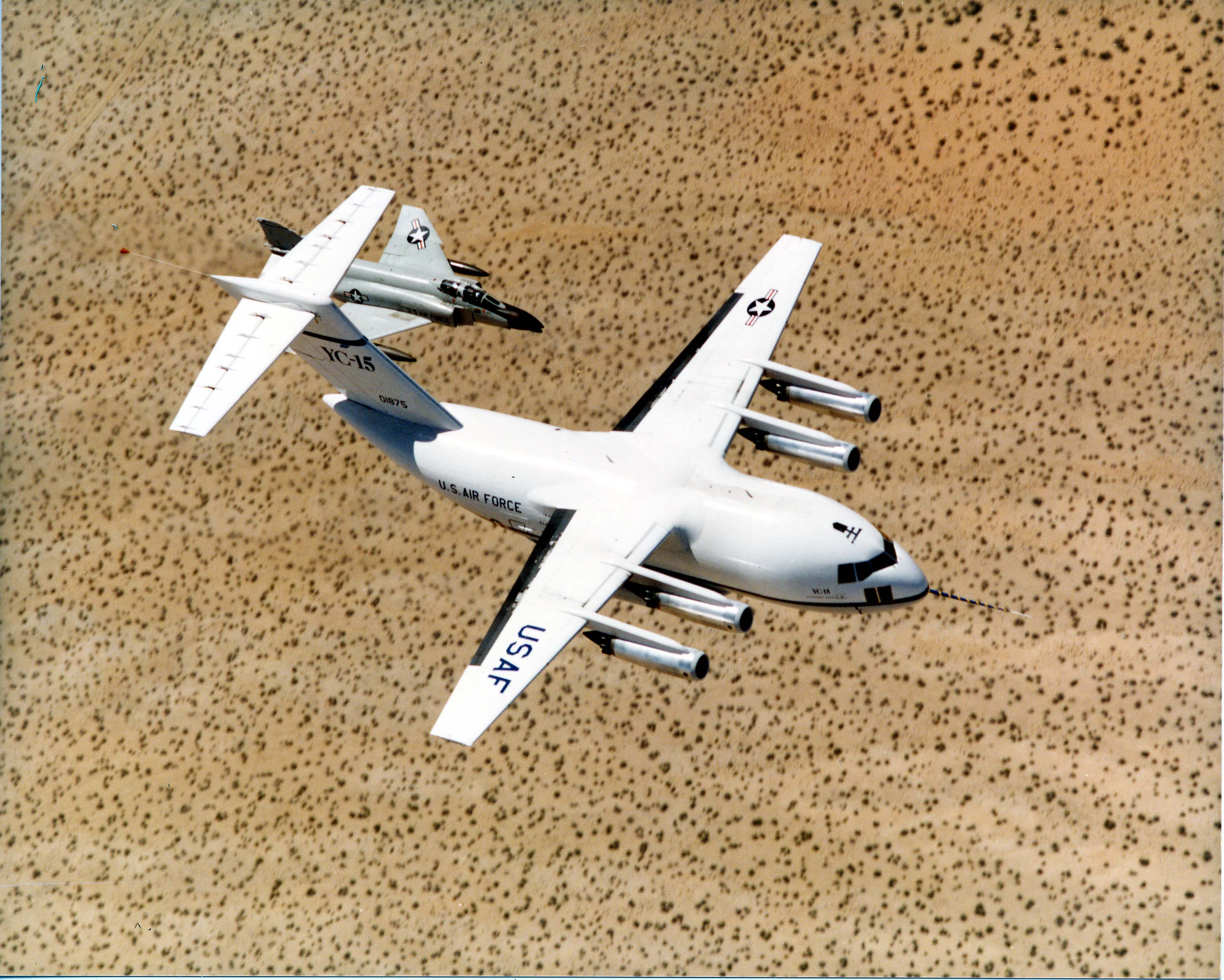
The C-17 is based upon the YC-15, a smaller prototype airlifter designed during the 1970s. It was designed to replace the Lockheed C-141 Starlifter, and also fulfill some of the duties of the Lockheed C-5 Galaxy. The redesigned airlifter differs from the YC-15 in that it is larger and has swept wings and more powerful engines. Development was protracted by a series of design issues, causing the company to incur a loss of nearly US$1.5 billion on the program's development phase. On 15 September 1991, roughly one year behind schedule, the first C-17 performed its maiden flight. The C-17 formally entered USAF service on 17 January 1995. McDonnell Douglas and later Boeing after it merged with McDonnell Douglas in 1997, manufactured the C-17 for more than two decades. The final C-17 was completed at the Long Beach, California, plant and flown in November 2015.
The C-17 commonly performs tactical and strategic airlift missions, transporting troops and cargo throughout the world; additional roles include medical evacuation and airdrop duties. The transport is in service with the USAF along with the air forces of India, the United Kingdom, Australia, Canada, Qatar, the United Arab Emirates, Kuwait, and the Europe-based multilateral organization Heavy Airlift Wing.
The type played a key logistical role during both Operation Enduring Freedom in Afghanistan and Operation Iraqi Freedom in Iraq, as well as in providing humanitarian aid in the aftermath of various natural disasters, including the 2010 Haiti earthquake, the 2011 Sindh floods and the 2023 Turkey-Syria earthquake.
Development
Background and design phase
In the 1970s, the U.S. Air Force began looking for a replacement for its Lockheed C-130 Hercules tactical cargo aircraft. The Advanced Medium STOL Transport (AMST) competition was held, with Boeing proposing the YC-14, and McDonnell Douglas proposing the YC-15. Though both entrants exceeded specified requirements, the AMST competition was canceled before a winner was selected. The USAF started the C-X program in November 1979 to develop a larger AMST with longer range to augment its strategic airlift.
By 1980, the USAF had a large fleet of aging C-141 Starlifter cargo aircraft. Compounding matters, increased strategic airlift capabilities were needed to fulfill its rapid-deployment airlift requirements. The USAF set mission requirements and released a request for proposals (RFP) for C-X in October 1980. McDonnell Douglas chose to develop a new aircraft based on the YC-15. Boeing bid an enlarged three-engine version of its AMST YC-14. Lockheed submitted both a C-5-based design and an enlarged C-141 design. On 28 August 1981, McDonnell Douglas was chosen to build its proposal, then designated C-17. Compared to the YC-15, the new aircraft differed in having swept wings, increased size, and more powerful engines. This would allow it to perform the work done by the C-141, and to fulfill some of the duties of the Lockheed C-5 Galaxy, freeing the C-5 fleet for outsize cargo.
Alternative proposals were pursued to fill airlift needs after the C-X contest. These were lengthening of C-141As into C-141Bs, ordering more C-5s, continued purchases of KC-10s, and expansion of the Civil Reserve Air Fleet. Limited budgets reduced program funding, requiring a delay of four years. During this time contracts were awarded for preliminary design work and for the completion of engine certification. At this time, first flight was planned for 1990. The USAF had formed a requirement for 210 aircraft.
Development problems and limited funding caused delays in the late 1980s. Criticisms were made of the developing aircraft and questions were raised about more cost-effective alternatives during this time. In April 1990, Secretary of Defense Dick Cheney reduced the order from 210 to 120 aircraft. The maiden flight of the C-17 took place on 15 September 1991 from the McDonnell Douglas's plant in Long Beach, California, about a year behind schedule. Two complete airframes were built for static and repeated load testing.
Development difficulties
A static test of the C-17 wing in October 1992 resulted in its failure at 128% of design limit load, below the 150% requirement. Both wings buckled rear to the front and failures occurred in stringers, spars, and ribs. Some $100 million was spent to redesign the wing structure; the wing failed at 145% during a second test in September 1993. A review of the test data, however, showed that the wing was not loaded correctly and did indeed meet the requirement. The C-17 received the "Globemaster III" name in early 1993. By accepting the 1993 terms, McDonnell Douglas incurred a loss of nearly US$1.5 billion on the program's development phase.
In March 1994, the Non-Developmental Airlift Aircraft program was established to procure a transport aircraft using commercial practices as a possible alternative or supplement to the C-17. Initial material solutions considered included: buy a modified Boeing 747-400 NDAA, restart the C-5 production line, extend the C-141 service life, and continue C-17 production. The field eventually narrowed to: the Boeing 747-400 (provisionally named the C-33), the Lockheed Martin C-5D, and the McDonnell Douglas C-17. The NDAA program was initiated after the C-17 program was temporarily capped at a 40-aircraft buy (in December 1993) pending further evaluation of C-17 cost and performance and an assessment of commercial airlift alternatives.
In April 1994, the program remained over budget and did not meet weight, fuel burn, payload, and range specifications. It failed several key criteria during airworthiness evaluation tests. Problems were found with the mission software, landing gear, and other areas. In May 1994, it was proposed to cut production to as few as 32 aircraft; these cuts were later rescinded. A July 1994 Government Accountability Office (GAO) report revealed that USAF and DoD studies from 1986 and 1991 stated the C-17 could use 6,400 more runways outside the U.S. than the C-5, but these studies had only considered runway dimensions, but not runway strength or load classification numbers (LCN). The C-5 has a lower LCN, but the USAF classifies both in the same broad load classification group. When considering runway dimensions and load ratings, the C-17's worldwide runway advantage over the C-5 shrank from 6,400 to 911 airfields. The report also stated "current military doctrine that does not reflect the use of small, austere airfields", thus the C-17's short field capability was not considered.
A January 1995 GAO report stated that the USAF originally planned to order 210 C-17s at a cost of $41.8 billion, and that the 120 aircraft on order were to cost $39.5 billion based on a 1992 estimate. In March 1994, the U.S. Army decided it did not need the 60000 lb low-altitude parachute-extraction system delivery with the C-17 and that the C-130's 42000 lb capability was sufficient. The YC-15 was transferred to AMARC to be made flightworthy again for further flight tests for the C-17 program in March 1997.
By September 1995, most of the prior issues were reportedly resolved and the C-17 was meeting all performance and reliability targets. The first USAF squadron was declared operational in January 1995.
Production and deliveries

In 1996, the DoD ordered another 80 aircraft for a total of 120. In 1997, McDonnell Douglas merged with domestic competitor Boeing. In April 1999, Boeing offered to cut the C-17's unit price if the USAF bought 60 more; in August 2002, the order was increased to 180 aircraft. In 2007, 190 C-17s were on order for the USAF. On 6 February 2009, Boeing was awarded a $2.95 billion contract for 15 additional C-17s, increasing the total USAF fleet to 205 and extending production from August 2009 to August 2010. On 6 April 2009, U.S. Secretary of Defense Robert Gates stated that there would be no more C-17s ordered beyond the 205 planned. However, on 12 June 2009, the House Armed Services Air and Land Forces Subcommittee added a further 17 C-17s.
Debate arose over follow-on C-17 orders, the USAF requested line shutdown while Congress called for further production. In FY2007, the USAF requested $1.6 billion (~$ in ) in response to "excessive combat use" on the C-17 fleet. In 2008, USAF General Arthur Lichte, Commander of Air Mobility Command, indicated before a House of Representatives subcommittee on air and land forces a need to extend production to another 15 aircraft to increase the total to 205, and that C-17 production may continue to satisfy airlift requirements. The USAF finally decided to cap its C-17 fleet at 223 aircraft; the final delivery was on 12 September 2013.
In 2010, Boeing reduced the production rate to 10 aircraft per year from a high of 16 per year, due to dwindling orders and to extend the production line's life while additional orders were sought. The workforce was reduced by about 1,100 through 2012, a second shift at the Long Beach plant was also eliminated. By April 2011, 230 production C-17s had been delivered, including 210 to the USAF. The C-17 prototype "T-1" was retired in 2012 after use as a testbed by the USAF. In January 2010, the USAF announced the end of Boeing's performance-based logistics contracts to maintain the type. On 19 June 2012, the USAF ordered its 224th and final C-17 to replace one that crashed in Alaska in July 2010.
In September 2013, Boeing announced that C-17 production was starting to close down. In October 2014, the main wing spar of the 279th and last aircraft was completed; this C-17 was delivered in 2015, after which Boeing closed the Long Beach plant. Production of spare components was to continue until at least 2017. The C-17 is projected to be in service for several decades. In February 2014, Boeing was engaged in sales talks with "five or six" countries for the remaining 15 C-17s; thus Boeing decided to build ten aircraft without confirmed buyers in anticipation of future purchases.
In May 2015, The Wall Street Journal reported that Boeing expected to book a charge of under $100 million and cut 3,000 positions associated with the C-17 program, and also suggested that Airbus' lower cost A400M Atlas took international sales away from the C-17.
In June 2025, it was announced that Boeing was in talks with an international customer to restart the production of C-17s, and that several other countries were interested in the prospect. There is speculation that the United States may be interested in buying new C-17s, as there is currently no replacement planned for existing C-17s or the aging C-5 Galaxy. Japanese Prime Minister Shigeru Ishiba stated that the Japanese Air Self-Defense Force would be interested in acquiring C-17s.
| 1991 | 1992 | 1993 | 1994 | 1995 | 1996 | 1997 | 1998 | 1999 | 2000 | 2001 | 2002 | 2003 | 2004 | 2005 | 2006 | 2007 | 2008 | 2009 | 2010 | 2011 | 2012 | 2013 | 2014 | 2015 | 2016 | 2017 | 2018 | 2019 |
|---|---|---|---|---|---|---|---|---|---|---|---|---|---|---|---|---|---|---|---|---|---|---|---|---|---|---|---|---|
| 1 | 4 | 5 | 8 | 6 | 6 | 7 | 10 | 11 | 13 | 14 | 16 | 16 | 16 | 16 | 16 | 16 | 16 | 16 | 14 | 12 | 10 | 10 | 7 | 5 | 4 | 0 | 0 | 1 |
Design
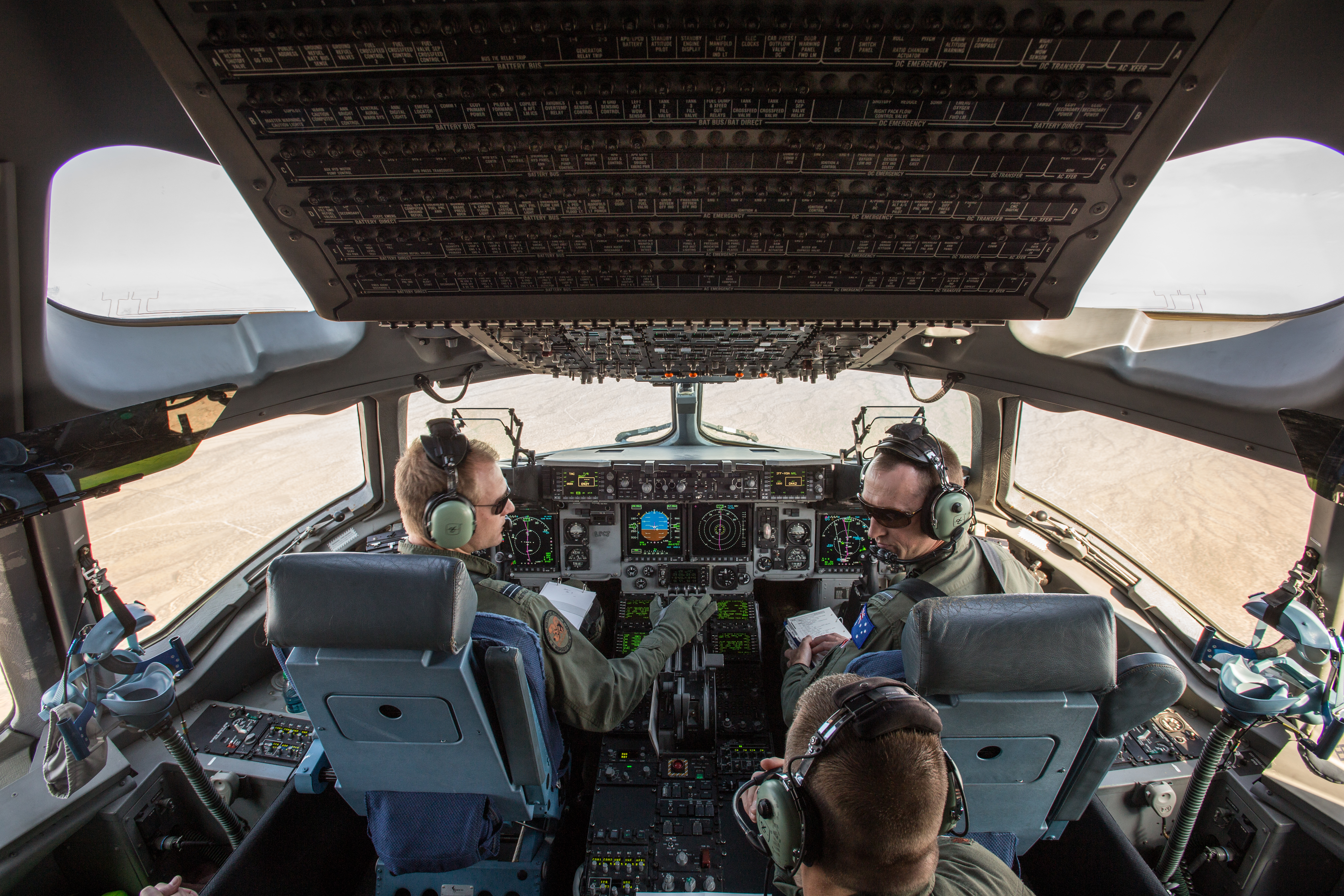
The C-17 Globemaster III is a strategic transport aircraft, able to airlift cargo close to a battle area. The size and weight of U.S. mechanized firepower and equipment have grown in recent decades from increased air mobility requirements, particularly for large or heavy non-palletized outsize cargo. It has a length of 174 ft and a wingspan of 169 ft, The aircraft features an anhedral wing configuration, providing pitch and roll stability to the aircraft. The aircraft's stability is furthered by its T-tail design, raising the center of pressure even higher above the center of mass. Drag is also lowered, as the horizontal stabilizer is far removed from the vortices generated by the two wings of the aircraft.
The C-17 is powered by four Pratt & Whitney F117-PW-100 turbofan engines, which are based on the commercial Pratt & Whitney PW2040 used on the Boeing 757. Each engine is rated at 40400 lbf of thrust. The engine's thrust reversers direct engine exhaust air upwards and forward, reducing the chances of foreign object damage by ingestion of runway debris, and providing enough reverse thrust to back up the aircraft while taxiing. The thrust reversers can also be used in flight at idle-reverse for added drag in maximum-rate descents. In vortex surfing tests performed by two C-17s, up to 10% fuel savings were reported.

For cargo operations the C-17 requires a crew of three: pilot, copilot, and loadmaster. The cargo compartment is 88 ft long by 18 ft wide by 12 ft high. The cargo floor has rollers for palletized cargo but it can be flipped to provide a flat floor suitable for vehicles and other rolling stock. Cargo is loaded through a large aft ramp that accommodates rolling stock, such as a 69-ton (63-metric ton) M1 Abrams main battle tank, other armored vehicles, trucks, and trailers, along with palletized cargo.
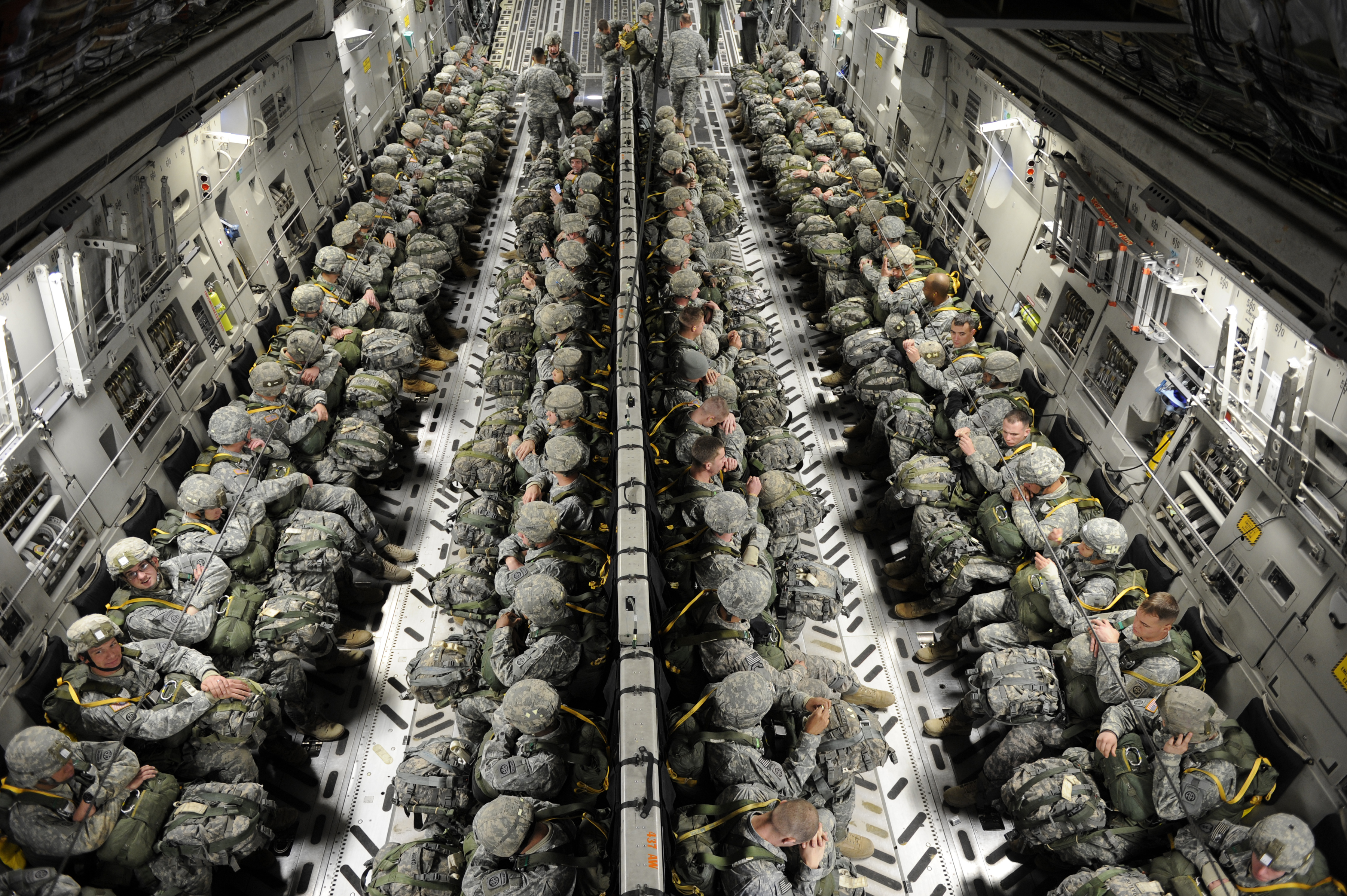
Maximum payload of the C-17 is 170900 lb, and its maximum takeoff weight is 585000 lb. With a payload of 160000 lb and an initial cruise altitude of 28000 ft, the C-17 has an unrefueled range of about 2400 nmi on the first 71 aircraft, and 2800 nmi on all subsequent extended-range models that include a sealed center wing bay as a fuel tank. Boeing informally calls these aircraft the C-17 ER. The C-17's cruise speed is about 450 kn (Mach 0.74). It is designed to airdrop 102 paratroopers and their equipment.
The C-17 is designed to operate from runways as short as 3500 ft and as narrow as 90 ft. The C-17 can also operate from unpaved, unimproved runways (although with a higher probability to damage the aircraft). The thrust reversers can be used to move the aircraft backwards and reverse direction on narrow taxiways using a three- (or more) point turn. The plane is designed for 20 man-hours of maintenance per flight hour, and a 74% mission availability rate.
Operational history
United States Air Force

The first production C-17 was delivered to Charleston Air Force Base, South Carolina, on 14 July 1993. The first C-17 unit, the 17th Airlift Squadron, became operationally ready on 17 January 1995. It has broken 22 records for oversized payloads. The C-17 was awarded U.S. aviation's most prestigious award, the Collier Trophy, in 1994. A Congressional report on operations in Kosovo and Operation Allied Force noted "One of the great success stories...was the performance of the Air Force's C-17A" It flew half of the strategic airlift missions in the operation, the type could use small airfields, easing operations; rapid turnaround times also led to efficient utilization.
C-17s delivered military supplies during Operation Enduring Freedom in Afghanistan and Operation Iraqi Freedom in Iraq as well as humanitarian aid in the aftermath of the 2010 Haiti earthquake, and the 2011 Sindh floods, delivering thousands of food rations, tons of medical and emergency supplies. On 26 March 2003, 15 USAF C-17s participated in the biggest combat airdrop since the United States invasion of Panama in December 1989: the night-time airdrop of 1,000 paratroopers from the 173rd Airborne Brigade occurred over Bashur, Iraq. These airdrops were followed by C-17s ferrying M1 Abrams, M2 Bradleys, M113s and artillery. USAF C-17s have also assisted allies in their airlift needs, such as Canadian vehicles to Afghanistan in 2003 and Australian forces for the Australian-led military deployment to East Timor in 2006. In 2006, USAF C-17s flew 15 Canadian Leopard C2 tanks from Kyrgyzstan into Kandahar in support of NATO's Afghanistan mission. In 2013, five USAF C-17s supported French operations in Mali, operating with other nations' C-17s (RAF, NATO and RCAF deployed a single C-17 each).
Flight crews have nicknamed the aircraft "the Moose", because during ground refueling, the pressure relief vents make a sound like the call of a female moose in heat.
Since 1999, C-17s have flown annually to Antarctica on Operation Deep Freeze in support of the US Antarctic Research Program, replacing the C-141s used in prior years. The initial flight was flown by the USAF 62nd Airlift Wing. The C-17s fly round trip between Christchurch Airport and McMurdo Station around October each year and take 5 hours to fly each way. In 2006, the C-17 flew its first Antarctic airdrop mission, delivering 70,000 pounds of supplies. Further air drops occurred during subsequent years.

A C-17 accompanies the President of the United States on his visits to both domestic and foreign arrangements, consultations, and meetings. It is used to transport the Presidential Limousine, Marine One, and security detachments. On several occasions, a C-17 has been used to transport the President himself, using the Air Force One call sign while doing so.
Rapid Dragon missile launcher testing
In 2015, as part of a missile-defense test at Wake Island, simulated medium-range ballistic missiles were launched from C-17s against THAAD missile defense systems and the USS John Paul Jones (DDG-53). In early 2020, palletized munitions–"Combat Expendable Platforms"– were tested from C-17s and C-130Js with results the USAF considered positive.
In 2021, the Air Force Research Laboratory further developed the concept into tests of the Rapid Dragon system, which transforms the C-17 into a lethal cruise missile arsenal ship capable of mass launching 45 JASSM-ER with 500 kg warheads from a standoff distance of 925 km. Anticipated improvements included support for JDAM-ER, mine laying, drone dispersal as well as improved standoff range when full production of the 1900 km JASSM-XR was expected to deliver large inventories in 2024.
Evacuation of Afghanistan
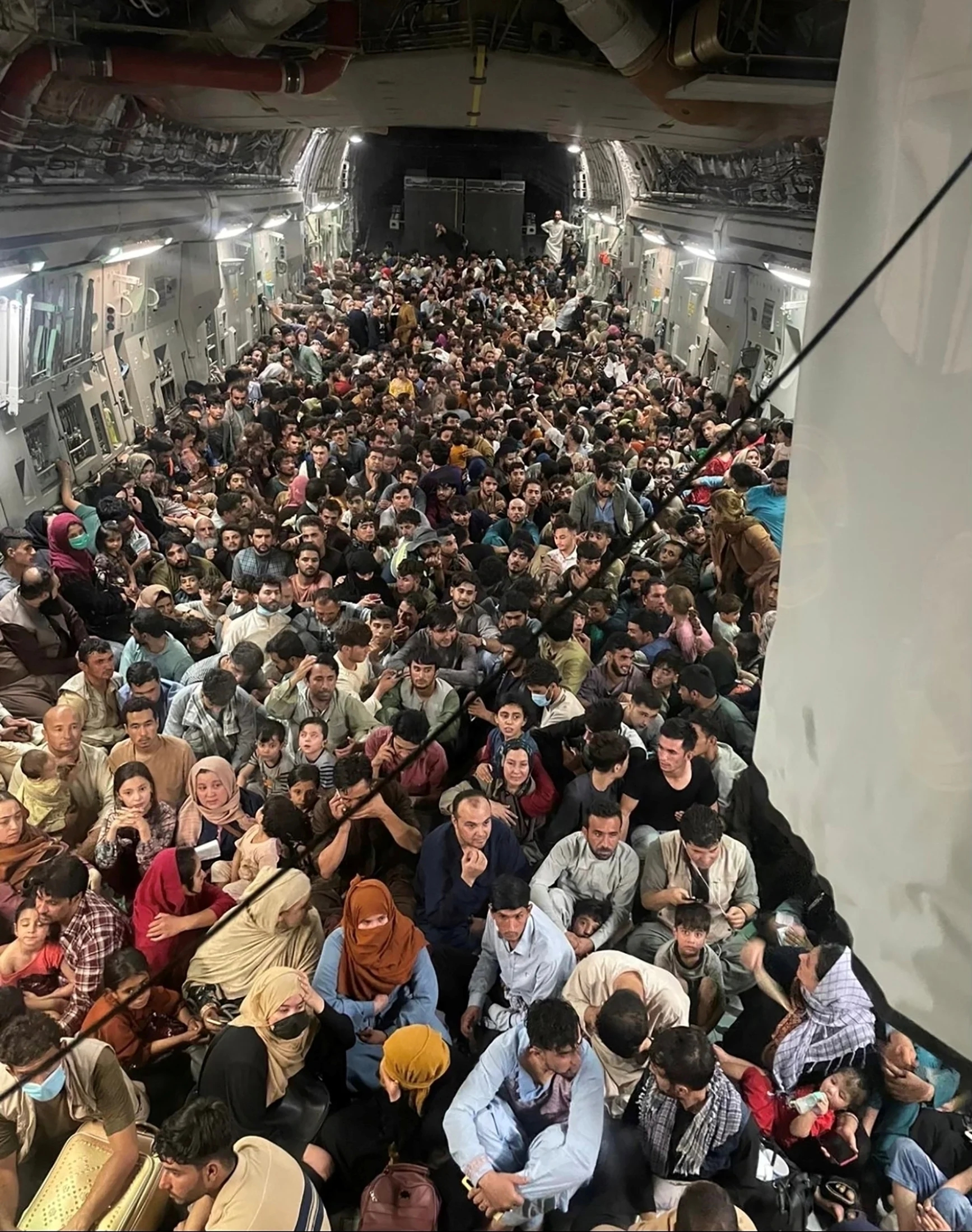
On 15 August 2021, USAF C-17 02-1109 from the 62nd Airlift Wing and 446th Airlift Wing at Joint Base Lewis-McChord departed Hamid Karzai International Airport in Kabul, Afghanistan, while crowds of people trying to escape the 2021 Taliban offensive ran alongside the aircraft. The C-17 lifted off with people holding on to the outside, and at least two died after falling from the aircraft. There were an unknown number possibly crushed and killed by the landing gear retracting, with human remains found in the landing-gear stowage. Also that day, C-17 01-0186 from the 816th Expeditionary Airlift Squadron at Al Udeid Air Base transported 823 Afghan citizens from Hamid Karzai International Airport on a single flight, setting a new record for the type, which was previously over 670 people during a 2013 typhoon evacuation from Tacloban, Philippines.
Royal Air Force
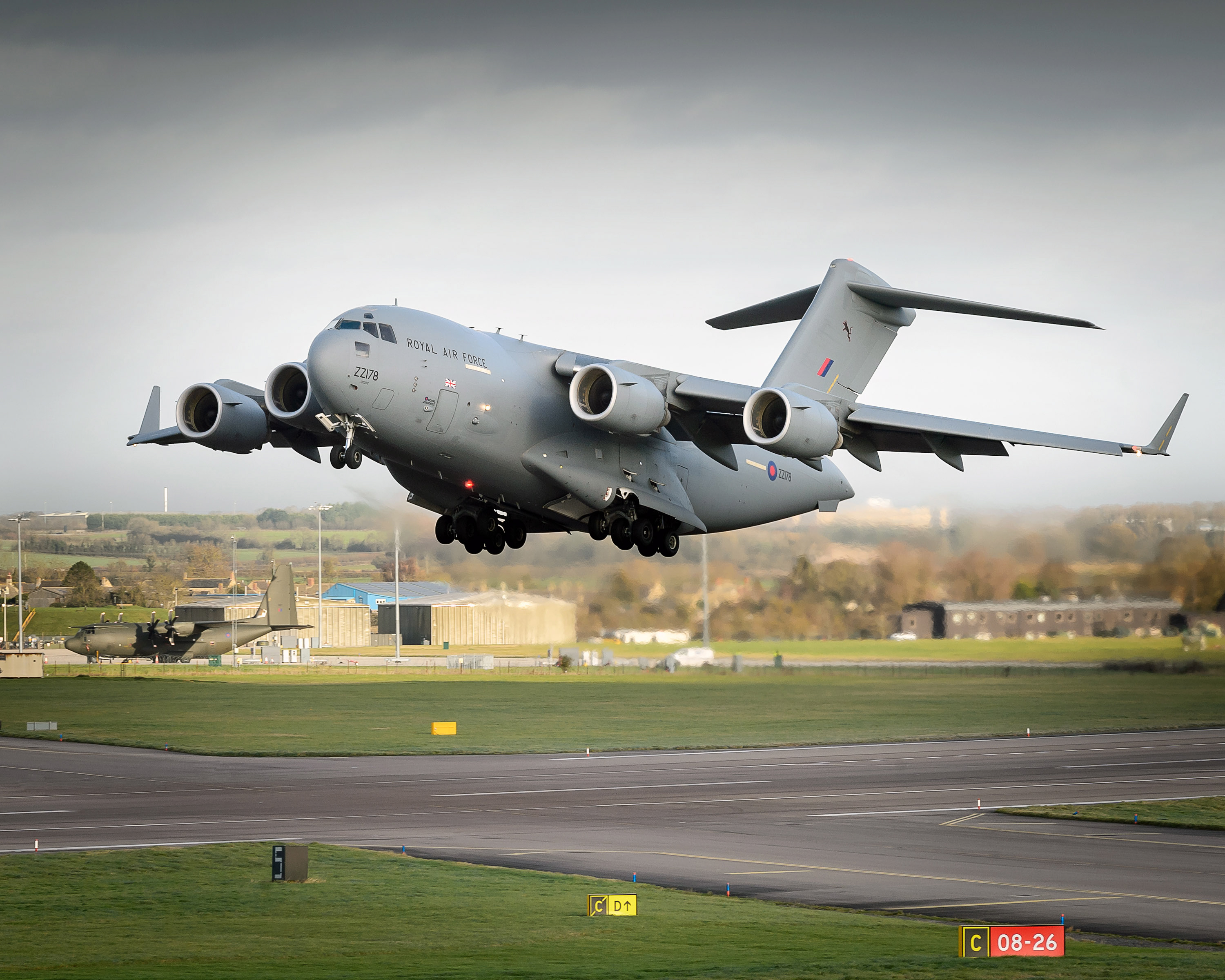
On 13 January 2013, the RAF deployed two C-17s from RAF Brize Norton to the French Évreux Air Base, transporting French armored vehicles to the Malian capital of Bamako during the French intervention in Mali. In June 2015, an RAF C-17 was used to medically evacuate four victims of the 2015 Sousse attacks from Tunisia. On 13 September 2022, C-17 ZZ177 carried the body of Queen Elizabeth II from Edinburgh Airport to RAF Northolt in London. She had been lying in state at St Giles' Cathedral in Edinburgh, Scotland.
Royal Canadian Air Force

The Canadian Armed Forces had a long-standing need for strategic airlift for military and humanitarian operations around the world. It had followed a pattern similar to the German Air Force in leasing Antonovs and Ilyushins for many requirements, including deploying the Disaster Assistance Response Team (DART) to tsunami-stricken Sri Lanka in 2005; the Canadian Forces had relied entirely on leased An-124 Ruslan for a Canadian Army deployment to Haiti in 2003. A combination of leased Ruslans, Ilyushins and USAF C-17s was also used to move heavy equipment to Afghanistan. In 2002, the Canadian Forces Future Strategic Airlifter Project began to study alternatives, including long-term leasing arrangements.
On 14 April 2010, a Canadian CC-177 landed for the first time at CFS Alert, the world's most northerly airport. Canadian Globemasters have been deployed in support of numerous missions worldwide, including Operation Hestia after the 2010 Haiti earthquake, providing airlift as part of Operation Mobile and support to the Canadian mission in Afghanistan. After Typhoon Haiyan hit the Philippines in 2013, CC-177s established an air bridge between the two nations, deploying Canada's DART and delivering humanitarian supplies and equipment. In 2014, they supported Operation Reassurance and Operation Impact.
Strategic Airlift Capability program

At the 2006 Farnborough Airshow, a number of NATO member nations signed a letter of intent to jointly purchase and operate several C-17s within the Strategic Airlift Capability (SAC). The purchase was for two C-17s, and a third was contributed by the U.S. On 14 July 2009, Boeing delivered the first C-17 for the SAC program with the second and third C-17s delivered in September and October 2009. SAC members are Bulgaria, Estonia, Finland, Hungary, Lithuania, the Netherlands, Norway, Poland, Romania, Slovenia, Sweden and the U.S. as of 2024.
The SAC C-17s are based at Pápa Air Base, Hungary. The Heavy Airlift Wing is hosted by Hungary, which acts as the flag nation. The aircraft are crewed in similar fashion as the NATO E-3 AWACS aircraft. The C-17 flight crew are multi-national, but each mission is assigned to an individual member nation based on the SAC's annual flight hour share agreement. The NATO Airlift Management Programme Office (NAMPO) provides management and support for the Heavy Airlift Wing. NAMPO is a part of the NATO Support Agency (NSPA). In September 2014, Boeing stated that the three C-17s supporting SAC missions had achieved a readiness rate of nearly 94 percent over the last five years and supported over 1,000 missions.
Indian Air Force


The C-17 provides the IAF with strategic airlift, the ability to deploy special forces, and to operate in diverse terrains ranging from high-altitude Himalayan air bases in the north to Indian Ocean bases in the south. The C-17s are based at Hindon Air Force Station and are operated by No. 81 Squadron IAF Skylords. The first C-17 was delivered in January 2013 for testing and training; it was officially accepted on 11 June 2013. The second C-17 was delivered on 23 July 2013 and put into service immediately. IAF Chief of Air Staff Norman AK Browne called it "a major component in the IAF's modernization drive" while taking delivery of the aircraft at Boeing's Long Beach factory. On 2 September 2013, the Skylords squadron with three C-17s officially entered IAF service.
The Skylords regularly fly missions within India, such as to high-altitude bases at Leh and Thoise. The IAF first used the C-17 to transport an infantry battalion's equipment to Port Blair on Andaman Islands on 1 July 2013. Foreign deployments to date include Tajikistan in August 2013, and Rwanda to support Indian peacekeepers. One C-17 was used for transporting relief materials during Cyclone Phailin.
The sixth aircraft was received in July 2014. In June 2017, the U.S. Department of State approved the potential sale of one C-17 to India under a proposed $366 million (~$ in ) U.S. Foreign Military Sale. This aircraft, the last C-17 produced, increased the IAF's fleet to 11 C-17s. In March 2018, a contract was awarded for completion by 22 August 2019. On 26 August 2019, Boeing delivered the 11th C-17 Globemaster III to the Indian Air Force.
On 7 February 2023, an IAF C-17 delivered humanitarian aid packages for earthquake victims in Turkey and Syria by taking a detour around Pakistan's airspace in the aftermath of 2021 Taliban takeover of Afghanistan.
An IAF C-17 executed a precision airdrop of two Combat Rubberised Raiding Craft along with a platoon of 8 MARCOS commandos in an operation to rescue the ex-MV Ruen, a Maltese-flagged cargo ship hijacked by Somali pirates in December 2023. The mission was conducted on 16 March 2024 in a 10-hour round trip mission to an area 2600 km away from the Indian coast. The ship was being used as a mothership for piracy. In a joint operation carried out with the Indian Navy assets such as P-8I Neptune maritime patrol aircraft, SeaGuardian drones, destroyer INS Kolkata and patrol vessel INS Subhadra, the IAF C-17 airdropped Navy's MARCOS commandos, who boarded the hijacked ship, rescued 17 sailors and disarmed 35 pirates in the operation.
On 5 August 2025, the Defence Acquisition Council (DAC) accorded the Acceptance of Necessity (AoN) for the sustenance of the C-17 and C-130J fleet of the Indian Air Force.
Qatar
.jpg)
Boeing delivered Qatar's first C-17 on 11 August 2009 and the second on 10 September 2009 for the Qatar Emiri Air Force. Qatar received its third C-17 in 2012, and fourth C-17 was received on 10 December 2012. In June 2013, The New York Times reported that Qatar was allegedly using its C-17s to ship weapons from Libya to the Syrian opposition during the civil war via Turkey. On 15 June 2015, it was announced at the Paris Airshow that Qatar agreed to order four additional C-17s from the five remaining "white tail" C-17s to double Qatar's C-17 fleet. One Qatari C-17 bears the civilian markings of government-owned Qatar Airways, although the airplane is owned and operated by the Qatar Emiri Air Force. The head of Qatar's airlift selection committee, Ahmed Al-Malki, said the paint scheme was "to build awareness of Qatar's participation in operations around the world."
Variants
- C-17A: Initial military airlifter version.
- C-17A "ER": Unofficial name for C-17As with extended range due to the addition of the center wing tank.
- Block 16: This software/hardware upgrade was a major improvement of the improved Onboard Inert Gas-Generating System (OBIGGS II), a new weather radar, an improved stabilizer strut system and other avionics.
- Block 21: Adds ADS-B capability, IFF modification, communication/navigation upgrades and improved flight management.
- C-17B: A proposed tactical airlifter version with double-slotted flaps, an additional main landing gear on the center fuselage, more powerful engines, and other systems for shorter landing and take-off distances. Boeing offered the C-17B to the U.S. military in 2007 for carrying the Army's Future Combat Systems (FCS) vehicles and other equipment.
- KC-17: Proposed tanker variant of the C-17.
- MD-17: Proposed variant for US airlines participating in the Civil Reserve Air Fleet, later redesignated as BC-17X after 1997 merger.
Operators


.jpg)
; Main article: Boeing C-17 Globemaster III in Australian service
- Royal Australian Air Force – 8 C-17A ERs in service as of January 2018.
- No. 36 Squadron ;
- Royal Canadian Air Force – 5 CC-177 (C-17A ER) aircraft in use as of January 2025.
- 429 Transport Squadron, CFB Trenton, Ontario ;
- Indian Air Force – 11 C-17s as of August 2019.
- No. 81 Squadron (Skylords), Hindon AFS ;
- Kuwait Air Force – 2 C-17s as of January 2018 ; European Union Europe
- The multi-nation Strategic Airlift Capability Heavy Airlift Wing – 3 C-17s in service as of January 2018, including 1 C-17 contributed by the USAF; based at Pápa Air Base, Hungary. ;
- Qatar Emiri Air Force – 8 C-17As in use as of January 2018, ;
- United Arab Emirates Air Force – 8 C-17As in operation as of January 2018 ;
- Royal Air Force – 8 C-17A ERs in use as of May 2021
- No. 24 Squadron, RAF Brize Norton
- No. 99 Squadron, RAF Brize Norton ;
- United States Air Force – 222 C-17s in service (157 Active, 47 Air National Guard, 18 Air Force Reserve)
- 60th Air Mobility Wing – Travis Air Force Base, California
- 62d Airlift Wing – McChord AFB, Washington
- 305th Air Mobility Wing – McGuire Air Force Base, New Jersey
- 385th Air Expeditionary Group – Al Udeid Air Base, Qatar
- 436th Airlift Wing – Dover Air Force Base, Delaware
- 437th Airlift Wing – Charleston Air Force Base, South Carolina
- 3rd Wing – Elmendorf Air Force Base, Alaska
- 517th Airlift Squadron (Associate)
- 15th Wing – Hickam Air Force Base, Hawaii
- 97th Air Mobility Wing – Altus AFB, Oklahoma
- 412th Test Wing – Edwards AFB, California
- Air Force Reserve
- 315th Airlift Wing (Associate) – Charleston AFB, South Carolina
- 349th Air Mobility Wing (Associate) – Travis AFB, California
- 445th Airlift Wing – Wright-Patterson AFB, Ohio
- 446th Airlift Wing (Associate) – McChord AFB, Washington
- 452d Air Mobility Wing – March ARB, California
- 507th Air Refueling Wing – Tinker AFB, Oklahoma
- 730th Air Mobility Training Squadron (Altus AFB)
- 512th Airlift Wing (Associate) – Dover AFB, Delaware
- 514th Air Mobility Wing (Associate) – McGuire AFB, New Jersey
- 911th Airlift Wing – Pittsburgh Air Reserve Station, Pennsylvania
- Air National Guard
- 105th Airlift Wing – Stewart ANGB, New York
- 145th Airlift Wing – Charlotte Air National Guard Base, North Carolina
- 154th Wing – Hickam AFB, Hawaii
- 204th Airlift Squadron (Associate)
- 164th Airlift Wing – Memphis ANGB, Tennessee
- 167th Airlift Wing – Shepherd Field ANGB, West Virginia
- 172d Airlift Wing – Allen C. Thompson Field ANGB, Mississippi
- 176th Wing – Elmendorf AFB, Alaska
Accidents and notable incidents {{anchor|Accidents and notable incidents}}
--
- On 10 September 1998, a USAF C-17 (AF Serial No. 96-0006) delivered Keiko the orca to Vestmannaeyjar, Iceland, a 3800 ft runway, and suffered a landing gear failure during landing. There were no injuries, but the landing gear sustained major damage.
- On 10 December 2003, a USAF C-17 (AF Serial No. 98-0057) was hit by a surface-to-air missile after take-off from Baghdad, Iraq. One engine was disabled and the aircraft returned for a safe landing. It was repaired and returned to service.
- On 6 August 2005, a USAF C-17 (AF Serial No. 01-0196) ran off the runway at Bagram Air Base in Afghanistan while attempting to land, destroying its nose and main landing gear. After two months making it flightworthy, a test pilot flew the aircraft to Boeing's Long Beach facility as the temporary repairs imposed performance limitations. In October 2006, it returned to service following repairs.

- On 30 January 2009, a USAF C-17 (AF Serial No. 96-0002 – "Spirit of the Air Force") made a gear-up landing at Bagram Air Base. It was ferried from Bagram AB, making several stops along the way, to Boeing's Long Beach plant for extensive repairs. The USAF Aircraft Accident Investigation Board concluded the cause was the crew's failure to follow the pre-landing checklist and lower the landing gear.
- On 28 July 2010, a USAF C-17 (AF Serial No. 00-0173 – "Spirit of the Aleutians") crashed at Elmendorf Air Force Base, Alaska, while practicing for the 2010 Arctic Thunder Air Show, killing all four aboard. It crashed near a railroad, disrupting rail operations. A military investigation found pilot error caused a stall. This is the C-17's only fatal crash and the only hull loss accident.
- On 23 January 2012, a USAF C-17 (AF Serial No. 07-7189), assigned to the 437th Airlift Wing, Joint Base Charleston, South Carolina, landed on runway 34R at Forward Operating Base Shank, Afghanistan. The crew did not realize the required stopping distance exceeded the runway's length thus were unable to stop. It came to rest approximately 700 feet from the runway's end upon an embankment, causing major structural damage but no injuries. After 9 months of repairs to make it airworthy, the C-17 flew to Long Beach. It returned to service at a reported cost of $69.4 million.
- On 20 July 2012, a USAF C-17 of the 305th Air Mobility Wing, flying from McGuire AFB, New Jersey, to MacDill Air Force Base in Tampa, Florida, mistakenly landed at nearby Peter O. Knight Airport, a small municipal field without a control tower, with Gen. Jim Mattis, then commander of CENTCOM, on board. After a few hours, the Globemaster took off from the airport's 3580 ft runway without incident and made the short trip to MacDill AFB. The mistaken landing followed an extended duration flight from Europe to Southwest Asia to embark military passengers before returning to the U.S. The USAF investigation attributed the incident to fatigue leading to pilot error, as both airfields' main runways share the same magnetic heading and are only four miles apart along the shore of Tampa Bay.
- On 9 April 2021, USAF C-17 10-0223 suffered a fire in its undercarriage after landing at Charleston AFB following a flight from RAF Mildenhall, UK. The fire spread to the fuselage before it was extinguished.
Specifications (C-17A)

|prime units?=kts
-
102 paratroopers or
-
134 troops with palletized and sidewall seats or
-
54 troops with sidewall seats (allows 13 cargo pallets) only or
-
36 litter and 54 ambulatory patients and medical attendants or
-
Cargo, such as one M1 Abrams tank, two Bradley armored vehicles, or three Stryker armored vehicles |max takeoff weight kg= |max takeoff weight lb=585000 |max takeoff weight note= -- -- |never exceed speed kts= |never exceed speed note= |minimum control speed kts= |minimum control speed note= |wing loading lb/sqft=150 |fuel consumption lb/mi= |thrust/weight=0.277 (minimum)
-
Takeoff run at MTOW: 8200 ft
-
Takeoff run at 395000 lb: 3000 ft
-
Landing distance: 3500 ft
References
Bibliography
- Bonny, Danny, Barry Fryer and Martyn Swann. AMARC MASDC III, The Aerospace Maintenance and Regeneration Center, Davis-Monthan AFB, AZ, 1997–2005. Surrey, UK: British Aviation Research Group, 2006. .
- Department of Defense. Kosovo/Operation Allied Force After-Action Report, DIANE Publishing; 31 January 2000..
- Gertler, Jeremiah. "Air Force C-17 Aircraft Procurement: Background and Issues for Congress." Congressional Research Service, DIANE Publishing; 22 December 2009. .
- Kennedy, Betty R. Globemaster III: Acquiring the C-17. McConnell AFB, Kansas: Air Mobility Command Office of History, 2004.
- McLaughlin, Andrew. "Big Mover." Canberra: Australian Aviation (Phantom Media), September 2008.
- Norton, Bill. Boeing C-17 Globemaster III (Warbird Tech, Vol. 30). North Branch, Minnesota: Specialty Press, 2001. .
- C-17 aircraft: cost of spare parts higher than justified, U.S. General Accounting Office, 2011. . --
References
- [http://www.presstelegram.com/business/20150226/workers-at-boeing-say-goodbye-to-c-17-with-last-major-join-thursday "Workers at Boeing Say Goodbye to C-17 with Last Major Join Thursday"] {{Webarchive. link. (6 May 2015. Press-Telegram, 26 February 2015.)
- (29 November 2015). "Final Boeing C-17 Globemaster III Departs Long Beach Assembly Facility". Boeing.
- link. (7 November 2012 ''The Wall Street Journal'', 13 November 1972.)
- link. (7 November 2012 ''Los Angeles Times'', 11 November 1972.)
- Kennedy 2004, pp. 3–20, 24.
- Norton 2001, pp. 12–13.
- link. (7 November 2012 ''Los Angeles Times'', 3 January 1986.)
- Norton 2001, pp. 13, 15.
- Kennedy 2004, pp. 70, 81–83.
- Kennedy, Betty Raab. [http://rtoc.ida.org/rtoc/open/briefings_articles/kennednd.pdf "Historical Realities of C-17 Program Pose Challenge for Future Acquisitions."] {{Webarchive. link. (29 December 2006 ''Institute for Defense Analyses'', December 1999.)
- link. (7 November 2012 ''Chicago Tribune'', 9 September 1989.)
- link. (9 June 2011 ''St. Louis Post-Dispatch'', 3 April 1989.)
- (26 April 1990). "Cheney cuts back on Air Force programs". Bryan Times.
- [https://www.nytimes.com/1991/09/17/us/c-17-s-first-flight-smoother-than-debate.html "C-17's First Flight Smoother Than Debate."] {{Webarchive. link. (24 February 2017 ''The New York Times'', 17 September 1991.)
- link. (10 February 2009 ''Congressional Research Service'', 5 June 2007.)
- Norton 2001, pp. 25–26, 28.
- [http://www.dodig.mil/Audit/Audit2/93-159.pdf "Technical Assessment Report; C-17 Wing Structural Integrity."] {{Webarchive. link. (28 March 2012 ''Department of Defense'', 24 August 1993. Retrieved: 23 August 2011.)
- "C-17 Wing Fails Again; Probe Is Sought {{!}} The Seattle Times".
- [http://documents.blackvault.com/documents/dod/readingroom/5/767.pdf "Findings, Conclusions and Recommendations of the Executive Independent Review Team."] {{Webarchive. link. (10 March 2012 ''US Government Executive Independent Review Team'' via ''blackvault.com'', 12 December 1993.)
- In late 1993, the [[United States Department of Defense. link. (7 November 2012 ''Chicago Tribune'', 29 March 1993.)
- "NSIAD-94-209 Airlift Requirements: Commercial Freighters Can Help Meet Requirements at Greatly Reduced Costs". United States General Accounting Office.
- "NSIAD-97-38 Military Airlift: Options Exist for Meeting Requirements While Acquiring Fewer C-17s". United States General Accounting Office.
- [https://archive.seattletimes.com/archive/19910528/1285732/air-force-letter-to-douglas-spells-out-75-defects-for-c-17 "Air Force Letter To Douglas Spells Out 75 Defects For C-17."] ''Los Angeles Times'', 28 May 1991.
- link. (9 June 2011 ''Press-Telegram'', 12 April 1994.)
- link. (9 June 2011 ''Charlotte Observer'', 16 March 1994.)
- [http://archive.gao.gov/t2pbat3/151473.pdf "The C-17 Proposed Settlement and Program Update."] {{Webarchive. link. (6 September 2009 ''United States General Accounting Office'', 28 April 1994.)
- (July 2024)
- [http://archive.gao.gov/t2pbat3/152088.pdf "Comparison of C-5 and C-17 Airfield Availability."] {{Webarchive. link. (27 September 2007 ''United States General Accounting Office'', July 1994.)
- [http://www.gao.gov/archive/1995/ns95026.pdf "C-17 Aircraft – Cost and Performance Issues."] {{Webarchive. link. (30 September 2007 United States General Accounting Office, January 1995.)
- C-17 testing was limited to this lower weight. Airflow issues prevented the C-17 from meeting airdrop requirements. A February 1997 GAO report revealed that a C-17 with a full payload could not land on {{convert. 3000. ft. m. 5000. ft. link. (30 September 2007 ''United States General Accounting Office'', February 1997.)
- Bonny et al. 2006, p. 65.
- [http://www.afa.org/media/press/windall.asp "Air Force Secretary Says Modernization, C-17 on Track."] {{Webarchive. link. (14 September 2007 ''Air Force magazine'', 19 September 1995.)
- link. (9 June 2011 ''Press-Telegram'', 31 March 1995.)
- link. (9 June 2011 Associated Press, 18 January 1995.)
- link. (7 November 2012 ''Chicago Tribune'', 1 July 1996.)
- Wallace, James. [https://web.archive.org/web/20081122153258/http://www.highbeam.com/doc/1G1-64094695.html "Boeing to cut price of C-17 if Air Force buys 60 more."] ''Seattle Post'', 2 April 1999.
- [https://www.nytimes.com/2002/08/16/business/9.7-billion-us-deal-for-boeing-c-17-s.html "$9.7 Billion U.S. Deal for Boeing C-17's."] {{Webarchive. link. (24 February 2017 ''The New York Times'', 16 August 2002.)
- [http://www.boeing.com/defense-space/military/c17/c17news.html "Boeing Company Funds Extension."] {{Webarchive. link. (7 September 2008 ''Boeing'', 9 July 2008.)
- Trimble, Stephen. [http://www.flightglobal.com/articles/2009/02/10/322315/usaf-signs-deals-for-15-more-c-17s-upgraded-c-5ms.html "Boeing in $3bn air force contract."] {{Webarchive. link. (21 February 2009 ''Flight International'', 10 February 2009.)
- Cole, August and [[Yochi Dreazen. Yochi J. Dreazen]]. "Pentagon Pushes Weapon Cuts." ''[[The Wall Street Journal]]'', 7 April 2009, p. 1.
- Kreisher, Otto. [http://www.govexec.com/dailyfed/0609/061209cdpm1.htm "House panel reverses cuts in aircraft programs."] {{Webarchive. link. (6 June 2011 ''Congress Daily'', 12 June 2009.)
- (July 2019)
- Trimble, Stephen. [http://www.flightglobal.com/articles/2008/04/04/222723/usaf-reveals-c-17-cracks-and-dispute-on-production-future.html "USAF reveals C-17 cracks and dispute on production future."] {{Webarchive. link. (6 April 2008 ''Flightglobal.com'', 4 April 2008.)
- Mai, Pat. [http://www.ocregister.com/articles/boeing-524848-force-air.html "Air Force to receive its last C-17 today"] {{Webarchive. link. (14 September 2013 "OrangeCountRegister.com",12 September 2013.)
- link. (1 April 2011 ''Boeing Press Release'', 20 January 2011.)
- Hoyle, Craig. [http://www.flightglobal.com/articles/2011/04/19/355726/australia-to-get-fifth-c-17-in-august.html "Australia to get fifth C-17 in August."] ''Flightglobal'', 19 April 2011.
- Sanchez, Senior Airman Stacy. [https://www.edwards.af.mil/News/story/id/123090905/ "Edwards T-1 reaches 1,000 flight milestone."] ''95th Air Base Wing Public Affairs'', 20 March 2008.
- [http://www.flightglobal.com/articles/2010/05/18/341939/why-is-usaf-bringing-maintenance-in-house.html "Why is USAF bringing maintenance in-house?"] {{Webarchive. link. (24 May 2010 ''flightglobal.com'', 18 May 2005.)
- (20 June 2012). "End of the Line".
- The World, Aviation Week and Space Technology, 4 August 2014, p. 10.
- Meeks, Karen Robes. (24 February 2015). "Long Beach's Boeing workers assemble final C-17, plan for an uncertain future". [[Long Beach Press-Telegram]].
- link. (6 October 2014 ''Chicago Tribune'', 18 September 2013.)
- [http://www.militarytimes.com/article/20130918/NEWS04/309180036/Boeing-end-C-17-production-2015 "Boeing to end C-17 production in 2015"] {{Webarchive. link. (18 November 2018. Militarytimes.com, 18 September 2013.)
- [http://www.flightglobal.com/news/articles/singapore-boeing-confident-of-placing-unsold-c-17s-395826/ "Boeing confident of placing unsold C-17s"] {{Webarchive. link. (22 February 2014. Flightglobal.com, 22 February 2014.)
- Waldron, Greg. (10 April 2015). "Australia confirms order for two additional C-17s". Reed Business Information.
- Shukla, Tarun. "A forlorn end to California's aviation glory". ''The Wall Street Journal'', 6 May 2015, pp. B1-2.
- (18 June 2025). "Boeing In Talks To Restart C-17 Production".
- (19 June 2025). "Boeing Explores C-17 Globemaster Production Restart".
- (27 February 2025). "Ishiba told Trump Japan willing to buy U.S. transport planes for SDF".
- "C-17 Globemaster III Pocket Guide", The Boeing Company, Long Beach, CA, June 2010.
- [http://www.boeing.com/bds/deliveries.html "BDS Major Deliveries (current year)."] {{Webarchive. link. (11 March 2010 ''Boeing'', March 2014. Retrieved: 5 April 2014.)
- (9 August 2021). "An Assessment of the State-of-the-Art in the Design and Manufacturing of Large Composite Structures for Aerospace Vehicles".
- Drinnon, Roger. [https://www.af.mil/News/story/id/123321609/ "'Vortex surfing' could be revolutionary."] ''[[United States Air Force]]'', 11 October 2012. Retrieved: 23 November 2012.
- [http://www.boeing.com/commercial/airports/arff/arffc17.pdf "C-17/C-17 ER Flammable Material Locations."] {{Webarchive. link. (25 October 2007 ''Boeing'', 1 May 2005.)
- Norton 2001, pp. 94–95.
- [http://www.boeing.com/news/releases/2001/q4/nr_011128n.htm "Boeing C-17 Globemaster III Claims 13 World Records."] {{Webarchive. link. (15 April 2012 ''Boeing'', 28 November 2001.)
- link. (28 May 2008 ''National Aeronautic Association''. Retrieved: 1 April 2010.)
- Department of Defense 2000, p. 39.
- Department of Defense 2000, p. 40.
- Anderson, Jon R. [http://www.stripes.com/news/1st-id-task-force-s-tanks-deployed-to-northern-iraq-1.4187 "1st ID task force's tanks deployed to northern Iraq."] {{Webarchive. link. (2 October 2012 ''Stars and Stripes'', 10 April 2003. Retrieved: 8 June 2011.)
- "Massive air lift". United States Air Force.
- Barrie Barber. (11 January 2015). "Wright-Patt crew plays crucial Afghanistan role: As combat operations end, Ohio airmen make frequent, risky flights". Dayton Daily News.
- David Roza. (6 August 2021). "Here's why the Air Force's workhorse C-17 is called 'the Moose'".
- (3 July 2019). "Where it's cold we go". US Air Force.
- Maj. Brooke Davis. (22 February 2019). "Stars align for Deep Freeze's last regular season mission".
- (21 December 2006). "C-17 makes 1st-ever airdrop to Antarctica". US Air Force.
- (18 December 2009). "Test Run: Air Force Makes Air Drop Over South Pole For Training Exercise".
- link. (9 June 2011 Associated Press, 1 September 2004.)
- [https://web.archive.org/web/20130126225131/http://channel.nationalgeographic.com/channel/episodes/on-board-marine-one1/video/ "On Board Marine One, Presidential Fleet"]. National Geographic, 2009. Retrieved 5 September 2013.
- link. (9 June 2011 ''St Paul Pioneer'', 16 February 1996.)
- Shalal, Andrea. (1 November 2015). "U.S. completes complex test of layered missile defense system". Reuters.
- Insinna, Valerie. (27 May 2020). "US Air Force looks to up-gun its airlift planes". Defense News.
- (16 December 2021). "Rapid Dragon's first live fire test of a Palletized Weapon System deployed from a cargo aircraft destroys target". Air Force Research Laboratory Public Affairs.
- (1 October 2021). "US AFRL plans Rapid Dragon palletized munitions experiments with additional weapons". Janes.
- (2021-08-16). "Kabul airport: footage appears to show Afghans falling from plane after takeoff".
- (2021-08-17). "Body Parts Found in Landing Gear of Flight From Kabul, Officials Say". The New York Times.
- (18 August 2021). "The last runway out of Kabul: US transport jets face complex evacuation mission".
- (20 August 2021). "Kabul Evacuation Flight Sets C-17 Record With 823 on Board". Air Force News.
- (19 December 2013). "C-17 crew members reflect on Philippine relief efforts". U.S. Air Force.
- (13 January 2013). "Mali: RAF C17 cargo plane to help French operation". BBC News.
- (30 June 2015). "Tunisia attack: Injured Britons flown home by RAF". BBC News.
- (14 September 2022). "Queen Elizabeth II: Flight carrying coffin most tracked plane in history". BBC News.
- "The Standard For Strategic Airlift".
- Whelan, Peter. [http://ploughshares.ca/pl_publications/strategic-lift-capacity-for-canada/ "Strategic lift capacity for Canada."] {{Webarchive. link. (5 March 2016 ''The Ploughshares Monitor'', Volume 26, Issue 2, Summer 2005.)
- link. (11 June 2011 ''airforce.forces.gc.ca.'' Retrieved: 18 August 2011.)
- (19 December 2014). "Ottawa to buy 5th C-17 aircraft". Bell Media.
- [http://www.nato.int/issues/strategic-lift-air-sac/index.html "Strategic Airlift Capability: A key capability for the Alliance."] {{Webarchive. link. (19 October 2006 ''NATO''. Retrieved: 1 April 2010.)
- Hoyle, Craig. [http://www.flightglobal.com/articles/2009/07/15/329668/pictures-boeing-delivers-first-c-17-for-nato-led-heavy-airlift-wing.html "Boeing delivers first C-17 for NATO-led Heavy Airlift Wing."] {{Webarchive. link. (18 July 2009 ''Flight International'', 15 July 2009.)
- link. (19 September 2011 ''Boeing'', 7 October 2009.)
- NATO. "Strategic airlift".
- [http://www.heavyairliftwing.org/background "Background."] {{Webarchive. link. (11 November 2011 ''Heavy Airlift Wing''. Retrieved: 2 August 2012.)
- [http://www.e3a.nato.int/ "NATP Airborne Early Warning & Control Force: E-3A Component."] {{Webarchive. link. (14 September 2006 ''NATO''. Retrieved: 1 April 2010.)
- "Nato Support and Procurement Agency".
- (7 September 2014). "Boeing C-17 Support Effort for Strategic Airlift Capability Exceeds 1,000 Missions". Defensemedianetwork.com.
- Knowles, Victoria. [http://www.armedforces-int.com/news/c-17-globemaster-for-indian-air-force.html "C-17 Globemaster for Indian Air Force."] {{Webarchive. link. (3 August 2012 Armed Forces International, 1 August 2012.)
- (24 July 2013). "US Army chief apprised of Indian strategies". Deccan Herald.
- (2 September 2013). "Indian Air Force inducts C-17 Globemaster III, forms Skylords Squadron". Frontier India.
- [https://archive.today/20130215192949/http://www.defensenews.com/article/20130124/DEFREG03/301240018/1st-C-17-Airlifter-8216-Delivered-8217-Indian-Officials "1st C-17 Airlifter 'Delivered' to Indian Officials"]. Defense News, 24 January 2013.
- link. (15 June 2013. Boeing, 11 June 2013.)
- (23 July 2013). "IAF gets its second C-17". The Tribune.
- [http://www.armedforces-int.com/news/c-17-globemaster-iii-joins-indian-air-force.html "C-17 Globemaster III Joins Indian Air Force"] {{Webarchive. link. (6 September 2013. Armedforces-Int.com, 2 September 2013.)
- (2 July 2013). "IAF's new C-17 flies non-stop to Andamans to supply Army equipment". [[The Times of India]].
- Hudson, Amy. (31 July 2013). "US, India Consider C-17 Exchange".
- (10 September 2013). "Globemasters deployed for overseas missions". The Times of India.
- (12 October 2013). "IAF C-17 Globemaster makes debut in Cyclone Phailin rescue efforts". Business Standard.
- PTI. "Indian Air Force gets sixth C-17 Globemaster with vintage package in belly". financialexpress.com.
- "Government of India – C-17 Transport Aircraft".
- "India to receive final 'white-tail' C-17 – Jane's Contracts for March 30, 2018".
- "Boeing delivers 11th C-17 Globemaster III to the Indian Air Force".
- Garg, Arjit. (14 March 2023). "Turkey Earthquake: India's C-17 Plane Carrying Relief Aid Avoids Pakistan's Airspace". Zee News.
- Peri, Dinakar. (2024-03-17). "Indian Navy's 40-hour operation {{!}} Pirates shot down Navy's drone, Marine Commandos airdropped". The Hindu.
- (17 March 2024). "Navy rescues 17 crew from hijacked ship, captures 35 pirates after 40-hour op".
- "Ships, Drones, Commandos: How Indian Navy Rescued Hijacked Vessel".
- (2024-03-17). "Dramatic ops on high seas: Indian Navy rescues hijacked vessel MV Ruen, arrests 35 Somali pirates".
- (2025-08-06). "MoD clears big arms deals, including BrahMos, armed drones, worth Rs 67,000cr". The Times of India.
- (2025-08-05). "DAC clears proposals worth Rs 67,000 crore to enhance operational capability of the Armed Forces". [[Press Information Bureau]].
- link. (16 September 2009 ''Boeing'', 10 September 2009.)
- (10 December 2012). "Boeing delivers Qatar Emiri Air Force's 4th C-17 Globemaster III". Boeing.
- (21 June 2013). "In Turnabout, Syria Rebels Get Libyan Weapons". The New York Times.
- (15 June 2015). "Paris Air Show: Qatar to double C-17 fleet". IHS Jane's 360.
- Hoyle, Craig. (2009-08-12). "PICTURE: Gulf state's second C-17 gets Qatar Airways livery".
- (2009-09-10). "Boeing Delivers Qatar's 2nd C-17 Globemaster III".
- This upgrade was incorporated in production beginning in 2001 with Block 13 aircraft.Norton 2001, p. 93.
- "Boeing Frontiers Online".
- (28 January 2020). "C-17 fleet Completes Block 21 Upgrade".
- Trimble, Stephen. [https://www.flightglobal.com/news/articles/boeing-offers-c-17b-as-piecemeal-upgrade-314814/ "Boeing offers C-17B as piecemeal upgrade."] {{Webarchive. link. (7 December 2017 ''Flight International'', 19 August 2008.)
- Trimble, Stephen. [http://www.flightglobal.com/articles/2007/10/16/218272/boeing-offers-c-17b-to-us-army.html "Boeing offers C-17B to US Army."] {{Webarchive. link. (4 July 2008 ''Flight International'', 16 October 2007.)
- FlightGlobal.[https://www.flightglobal.com/mdc-reveals-kc-17-cargo/tanker-details/5706.article "MDC reveals KC-17 cargo/tanker details"]
- Sillia, George. [http://www.boeing.com/news/releases/1997/news_release_970828n.html "MD-17 Receives FAA Certification."] {{Webarchive. link. (9 June 2007 ''Boeing'', 28 August 1997.)
- Saling, Bob. [http://www.boeing.com/news/releases/2000/news_release_000928a.html "Boeing Is Undisputed Leader In Providing Air Cargo Capacity (Boeing proposes BC-17X)."] {{Webarchive. link. (14 January 2011 ''Boeing'' 28 September 2000.)
- "BC-17X Commercial Freighter".
- (4 November 2015). "Eighth and final RAAF C-17 delivered". Australian Aviation.
- [http://www.defence.gov.au/news/raafnews/editions/4804/topstories/story02.htm "Master plan for C-17s."] {{webarchive. link. (18 May 2006 ''Air Force News'', Volume 48, No. 4, 23 March 2006.)
- (2025). "The Military Balance". [[International Institute for Strategic Studies]].
- Hoyle, Craig. (1 December 2017). "World Air Forces 2018". Flightglobal Insight.
- link. (28 May 2008 Canadian Department of National Defence, 18 July 2007.)
- link. (19 September 2011 Boeing, 7 October 2009.)
- "Globemaster (C-17)".
- "Home of the 145th Airlift Wing".
- "C-17A S/N 96-0006".
- [https://archive.today/20120529185612/http://findarticles.com/p/articles/mi_6712/is_24_203/ai_n28736153/ "C-17 Accident During Whale Lift Due To Design Flaw."] ''findarticles.com.'' Retrieved: 2 August 2012.
- link. (28 May 2008 ''Aviation-Safety.net.'' Retrieved: 2 August 2012.)
- [http://www.airliners.net/open.file/0614580/M/ "C-17, tail 98-0057 image from 2004."] {{Webarchive. link. (1 June 2009 ''airliners.net.'' Retrieved: 2 August 2012.)
- [http://www.defendamerica.mil/articles/aug2005/a080905wm5.html "Bagram Runway Reopens After C-17 Incident."] {{Webarchive. link. (18 February 2008 ''DefendAmerica News Article''. Retrieved: 2 August 2012.)
- [http://www.boeing.com/news/frontiers/archive/2006/february/i_ids1.html "The Big Fix."] {{Webarchive. link. (28 May 2008 ''Boeing Frontiers Online'', February 2006.)
- (4 February 2009). "Bagram Air Base runway recovery".
- (7 May 2009). "Bagram C-17 Accident Investigation Board complete". [[Air Mobility Command]].
- worldmediacollective. (9 September 2013). "Alaska C-17 Airshow Rehearsal Tragedy 2010".
- "USAF Aircraft Accident Investigation Board Report for Incident of 28 July 2010".
- [http://www.adn.com/2010/07/29/1387215/fatal-c-17-crash-also-damaged.html "Arctic Thunder to continue after 4 died."] {{Webarchive. link. (2 August 2010 ''adn.com'', 30 July 2010.)
- [http://www.cnn.com/2010/US/12/11/alaska.plane.crash/ "Pilot error cause of Alaska cargo plane crash, report concludes."] {{Webarchive. link. (12 October 2015 CNN, 11 December 2010.)
- Ranter, Harro. "ASN Aircraft incident 23-JAN-2012 McDonnell Douglas C-17A Globemaster III 07-7189".
- "07-7189 Boeing C-17A Globemaster III 04.05.2016".
- (22 January 2013). "Air Force C-17 Globemaster III makes surprise landing at Peter O. Knight Airport on Davis Islands". [[Tampa Bay Times]].
- (23 January 2013). "Air Force blames pilot fatigue for C-17 landing 4 miles from MacDill". [[Tampa Bay Times]].
- "10-0223 Accident". Flight Safety Foundation.
- (14 May 2018). "C-17 Globemaster III". [[United States Air Force]].
- [http://www.boeing.com/defense-space/military/c17/index.htm "Boeing C-17 Globemaster III Overview"] {{Webarchive. link. (8 March 2013. Boeing, May 2008.)
- [http://www.boeing.com/defense-space/military/c17/c17spec.htm "C-17 Globemaster III, Technical Specifications"] {{Webarchive. link. (5 March 2009. Boeing. Retrieved: 2 August 2012.)
- "The Incomplete Guide to Airfoil Usage".
- "C-17 Globemaster III".
- (14 October 1993). "C-17 Takeoff and Landing Distances (NSIAD-93-288R)".
This article was imported from Wikipedia and is available under the Creative Commons Attribution-ShareAlike 4.0 License. Content has been adapted to SurfDoc format. Original contributors can be found on the article history page.
Ask Mako anything about Boeing C-17 Globemaster III — get instant answers, deeper analysis, and related topics.
Research with MakoFree with your Surf account
Create a free account to save articles, ask Mako questions, and organize your research.
Sign up freeThis content may have been generated or modified by AI. CloudSurf Software LLC is not responsible for the accuracy, completeness, or reliability of AI-generated content. Always verify important information from primary sources.
Report