From Surf Wiki (app.surf) — the open knowledge base
Boeing 757
Large single-aisle airliner family

Large single-aisle airliner family
| Field | Value | |
|---|---|---|
| name | Boeing 757 | |
| image | Delta 757-200 N713TW on final approach to Boston Dec 2024 2.jpg | |
| image_caption | A Boeing 757-200 of Delta Air Lines, the largest operator | |
| alt | A mostly white Boeing 757 with blue and yellow trim preparing for landing against a grey sky. | |
| aircraft_type | Narrow-body jet airliner | |
| national_origin | United States | |
| manufacturer | Boeing Commercial Airplanes | |
| first_flight | ||
| introduction | January 1, 1983 with Eastern Air Lines | |
| status | In service | |
| primary_user | Delta Air Lines | |
| more_users | {{Plainlist | |
| produced | 1981–2004 | |
| number_built | 1,050 | |
| variants | Boeing C-32 |
- FedEx Express
- United Airlines
- UPS Airlines}}
The Boeing 757 is an American narrow-body airliner designed and built by Boeing Commercial Airplanes. The then-named 7N7, a twinjet successor for the trijet 727, received its first orders in August 1978. The prototype completed its maiden flight on February 19, 1982, and it was FAA certified on December 21, 1982. Eastern Air Lines placed the initial 757-200 variant in commercial service on January 1, 1983. A package freighter (PF) variant entered service in September 1987 followed by a combi model in September 1988. The stretched 757-300 was launched in September 1996 and began service in March 1999. After 1,050 had been built for 54 customers, production ended in October 2004, while Boeing offered the largest 737 Next Generation variants as a successor to the -200.
The jetliner is powered by 36,600–43,500 lbf (163–193 kN) Rolls-Royce RB211 or Pratt & Whitney PW2000 underwing turbofan engines for a 255,000-273,000 lb maximum takeoff weight (MTOW). The 757 has a 2,000 sq ft (185 m2) supercritical wing for reduced aerodynamic drag and a conventional tail. It keeps the 707 fuselage width and six–abreast seating and its two-crew glass cockpit has a common type rating with the concurrently designed 767 (a wide-body aircraft). It was produced in two fuselage lengths: the 47.3 m long 757-200 (the most popular with 913 built) typically seats 200 passengers in two classes over 3,915 nautical miles [nmi] (7,250 km; 3915 nmi); while the 54.4 m long 757-300 typically seats 243 over 3,400 nmi (6,295 km; 3400 nmi). The 757-200F can haul a 72,210 lb (32,755 kg) payload over 2,935 nmi (5,435 km; 2935 nmi). Passenger 757-200s have been modified for cargo use as the Special Freighter (SF) and the Precision Converted Freighter (PCF).
Major customers for the 757 included U.S. mainline carriers, European charter airlines, and cargo companies. It was commonly used for short and mid-range domestic routes, shuttle services, and transcontinental U.S. flights. ETOPS extended flights were approved in 1986 to fly intercontinental routes. Private and government operators have customized the 757 as VIP carriers such as the US C-32. In July 2017, there were 665 Boeing 757 in commercial service, with Delta Air Lines being the largest operator with 127 airplanes in its fleet. The airliner has recorded ten hull-loss accidents out of a total of 13 hull losses, .
Development
Background
In the early 1970s, following the launch of the first wide-body airliner, the 747, Boeing began considering further developments of its narrow-body 727. Designed for short and medium length routes, the trijet was the best-selling jetliner of the 1960s and a mainstay of the U.S. domestic airline market. Studies focused on improving the 189-seat 727-200, the most successful variant. The former was a cheaper derivative using the 727's existing technology and tail-mounted engine configuration, while the latter was a twin-engine aircraft which made use of new materials and improvements to propulsion technology which had become available in the civil aerospace industry.
United Airlines provided input for the proposed 727-300, which Boeing was poised to launch in late 1975, Work on both proposals accelerated as a result of the airline industry upturn in the late 1970s.
By 1978, development studies focused on two variants: a 7N7-100 with seating for 160, and a 7N7-200 with room for over 180 seats. New features included a redesigned wing, under-wing engines, and lighter materials, while the forward fuselage, cockpit layout, and T-tail configuration were retained from the 727. Boeing planned for the aircraft to offer the lowest fuel burn per passenger-kilometer of any narrow-body airliner. On August 31, 1978, Eastern Air Lines and British Airways became the first carriers to publicly commit to the 7N7 when they announced launch orders totaling 40 aircraft for the 7N7-200 version.
Design effort
The 757 was intended to be more capable and more efficient than the preceding 727. The focus on fuel efficiency reflected airline concerns over operating costs, which had grown amid rising oil prices during the Yom Kippur War of 1973. Design targets included a 20 percent reduction in fuel consumption from new engines, plus 10 percent from aerodynamic improvements, versus preceding aircraft.

The twin-engine configuration was chosen for greater fuel efficiency versus three- and four-engine designs. Launch customers Eastern Air Lines and British Airways selected the RB211-535C turbofan built by Rolls-Royce, which was capable of 37400 lbf of thrust. This marked the first time that a Boeing airliner was launched with engines produced outside the U.S. General Electric also offered its CF6-32 engine early in the program, but eventually abandoned its involvement due to insufficient demand.
As development progressed, the 757 increasingly departed from its 727 origins and adopted elements from the 767, To reduce risk and cost, Boeing combined design work on both twinjets, In early 1979, a common two-crew member glass cockpit was adopted for the two aircraft, including shared instrumentation, avionics, and flight management systems. In October 1979 the nose was widened and dropped to reduce aerodynamic noise by six dB, to improve the flight deck view and to give more working area for the crew and for greater commonality with the 767. Cathode-ray tube (CRT) color displays replaced conventional electromechanical instruments, with increased automation eliminating the flight engineer position common to three-person cockpits. After completing a short conversion course, pilots rated on the 757 could be qualified to fly the 767 and vice versa, due to their design similarities.

A new aft-loaded shape which produced lift across most of the upper wing surface, instead of a narrow band as in previous airfoil designs, was used for the 757's wings. The more efficient wings had less drag and greater fuel capacity, and were similar in configuration to those on the 767. A wider wingspan than the 727's produced less lift-induced drag, while larger wing roots increased undercarriage storage space and provided room for future stretched versions of the aircraft.
One of the last 727 vestiges, the T-tail, was dropped in mid-1979 in favor of a conventional tail. At 155.3 ft in length, was the only major structural feature to be retained from the 727. This was mainly to reduce drag, and while a wider fuselage had been considered, Boeing's market research found low cargo capacity needs and reduced passenger preference for wide-body aircraft on short-haul routes.
Production and testing
Boeing built a final assembly line in Washington at its Renton factory, home of 707, 727, and 737 production, to produce the 757. Early in the development program, Boeing, British Airways, and Rolls-Royce unsuccessfully lobbied the British aircraft industry to manufacture 757 wings. Ultimately, about half of the aircraft's components, including the wings, nose section, and empennage, were produced in-house at Boeing facilities with the remainder subcontracted to primarily U.S.-based companies. Fairchild Aircraft made the leading edge slats, Grumman supplied the flaps, and Rockwell International produced the main fuselage. Production ramp-up for the new narrow-body airliner coincided with the winding-down of the 727 program, and final assembly of the first aircraft began in January 1981.

The prototype 757 rolled out of the Renton factory on January 13, 1982. completed its maiden flight one week ahead of schedule on February 19, 1982. The first flight was affected by an engine stall, following indications of low oil pressure. Subsequently, the 757 embarked on a seven-day weekly flight test schedule. By this time, the aircraft had received 136 orders from seven carriers, namely Air Florida, American Airlines, British Airways, Delta Air Lines, Eastern Air Lines, Monarch Airlines, and Transbrasil.

The seven-month 757 flight test program used the first five aircraft built. Tasks included flight systems and propulsion tests, hot and cold weather trials, and route-proving flights. Data from the 767 program helped expedite the process. After design issues were identified, the 757's exit doors received dual-spring mechanisms for easier operation, and the fuselage was strengthened for greater bird strike resistance. The production aircraft was 3600 lb lighter than originally specified, and recorded a three percent better-than-expected rate of fuel burn. This resulted in a range increase of 200 nmi, and prompted Boeing to tout the aircraft's fuel efficiency characteristics. After 1,380 flight test hours, the RB211-powered 757 received U.S. Federal Aviation Administration (FAA) certification on December 21, 1982, followed by UK Civil Aviation Authority (CAA) certification on January 14, 1983. The first delivery to launch customer Eastern Air Lines occurred on December 22, 1982, about four months after the first 767 deliveries. The first 757 with PW2037 engines rolled out about one year later, and was delivered to Delta Air Lines on November 5, 1984. The first 757 was later modified into the F-22 Flying Test Bed to serve as a flying avionics laboratory for the F-22 Raptor fighter aircraft.
Service entry and operations
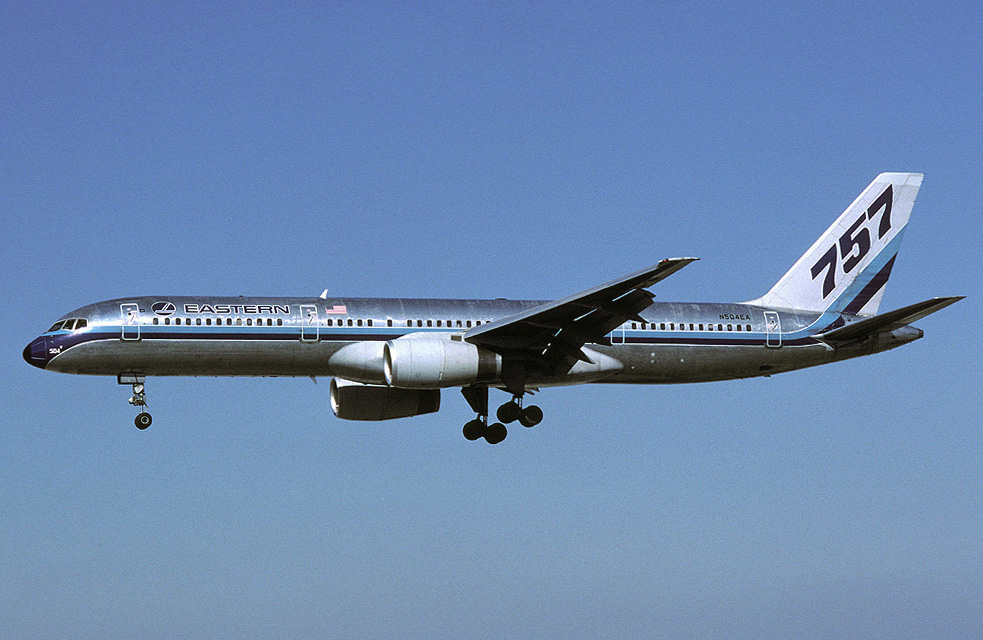
Eastern Air Lines operated the first commercial 757 flight on January 1, 1983, on the Atlanta-to-Tampa route. Charter carriers Monarch Airlines and Air Europe also began 757 operations later that year. Early operators noted improved reliability and quieter performance compared with previous jetliners. Transition courses eased pilots' introduction to the new CRT-based cockpit, and no major technical issues arose. Eastern Air Lines, the first 727 operator to take delivery of 757s, confirmed that the aircraft had greater payload capability than its predecessor, along with lower operating costs through improved fuel burn and the use of a two-crew member flight deck. Compared with the 707 and 727, the new twinjet consumed 42 and 40 percent less fuel per seat, respectively, on typical medium-haul flights.
Despite the successful debut, 757 sales remained stagnant for most of the 1980s, a consequence of declining fuel prices and a shift to smaller aircraft in the post-deregulation U.S. market. In December 1985, a freighter model, the 757-200PF, was announced following a launch order for 20 aircraft from UPS Airlines, The freighter model included a main deck cargo hold and entered service with UPS in September 1987. The combi model could carry both cargo and passengers on its main deck and entered service with Royal Nepal Airlines in September 1988.
In the late 1980s, increasing airline hub congestion and the onset of U.S. airport noise regulations fueled a turnaround in 757 sales. By this time, the 757 had become commonplace on short-haul domestic flights and transcontinental services in the U.S., The 757-200's maximum range of 3900 nmi, The 757 was also flown out of airports with stringent noise regulations, such as John Wayne Airport in Orange County, California, and airports with aircraft size restrictions, such as Washington National Airport near downtown Washington, D.C. The largest U.S. operators, Delta Air Lines and American Airlines, would ultimately operate fleets of over 100 aircraft each.

In Europe, British Airways, Iberia, and Icelandair were the 757's largest mainline customers, while other carriers such as Lufthansa rejected the type as too large for their narrow-body aircraft needs. A 1982 sales demonstration was unable to attract a purchase from potential customer Japan Airlines, and the first Asian customer, Singapore Airlines, sold its four 757s in 1989 in favor of standardizing on the 240-seat wide-body Airbus A310, just five years after debuting the type on Indonesian and Malaysian routes. The 757 fared better in China, where following an initial purchase by the CAAC Airlines in 1987,
In 1986, the FAA approved RB211-powered 757s for extended-range twin-engine operational performance standards (ETOPS) operations over the North Atlantic, following precedents set by the 767. Under ETOPS regulations, a set of safety standards governing twinjet flights over oceans and other areas without nearby suitable landing sites, airlines began using the aircraft for mid-range intercontinental routes. Although the 757 was not originally intended for transoceanic flights, regulators based their decision on its reliable performance record on extended transcontinental U.S. services. ETOPS certification for 757s equipped with PW2000 series engines was granted in 1992.
In the early 1990s, the FAA and other U.S. government agencies, including the National Aeronautics and Space Administration (NASA) and the National Transportation Safety Board (NTSB), began studying the 757's wake turbulence characteristics. This followed several incidents, including two fatal crashes, in which small private aircraft experienced loss of control when flying close behind the twinjet. Other tests were inconclusive, leading to debate among government agencies, and in 1994 and 1996 the FAA updated air traffic control regulations to require greater separation behind the 757 than other large-category jets. The 757 became the only sub-300000 lb airliner to be classified as a "heavy" jet, alongside wide-body aircraft, under FAA separation rules.
Shortened variant: -100
757-100 was a 150-seat, short fuselage version intended to offer similar capacity to a 727-200 but with greater range. Both the 757-100 and -200 were announced at the product launch on August 31, 1978, however the large wing and landing gear common with the 757-200 were found to be excessively heavy for an aircraft of that capacity. Planning for the 757-100 was discontinued in March 1979.
Stretched variant: -300
Production of the 757 peaked at an annual rate of 100 aircraft in the early 1990s, during which time upgraded models came under consideration. and counter longer-range versions of the 185-seat Airbus A321, a new stretched variant of the A320 narrow-body airliner.
_@_FRA,_July_2005.jpg)
In September 1996, following a launch order for 12 aircraft from charter carrier Condor, Boeing announced the stretched 757-300 at the Farnborough Airshow. The first 757-300 rolled out on May 31, 1998, and completed its maiden flight on August 2, 1998. Following regulatory certification in January 1999, the type entered service with Condor on March 19, 1999.
The 757-300 was also ordered by American Trans Air, Arkia Israel Airlines, Continental Airlines, Icelandair, and Northwest Airlines. Boeing had targeted the 757-300 as a potential 767-200 replacement for two of its largest customers, American Airlines and United Airlines, but neither were in a financial position to commit to new aircraft. Overtures to other charter airlines also did not result in further orders.
Further developments
While the 757 program had been financially successful, declining sales in the early 2000s threatened its continued viability. Airlines were again gravitating toward smaller aircraft, now mainly the 737 and A320, because of their reduced financial risk. An airline industry downturn and the large number of relatively young 757s already in service also reduced customer demand. However, the proposal failed to garner any orders. In March 2001, Boeing delivered the first 757-200SF, a second-hand 757-200 converted for freighter use, to DHL Aviation. The 757-200SF marked the manufacturer's first foray into passenger-to-freighter conversions.

Customer interest in new 757s continued to decline, and in 2003, a renewed sales campaign centered on the 757-300 and 757-200PF yielded only five new orders. In October 2003, following Continental Airlines' decision to switch its remaining 757-300 orders to the 737-800, Boeing announced the end of 757 production. and was delivered on November 28, 2005, after several months of storage. With the conclusion of the 757 program, Boeing consolidated 737 assembly at its Renton factory, downsizing its facilities by 40 percent and shifting staff to different locations.
Since the end of production, many Boeing 757s have remained in service, mainly in the U.S. From 2004 to 2008, the average fuel cost for typical mid-range U.S. domestic 757 flights tripled, putting pressure on airlines to improve the fuel efficiency of their fleets. In May 2005, the FAA granted regulatory approval for manufacturer-sanctioned blended winglets from Aviation Partners Incorporated as a retrofit on the 757-200. The winglets improve fuel efficiency by five percent and increase range by 200 nmi through the reduction of lift-induced drag. Continental Airlines was the first carrier to order winglets for the 757-200, and in February 2009 became the first operator of 757-300s with winglets. Aviation Partners further developed the blended winglet into the Scimitar Blended Winglet, which improves fuel burn by 1.1% over the original blended winglet. Icelandair and United Airlines have retrofitted their 757-200s with Scimitar Blended Winglets.
,_N77865_-_LAX_(19250114029).jpg)
Prior to the United-Continental merger in 2010, the 757 remained the only narrow-body aircraft in use by the large fleets of all three U.S. legacy carriers: American Airlines, Delta Air Lines and United Airlines. when selecting replacement aircraft, airlines have had to either downsize to smaller single-aisle aircraft in production with fewer seats and less range such as the 737-900ER and A321, or upsize to the larger, longer-range 787 Dreamliner and A330-200 wide-body jets. The Tupolev Tu-204, a narrow-body twinjet introduced in 1989 with a design similar to the 757's, is offered in a 200-seat version and has seen limited production for mainly Russian customers. Within Boeing, the 215-seat, 3200 nmi range 737-900ER had been regarded as the closest aircraft in production to the 757-200 after the latter ceased production. The Airbus A321neo LR and XLR variants finally provided a suitable 757-200 replacement on market in terms of range and capacity, and Icelandair and United Airlines have ordered the A321XLR to replace the Boeing 757 on their longer-range routes.
Replacement aircraft
Main article: Middle of the market, Boeing New Midsize Airplane
In February 2015, Boeing marketing Vice President Randy Tinseth stated that re-engining the 757 had been studied but there was no business case to support it. At the March 2015 ISTAT conference, Air Lease Corporation's Steven Udvar-Hazy predicted the 757 replacement would be a more capable, clean-sheet 767-like twin-aisle airplane capable of taking off from 7000 ft runways like New York-LaGuardia, and Tinseth was focused on 20% more range and more capacity than the 757-200.
Design

Overview
The 757 is a low-wing cantilever monoplane with a conventional tail unit featuring a single fin and rudder. Each wing features a supercritical cross-section and is equipped with five-panel leading edge slats, single- and double-slotted flaps, an outboard aileron, and six spoilers. The wings are largely identical across all 757 variants, swept at 25 degrees, and optimized for a cruising speed of Mach 0.8 (533 mph). The airframe further incorporates carbon-fiber reinforced plastic wing surfaces, Kevlar fairings and access panels, plus improved aluminum alloys, which together reduce overall weight by 2100 lb.
To distribute the aircraft's weight on the ground, the 757 has a retractable tricycle landing gear with four wheels on each main gear and two for the nose gear. In 1982, the 757-200 became the first subsonic jetliner to offer longer lasting carbon brakes as a factory option, supplied by Dunlop. The stretched 757-300 features a retractable tailskid on its aft fuselage to prevent damage if the tail section contacts the runway surface during takeoff.
Besides common avionics and computer systems, the 757 shares its auxiliary power unit, electric power systems, flight deck, and hydraulic parts with the 767. Through operational commonality, 757 pilots can obtain a common type rating to fly the 767 and share the same seniority roster with pilots of either aircraft. This reduces costs for airlines that operate both twinjets.
Flight systems

The 757's flight deck uses six Rockwell Collins CRT screens to display flight instrumentation, as well as an electronic flight instrument system (EFIS) and an engine indication and crew alerting system (EICAS). The inertial reference system (IRS) which debuted with the 757-200 was the first to feature laser-light gyros. On the 757-300, the upgraded flight deck features a Honeywell Pegasus flight management computer, enhanced EICAS, and updated software systems.
To accommodate the same flight deck design as the 767, the 757 has a more rounded nose section than previous narrow-body aircraft. The resulting space has unobstructed panel visibility and room for an observer seat. Similar pilot viewing angles as the 767 result from a downward sloped cockpit floor and the same forward cockpit windows.
Three independent hydraulic systems are installed on the 757, one powered by each engine, and the third using electric pumps. A basic form of fly-by-wire facilitates spoiler operation, utilizing electric signaling instead of traditional control cables. When equipped for extended-range operations, the 757 features a backup hydraulic motor generator and an additional cooling fan in the aircraft's electronics bay.
Interior

The 757 interior allows seat arrangements of up to six per row with a single center aisle. The bins have twice the capacity as those on the preceding 727.
In 1998, the 757-300 debuted a redesigned interior derived from the Next Generation 737 and 777, including sculptured ceiling panels, indirect lighting, and larger overhead bins with an optional continuous handrail built into their base for the entire cabin length. Centerline storage containers mounted in the aisle ceiling for additional escape rafts and other emergency equipment were also added. The 757-300's interior later became an option on all new 757-200s. In 2000, with wheeled carry-on baggage becoming more popular, Delta Air Lines began installing overhead bin extensions on their 757-200s to provide additional storage space, and American Airlines did the same in 2001. The second interior upgrades based on Boeing Sky Interior, which provide even larger bins and updated ceiling panels and lighting divided from the design from Boeing 787, were introduced in 2011.
Variants
The 757 was produced in standard and stretched lengths. When referring to different versions, Boeing, and airlines are known to collapse the model number (757) and the variant designator (e.g. -200 or -300) into a truncated form (e.g. "752" or "753"). The International Civil Aviation Organization (ICAO) classifies all variants based on the 757-200 under the code "B752", and the 757-300 is referred to as "B753" for air traffic control purposes.
757-200

The 757-200, the original version of the aircraft, entered service with Eastern Air Lines in 1983. The 757-200 was offered with a MTOW of up to 255000 lb; but this designation is not used by the manufacturer. The first engine to power the 757-200, the Rolls-Royce RB211-535C, was succeeded by the upgraded RB211-535E4 in October 1984. Other engines used include the Rolls-Royce RB211-535E4B, along with the Pratt & Whitney PW2037 and Pratt & Whitney PW2000-37/40/43.
Although designed for short and medium length routes, the 757-200 has since been used in a variety of roles ranging from high-frequency shuttle services to transatlantic routes. Production for the 757-200 totaled 913 aircraft, making the type by far the most popular 757 model. At over 4000 nmi, , the longest commercial route served by a 757 is United Airlines' Newark to Berlin flight; the aircraft assigned to this route cannot fly with full payload. United's 757s assigned to transatlantic routes are fitted with 169 seats. In July 2018, 611 of the 757-200 versions were in service.
757-200PF

The 757-200PF, the production cargo version of the 757-200, entered service with UPS Airlines in 1987. Targeted at the overnight package delivery market, the freighter can carry up to 15 ULD containers or pallets on its main deck, for a volume of up to 6600 cuft, while its two lower holds can carry up to 1830 cuft of bulk cargo. The maximum revenue payload capability is 87700 lb including container weight. The 757-200PF is specified with a MTOW of 255000 lb for maximal range performance; when fully loaded, the aircraft can fly up to 3150 nmi. Power is provided by RB211-535E4B engines from Rolls-Royce, or PW2037 and PW2040 engines from Pratt & Whitney.
The freighter features a large, upward-opening main deck cargo door on its forward port-side fuselage. Next to this large cargo door is an exit door used by the pilots. The main-deck cargo hold has a smooth fiberglass lining, and a fixed rigid barrier with a sliding access door serves as a restraint wall next to the flight deck. Both lower holds can be equipped with a telescoping baggage system to load custom-fitted cargo modules. When equipped for extended-range operations, UPS's 757-200PFs feature an upgraded auxiliary power unit, additional cargo bay fire suppression equipment, enhanced avionics, and an optional supplemental fuel tank in the aft lower hold. Production for the 757-200PF totaled 80 aircraft.
757-200SF/PCF (conversion)
.jpg)
The 757-200SF is a passenger to freighter conversion developed by Boeing following an order for 34 aircraft plus 10 options by DHL. It entered service in 2001 with the initial ex-British Airways aircraft converted at Boeing's Wichita site and subsequent blocks of aircraft were converted by Israel Aerospace Industries and ST Aerospace Services. Modifications included the removal of passenger amenities, main deck structural reinforcement, addition of cargo handling flooring, and the installation of a 757-200PF port-side cargo door in the forward fuselage. The forward two entry doors and lobby area of the passenger aircraft are retained, resulting in a main deck cargo capacity of 14 full sized pallets and one smaller LD3. Environmental controls can be fitted for animal cargo such as racehorses, and rear exits and window pairs are retained on some aircraft to facilitate animal handlers. ST Aerospace continued to offer 14, 14.5 and 15 Unit load device variants of the SF in 2020.
In September 2006, FedEx Express announced a US$2.6 billion (~$ in ) plan to acquire over 80 converted 757 freighters to replace its 727 fleet, citing a 25% reduction in operating cost along with noise benefits.
The 757-200PCF is another passenger to freighter conversion developed by Precision Conversions, and was certificated in 2005. In 2019, the conversion was reported to cost $5 million (~$ in ) per aircraft, and has 15 pallet positions just like the SF. The forward passenger doors are removed and replaced with a small crew door, similar to the -200PF. , a total of 120 757-200PCFs had been delivered.
757-200M/CB
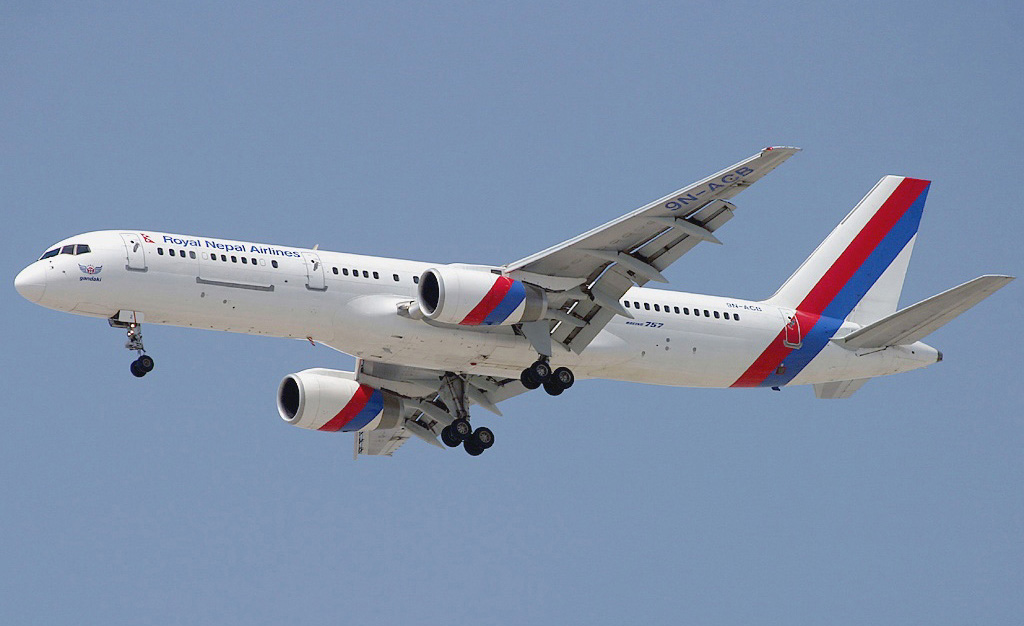
The 757-200M, a convertible version capable of carrying cargo and passengers on its main deck, entered service with Royal Nepal Airlines in 1988. Also known as the 757-200CB (Combi), the type retains the passenger windows and cabin doors of the 757-200, while adding a forward port-side cargo door in the manner of the 757-200PF. Kathmandu-based Royal Nepal Airlines, later renamed Nepal Airlines, included the convertible model as part of an order for two 757s in 1986.
Nepal Airlines ordered the 757-200M to fulfill a requirement for an aircraft that could carry mixed passenger and freight loads, and operate out of Tribhuvan International Airport, with its 4400 ft elevation, in the foothills of the Himalayas. Patterned after convertible variants of the 737 and 747, the 757-200M can carry two to four cargo pallets on its main deck, along with 123 to 148 passengers in the remaining cabin space. Nepal Airlines' 757-200M, which features Rolls-Royce RB211-535E4 engines and an increased MTOW of 240000 lb, was the only production example ordered. When cargo is carried on the main deck, the crew must include an additional dedicated, trained cargo firefighter.
In October 2010, Pemco World Air Services and Precision Conversions launched aftermarket conversion programs to modify 757-200s into 757 Combi aircraft. Vision Technologies Systems launched a similar program in December 2011. All three aftermarket conversions modify the forward portion of the aircraft to provide room for up to ten cargo pallets, while leaving the remaining space to fit around 45 to 58 passenger seats. This configuration is targeted at commercial charter flights which transport heavy equipment and personnel simultaneously. Customers for converted 757 Combi aircraft include the Air Transport Services Group, National Airlines, and North American Airlines.
757-300

The 757-300, the stretched and longest version of the Boeing 757 variants, entered service with Condor in 1999. Engines used on the type include the RB211-535E4B from Rolls-Royce and the PW2043 from Pratt & Whitney. Due to its greater length, the 757-300 features a retractable tailskid on its aft fuselage to avoid tailstrikes.
Condor ordered the stretched 757 to replace its McDonnell Douglas DC-10s and serve as low-cost, high-density transportation to holiday destinations such as the Canary Islands. Because tests showed that boarding the 757-300 could take up to eight minutes longer than the 757-200, The 757-300 has been operated by mainline carriers Continental Airlines (now part of United Airlines as of 2010), Northwest Airlines (now part of Delta Air Lines as of 2008), and Icelandair; other operators have included American Trans Air (the first North American operator), Arkia Israel Airlines, along with charter carriers Condor and Thomas Cook Airlines as of 2014. Production for the 757-300 totaled 55 aircraft. All 55 were in service in July 2018.
Government, military, and corporate
Government, military, and private customers have acquired the 757 for uses ranging from aeronautical testing and research to cargo and VIP transport. The 757-200, the most widely ordered version of the aircraft, has formed the basis for these applications. The first government operator of the 757 was the Mexican Air Force, which took delivery of a VIP-configured 757-200 in November 1987.
- Airborne Research Integrated Experiments System (ARIES) – A NASA platform for air safety and operational research, was created in 1999 using the second production 757. The aircraft originally flew in the 757 flight test program before entering service with Eastern Air Lines. After NASA purchased the aircraft in 1994 to replace its 737-100 testbed, it was initially used to evaluate a hybrid laminar flow control system, avionics systems for the proposed Northrop YF-23 jet fighter, and the 777's fly-by-wire control system. Equipped with a flight deck research station, on-board laboratories, and two experimental flight decks, ARIES was used for evaluating weather information and landing approach systems, as well as runway friction tests. ARIES went into storage in 2006.
_JP7581351.jpg)

- C-32 – The United States Air Force operates six 757-200s under the designation C-32. Four are VIP-configured C-32A variants, whose mission is primarily transport of the Vice President of the United States, First Lady, and Secretary of State. The C-32As are powered by the Pratt & Whitney PW2000, and outfitted with a communication center, conference room, seating area, and private living quarters. The USAF also operates two 45-seat Rolls-Royce powered 757-200 aircraft, designated C-32B Gatekeeper, which provides airlift to special operations units and global emergency response teams. The C-32Bs are outfitted for any contingency, with an advanced communications suite, aerial refueling capabilities, extended fuel tanks, and an internal airstair. The C-32As are painted in the Raymond Loewy-designed blue and white livery used on most Special Air Mission aircraft, while the C-32Bs are painted gloss white with minimal identification markings. The first C-32s were acquired in 1998 and replaced C-137 Stratoliner transports.

- F-22 Flying Testbed – The first 757 built was used in 1998 as a testbed for Lockheed Martin F-22 Raptor avionics and sensor integration. The Boeing-owned aircraft was fitted with a canard above its cockpit to simulate the jet fighter's wing sensor layout, along with a forward F-22 fuselage section with radar and other systems, and a 30-seat laboratory with communication, electronic warfare, identification, and navigation sensors.
- Krueger flap and Natural Laminar Flow Insect Mitigation Test Program – As part of their ecoDemonstrator program, Boeing commenced a series of test flights on March 17, 2015, with a modified Boeing 757, incorporating new wing-leading-edge sections and an actively blown vertical tail. The left wing was modified to include a 6.7 m-span glove section supporting a variable-camber Krueger flap to be deployed during landing which protrudes just ahead of the leading edge. Although Krueger flaps have been tried before as insect-mitigation screens, previous designs caused additional drag; the newer design is variable-camber and designed to retract as seamlessly as possible into the lower wing surface. Increasing the use of natural laminar flow (NLF) on an aircraft wing has the potential to improve fuel burn by as much as 15%, but even small contaminants from insect remains will trip the flow from laminar to turbulent, destroying the performance benefit. The test flights have been supported by the European airline group TUI AG and conducted jointly with NASA as part of the agency's Environmentally Responsible Aviation (ERA) program. While the left wing tests the Krueger flaps, the right wing is being used to test coatings that prevent insects from adhering to the wing.
- Active Flow Control System – On one aircraft Boeing has mounted 31 active flow jets mounted ahead of the rudder's leading edge. They receive air from the Auxiliary Power Unit (APU). Their purpose is to recover air flow that has separated from the rudder and redirect it to the rudder so that the rudder regains effectiveness, even at high deflection angles. The air exiting the APU is very hot, at 380 F, and is cooled by a heat exchanger mounted under the aft fuselage, which is connected to the ducts running along the front and back of the stabilizer's spars. This ensures an even air supply at all times.

- Royal New Zealand Air Force 757 Combi – The Royal New Zealand Air Force (RNZAF) operates two 757s converted to 757-200M standard by ST Aerospace Services for delivering equipment, medical evacuation, troop movements, and VIP transport. A cargo door, upgraded auxiliary power unit, enhanced communications systems, and retractable airstairs are fitted. The two aircraft, which replaced two 727-100QCs, have carried the Prime Minister of New Zealand, and flown to the ice-covered Pegasus Field near New Zealand's Scott Base in McMurdo Sound, Antarctica.
- VIP transport – The 757-200 serves as VIP transports for the President of Argentina under the Presidential Air Group serial Tango 01 and for the President of Mexico under the Mexican Air Force call sign TP01 or Transporte Presidencial 1. A Royal Brunei Airlines 757-200 was used by the Sultan of Brunei in the 1980s before being sold to the Government of Kazakhstan in 1995. The royal family of Saudi Arabia uses a 757-200 as a flying hospital. Microsoft co-founder Paul Allen used a private 757 from 2005 until 2011; the aircraft was then sold to Donald Trump and became known as "Trump Force One" during his 2016 U.S. presidential campaign.
- Excalibur – A testbed for the British BAE Systems Tempest's avionics and sensors. The aircraft is to be converted from a civilian airliner by Leonardo UK and 2Excel.
Operators
Main article: List of Boeing 757 operators
.jpg)

, the largest 757 operators were Delta Air Lines, FedEx Express and United Airlines. FedEx operates 92 757 freighters, and United operates 61 757s.
American Airlines formerly operated a substantial 757 fleet of 142 aircraft, which was the largest until 2007, when the carrier retired Pratt & Whitney PW2000-powered models originating from its TWA acquisition to have an all Rolls-Royce RB211-powered 757 fleet. American retired the last of its 757s in 2020.
In addition to FedEx, UPS and DHL were substantial operators of 757 freighters as of 2018. combined operating 35 cargo 757s of various types in 2018.
Joint launch customer British Airways operated the 757-200 for 27 years before retiring the type in November 2010. To celebrate the fleet's retirement, the airline unveiled one of its last three 757-200s in a retro style livery on October 4, 2010, matching the color scheme that it introduced the aircraft into service with in 1983. Subsequently, the type remained in operation with the company's subsidiary, OpenSkies.
Over the duration of the program, 1,050 Boeing 757s were built with 1,049 aircraft delivered. The prototype 757 remained with the manufacturer for testing purposes. In August 2018, a total of 611 Boeing 757 aircraft of all variants were in commercial service with operators Delta Air Lines (127), FedEx Express (111), UPS Airlines (75), United Airlines (77), Icelandair (26) and others with fewer aircraft of the type.
Orders and deliveries
| Year | Total | 2005 | 2004 | 2003 | 2002 | 2001 | 2000 | 1999 | 1998 | 1997 | 1996 | 1995 | 1994 | 1993 | 1992 | Orders | Deliveries |
|---|---|---|---|---|---|---|---|---|---|---|---|---|---|---|---|---|---|
| 1,049 | 0 | 0 | 7 | 0 | 37 | 43 | 18 | 50 | 44 | 59 | 13 | 12 | 33 | 35 | |||
| 1,049 | 2 | 11 | 14 | 29 | 45 | 45 | 67 | 54 | 46 | 42 | 43 | 69 | 71 | 99 |
| Year | 1991 | 1990 | 1989 | 1988 | 1987 | 1986 | 1985 | 1984 | 1983 | 1982 | 1981 | 1980 | 1979 | 1978 | Orders | Deliveries |
|---|---|---|---|---|---|---|---|---|---|---|---|---|---|---|---|---|
| 50 | 95 | 166 | 148 | 46 | 13 | 45 | 2 | 26 | 2 | 3 | 64 | 0 | 38 | |||
| 80 | 77 | 51 | 48 | 40 | 35 | 36 | 18 | 25 | 2 | 0 | 0 | 0 | 0 |
Boeing 757 orders and deliveries (cumulative, by year):
ImageSize = width:auto height:250 barincrement:38 PlotArea = left:35 bottom:15 top:10 right:18 AlignBars = justify DateFormat = yyyy Period = from:0 till:1100 TimeAxis = orientation:vertical ScaleMajor = unit:year increment:100 start:0
PlotData= color:skyblue width:38 bar:1978 from:start till:38 text:38 align:center bar:1979 from:start till:38 text:38 align:center bar:1980 from:start till:102 text:102 align:center bar:1981 from:start till:105 text:105 align:center bar:1982 from:2 till:107 text:107 align:center bar:1983 from:27 till:133 text:133 align:center bar:1984 from:45 till:135 text:135 align:center bar:1985 from:81 till:180 text:180 align:center bar:1986 from:116 till:193 text:193 align:center bar:1987 from:156 till:239 text:239 align:center bar:1988 from:204 till:387 text:387 align:center bar:1989 from:255 till:553 text:553 align:center bar:1990 from:332 till:648 text:648 align:center bar:1991 from:412 till:698 text:698 align:center bar:1992 from:511 till:733 text:733 align:center bar:1993 from:582 till:766 text:766 align:center bar:1994 from:651 till:778 text:778 align:center bar:1995 from:694 till:791 text:791 align:center bar:1996 from:736 till:850 text:850 align:center bar:1997 from:782 till:894 text:894 align:center bar:1998 from:836 till:944 text:944 align:center bar:1999 from:903 till:962 text:962 align:center bar:2000 from:948 till:1005 text:1005 align:center bar:2001 from:993 till:1042 text:1042 align:center bar:2002 from:1022 till:1042 text:1042 align:center bar:2003 from:1036 till:1049 text:1049 align:center bar:2004 from:1047 till:1049 text:1049 align:center color:powderblue width:38 bar:2005 from:1049 till:1049 text:1049 align:center
color:green width:38– bar:1982 from:start till:2 text:2 align:center bar:1983 from:start till:27 text:27 align:center bar:1984 from:start till:45 text:45 align:center bar:1985 from:start till:81 text:81 align:center bar:1986 from:start till:116 text:116 align:center bar:1987 from:start till:156 text:156 align:center bar:1988 from:start till:204 text:204 align:center bar:1989 from:start till:255 text:255 align:center bar:1990 from:start till:332 text:332 align:center bar:1991 from:start till:412 text:412 align:center bar:1992 from:start till:511 text:511 align:center bar:1993 from:start till:582 text:582 align:center bar:1994 from:start till:651 text:651 align:center bar:1995 from:start till:694 text:694 align:center bar:1996 from:start till:736 text:736 align:center bar:1997 from:start till:782 text:782 align:center bar:1998 from:start till:836 text:836 align:center bar:1999 from:start till:903 text:903 align:center bar:2000 from:start till:948 text:948 align:center bar:2001 from:start till:993 text:993 align:center bar:2002 from:start till:1022 text:1022 align:center bar:2003 from:start till:1036 text:1036 align:center bar:2004 from:start till:1047 text:1047 align:center bar:2005 from:start till:1049 text:1049 align:center : — Data from Boeing, through to the end of production
Model summary
| Model series | ICAO code | Orders | Deliveries | 757-200 | 757-200M | 757-200PF | 757-300 | Total | 1,049 | 1,049 | ||||
|---|---|---|---|---|---|---|---|---|---|---|---|---|---|---|
| B752 | 913 | 913 | ||||||||||||
| B752 | 1 | 1 | ||||||||||||
| B752 | 80 | 80 | ||||||||||||
| B753 | 55 | 55 |
- Data from Boeing, through the end of production
Accidents and incidents
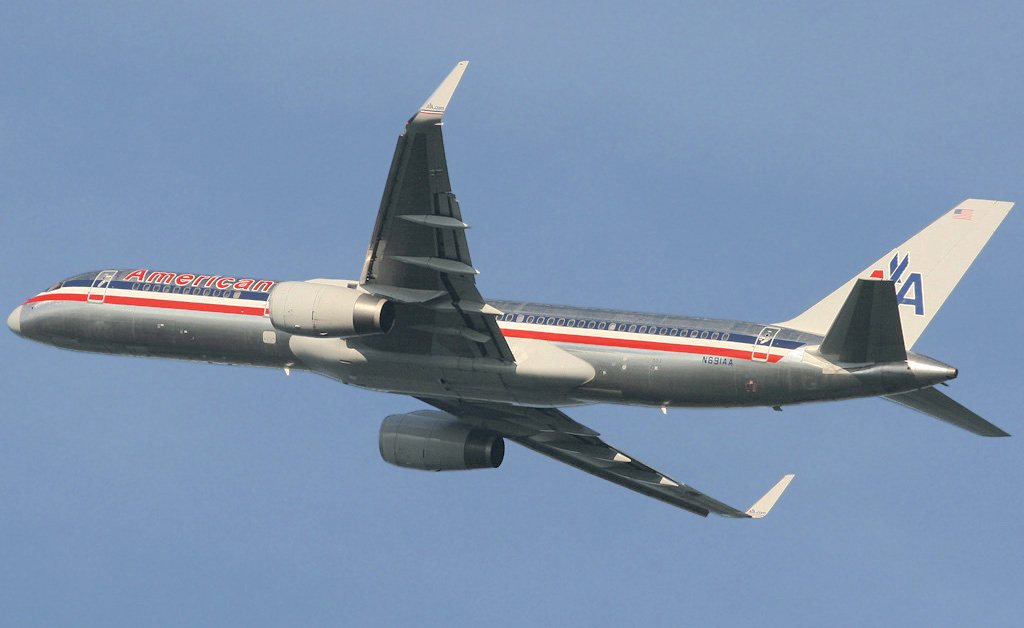
, the 757 has been involved in 47 aviation occurrences, including ten hull-loss accidents out of a total of 13 hull-losses. Nine incidents and 12 hijackings have resulted in a total of occupant fatalities.
Accidents
The first fatal event involving the aircraft occurred on October 2, 1990, when a hijacked Xiamen Airlines 737-200 collided with a China Southern Airlines 757-200 on the runways of Guangzhou Baiyun International Airport, China, killing 46 of the 122 people on board. Two 757-200s were hijacked as part of the September 11, 2001 attacks: hijackers crashed American Airlines Flight 77 into the Pentagon in Arlington, Virginia, killing all 64 on board and 125 on the ground, and hijackers crashed United Airlines Flight 93 near Shanksville, Pennsylvania after crew and passengers fought back to regain control, killing all 44 on board.
Accidents involving pilot error include American Airlines Flight 965, which crashed into a mountain in Buga, Colombia, on December 20, 1995, killing 151 passengers and all eight crew members with four survivors, and a dog, and the mid-air collision of DHL Flight 611 near Überlingen, Baden-Württemberg, Germany, on July 1, 2002, with the loss of both crew members on board plus 69 others on a Bashkirian Airlines Tupolev Tu-154. Accidents attributed to spatial disorientation due to improperly maintained instruments include Birgenair Flight 301 on February 6, 1996, which crashed into the ocean near Puerto Plata, Dominican Republic, with the loss of all 189 passengers and crew, and Aeroperú Flight 603 on October 2, 1996, which crashed into the ocean off the coast of Pasamayo, Peru, with the loss of all 70 on board. In the Birgenair accident, investigators found that the aircraft had been stored without the necessary covers for its pitot tube sensors, thus allowing insects and debris to collect within, while in the Aeroperú accident, protective tape covering static vent sensors had not been removed.
On September 14, 1999, Britannia Airways Flight 226A crash-landed near Girona-Costa Brava Airport, Spain, during a thunderstorm; the 757's fuselage broke into several pieces. The 245 occupants evacuated successfully, with 40 requiring hospital treatment; one passenger died five days later of unsuspected internal injuries. On October 25, 2010, American Airlines Flight 1640, a 757 flying between Miami and Boston, safely returned to Miami after suffering the loss of a 2 ft fuselage section at an altitude of approximately 31000 ft. After investigating the incident, the FAA ordered all 757 operators in the U.S. to regularly inspect upper fuselage sections of their aircraft for structural fatigue.
On November 9, 2018, Fly Jamaica Airways Flight 256 was substantially damaged after a runway excursion at Cheddi Jagan International Airport. One fatality was reported, and the aircraft was declared a hull loss. The other 127 occupants survived.
Incidents
Two private aircraft crashes were blamed on wake turbulence emanating from 757s. On December 18, 1992, a Cessna Citation crashed near Billings Logan International Airport in Montana, killing all six aboard, and on December 15, 1993, an IAI Westwind crashed near John Wayne Airport in California, killing all five aboard. Both airplanes had been flying less than 3 nmi behind a 757. The FAA subsequently increased the required separation between small aircraft and 757s from 4 nmi to 5 nmi.
On April 7, 2022, a DHL Boeing 757 aircraft operating Flight 7216 crash landed at San Jose, Costa Rica after attempting an emergency landing due to a hydraulic failure. Both crew members survived without injuries; the incident is under investigation.
Aircraft on display

A Delta Air Lines 757-200, registered as N608DA, is on display at the Delta Flight Museum in Atlanta, Georgia. The aircraft was the sixty-fourth example built. The aircraft was repainted into Delta's 'Widget' livery, the livery it wore when it was originally delivered, and is now on static display at the museum entrance.
Specifications

| Variant | date=2007 | title=757 Passenger | url=http://www.boeing.com/resources/boeingdotcom/company/about_bca/startup/pdf/historical/757_passenger.pdf | url-status=live | archive-url=https://web.archive.org/web/20180329043107/http://www.boeing.com/resources/boeingdotcom/company/about_bca/startup/pdf/historical/757_passenger.pdf | archive-date=March 29, 2018 | access-date=December 1, 2015 | publisher=Boeing}} | 757-200F | 757-300 | Cockpit crew | 2-class seating | 1-class seating | Cargo volume | Width | Length | Height | Wing | MTOW | Max. Payload | OEW | Fuel capacity | Speed | Range | Takeoff | Ceiling | Engines (×2) |
|---|---|---|---|---|---|---|---|---|---|---|---|---|---|---|---|---|---|---|---|---|---|---|---|---|---|---|---|
| Two | |||||||||||||||||||||||||||
| 200 (12F+188Y) | 5 max | 243 (12F+231Y) | |||||||||||||||||||||||||
| 219–239 max | 275–295 max | ||||||||||||||||||||||||||
| 1,670 cu ft (47.3 m3) | 6,600 cu ft (187 m3) | 2,370 cu ft (61.7 m3) | |||||||||||||||||||||||||
| 148 in (3.76 m) fuselage, | |||||||||||||||||||||||||||
| 139.3 in (3.54 m) cabin | |||||||||||||||||||||||||||
| 155 ft 3 in (47.3 m) | 178 ft 7 in (54.4 m) | ||||||||||||||||||||||||||
| 44 ft 6 in (13.6 m) | |||||||||||||||||||||||||||
| 124 ft 10 in (38.0 m) span, 185.25 m2 area, 25° sweep, AR | |||||||||||||||||||||||||||
| 255,000 lb (115,660 kg) | 273,000 lb (123,830 kg) | ||||||||||||||||||||||||||
| lb ( kg) | lb ( kg) | lb ( kg) | |||||||||||||||||||||||||
| 128,840 lb (58,440 kg) | 115,580 lb (52,430 kg) | 141,860 lb (64,340 kg) | |||||||||||||||||||||||||
| 11,489 US gal (43,490 L) | 11,276 US gal (42,680 L) | 11,466 US gal (43,400 L) | |||||||||||||||||||||||||
| Cruise: .8 Mach, | |||||||||||||||||||||||||||
| Max.: .86 Mach | |||||||||||||||||||||||||||
| 3,915 nmi (7,250 km; 3915 nmi) | 2,935 nmi (5,435 km; 2935 nmi) | 3,400 nmi (6,295 km; 3400 nmi) | |||||||||||||||||||||||||
| 6,800 ft (2,070 m) | 6,900 ft (2,103 m) | 8,550 ft (2,605 m) | |||||||||||||||||||||||||
| 42,650 ft | |||||||||||||||||||||||||||
| 40,200 - Rolls-Royce RB211-535-E4(B) | |||||||||||||||||||||||||||
| 36,600 - Pratt & Whitney PW2000-37/40/43 |
Notes
References
Sources
References
- (August 21, 2018). "World Airline Census 2018". Flightglobal.
- {{harvnb. Norris. Wagner. 1998
- {{harvnb. Eden. 2008
- Norris. Wagner. 1999
- Norris. Wagner. 1998
- {{harvnb. Norris. Wagner. 1999
- {{harvnb. Norris. Wagner. 1998
- {{harvnb. Eden. 2008
- Norris. Wagner. 1999
- {{harvnb. Birtles. 2001
-
- lb. kg. 10000. lb. kg. Birtles. 2001
- Ostrower, Jon, and Wall, Robert, "Boeing weighs options to reprise aging 757s", ''Wall Street Journal'', February 11, 2015, pp. B1–2.
- Velupillai, David. (January 2, 1982). "Boeing 757: introducing the big-fan narrowbody".
- {{harvnb. Velupillai. 1982
- {{harvnb. Eden. 2008
- {{harvnb. Norris. Wagner. 1999
- (October 6, 1979). "Boeing refine 757 flight deck".
- "Boeing 727 Specifications". Boeing.
- The fuselage cross-section, whose upper lobe was common to the [[Boeing 707. 707]] and 737,{{harvnb. Sharpe. Shaw. 2001
- {{harvnb. Davies. 2003
- {{harvnb. Birtles. 2001
- {{harvnb. Birtles. 2001
- {{harvnb. Velupillai. 1982
- Ramsden, J. M.. (April 29, 1978). "Europe's Jet v. Boeing's 757".
- {{harvnb. Velupillai. 1982
- The aircraft, equipped with {{nowrap. Eden. 2008
- {{harvnb. Birtles. 2001
- Norris. Wagner. 1998
- Sweetman, Bill. (March 20, 1982). "Boeing tests the twins".
- {{harvnb. Birtles. 2001
- {{harvnb. Birtles. 2001
- (July 28, 1983). "Boeing 757: six months in service".
- Birtles. 2001
- {{harvnb. Birtles. 2001
- {{harvnb. Birtles. 2001
- Birtles. 2001
- {{harvnb. Birtles. 2001
- {{harvnb. Birtles. 2001
- {{harvnb. Norris. Wagner. 1998
- "Concept to Reality – Wake-Vortex Hazard". National Aeronautics and Space Administration.
- Maksel, Rebecca. (May 27, 2008). "Is the Boeing 757 a threat to other airliners?".
- Green, William. (1987). "Modern Commercial Aircraft". Portland House.
- Richard O'Lone. (1980). "Study Shows Air's Cost Over Auto". Aviation Week & Space Technology.
- {{harvnb. Birtles. 2001
- For over a decade, the narrow-body twinjet had been its manufacturer's only single-aisle airliner without a stretched variant, and while rumors of a long-range {{nowrap. 757-200X and stretched {{nowrap. Norris. Wagner. 1999
- {{harvnb. Eden. 2008
- Norris, Guy. (August 27, 2002). "Fix sought as 757 backlog nosedives".
- Norris, Guy. (November 17, 1999). "Boeing looks at 757 slowdown".
- McMillin, Molly. (August 10, 2004). "Wichita's final 757 to take a bow".
- Kingsley-Jones, Max. (April 11, 2003). "Omens good for old 757s despite production axe".
- In 2000, spurred by interest from Air 2000 and Continental Airlines, Boeing reexamined the possibility of building a longer-range {{nowrap. 757-300, resulting in a higher MTOW and a potential range increase to over {{convert. 5000. nmi. Birtles. 2001
- Norris, Guy. (October 21, 2003). "Sales drought takes 757's scalp".
- "Aircraft Profiles: Boeing 757".
- Steinke, Sebastian. (May 2005). "Last 757 Leaves Final Assembly".
- Norris, Guy. (February 24, 2004). "Boeing consolidates at Renton as 757 line ends".
- "$3.3 Million a Day – That's How Much American Airlines is Losing in the Era of Insane Fuel Prices." ''Fortune'', May 12, 2008, p. 94.
- Freitag, William. (2009). "Blended winglets improve performance".
- Faye, Robert. (2002). "Blended Winglets".
- (June 27, 2008). "As fuel costs spiral, winglets are a simple way for airlines to cut fuel consumption".
- Norris, Guy. (February 4, 2009). "Continental Receives First Wingletted 757-300".
- (February 15, 2017). "Icelandair the First to Operate 757-200 Scimitar Blended Winglets in Europe".
- (October 27, 2016). "United Moves Forward with 757 Scimitar Winglets Installation".
- Ostrower, Jon. (September 5, 2010). "Icelandair's 757 replacement dilemma".
- (February 26, 1991). "Tupolev Takes on Boeing".
- {{harvnb. Eden. 2008
- Karnozov, Vladimir. (April 27, 2011). "Tu-204SM struggles as key supporter backs away".
- Schofield, Adrian. (July 20, 2005). "Boeing's 737-900ER Seen As Direct Competitor To A321".
- (April 7, 2023). "Icelandair signs deal for 13 Airbus A321XLR as it replaces Boeing 757s". Reuters.
- Taylor Rains. (August 25, 2024). "United executive said the new Airbus A321XLR will replace Boeing 757 routes and open new ones".
- Fehrm, Bjorn. (July 4, 2024). "To what extent can the A321XLR replace the Boeing 757, Part 2". Leeham News.
- Stephen Trimble. (February 11, 2015). "Boeing rejects business case for 757 re-engining". [[Flight Global]].
- Stephen Trimble. (March 11, 2015). "Udvar-Hazy reveals preferences for Boeing's next project". [[Flight Global]].
- {{harvnb. Velupillai. 1982
- Birtles. 2001
- {{harvnb. Norris. Wagner. 1998
- The landing gear was purposely designed to be taller than the company's previous narrow-body aircraft to provide ground clearance for stretched models.{{harvnb. Norris. Wagner. 1998
- (July 17, 1982). "Carbon brakes for 757".
- {{harvnb. Norris. Wagner. 1999
- {{harvnb. Velupillai. 1982
- {{harvnb. Wells. Clarence. 2004
- {{harvnb. Birtles. 2001
- {{harvnb. Norris. Wagner. 1998
- Rinearson, Peter. (June 19–26, 1983). "Making It Fly".
- Velupillai, David. (August 8, 1981). "Boeing 767: The new fuel saver".
- (March 20, 2020). "The 757 conundrum: why this airliner is not easily replaceable". [[Key Publishing.
- (August 12, 2025). "Here's Why The Boeing 757 Got The Nickname 'Atari Ferrari'". [[Jalopnik]].
- (February 12, 1982). "Boeing's Big, Quiet 737-300".
- {{harvnb. Norris. Wagner. 1999
- (April 25, 2000). "Icelandair Takes First Boeing 757-200 with New Interior". Boeing.
- (May 15, 2000). "Delta Air Lines Announces Installation Of Overhead Bin Extensions.". Delta Air Lines.
- (January 17, 2001). "American's First Aircraft Featuring Bigger Overhead Bins Takes to the Skies.". American Airlines.
- (2011). "Heath Tecna to unveil Project Amber for B737s and B757s".
- "Heath Tecna unveils Project Amber interior". Aircraft Interiors International.
- "Boeing 757-300 Background". Boeing.
- "Airplane Types and seating maps". Delta Air Lines.
- "ICAO Document 8643". International Civil Aviation Organization.
- "757-200ER (with BusinessElite version 2) – 75E". Delta Air Lines.
- {{harvnb. Veronico. Dunn. 2004
- {{harvnb. Birtles. 2001
- {{harvnb. Birtles. 2001
- {{harvnb. Norris. Wagner. 1998
- {{harvnb. Kane. 2003
- (November 19, 2001). "Boeing, ST Aero deliver 757 special freighter".
- (January 15, 2001). "757 SF makes first flight".
- (March 20, 2001). "Converted Boeing 757-200 freighter enters service with DHL".
- Kingsley-Jones, Max. (October 13, 1999). "Boeing launches turnkey initiative with DHL freighter conversion contract".
- (September 19, 2000). "Very special freighters".
- (May 31, 2006). "Blue Dart inducts two Boeing 757-200 freighters". Business Standard.
- "Tasman Cargo Airlines 757-200F". Tasman Cargo Airlines.
- Hendriks, Carl. (August 23, 2006). ["DHL Boeing 757-236(SF) OO-DPJ"](http://www.airliners.net/photo/DHL-(European-Air/Boeing-757-236(SF)/1101664/&sid=92682d561495d7a80417219d0c3a7748). Airliners.net.
- (March 2024). "ST Aerospace Brochure".
- Torbenson, Eric. (September 26, 2006). "FedEx to spend $2.6 billion to replace its fleet of 727s". Bloomberg.
- "Passenger to Freighter Aircraft Conversions".
- Engel, Samuel. (April 2, 2019). "amazon-and-alibaba-have-saved-a-legacy-boeing-aircraft-before-will-it-happen-again".
- Lee, Jeff. (April 17, 2020). "Precision conversion now total 120".
- (December 17, 1988). "World Airliner Census".
- {{harvnb. Norris. Wagner. 1998
- (October 30, 2010). "Pemco launches 757-200 Combi conversation program".
- Sobie, Brendan. (October 21, 2010). "Precision follows Pemco in launching 757 combi conversion".
- (December 17, 2010). "North American Airlines and VT Systems plan conversion of Boeing 757-200 to Combi configuration". Global Aviation Holdings Inc..
- "757-300 Technical Characteristics". Boeing.
- (February 19, 2002). "P&W-powered 757-300 tests begin".
- Norris, Guy. (December 2, 1998). "Testing a stretch".
- {{harvnb. Norris. Wagner. 1999
- Norris. Wagner. 1999
- (August 8, 2001). "American Trans Air Receives First and Second Boeing 757-300s". Boeing.
- (2014). "World Airliner Census".
- {{harvnb. Birtles. 2001
- (December 1999). "ARIES: NASA's Flying Lab Takes Wing". National Aeronautics and Space Administration.
- Adams, Denise. (August 11, 2006). "State of the Center Updated at Town Meeting". National Aeronautics and Space Administration.
- "Factsheets: C-32". United States Air Force.
- [https://www.nationalguard.mil/Leadership/Joint-Staff/Personal-Staff/Legislative-Liaison/Important-Documents/FileId/60892/ "Air National Guard 2014 Weapons System Modernization Priorities"] {{Webarchive. link. (November 30, 2021. ''[[United States Air National Guard]]''. 2014.)
- {{harvnb. United States General Accounting Office. 2003
- (September 2007). "Midair Collision Avoidance Guide". 305th and 514th Air Mobility Wings, McGuire Air Force Base.
- Heisterkamp, Eddie. (May 24, 2011). "Boeing C-32B (757-23A)". Airliners.net.
- {{harvnb. Birtles. 2001
- {{harvnb. Pace. 1999
- (March 23, 2015). "757 EcoDemo Focuses On Laminar And Active Flow".
- Norris, Guy, Bug smasher, Aviation Week & Space Technology, March 30 – April 12, 2015, p.37
- Norris, Guy, Bug Smasher, Aviation Week & Space Technology, March 30 – April 12, 2015, p.37
- "RNZAF – Boeing 757". Royal New Zealand Air Force.
- Smith, Anneke. (June 21, 2024). "Inside the Defence Force's 757 planes: Breaking down the details". [[RNZ]].
- Field, Michael. (July 8, 2011). "Air force plane struck by lightning".
- Field, Michael. (December 17, 2009). "RNZAF jet lands on ice".
- Braslavsky, Guido. (April 20, 2009). "El avión de Cristina se averió y tuvo que aterrizar en Caracas".
- Guevera, Íñigo. (2009). "Defensa Nacional – Ejército, Fuerza Aérea y Marina". Seguridad con Democracia.
- {{harvnb. Birtles. 2001
- "Airline profile: Saudi Arabian".
- "Check out 'Trump Force One' — Donald Trump's personal Boeing airliner". Business Insider.
- Robinson, Tim. (September 17, 2021). "Defence back on show - DSEI 2021 report".
- (October 2024}} {{As of). "Delta Air Lines, Inc. 2024 Form 10-K".
- (March 20, 2025). "FedEx FY2025-Q3 report". fedex.com.
- (24 February 2025). "UAL 2024 10K".
- (August 21–27, 2007). "World Airliner Census".
- "American set to return 19 jets when leases up." ''Fort Worth Star-Telegram'', June 8, 2006, p. C1.
- (January 28, 2021). "American Airlines Reports Fourth-Quarter and Full-Year 2020 Financial Results".
- (May 24, 2007). "DHL & Lemuir Consolidate Logistics Business in India". DHL Aviation.
- Cohen, Aubrey. (October 5, 2010). "British Airways revives 1983 livery for retiring Boeing 757".
- Kaminski-Morrow, David. (May 10, 2010). "British Airways unveils 'retro' livery as 757 era ends".
- Kingsley-Jones, Max. (October 3, 2010). "BA goes retro for 757 bye-bye".
- (April 2011). "757 Model Summary". Boeing.
- (December 3, 2023). "Boeing 757 incidents". Aviation Safety Network.
- (December 3, 2023). "Boeing 757 hull-losses". Aviation Safety Network.
- (December 3, 2023). "Boeing 757 Statistics". Aviation Safety Network.
- {{harvnb. Birtles. 2001
- (July 23, 2004). "Threats and Responses; Excerpts from the Report of the Sept. 11 Commission: 'A Unity of Purpose'". The New York Times.
- (December 21, 1995). "American Airlines jet crashes in the Andes". CNN.
- (May 2, 2004). "Investigation Report AX001-1-2". German Federal Bureau of Aircraft Accidents Investigation.
- Pope, Hugh. (February 10, 1996). "Crash plane may not have been serviced". The Independent.
- (September 15, 1999). "Plane crash Britons due home". BBC News.
- CAA [http://www.caa.co.uk/docs/33/SRGSafetyPlanUpdate2008.pdf SRG Safety Plan 2008] {{webarchive. link. (June 6, 2011 (PDF file))
- (October 29, 2010). "Officials investigate what caused hole in American jet's fuselage".
- Karp, Aaron. (January 10, 2011). "FAA issues AD requiring 'repetitive' 757 fuselage skin inspections".
- Ranter, Harro. "Accident Boeing 757-23N N524AT, Friday 9 November 2018".
- "FAA Notice N JO 7110.525".
- "FAA Order JO 7110.65Z - Air Traffic Control. Section 5. Radar Separation".
- (April 8, 2022). "DHL cargo plane splits in two after crash landing at Costa Rica airport". The Guardian.
- (April 8, 2022). "Video: Cargo plane splits in two after emergency landing in Costa Rica".
- Meng, Tiffany. (April 28, 2014). "Two new planes". Delta Flight Museum.
- {{Harvnb. Birtles. 1999
- (2007). "757 Passenger". Boeing.
- (2007). "757 Freighter". Boeing.
- (February 16, 2016). "Type Certificate Data Sheet". FAA.
- (August 2002). "757 Airplane Characteristics for Airport Planning". Boeing.
- (January 1999). "Civil Jet Aircraft Design". Elsevier.
- (1998). "Boeing Jetliners". Barnes & Noble Books.
- (January 11, 2000). "TWA looks at stretched 757s to replace ageing 767 fleet". Flight International.
This article was imported from Wikipedia and is available under the Creative Commons Attribution-ShareAlike 4.0 License. Content has been adapted to SurfDoc format. Original contributors can be found on the article history page.
Ask Mako anything about Boeing 757 — get instant answers, deeper analysis, and related topics.
Research with MakoFree with your Surf account
Create a free account to save articles, ask Mako questions, and organize your research.
Sign up freeThis content may have been generated or modified by AI. CloudSurf Software LLC is not responsible for the accuracy, completeness, or reliability of AI-generated content. Always verify important information from primary sources.
Report