From Surf Wiki (app.surf) — the open knowledge base
Bodie, California
Ghost town in Mono County
Ghost town in Mono County
| Field | Value |
|---|---|
| name | Bodie |
| settlement_type | Ghost town |
| image_skyline | Bodie September 2016 019.jpg |
| image_caption | County Barn, Bodie, California |
| pushpin_map | USA California#USA |
| pushpin_label_position | bottom |
| pushpin_mapsize | 190 |
| pushpin_relief | 1 |
| subdivision_type | Country |
| subdivision_type1 | State |
| subdivision_type2 | County |
| subdivision_name | United States |
| subdivision_name1 | California |
| subdivision_name2 | Mono |
| leader_title | None |
| population_as_of | 2020 |
| population_footnotes | |
| population_total | 11 |
| timezone | Pacific |
| utc_offset | −8 |
| timezone_DST | PDT |
| utc_offset_DST | −7 |
| area_code_type | Area codes |
| area_code | 442/760 |
| coordinates | |
| elevation_footnotes | |
| elevation_ft | 8379 |
| website | Bodie State Historic Park |
| established_title | Founded |
| established_date | 1876 |
| footnotes | {{Infobox NRHP |
| embed | yes |
| name | Bodie Historic District |
| nrhp_type | nhld |
| nocat | yes |
| designated_other1 | California |
| image | BodieCaliforniaSanbornFireInsuranceMap1890.jpg |
| image_size | 224 |
| caption | Map of Bodie, as of 1890 |
| location | California |
| nearest_city | Bridgeport, California |
| architecture | Various; Southwestern U.S. frontier-style, late-19th to early-20th century. |
| added | October 15, 1966 |
| designated_nrhp_type | July 4, 1961 |
| refnum | 66000213 |
| designated_other1_number | 341 |
| designated_other1_num_position | both |
| designated_other2_num_position | both |
| designated_other3_num_position | both |
| blank_name_sec1 | Climate |
| blank_info_sec1 | Dsc |
Bodie ( ) is a ghost town in the Bodie Hills east of the Sierra Nevada mountain range in Mono County, California, United States. It is about 75 mi southeast of Lake Tahoe, and 12 mi east-southeast of Bridgeport, at an elevation of 8,379 ft.
The town went into decline in the subsequent decades and came to be described as a ghost town by . The U.S. Department of the Interior recognizes the designated Bodie Historic District as a National Historic Landmark.
Also registered as a California Historical Landmark, the ghost town officially was established as Bodie State Historic Park in 1962. It receives about 200,000 visitors yearly. Bodie State Historic Park is partly supported by the Bodie Foundation.
History
Discovery of gold
Bodie began as a mining camp of little note following the discovery of gold in 1859 by a group of prospectors, including W. S. Bodey. Bodey died in a blizzard the following November while making a supply trip to Monoville (near present-day Mono City), never able to see the rise of the town that was named after him. According to area pioneer Judge J. G. McClinton, the district's name had been "Bodey," "Body," and a few other orthographic variations. After a painter in the nearby boomtown of Aurora lettered a sign "Bodie Stables," it was then standardized to "Bodie."
Gold discovered at Bodie coincided with the discovery of silver at nearby Aurora (thought to be in California, later found to be Nevada), and the distant Comstock Lode beneath Virginia City, Nevada. But while these two towns boomed, interest in Bodie remained lackluster. By 1868 only two companies had built stamp mills at Bodie, and both had failed.
Boom
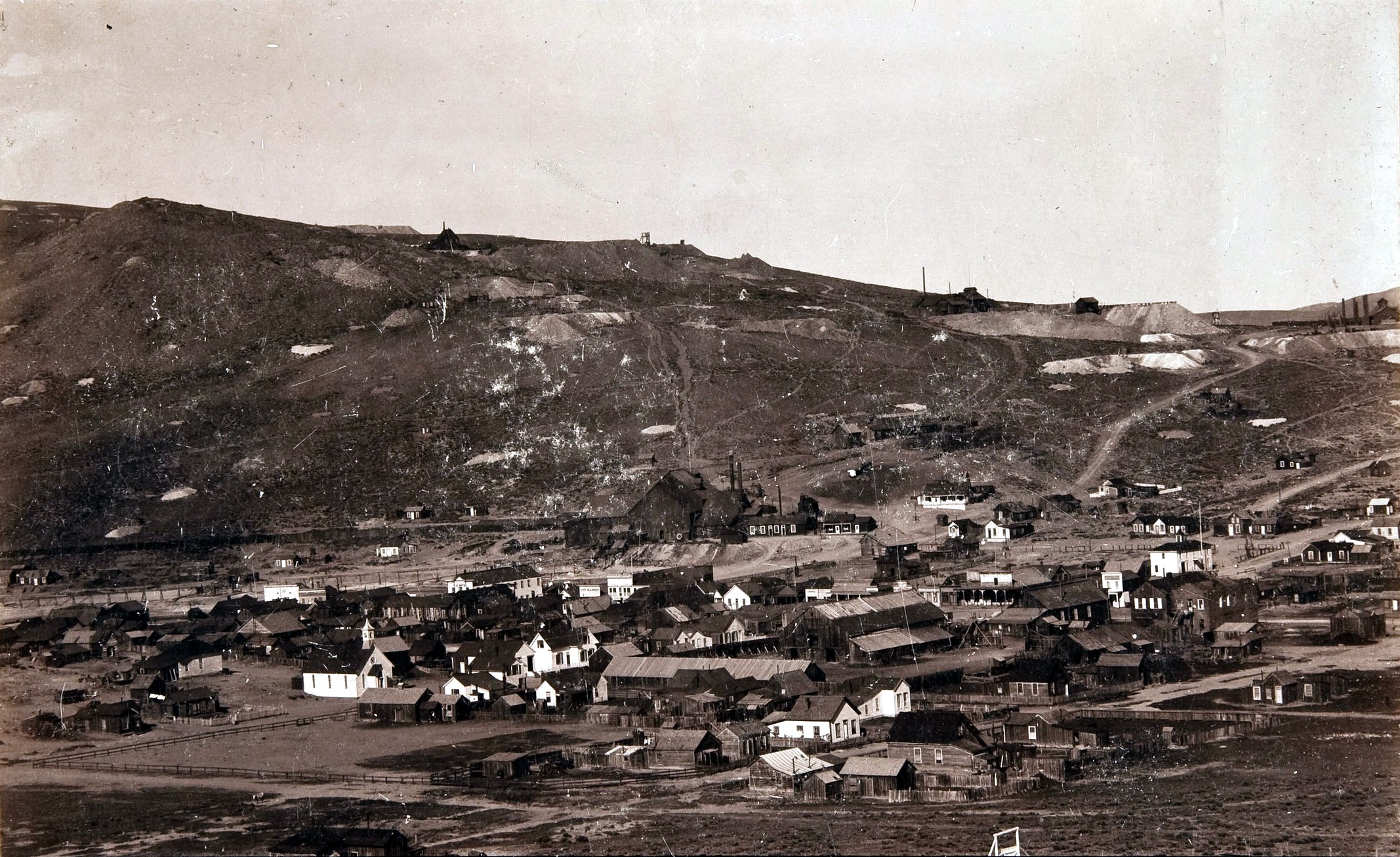
In 1876, the Standard Company discovered a profitable deposit of gold-bearing ore, which transformed Bodie from an isolated mining camp comprising a few prospectors and company employees to a Wild West boomtown. Rich discoveries in the adjacent Bodie Mine during 1878 attracted even more hopeful people. By 1879, Bodie had a population of approximately 7,000–10,000 people and around 2,000 buildings. One legend says that in 1880, Bodie was California's second or third largest city, but the U.S. Census of that year disproves this. Over the years 1860–1941 Bodie's mines produced gold and silver valued at an estimated (in 1986 dollars, or $85 million in 2021).
Bodie boomed from late 1877 through mid to late 1880. The first newspaper, The Standard Pioneer Journal of Mono County, published its first edition on October 10, 1877. Starting as a weekly, it soon expanded publication to three times a week. It was also during this time that a telegraph line was built which connected Bodie with Bridgeport and Genoa, Nevada. California and Nevada newspapers predicted Bodie would become the next Comstock Lode. Men from both states were lured to Bodie by the prospect of another bonanza.
Gold bullion from the town's nine stamp mills was shipped to Carson City, Nevada, by way of Aurora, Wellington, and Gardnerville. Most shipments were accompanied by armed guards. After the bullion reached Carson City, it was delivered to the mint there, or sent by rail to the mint in San Francisco.
Districts and amenities

As a bustling gold mining center, Bodie had the amenities of larger towns, including a Wells Fargo Bank, four volunteer fire companies, a brass band, railroad, miners' and mechanics' union, several daily newspapers, and a jail. At its peak, 65 saloons lined Main Street, which was a mile long. Murders, shootouts, barroom brawls, and stagecoach holdups were regular occurrences.
As with other remote mining towns, Bodie had a popular, though clandestine, red light district on the north end of town. There is an unsubstantiated story of Rosa May, a prostitute who, in the style of Florence Nightingale, came to the aid of the town menfolk when a serious epidemic struck the town at the height of its boom. She is credited with giving life-saving care to many, but after she died she was buried outside the cemetery fence.
Bodie had a Chinatown, the main street of which ran at a right angle to Bodie's Main Street. At one point it had several hundred Chinese residents and a Taoist temple. Opium dens were plentiful in this area.
Bodie also had a cemetery on the outskirts of town and a nearby mortuary. It is the only building in the town built of red brick three courses thick, most likely for insulation to keep the air temperature steady during the cold winters and hot summers. The cemetery includes a Miners Union section, and a cenotaph erected to honor President James A. Garfield. The Bodie Boot Hill was located outside of the official city cemetery.
On Main Street stands the Miners Union Hall, which was the meeting place for labor unions. It also served as an entertainment center that hosted dances, concerts, plays, and school recitals. It now serves as a museum.
Mining town

The first signs of decline appeared in 1880 and became obvious toward the end of the year. Promising mining booms in Butte, Montana; Tombstone, Arizona; and Utah lured men away from Bodie. Also in 1881, a narrow-gauge railroad was built called the Bodie Railway & Lumber Company, bringing lumber, cordwood, and mine timbers to the mining district from Mono Mills south of Mono Lake.
During the early 1890s, Bodie enjoyed a short revival from technological advancements in the mines that continued to support the town. In 1890, the recently invented cyanide process promised to recover gold and silver from discarded mill tailings and from low-grade ore bodies that had been passed over. In 1892, the Standard Company built its own hydroelectric plant approximately 13 mi away at Dynamo Pond. The plant developed a maximum of 130 hp and 3,530 volts alternating current (AC) to power the company's 20-stamp mill. This pioneering installation marked the country's first transmissions of electricity over a long distance.
In 1910, the population was recorded at 698 people, which were predominantly families who decided to stay in Bodie instead of moving on to other prosperous strikes.
Decline
The first signs of an official decline occurred in 1912 with the printing of the last Bodie newspaper, The Bodie Miner. In a 1913 book titled California Tourist Guide and Handbook: Authentic Description of Routes of Travel and Points of Interest in California, the authors, Wells and Aubrey Drury, described Bodie as a "mining town, which is the center of a large mineral region". They referred to two hotels and a railroad operating there. In 1913, the Standard Consolidated Mine closed.
Mining profits in 1914 were at a low of $6,821 (~$ in ). James S. Cain bought everything from the town lots to the mining claims, and reopened the Standard mill to former employees, which resulted in an over $100,000 profit in 1915. However, this financial growth was not in time to stop the town's decline. In 1917, the Bodie Railway was abandoned and its iron tracks were scrapped.
The last mine closed in 1942, due to War Production Board order L-208, shutting down all non-essential gold mines in the United States during World War II. Mining never resumed after the war.
Bodie was first described as a "ghost town" in 1915. In a time when auto travel was on the rise, many travelers reached Bodie via automobiles. The San Francisco Chronicle published an article in 1919 to dispute the "ghost town" label.
By 1920, Bodie's population was recorded by the US Federal Census at a total of 120 people. Despite the decline and a severe fire in the business district in 1932, Bodie had permanent residents through nearly half of the 20th century. A post office operated at Bodie from 1877 to 1942.
Ghost town and park
In the 1940s, the threat of vandalism faced the ghost town. The Cain family, who owned much of the land, hired caretakers to protect and to maintain the town's structures. Martin Gianettoni, one of the last three people living in Bodie in 1943, was a caretaker.

Bodie is now an authentic Wild West ghost town.
The town was designated a National Historic Landmark in 1961, and in 1962 the state legislature authorized creation of Bodie State Historic Park. A total of 170 buildings remained. Bodie has been named as California's official state gold rush ghost town.
Visitors arrive mainly via SR 270, which runs from US 395 near Bridgeport to the west; the last three miles of it is a dirt road. There is also a road to SR 167 near Mono Lake in the south, but this road is extremely rough, with more than 10 miles of dirt track in a bad state of repair. Due to heavy snowfall, the roads to Bodie are usually closed in winter.

Today, Bodie is preserved in a state of arrested decay. Only a small part of the town survived, with about 110 structures still standing, including one of many once operational gold mills. Visitors can walk the deserted streets of a town that once was a bustling area of activity. Interiors remain as they were left and stocked with goods. Littered throughout the park, one can find small shards of china dishes, square nails, and an occasional bottle, but removing these items is illegal.
The California State Parks' ranger station is located in one of the original homes on Green Street.
In 2009 and again in 2010, Bodie was scheduled to be closed. The California state legislature worked out a budget compromise that enabled the state's Parks Closure Commission to keep it open. As of 2024, the park is still operating, now administered by the Bodie Foundation.
Climate

Bodie is a rare example of the dry-summer subarctic climate (Köppen climate classification Dsc), with hot to freezing summers and long, snowy winters, and is part of USDA Plant Hardiness Zone 5. Winds can sweep across the valley at close to 100 mph. Nights remain cold even through the summer, often dropping well below freezing throughout the year.
With an average of 303 nights below freezing per year, Bodie rivals Utqiagvik, Alaska's 315, and no month has ever been completely frost-free. The fewest nights below freezing in a month was two, the exceptionally warm August 1967, whose mean minimum of 38.8 F was the highest during the twentieth century, although July 1896 had a mean minimum of 41.4 F. Bodie's actual highest minimum on record is 60 F on August 1, 1968; however, on average only two nights per year stay above 50 F, and minima that high have never occurred between September 14 and June 4.
The longest frost-free period is a mere thirty days from July 20 to August 18, 1901, but to illustrate the vast diurnal temperature range, Bodie had as many as 98 consecutive maxima at or above 68 F between June 9 and September 14, 2007 – which included the record hot July 2007 with mean maximum 82.1 F.
The harsh weather is due to a particular combination of high altitude (8400 ft) and a very exposed plateau, with little in the way of a natural surrounding wall to protect the long, flat piece of land from the elements. Plenty of firewood was needed to keep residents warm through the long winters. Bodie is not located in a forest, so lumber had to be imported from Bridgeport, Benton, Carson City, or Mono Mills. The winter of 1878–79 was particularly harsh and deadly. On average, there are 22.7 days with 80 °F+ highs, 19.6 days where the high fails to rise above freezing, and 35 nights with sub-0 °F lows. The record high temperature of 91 F was set on July 21, 1988, while the record low of −36 F was set on February 13, 1903, which also saw the lowest maximum temperature of −4 F.
Average annual precipitation is 11.79 in, with August on average being the driest month and January the wettest. There are an average of 60 days annually with measurable precipitation. The wettest "rain year" was from July 1968 to June 1969 with 22.18 in and the driest was from July 1999 to June 2000 with 6.24 in. The most precipitation in one month was 7.39 in in January 1901, and the most in 24 hours 4.57 in on February 12, 1895. Average annual snowfall is 93.2 in. The snowiest year was 1965 with 269 in. The most snow in one month was 97.1 in in January 1969.
|Jan record high F = 61 |Feb record high F = 63 |Mar record high F = 68 |Apr record high F = 77 |May record high F = 82 |Jun record high F = 90 |Jul record high F = 91 |Aug record high F = 89 |Sep record high F = 88 |Oct record high F = 81 |Nov record high F = 71 |Dec record high F = 64 |year record high F= 91 |Jan record low F = −27 |Feb record low F = −36 |Mar record low F = −22 |Apr record low F = −13 |May record low F = -4 |Jun record low F = 2 |Jul record low F = 12 |Aug record low F = 12 |Sep record low F = 1 |Oct record low F = -13 |Nov record low F = −25 |Dec record low F = −31 |year record low F= −36 | Jan avg record high F = 53.0 | Feb avg record high F = 53.4 | Mar avg record high F = 58.3 | Apr avg record high F = 66.4 | May avg record high F = 73.9 | Jun avg record high F = 81.2 | Jul avg record high F = 85.1 | Aug avg record high F = 83.6 | Sep avg record high F = 79.9 | Oct avg record high F = 72.9 | Nov avg record high F = 64.3 | Dec avg record high F = 54.0 |year avg record high F = 86.0 | Jan avg record low F = -15.0 | Feb avg record low F = -12.6 | Mar avg record low F = -7.8 | Apr avg record low F = 2.9 | May avg record low F = 10.5 | Jun avg record low F = 15.6 | Jul avg record low F = 22.5 | Aug avg record low F = 20.5 | Sep avg record low F = 14.0 | Oct avg record low F = 2.9 | Nov avg record low F = -7.7 | Dec avg record low F = -14.1 |year avg record low F = -19.8 | Jan snow depth inch = 21 | Feb snow depth inch = 25 | Mar snow depth inch = 28 | Apr snow depth inch = 16 | May snow depth inch = 5 | Jun snow depth inch = 0 | Jul snow depth inch = 0 | Aug snow depth inch = 0 | Sep snow depth inch = 0 | Oct snow depth inch = 2 | Nov snow depth inch = 7 | Dec snow depth inch = 14 | year snow depth inch =
In fiction
- Bodie was the setting for the young reader's novel Behind the Masks, by Susan Patron.
- Kathleen Haun's historical novel No Trees for Shade (2013) is set in Bodie in 1880.
- Key incidents in Chapter One of James Rollins' tenth Sigma Force novel, The Sixth Extinction (2014), span nearby Mono Lake, the secret military testing site neighboring Bodie Park, and the ghost town itself, where terrorists attack a National Park Service Ranger and details unfold about both the area's significance to the rest of the plot.
- Bodie is the setting for the Kristiana Gregory book Orphan Runaways (1998).
References
Bibliography
References
- "Mono County, California". US Census Bureau.
- {{GNIS. 1658094
- {{NRISref. 2008a
- "Bodie Historic District". National Park Service.
- {{California's Geographic Names
- "Bodie SHP".
- {{cite ohp. 341. Bodie. 2012-10-10
- DeLyser, Dydia. (December 1999). "Authenticity on the Ground: Engaging the Past in a California Ghost Town". Association of American Geographers.
- "Bodie State Historic Park". California State Parks.
- Quivik, Fredric L.. (2003). "Gold and Tailings: The Standard Mill at Bodie, California". [[IA, The Journal of the Society for Industrial Archeology]].
- Piatt, Michael H.. (2003). "Bodie: "The Mines Are Looking Well..."". North Bay Books.
- McClinton, J.G. (October 29, 1879). "Cold History Condensed". Daily Bodie Standard.
- Loose, Warren. (1971). "Bodie Bonanza: The True Story of a Flamboyant Past". Exposition Press.
- Federal Writers' Project. (1941). "Origin of Place Names: Nevada". W.P.A..
- Jimenez, Corri Lyn. (2000). "Bodie, California: Understanding the Architecture and Built Environment of a Gold Mining Town". University of Oregon.
- Piatt, Michael H.. "What the Historic Record Reveals About Bodie's Peak Population".
- "California State Park employment flyer".
- "1880 California census".
- Smith, H.L.. (1933). "The Bodie Era: The Chronicles of the Last Old Time Mining Camp.". California State Library.
- Cain, Ella M.. (1956). "The Story of Bodie". Fearon Publishers.
- Smith, Grant H.. (1943). "History of the Comstock Lode, 1850–1920". University of Nevada.
- (January 24, 1878). "Bodie has taken from us some good men, and that is not good for us". Virginia City Territorial Enterprise.
- McGrath, Roger D.. (1987). "Gunfights, Highwaymen & Vigilantes: Violence on the Frontier". University of California Press.
- (October 18, 2014). "Miners Union Cemetery". Bodie.com.
- [http://www.hauntedhouses.com/states/ca/local-archive-california/_bodie-Cemetery-of-the-Week.pdf Wards Cemetery], Loren Rhoads
- DeCloedt, Lonnie. "Rosa May". Weekly Pioneer.
- (1986). "Geology and Ore Deposits of the Bodie Mining District, Mono County, California". California Department of Conservation/Division of Mines and Geology.
- (March 13, 2008). "Dynamo Pond Project". Bureau of Land Management.
- Moffat, Riley. (1996). "Population History of Western U.S. Cities and Towns, 1850–1990". Scarecrow Press, Inc..
- Drury, Wells. (1913). "California tourist guide and handbook: authentic description of routes of travel and points of interest in California". Western guidebook company.
- Billeb, Emil W.. (1968). "Mining camp days: Bodie, Aurora, Bridgeport, Hawthorne, Tonopah, Lundy, Masonic, Benton, Thorne, Mono Mills, Mammoth, Sodaville, Goldfield". Howell-North Books.
- Van Loan, Charles. (September 21, 1915). "Ghost cities of the West: Bad B-a-d Bodie". Saturday Evening Post.
- (January 28, 1919). "Bodie Not Dead, Says Camp Representative". San Francisco Chronicle.
- Finnegan, Lora J.. (September 1993). "Bodie: Even a ghost needs friends". Sunset.
- Watson, James. (2002). "Big Bad Bodie". Robert D. Reed.
- "California Codes (420–429.8)". California State Legislature.
- (August 12, 2022). "Bodie Ghost Town". Haunted US.
- "Helping to preserve Bodie State Historic Park". Bodie Foundation.
- "Bridgeport, CA hardiness zone". Arbor Day Foundation.
- "Bodie, California – Climate Summary".
- National Weather Service Corporate Image Web Team. "National Weather Service – Reno, NV". noaa.gov.
- Sprague, M.. (2003). "Bodie's gold: tall tales and true history from a California mining town". [[University of Nevada Press]].
- {{Ghost Towns of Northern California. 135
- "Bodie, California – Climate Summary". Western Regional Climate Center.
- Mean monthly maxima and minima (i.e. the highest and lowest temperature readings during an entire month or year) calculated based on data at said location from 1991 to 2020.
- "NOWData – NOAA Online Weather Data". [[National Oceanic and Atmospheric Administration]].
- Patron, Susan. (2012). "Behind the Masks: the Diary of Angeline Reddy". Scholastic.
- Haun, Kathleen. (2013). "No Trees for Shade: Bodie, California, 1880". Aventine Press.
- Rogers, Amy. (August 12, 2014). "New release book review: The Sixth Extinction (Sigma Force) by James Rollins".
- Gregory, Kristin. (1998). "Orphan Runaways". Scholastic.
This article was imported from Wikipedia and is available under the Creative Commons Attribution-ShareAlike 4.0 License. Content has been adapted to SurfDoc format. Original contributors can be found on the article history page.
Ask Mako anything about Bodie, California — get instant answers, deeper analysis, and related topics.
Research with MakoFree with your Surf account
Create a free account to save articles, ask Mako questions, and organize your research.
Sign up freeThis content may have been generated or modified by AI. CloudSurf Software LLC is not responsible for the accuracy, completeness, or reliability of AI-generated content. Always verify important information from primary sources.
Report