From Surf Wiki (app.surf) — the open knowledge base
Bo Diddley beat
Musical rhythm popularized by Bo Diddley
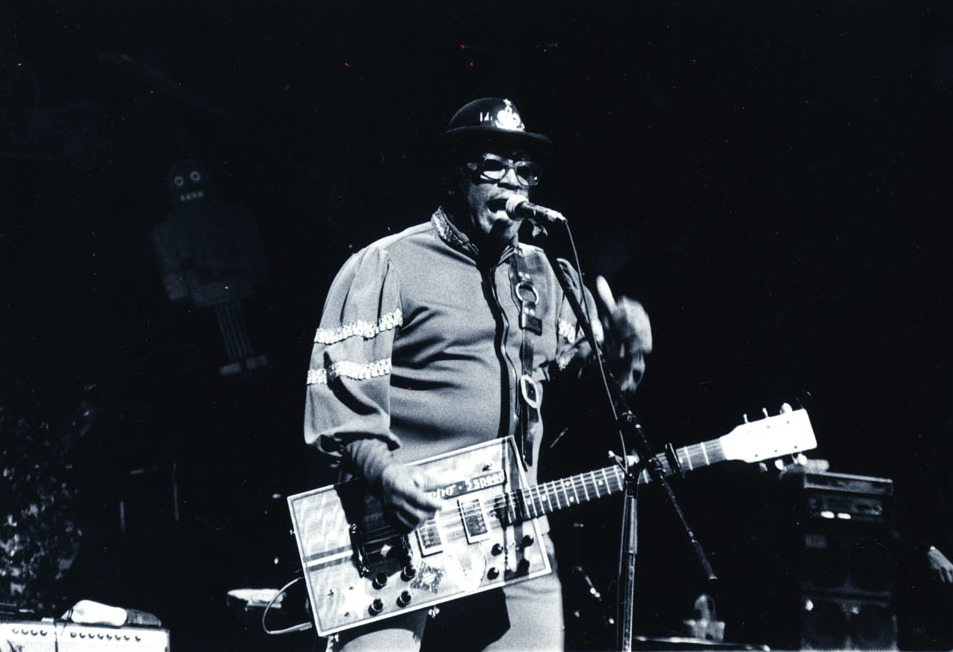
Musical rhythm popularized by Bo Diddley
The Bo Diddley beat is a syncopated musical rhythm that is widely used in rock and roll and pop music. The beat is named after rhythm and blues musician Bo Diddley, who introduced and popularized the beat with his self-titled debut single, "Bo Diddley", in 1955. The beat is essentially the Afro-Cuban clave rhythm or based on the clave or a variation thereof.
Music educator and author Mike Campbell explains that it "shows the relationship between Afro-Cuban music, Americanized Latin rhythms, and rock rhythm... [The beats] are more active and complicated than a simple rock rhythm, but less complex than a real Afro-Cuban rhythm.
History and composition

The Bo Diddley beat is a variation of the 3-2 clave, one of the most common bell patterns found in Afro-Cuban music that has been traced to sub-Saharan African music traditions. It is also akin to the rhythmic pattern known as "shave and a haircut, two bits", that has been linked to Yoruba drumming from West Africa. A folk tradition called "hambone", a style used by street performers who play out the beat by slapping and patting their arms, legs, chest, and cheeks while chanting rhymes has also been suggested.
According to musician and author Ned Sublette, "In the context of the time, and especially those maracas [heard on the record], 'Bo Diddley' has to be understood as a Latin-tinged record. A rejected cut recorded at the same session was titled only 'Rhumba' on the track sheets." Bo Diddley employed maracas, a percussion instrument used in Caribbean and Latin music, as a basic component of the sound. Jerome Green was the maraca player on Diddley's early records, initially using the instrument as a more portable alternative to a drum set. When asked how he began to use this rhythm, Bo Diddley gave many different accounts. In a 2005 interview with Rolling Stone magazine, he said that he came up with the beat after listening to gospel music in church when he was twelve years old.
Use by other artists
Prior to Bo Diddley's self-titled song, the rhythm occurred in at least 13 rhythm and blues songs recorded between 1944 and 1955, including two by Johnny Otis from 1948. In 1944, "Rum and Coca Cola", containing the beat, was recorded by the Andrews Sisters and in 1952, a song with similar syncopation, "Hambone", was recorded by Red Saunders' Orchestra with the Hambone Kids.
Later, the beat was included in many songs composed by artists other than Bo Diddley:
- "I Wish You Would" by Billy Boy Arnold (1955)
- "Not Fade Away" by Buddy Holly (1957)
- "Cannonball" by Duane Eddy (1958)
- "Willie and the Hand Jive" by Johnny Otis (1958)
- "Hey Little Girl" by Dee Clark (1959)
- "(Marie's the Name) His Latest Flame" by Elvis Presley (1961)
- "Mickey's Monkey" by the Miracles (1963)
- "When the Lovelight Starts Shining Through His Eyes" by the Supremes (1963)
- "Rosalyn" by Pretty Things (1964)
- "Don't Doubt Yourself, Babe" by the Byrds (1965)
- "Mystic Eyes" by Them (1965)
- "I Want Candy" by the Strangeloves (1965)
- "Please Go Home" by the Rolling Stones (1966)
- "Bummer in the Summer" by Love (1967)
- "Get Me to the World on Time" by the Electric Prunes (1967)
- "She Has Funny Cars" by Jefferson Airplane (1967)
- "Magic Bus" by the Who (1968)
- "1969" by the Stooges
- "Panic in Detroit" by David Bowie (1973)
- "Shame, Shame, Shame" by Shirley & Company (1974)
- "Custard Pie" by Led Zeppelin (1975)
- "New York Groove" by Hello (1975)
- "Billy Bones and the White Bird" by Elton John (1975)
- "She's the One" by Bruce Springsteen (1975)
- "Bad Blood" by Neil Sedaka (1975)
- "American Girl" by Tom Petty and the Heartbreakers (1977)
- "Big Alice" by Don Pullen (1977)
- "Hateful" by the Clash (1979)
- "Rudie Can't Fail" by The Clash (1979)
- "(She's So) Selfish" by the Knack (1979)
- "Lovers Walk" by Elvis Costello and the Attractions (1980)
- "Cuban Slide" by the Pretenders (1980)
- "What A Blow" by Ian Gomm (1980)
- "Europa and the Pirate Twins" by Thomas Dolby (1981)
- "Don't Let Him Go" by REO Speedwagon (1981)
- "Hare Krsna" by Hüsker Dü (1984)
- "How Soon Is Now?" by the Smiths (1985) (Diddley-style tremolo)
- "Mr. Brownstone" by Guns N' Roses (1987)
- "Faith" by George Michael (1987)
- "Ruby Dear" by Talking Heads (1988) {{Cite news|url = https://www.nytimes.com/1988/03/20/arts/recordings-talking-heads-confronts-the-modern-world.html|title = RECORDINGS; Talking Heads Confronts the Modern World |author-link = Jon Pareles |access-date = December 15, 2022}}
- "Desire" by U2 (1988)
- "Movin' On Up" by Primal Scream (1991)
- "Osez Joséphine" by Alain Bashung (1991)
- "Tribal Thunder" by Dick Dale and the Del-Tones (1993)
- "No One to Run With" by the Allman Brothers Band (1994)
- "Party at the Leper Colony" by "Weird Al" Yankovic (2003)
- "That Big 5-0" by Stan Ridgway (2004)
- "Black Horse and the Cherry Tree" by KT Tunstall (2005)
- "If It's Lovin' that You Want" by Rihanna (2005)
- "At the Bottom of the Ocean" by Ezra Furman (2013)
- "Water Fountain" by Tune-Yards (2014)
- "Fool For Love" by Lord Huron (2015)
- "Bluey Theme Tune" by Joff Bush (2018)
References
References
- Brown, Jonathan. (June 3, 2008). "Bo Diddley, Guitarist Who Inspired the Beatles and the Stones, Dies Aged 79".
- "Bo Diddley".
- (2001). "Bo Diddley".
- Thomakos, John. (2010). "The Drum Set Styles Encyclopedia". [[Mel Bay Publications]].
- (2020). "Music Around the World: A Global Encyclopedia". [[ABC-CLIO]].
- Roscetti, Ed. (2008). "Stuff! Good Drummers Should Know: An A to Z Guide to Getting Better". [[Hal Leonard]].
- Horne, Greg. (2000). "Intermediate Acoustic Guitar". [[Alfred Publishing]].
- Campbell, Michael. (2009). "Popular Music in America: And the Beat Goes On". [[Cengage]] Learning.
- Peñalosa, David. (2010). "The Clave Matrix; Afro-Cuban Rhythm: Its Principles and African Origins". Bembe Books.
- McDonald, Sam. (September 7, 2005). "CHUNKA{{snd}}CHUNKA{{snd}}CHUNK A{{snd}}CHUNK–CHUNK".
- Roscetti, Ed. (2008). "Stuff! Good Drummers Should Know". [[Hal Leonard]].
- Sublette, Ned. (2007). "The Kingsmen and the Cha-Cha-Chá.". [[Duke University Press]].
- Strauss, Neil. (August 25, 2005). "The Indestructible Beat of Bo Diddley".
- Tamlyn, Garry Neville. "''The Big Beat'': Origins and Development of Snare Backbeat and other Accompanimental Rhythms in Rock'n'Roll". [[University of Liverpool]].
- Hicks, Michael. (2000). "Sixties Rock". University of Illinois Press.
- Rosen, Steven. (March 16, 2011). "Behind the Song: 'Not Fade Away'".
- Dean, Bill. (June 2, 2008). "Rock Pioneer Bo Diddley Dies".
- Kot, Greg. (June 2, 2008). "Bo Diddley Dead at 79".
- Ratliff, Ben. (June 3, 2008). "Bo Diddley: The Beat That Will Go On".
- Aquila, Richard. (2016). "Let's Rock!: How 1950s America Created Elvis and the Rock and Roll Craze". [[Rowman & Littlefield]].
- Unterberger, Richie. "The Rolling Stones: ''Flowers'' – Review".
- Fremer, Michael. (December 26, 2021). "Love's 'Forever Changes' Finally Gets Long Deserved First Class Vinyl Reissue".
- Greenwald, Matthew. "Jefferson Airplane: 'She Has Funny Cars' – Review".
- (23 February 2024). "Led Zeppelin: Making of Physical Graffiti".
- Barton, Geoff. (September 24, 2016). "The Story Behind The Song: Ace Frehley's New York Groove – Classic Rock".
- Planer, Lindsay. "Elton John: ''Rock of the Westies'' – Review".
- Cioe, C.. (1979). "Be Hip, Get the Knack". [[High Fidelity (magazine).
- "Trust - Elvis Costello & the Attractions, Elvis Costello".
- Smith, Patrick. (2011-12-02). "Two new Hüsker Dü books as complicated and difficult as the band itself".
- Harris, John. (2010). "Hail! Hail! Rock'n'Roll: The Ultimate Guide to the Music, the Myths and the Madness". [[Hachette (publisher).
- Swanson, Dave. (24 September 2016). "When Primal Scream Created Their Own World With "Screamadelica"".
- Eder, Bruce. "Allman Brothers Band: "Where It All Begins" – Review".
- Cunnigham, Jen. "10 Times 'Weird Al' Parodied Pre-1980s Hits (And Was Awesome): 10) 'Party at the Leper Colony' (2003)".
- Allen, Jim. (February 1, 2022). "Tracing the Bo Diddley Beat".
- Jack, Malcolm. (February 13, 2014). "Ezra Furman – Review".
- Hann, Michael. (March 18, 2014). "Tune-Yards Comes Back with Water Fountain".
- Block, Melissa. (6 April 2015). "Lord Huron Wants You to Dance at the Apocalypse".
- (2023-04-23). "'Bluey' Composer Reveals Secret To That Catchy AF Theme Song".
This article was imported from Wikipedia and is available under the Creative Commons Attribution-ShareAlike 4.0 License. Content has been adapted to SurfDoc format. Original contributors can be found on the article history page.
Ask Mako anything about Bo Diddley beat — get instant answers, deeper analysis, and related topics.
Research with MakoFree with your Surf account
Create a free account to save articles, ask Mako questions, and organize your research.
Sign up freeThis content may have been generated or modified by AI. CloudSurf Software LLC is not responsible for the accuracy, completeness, or reliability of AI-generated content. Always verify important information from primary sources.
Report