From Surf Wiki (app.surf) — the open knowledge base
BMW VI
Aircraft engine family by BMW

Aircraft engine family by BMW
| Field | Value |
|---|---|
| name | BMW VI |
| image | File:BMW VI Berlin 02.jpg |
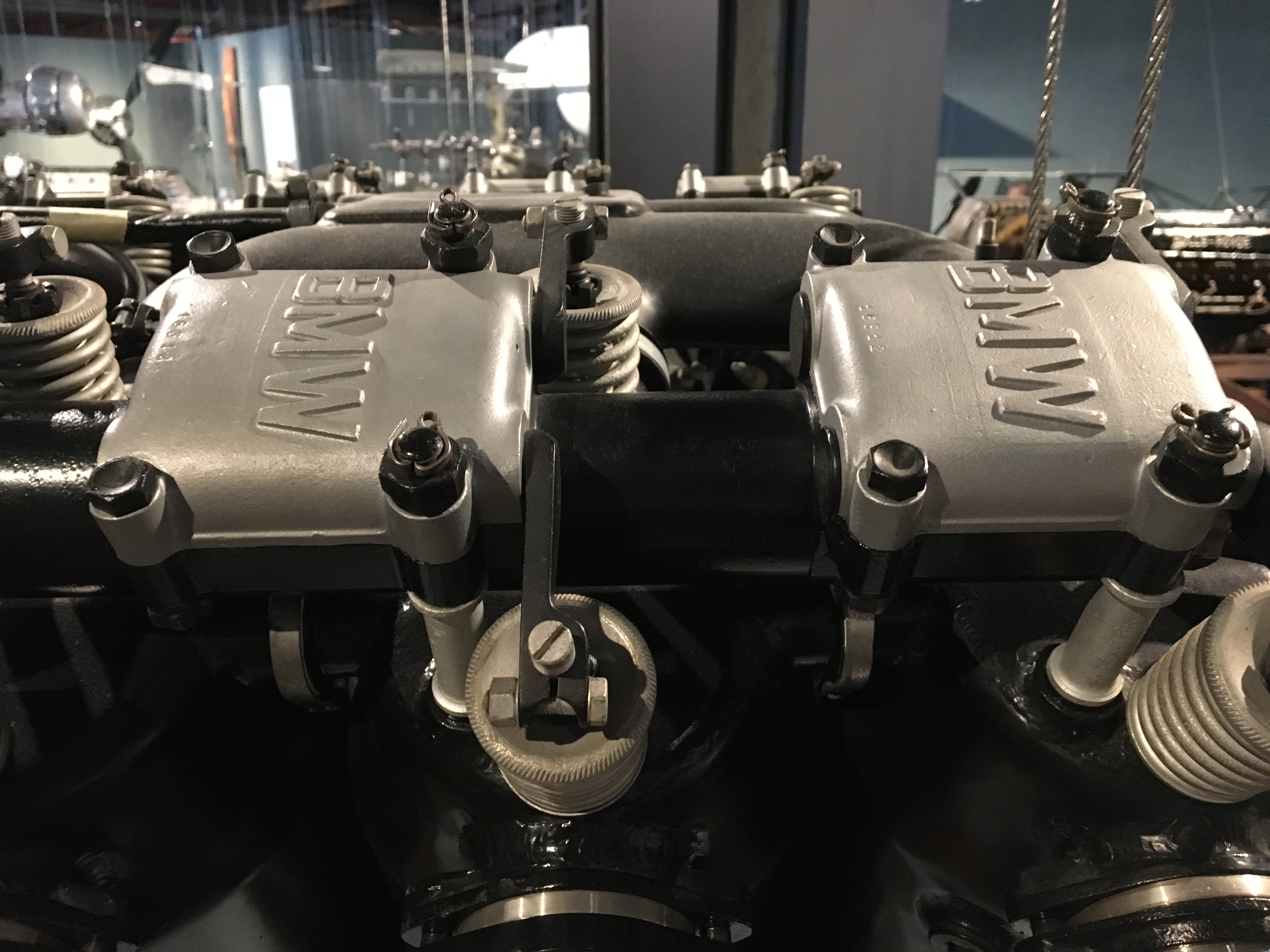
| caption | BMW VI at the Technik-Museum Berlin |
| engine_type | V engine |
| manufacturer | BMW |
| first_run | 1926 |
| major_applications | |
| developed_from | BMW IV |
| developed_into |
The BMW VI was a water-cooled V-12 aircraft engine built in Germany in the 1920s. It was one of the most important German aero engines in the years leading up to World War II, with thousands built. It was further developed as the BMW VII and BMW IX, although these saw considerably less use. It was also produced in the Soviet Union as the M-17 and Japan as the Kawasaki Ha-9.
Design and development
The BMW VI was the first twelve-cylinder engine built by the BMW. It essentially consisted of two cylinder banks from the six-cylinder BMW IV bolted to a common cast aluminium crankcase at a 60-degree included angle between the cylinder banks. Series production commenced in 1926 after type approval had been granted. From 1930 on, after 1000 engines of the BMW VI type had already been delivered, Germany was again permitted to construct military aircraft. The sudden additional demand resulted in the production figures increasing rapidly. In 1933 the BMW VI was used for BMW's first experiments with direct fuel injection.
The BMW VI was the chosen source of power for numerous record-breaking and long-distance flights, including an east-to-west crossing of the Atlantic in 1930 and a round-the world flight in 1932, both by Wolfgang von Gronau in an open Dornier Wal flying boat powered by two BMW VI engines.
The BMW VI was put to unusual use as a power unit for the "Rail Zeppelin" high-speed railcar. Many versions of the BMW VI engine were developed, and it was built under license in Japan and the Soviet Union. This was further evidence of the reliability of an engine with which BMW made a fundamental contribution to the build-up of German air transport. At least 9,200 were built between 1926 and 1938. The engine was license-built in the Soviet Union under the supervision of Mikulin, who then further developed it as the M-17. More license built engines were produced by Kawasaki Heavy Industries in Japan as the Kawasaki Ha9 (long designation:- Army Type 98 850hp Liquid Cooled In-line).
Variants
5.5, 6 or 7.3 denotes compression ratio. No additional letter denotes BMW carburetor and direct-drive propeller (7.3), u denotes a propeller reduction gear (7.3u), z denotes Zenith carburetor (7.3z), zu denotes Zenith carburetor and propeller reduction gear (7.3zu).

;BMW VI 5.5 : Compression ratio 5.5:1, 600-650 PS at up to 1600 rpm at sea level ;BMW VI 6.0 : Compression ratio 6:1, 630-660 PS at up to 1650 rpm at sea level, 80 Octane fuel ;BMW VI 7.3 : Compression ratio 7.3:1 680-750 PS at up to 1700 rpm at sea level, 87 Octane fuel ;Mikulin M-17: Licence production in the USSR
;Kawasaki Ha9: (long designation:- Army Type 98 850hp Liquid Cooled In-line) licence production in Japan by Kawasaki
Applications
- Albatros L 77v
- Arado Ar 64
- Arado Ar 65
- Arado Ar 68
- Arado SSD I
- Brutus (car)
- Dornier Do 10
- Dornier Do 14
- Dornier Do 17
- Focke-Wulf Fw 42
- Heinkel He 45
- Heinkel He 51
- Heinkel He 59
- Heinkel He 60
- Heinkel He 70
- Heinkel He 111 prototype and civilian versions
- Junkers F.24ko
- Kawasaki Type 92
- Kawasaki Ki-10
- Messerschmitt M.20
- Polikarpov R-5 prototype
- Schienenzeppelin
- Tupolev TB-3
Specifications (BMW VI 7.3z)

and start a new, fully formatted line with --
:*750 PS for takeoff at 1,700 rpm (1 minute) at sea level :*690 PS at 1,650 rpm (5 minutes) at sea level :*620 PS at 1,590 rpm (30 minutes) at sea level :*550 PS at 1,530 rpm (max. duration) at sea level
:*0.23 kg/PSh at 1,590 rpm :*0.225 kg/PSh at 1,530 rpm |power/weight=1.47 PS/kg
- B.M.E.P.: 6.9 atm
References
References
- Schneider, Helmut (Dipl.Ing.). (1944). "Flugzeug-Typenbuch. Handbuch der deutschen Luftfahrt- und Zubehör-Industrie 1944". Herm. Beyer Verlag.
This article was imported from Wikipedia and is available under the Creative Commons Attribution-ShareAlike 4.0 License. Content has been adapted to SurfDoc format. Original contributors can be found on the article history page.
Ask Mako anything about BMW VI — get instant answers, deeper analysis, and related topics.
Research with MakoFree with your Surf account
Create a free account to save articles, ask Mako questions, and organize your research.
Sign up freeThis content may have been generated or modified by AI. CloudSurf Software LLC is not responsible for the accuracy, completeness, or reliability of AI-generated content. Always verify important information from primary sources.
Report