From Surf Wiki (app.surf) — the open knowledge base
BMW M3
High-performance version of the BMW 3 Series automobile
_(cropped).jpg)
High-performance version of the BMW 3 Series automobile
| Field | Value |
|---|---|
| name | BMW M3 |
| image | BMW M3 Competition (G80) IMG 4041.jpg |
| caption | 2021 BMW M3 Competition (G80) |
| manufacturer | BMW M |
| production | {{unbulleted list |
| class | Compact executive car (D) |
| layout | {{unbulleted list |
| related | {{unbulleted list |
| 1986–2018 | 2020–present | Front-engine, rear-wheel-drive | Front-engine, all-wheel-drive (2021–present) | BMW 3 Series | BMW M4
The BMW M3 is a high-performance version of the BMW 3 Series, developed by BMW's in-house motorsport division, BMW M GmbH. M3 models have been produced for every generation of 3 Series since the E30 M3 was introduced in 1986.
The initial model was available in a coupé body style, with a convertible body style made available soon after. M3 saloons were offered initially during the E36 (1994–1999) and E90 (2008–2012) generations. Since 2014, the coupé and convertible models have been rebranded as the 4 Series range, making the high-performance variant the M4. Variants of the 3 Series since then have seen the M3 produced as a saloon, until 2020, when the M3 was produced as an estate (Touring) for the first time, alongside the saloon variant.
E30 generation (1986–1991) {{anchor|E30}}
The first BMW M3 was based on the E30 3 Series and was intended to be a homologation special to satisfy the Deutsche Tourenwagen Meisterschaft and Group A Touring rules, which required a total of 5,000 of the base model to be built with a further 500 evolution specials. It was presented to the public at the 1985 Frankfurt Motor Show, and began production from March 1986 to June 1991. The E30 M3 was mainly produced in the coupé body style, but limited volumes of convertibles were also produced.
The front splitter, the rear apron, sill panels, as well as changes to the body in the area of the rear window (C-pillar) and the bootlid improved the aerodynamics. For aerodynamic reasons, the rear window was flattened and the tailgate was made of light, glass-reinforced plastic raised by approximately 40 mm for better air flow. The changes over the rear of the car resulted in lower lift forces and better straight-line stability. In addition, the windscreen was glued in – not, as with the other E30 models, framed with a window rubber and piping. As a result, the M3 achieved a relatively low instead of as in the standard 3 Series. The only exterior body panels the regular 3 Series and the M3 shared were the bonnet, roof panel, and sunroof.
The brake calipers, discs and master cylinder were unique to the M3 model.
The transmission was a Getrag 265 5-speed manual. European models were outfitted with a dogleg version with close ratios and a 1:1 ratio for fifth gear. North American models used a traditional shift pattern and had wider gear spacing with an overdriven fifth gear. A clutch-type limited-slip differential was standard equipment.
In 2004, Sports Car International named the E30 M3 number six on the list of Top Sports Cars of the 1980s. In 2007, Automobile Magazine included the E30 M3 in their "5 greatest drivers cars of all time" under their 25 Greatest Cars of All Time.
File:BMW M3 (E30) IMG 4388.jpg|Coupé File:BMW M3 Cabrio 1991 purble vl TCE.jpg|Convertible File:P9163398 (1392205533).jpg|E30 M3 interior
Engine
The E30 M3 used the BMW S14 four-cylinder engine, a high-revving DOHC design with a head closely based on that of the BMW S38 six-cylinder engine and the block from the BMW M10 four-cylinder engine with a 7,250 rpm redline. In countries where the M3 was sold with a catalytic converter, the initial versions were rated at 195 PS and had a top speed of 146 mph. In countries where a catalytic converter was not fitted, the engine was rated at 200 PS.
Suspension & Brakes
Differences from the standard E30 models included:
- 5-stud wheel hubs
- 225/45R16 Pirelli P700-Z tyres
- offset control arm bushings in the front suspension, for increased caster angle
- front aluminium control arms introduced in 1989
- revised front strut tubes with bolt on kingpins and swaybar mounted to strut tube, similar to the E28 5 Series
- front wheel bearings and brake caliper bolt spacing from the E28 5 Series
- 280mm x 25mm vented front & 282mm x 12mm solid rear discs
- brake calipers similar to the E28 5 series
Special Editions
Evolution 1
In 1987 an "Evolution" model (also called "EVO1") was released. Although not designated by BMW as an Evolution model, these had a revised cylinder head (designated by an "E" stamp) to improve performance. Power was unchanged from the standard M3. Visually, these were unchanged from the standard E30 M3. In total, 505 were built between March and May 1987. To celebrate the M3’s victory at the 1987 Tour de Corse (round five of that year's World Rally Championship), BMW France commissioned a batch of 50 Evolution 1 special editions.
Evolution 2
To keep the M3 competitive for the 1988 season, the Evolution 2 was released. 501 examples were built between March and May 1988, it featured a revised camshaft, pistons and an increased compression ratio from 10.5:1 to 11.0:1. There was also a more efficient air intake and a lightened flywheel. Visually the Evolution 2 featured a BMW Motorsport tricolour camshaft and intake plenum cover. Power increased to 162 kW at 6750 rpm and 245 Nm at 4750 rpm. For the Evolution 2, BMW installed a slightly reduced final drive ratio to provide a higher top speed (3.15:1 instead of 3.25:1).
Visual changes included a deeper front air dam with brake cooling ducts instead of fog lights, while the boot lid featured a rear spoiler complete with a new trailing flap. These assemblies were all made lighter than on previous iterations of the M3. More weight was saved thanks to the installation of thinner side and rear glass.
Sport Evolution
For 1990, a more powerful and lighter "Sport Evolution" model (sometimes referred to as "EVO3") with a limited production run of 600 units, was produced with an upgraded 2467 cc engine rated at 238 PS at 7,000 rpm and 240 Nm at 4,750 rpm. The top speed was increased to 154 mi/h. Sport Evolution models have enlarged front bumper openings and an adjustable multi-position front splitter and rear wing. Brake cooling ducts were installed in place of front foglights.
Ravaglia and Cecotto editions
In April 1989, the Ravaglia and Cecotto limited editions were released, both named after Deutsche Tourenwagen Meisterschaft (DTM) racing drivers. Power was increased to 215 PS with a catalytic converter. Cecotto Edition production consisted of 480 cars, plus 80 cars for the Swiss market de-tuned to 211 PS to meet Swiss emissions limits. The production run for the Ravaglia Edition consisted of 25 cars.
M3 Pickup prototype
In 1986, BMW produced an "M3 Pickup" prototype pickup truck, based on the convertible model. The M3 Pickup used the narrower body of regular E30 models and was originally powered by the 2.0-litre version of the S14 engine from the Italian-specification M3. It was used by BMW M as a transporter for roughly 26 years before it was officially retired in 2012.
Production volumes
Total production of the E30 M3 was 17,970 cars.
| Model | Code | Market | Power | Units |
|---|---|---|---|---|
| Coupé | ||||
| M3 | ||||
| "Evolution" | ||||
| Evolution II | AK01 | Euro spec | 200 PS | |
| 200 PS | ||||
| 220 PS | 4,181 | |||
| 505 | ||||
| 501 | ||||
| M3 Cat. | AK05 | 195 PS | 4,591 | |
| M3 | 215 PS | 1,506 | ||
| M3 Sport Evolution | AK07 | 238 PS | 600 | |
| M3 | AK03 | US spec | 192 hp | 5,300 |
| Cabriolet | ||||
| M3 | BB01 | Euro spec | 200 PS | 136 |
| M3 Cat. | BB05 | 195 PS | 174 | |
| M3 | 215 PS | 476 |
Motorsport
.jpg)
The M3 E30 competed in many forms of motorsport and was highly successful in touring car racing. In full race trim, the 1988 M3's 2.3 L naturally aspirated engine was rated at approximately 221 kW. The E30 M3 won the 24 Hours Nürburgring five times (1989, 1990, 1991, 1992 and 1994) and the Spa 24 Hours four times (1987, 1988, 1990 and 1992), often competing against cars with significantly larger or turbocharged engines.
To keep the car competitive in racing following year-to-year homologation rules changes, homologation specials were produced and sold in limited volumes. These include the Evo 1, Evo 2, and Sport Evolution, with upgrades including weight reduction, improved aerodynamics, taller front wheel arches (to allow 18-inch wheels to be used in DTM racing), bigger brake ducts and more power output from the engine. With the introduction of the 2.5L evolution engine into racing in 1990, power increased to approximately 279 kW.
The M3 also competed as a rally car, with Prodrive-prepared examples contesting several national championships and selected rounds of the World Rally Championship between 1987 and 1989. By the latter year, the cars, based on the regular M3, were equipped with six-speed gearboxes and were rated at 300 PS. The M3 was not very competitive with the four-wheel drive cars on loose surfaces, but it was a very effective car on asphalt. Its most notable success was a victory on the Tour de Corse in 1987, driven by Bernard Béguin.
Championships
- World Touring Car Championship; 1 title (1987)
- European Touring Car Championship; 2 titles (1987 and 1988)
- British Touring Car Championship; 2 titles (1988 and 1991)
- Italia Superturismo Championship; 4 titles (1987, 1989, 1990 and 1991)
- Deutsche Tourenwagen Meisterschaft; 2 titles (1987 and 1989)
- Australian Touring Car Championship; 1 title (1987)
- Australian 2.0 Litre Touring Car Championship; 1 title (1993 – 1987 BMW M3 body with a 2.0L version of the S14 engine)
- Australian Manufacturers' Championship; 2 titles (1987 and 1988 – both shared. 1987 with Nissan, 1988 with Ford and Toyota)
- AMSCAR Series; 2 titles (1987, 1991)
- Asia-Pacific Touring Car Championship; 1 title (1988)
- Irish Tarmac Rally Championship; 1 title (1990)
- New Zealand Touring Car Championship; 2 titles (1988, 1991)
- Nissan-Mobil 500 Series; 1991
- Japanese Touring Car Championship; 7 titles in JTC-2 (1987, 1988, 1989, 1990, 1991, 1992, 1993)
E36 generation (1992–1999) {{anchor|E36}}
| 3.0 L S50 I6 (pre-facelift) | 3.0 L S50B30US I6 (pre-facelift US market) | 3.2 L S50 I6 (post-facelift) | 3.2 L S52 I6 (post-facelift US market)
The M3 model of the E36 3 Series was released in November 1992 and was initially available as a coupé only, with a convertible version added in 1994. A saloon version was also added in December 1994, to fill in the gap caused by the lack of the M5 saloon model between the end of E34 M5 production in 1995 and the launch of the E39 M5 in 1998.
In September 1995, a facelift version of the coupé was introduced. Changes included the engine displacement increasing to 3.2 L, the manual transmission upgrading from a 5-speed to a 6-speed, different wheels and clear indicator lenses. The facelift changes were applied to the saloon model in November 1995 and the convertible model in February 1996. The kerb weight of the 1996 M3 coupe in European specification is 1515 kg.
The facelift also saw the introduction of a 6-speed "SMG" automated manual transmission, the first time an automated transmission was available on an M3 outside the United States. The SMG transmission was praised for its fast shift times and operation in performance situations, but criticized for behavior in everyday driving situations.
In 1996, BMW M hand-built an E36 M3 Compact prototype as an M-car which would appeal to younger customers. It included various performance and styling features of the E36 M3, including the 3.2-litre S50 engine. The M3 Compact was reviewed in the German magazine "Auto Motor und Sport", but never reached production.
File:1995-1999 BMW M3 (E36) coupe 02.jpg|coupé File:E36 M3 Cabrio hardtop.jpg|convertible File:BMW-M.M3.arp.750pix.jpg|saloon File:BMW M3 Evo Covertible E36 Techno Violet - Flickr - The Car Spy (9).jpg|E36 M3 convertible interior
Engine
.jpg)
The E36 M3 is powered by the BMW S50 straight-six engine. It was the first M3 to use a six-cylinder engine, which has since been used in the majority of M3 models (albeit in turbocharged form since 2014).
In most countries, the initial 2990 cc version generated 210 kW at 7,000 rpm and 320 Nm at 3,600 rpm. North American models (except for the limited edition Canadian "M3 Euro-Spec" model) used the less powerful BMW S50B30US engine instead.
The facelift models in late 1995 were upgraded to a 3201 cc version of the BMW S50 engine, generating 236 kW at 7,400 rpm and 350 Nm at 3,250 rpm. North American models used the less powerful BMW S52 engine instead.
Special editions
M3 GT (Europe)

In 1994, BMW produced the limited-edition M3 GT as a racing homologation special for Europe, in order to compete in the FIA-GT class II, IMSA GT and international long-distance races. A total of 356 cars were produced, all in left-hand drive for mainland Europe. The UK received a special GT trim limited to 50 cars with only the cosmetic upgrades of the homologation special.
The engine was the European-specification S50B30, which was upgraded with larger camshafts and a higher compression ratio, resulting in peak power of 295 hp at 7,100rpm.
All M3 GTs only came in one single colour, "British Racing Green". Other changes include a deeper and adjustable front splitter, higher rear double wing, aluminum doors, wheels measuring 17 x 7.5 inches at the front and 17 x 8.5 inches at the rear, stiffer front suspension, a cross-brace and a strut brace. The M3 GT is approximately 30 kg lighter than the regular M3 and has a derestricted top speed of 275 kph.
M3 Evolution Imola Individual
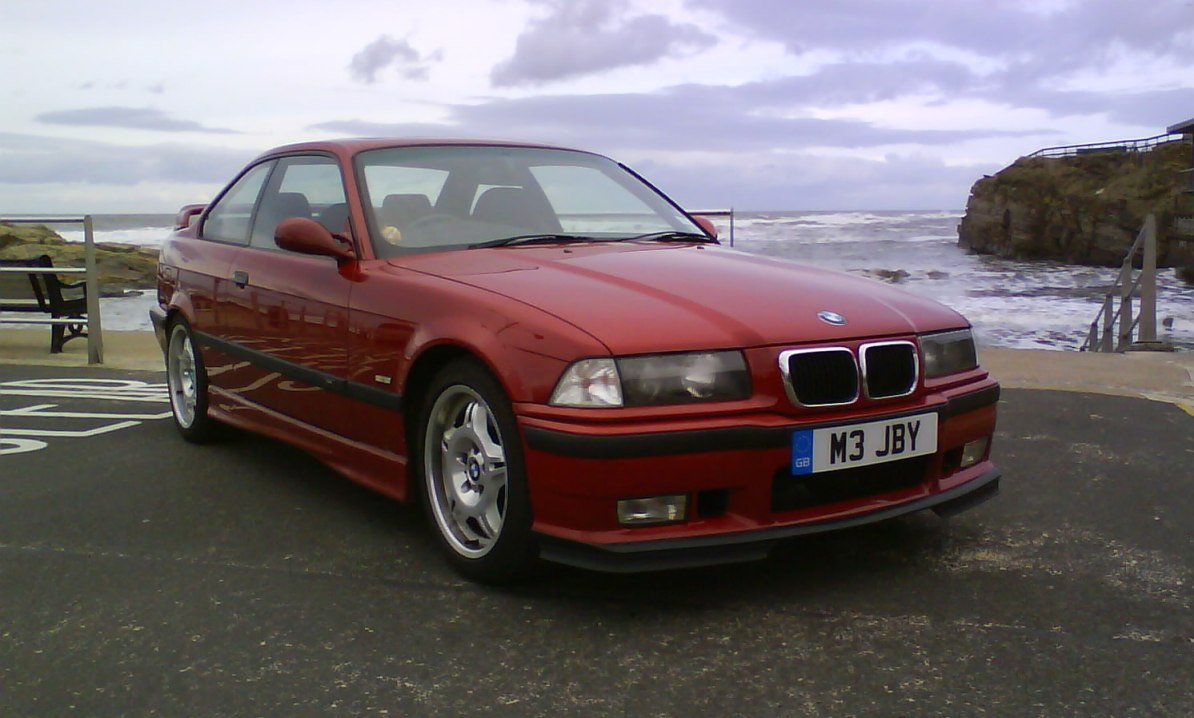
The M3 Evolution Imola Individual is a limited-edition variant of the M3 (50 for the United Kingdom). The engine and performance characteristics of the car were unchanged from the 1996 European M3, and a special exterior and interior colour combination was chosen by BMW UK: "Imola Red" (405) paint with Nappa leather seats in Imola Red and Amaretta suede bolsters in anthracite. It also included side airbags, the M3 GT Class II rear spoiler, front class II corner splitter extensions, electric seats, and double-spoke polished alloy wheels.
Prior to the release of the Imola Individual there was a pre-production model made which was used as the basis of the special edition. It featured the Class II front splitter and rear spoiler, special order Imola Red paint, special order Nappa leather and Anthracite Amaretta suede interior, SMG gearbox, GSM phone kit, headlamp washers and double-spoke polished alloy wheels.
M3 Lightweight (US Only)
Following the introduction of the E36 M3, racing teams in the United States began pressuring BMW for a homologation version in order to compete in sports-car racing. As a result, the 'M3 Lightweight' was introduced in 1995. The cars came without a radio (although the speakers were installed and the car pre-wired for the radio), air conditioning, leather seats, tool kit or a sunroof. The doors have aluminium skins. There is no under bonnet insulation blanket, and the boot only has carpet on the floor. The under body insulation is thinner and there is special carpeting to lower weight. Overall the changes resulted in a weight 200 lb less than a regular M3. The wheels are 17 inches in diameter, with a width of 7.5 inches at the front and 8.5 inches at the rear. The tyres fitted were 235/40ZR17.
Powertrain changes included the removal of the top speed limiter and a shorter differential ratio (3.23 compared to 3.15). Suspension upgrades consisted of shorter springs from the European-specification M3. Before being sold, the M3 Lightweights were sent to Prototype Technology Group Racing in Virginia for final preparation, which included the front and rear Motorsport flag decals, and "trunk kit". In the boot there was a dual-pickup oil pump (from the European-specification M3), front strut bar, lower cross-brace, spacer blocks to raise the rear wing, and an adjustable front splitter. Each owner was given a 1-page legal document to sign acknowledging that any installation of boot items voided the new car warranty.
All M3 Lightweight cars were produced in the "Alpine White" exterior colour, with the Motorsports flag decals on the left front and right rear corners of the car. There is a fixed wing on the bootlid, some carbon fibre interior trim, and the badges on the side moulding and dash read "BMW Motorsport International".
Although BMW promised to build approximately 100 cars, BMW never released the production numbers of M3 Lightweights built. However, it is estimated that approximately 125 were built.
Canadian Edition
Prior to the release of the North American specification M3, BMW Canada sold 45 of the European specification M3s. At the time, BMW North America was opposed to importing the E36 M3 (due to its high price and the poor sales of the previous M3). The Canadian Edition M3 was imported using a loophole that allows low volumes of Norwegian-certified cars to be sold in Canada. Despite a high price of nearly $60,000 CAD, all 45 cars were sold in 3 days. 42 of the M3s arrived in Canada via boat in January 1994, with the final 3 cars shipping sometime in the following few months. As with other European specification M3s, these 45 cars had the 213 kW version of the S50 engine, oil temperature gauge and glass headlights, as well as Canadian-required equipment such as a third brake light and daytime running lights. Each of the Canadian Edition cars has an individually-numbered plaque on the inside of the glovebox which reads "S50 B30 Limited Production Canadian Edition" as well as a special owners manual pouch with a similar plaque. The cars were numbered at random, with no correlation to VIN numbers, options or production date.
When the North American specification M3 was released in 1995, it was initially not available in Canada. Sales of the North American M3 in Canada began in 1997.
M3-R (Australia)
In order to race in the Australian Super Production series, fifteen M3-Rs were sold by BMW Australia in 1994. With a power output of 240 kW, the M3-R is the most powerful production E36 M3. Four of the cars were used for the race series, while the remaining eleven were sold to the general public. Buyers were required to possess a CAMS motorsport licence in order to purchase an M3-R.
The cars were delivered to the workshop of the Frank Gardner racing team for final preparation. A bolt-in FIA-approved roll cage was a factory option. Suspension upgrades consisted of new springs, adjustable struts and rear perches. Engine upgrades consisted of AC Schnitzer camshafts, dual pickup sump, an oil restrictor in the head and a cold air snorkel into the air filter box replacing the left hand foglight.
Other changes included four piston front brake calipers, a shorter (3.25:1) differential ratio, the driveshaft from the M5, a twin-plate clutch, a non-functional rear seat, no air conditioning, a deeper front splitter and a larger rear spoiler. The cars were individually numbered with a plaque fitted to the centre console near the handbrake.
M3 GTR (Germany)
The E36 M3 GTR is the road-going version of the competition machine built to compete in the 1993 ADAC German GT Cup Touring Car series. In 1993, a single road-going example was made. It featured a widebody kit, stripped interior, seam-welded body, upgraded suspension, and a stroked (from 2,990 to 3,018 cc) engine.
Production
Production of the E36 M3 began in September 1992 and was discontinued in August 1999.
The majority of cars were produced at the BMW Regensburg factory in Germany; however, a small number of low compression right-hand drive cars were assembled at BMW's plant in Rosslyn, South Africa. In total, 46,525 coupés, 12,114 convertibles, and 12,603 saloons were produced. The saloon ceased production in December 1997, the coupé in late 1998, and the convertible in December 1999.
North American models
Despite being released in other countries in 1992, the E36 M3 was not sold in the United States until 1995. A key difference between the "European specification" M3 (sold in the rest of the world) and the US M3 is the less powerful S50B30US engine used in the US M3, which was rated at 240 hp and 305 Nm. Other notable differences included an optional 5-speed ZF 5HP torque-converter automatic transmission, suspension changes, and single piece brake discs (instead of floating discs). The changes were made in order to reduce the price of the M3, as the US dealers believed the European specification M3 would be too expensive to sell well.
In November 1996, the engine was upgraded to the 3.2 L BMW S52, with the same power outputs of 240 hp, but with torque increased to 320 Nm. The manual gearbox remained a 5-speed, despite the European versions being upgraded to a 6-speed version.
US sales figures include a total of 18,961 coupés, 7,760 saloon and 6,211 convertibles.
Motorsport
The introduction of the E36 M3 coincided with BMW's withdrawal from the Deutsche Tourenwagen Meisterschaft (DTM), resulting in BMW focussing instead on the 318i and 320i models in the Super Tourenwagen Cup. Nonetheless, the E36 M3 competed in many motorsport events. In 1993, the E36 M3 GTR won the German ADAC GT Cup, driven by Johnny Cecotto. The M3 GT competed in the European FIA GT Championship.
In the United States, the Prototype Technology Group (PTG) Racing in Virginia ran the E36 M3 in the IMSA GT Championship. In the 1996 IMSA GT Championship, the M3 won 4 races in the GTS-2 class and BMW won the manufacturer's championship. In the 1997 IMSA GT Championship, the M3 won 8 races in the GTS-3 class, with BMW winning the manufacturer's championship again and Bill Auberlen winning the driver's championship. In the 1998 IMSA GT Championship, the M3 won 5 races and BMW won the manufacturer's championship in the GT3 class. The same year, the M3 won 4 races in the GT2 class. The M3 also competed in the 2000 American Le Mans Series, taking one win in the GT class.
In Australia, the M3-R competed in the Australian GT Production Car Championship.
E46 generation (2000–2006) {{anchor|E46}}
The M3 version of the E46 3 Series was produced in coupé and convertible body styles. The E46 M3 is powered by the S54 straight-six engine and has a acceleration time of 5.2 seconds for the coupé, with either the manual or SMG-II transmission. The skidpad cornering results are 0.89g for the coupé and 0.81g for the convertible. The top speed is electronically limited to 155 mi/h. The kerb weight is 3450 lb.
The available transmissions were a Getrag 420G 6-speed manual transmission or an SMG-II 6-speed automated manual transmission, which was based on the Getrag 420G. The SMG-II used an electrohydraulically actuated clutch, and gear shifts could be selected via the shift lever or paddles mounted on the steering wheel. The SMG-II was praised for its fast shift times and racetrack performance, but some people found its shifts to be delayed and lurching in stop-start traffic.
Total production of the E46 M3 was 56,133 coupés and 29,633 convertibles. The cars were assembled at the BMW Regensburg factory in Germany, and production was from September 2000 until August 2006, for a total of 85,766 cars.
An M3 Touring station wagon prototype was built to evaluate the feasibility of building an M3 model on the existing platform of the E46 station wagon (especially the integration of the M3's wider rear wheel arches onto the wagon body). The prototype did not reach production.
File:BMW E46 M3 Phoenix Yellow (2).jpg|Coupé File:BMW M3 Cabriolet - Flickr - The Car Spy (1).jpg|Convertible File:BMW M3 (E46) Touring Retro Classics 2025 DSC 7634.jpg|Touring prototype File:S54B32-BMW-E46-M3.jpg|BMW S54 straight-six engine File:E46 M3 SMG CONVERTIBLE in CARBON BLACK.jpg|E46 M3 interior
Engine
Main article: BMW S54
The 3.2 L S54 engine is the final evolution of the BMW S50 naturally aspirated straight-six engine. The S54 is rated at 252 kW at 7,900 rpm, 365 Nm at 4,900 rpm, and has a redline of 8,000 rpm. As with most M engines, the S54 has individual throttle bodies for each cylinder, with electronic throttle control (drive-by-wire) operation of the throttles being a new feature for the S54.
Development and launch
Concept design of the M3 began in 1997. The head of exterior design was Ulf Weidhase and the head of interior design was Martina Bachmann.
The M3 was previewed at the 1999 International Motor Show Germany as a concept, resembling the final production version very closely. The final production version was first introduced in March 2000 at the Geneva Motor Show, with the new 3.2L S54 M-tuned inline-6 engine.
Special editions
CSL
The BMW M3 CSL (Coupe Sport Leichtbau, meaning 'Coupé Sport Lightweight') is a limited edition version of the M3 that was produced in 2004, with production totaling to 1,383 cars. It was available in two colours: "Silver Grey Metallic" and "Black Sapphire Metallic".
As its name suggests, an emphasis was put on reducing weight. The CSL has a curb weight of 1385 kg, 110 kg lighter than the regular M3. Structural weight reduction measures include the use of glass-reinforced plastics in various structural points in the car, a roof constructed from carbon fibre reinforced plastic (reducing kerb weight by 7 kg and, more importantly, lowering the centre of gravity), body panels constructed from carbon fibre and thinner glass for the rear window.
The boot floor cover was made of lightweight fibre-board (not cardboard as infamously described on the Top Gear television show). The CSL discarded a large proportion of the M3's sound insulation, electric seats, navigation system, air conditioning, and stereo (the latter two were able to be re-added as no-cost options). The interior includes fibreglass front racing bucket seats, a fibreglass backing for the rear seats, and carbon fibre for the centre console, door panels, door trim, and head-liner. The steering wheel has just a single button which activates the M track mode, instead of the buttons for cruise control, stereo, and phone controls on the regular M3. The CSL retained the 50:50 weight distribution of the regular M3.
The wheels were increased in size to 19 inches. BMW took the unusual approach of supplying the CSL with semi-slick tyres (Michelin Pilot Sport Cup). These tyres provided high grip levels once warmed up on a racetrack, but poor performance on wet roads and when below their operating temperature. A warning label was included in the CSL to inform drivers about driving in cold or wet conditions. The brakes were upgraded with larger floating discs at the front and larger pistons at the rear.
The suspension system was revised with stiffer springs, upgraded shock absorbers and a quicker ratio for the steering rack (14.5:1 vs 15.4:1 on the regular M3). The electronic stability control was retuned and an "M track mode" was added, allowing higher thresholds before the system intervened.
The engine used in the CSL had increased output over the regular S54 by 17 hp and 5 Nm over the European M3. This is due to the use of sharper profile camshafts, a bigger air intake with carbon fibre manifold, a refinement of the exhaust manifold, and slightly different exhaust valves. The top speed was electronically limited as standard, but buyers with a current motorsport licence could order the CSL with the speed limiter removed. The sole transmission available was the 6-speed SMG II automated transmission, with revised software resulting in shift times of 80 milliseconds.
The aerodynamics were also revised, including a carbon fibre front splitter that improved downforce at high speeds by 50%, and a carbon fibre rear diffuser. The front bumper had a distinct hole that is used to draw cool air into the newly designed air intake. The bootlid was redesigned to incorporate a raised lip, unlike the regular M3 where one is simply added onto a flat boot.
Prototype CSL
In 2002, BMW M revealed a special V8 prototype engine (full model code S62B40) for the M3 CSL which was previously fitted to the E39 M5 and the E52 Z8. The S62 was BMW's first V8 engine to have double-VANOS (variable valve timing on the intake and exhaust camshafts). However, this prototype S62 engine produces 316 kW at 6,600 rpm and 500 Nm at 3,800 rpm. The last difference results in a displacement of 3999 cc, compared with the 4941 cc of the S62 engine found in the M5 and Z8 vehicles.
Competition Package / CS
In December 2004, a special edition was introduced which used several parts from the CSL. This model was called the M3 Competition Package (ZCP) in the United States and mainland Europe, and the M3 CS in the United Kingdom. Compared to the regular M3, the Competition Package includes:
- 19-inch BBS alloy wheels: 19in×8in at the front and 19in×9.5in at the rear.
- Stiffer springs (which were carried over to the regular M3 from 12/04).
- Faster ratio steering rack of 14.5:1 (compared with the regular M3's ratio of 15.4:1) as with the CSL
- Steering wheel from the CSL
- M-track mode for the electronic stability control, as with the CSL.
- The CSL's larger front brake discs (but with the regular M3 front calipers) and rear brake calipers with larger pistons.
- Alcantara steering wheel and handbrake covers.
The engine, gearbox, and other drivetrain components are the same as the standard M3.
GTR Straßenversion (Street Version)
GTR Road Car In order to homologate the M3 GTR for racing, a road version was developed during calendar year 2001 and shown for the first time at the season ending ALMS Petit Le Mans race. BMW produced 10 development units of which 3 were production ready display cars. For homologation purposes, the M3 GTR needed to be offered for sale to the general public and by Petit Le Mans 2001, the car was ready. The M3 GTR was to be priced at , When ALMS changed the homologation rules at the end of the 2001 season, the road version project was stopped. All 7 development prototypes were recycled but the three production ready display cars exist to this day and all still owned by BMW AG. One of the Road M3 GTRs was displayed by BMW of North America LLC at Legends of the Autobahn in 2015 along with the newly restored ALMS race version of the car. The road cars were built alongside bodies-in-white of the GTR race cars in the special vehicles department of BMW's Regensburg Plant.
As with the race car, the GTR road car was powered by the 4.0-litre P60 V8 engine. The engine retained the race cars' dry sump oil system and was slightly detuned from 331 to at 7,000 rpm. Top speed was 295 km/h. The transmission was a six-speed manual and the differential was the same variable locking unit as used in the race car.
The dry weight was 1350 kg. Weight reduction measures included a carbon fibre front bumper, rear bumper and rear wing.
The M3 GTR gained a cult following in the gaming community after it appeared in the 2005 video game Need for Speed: Most Wanted. Road & Track, who collaborated on the first Need for Speed video game, described the game's custom M3 GTR as being "so iconic that fans still recreate the livery in real life." Once searched about the M3 GTR, nearly 85% of the results will relate the car to Need for Speed: Most Wanted. It also makes an appearance in Real Racing 3, with a special livery of the Need for Speed games and its own exclusive series as well.
In November 2024, BMW vinyl-wrapped the 2001 ALMS GT-winning #42 M3 GTR driven by Jörg Müller with the livery from Need for Speed: Most Wanted as a museum piece, and it was available for show in the BMW Welt Show at Munich from December 2024-January 2025.
North American models
The North American models used the same S54 engine as in other countries (unlike the previous generation, which used lower performance engines in the United States). Due to minor differences in specification, the United States models were rated at 333 hp and 262 lbft, resulting in an official 0–60 mph acceleration time of 4.8 seconds for the coupé version (with either the manual and SMG transmission). As in other countries, top speed was electronically limited to 155 mi/h.
The CSL model was not sold in the North American market.
Motorsport
In the United States, the E46 M3 competed in the 2000 American Le Mans Series GT category and finished third in the championship. The straight-six engine was viewed as uncompetitive compared to the Porsche 996 GT3, therefore BMW began to develop a new M3 racing car based around a more powerful engine. The resulting E46 GTR racing car was introduced in February 2001 and was powered by a 330 kW version of the 3997 cc P60 V8 engine. With a more powerful engine than the straight-six powered M3 versions (which were outpaced by the competition), the GTR won the 2001 American Le Mans Series GT category, driven by Jörg Müller.
The eligibility of the GTR was the subject of controversy, with some rival teams believing that the GTR was an in-house prototype vehicle rather than a production model available for purchase by the general public. The ALMS homologation rules for 2001 required the M3 GTR road car to be sold on at least two continents within twelve months of the rules being issued, which BMW claimed to fulfill by stating that 10 GTR road cars were available for sale. The ALMS rules were altered for 2002, now requiring that 100 cars and 1,000 engines must be built for a car to qualify without penalties. The GTR road car was never intended for production on this scale, so BMW withdrew the GTR from competition at this point.
In 2003, the M3 GTR returned to competition at the 24 Hours Nürburgring, with two cars run by Schnitzer Motorsport. The GTR won the 24 Hours Nürburgring in 2004 and 2005, and competed in the 24 Hours Spa.
Also in 2003, an M3 GTR raced in the 2003 Bathurst 24 Hour race in the hands of Australian race team Prancing Horse Racing. Although the car only arrived in Australia just a week before the race, John Bowe managed to still qualify the car (which ran a fairly stock 5.0L version of the BMW P60B40 V8 engine) in 3rd place. The race, with drivers Bowe, Neil Crompton, Greg Crick and team owner, Indonesian millionaire businessman Maher Algadrie, would only last 131 laps however (the winner covered 527 laps) before Algadrie was put out in an accidental clash on top of The Mountain at around 11 PM while being lapped by the Holden Monaro 427C of eventual race winner Peter Brock.
E90/E92/E93 generation (2007–2013) {{anchor|E90}}
| 4.0 L S65B40 V8 | 4.4 L S65B44 V8 Karl Elmitt, Hans-Bruno Starke (E92)
The M3 model of the E90/E92/E93 3 Series range was powered by the BMW S65 V8 engine and was produced in saloon, convertible and coupé body styles. The E9x is the first and only standard production M3 powered by a V8 engine as its successor would revert to using a straight 6 engine. In the standard M3, the S65 engine rated at 309 kW at 8,400 rpm and 295 lbft at 3,900 rpm.
Initially, the M3 was produced with a 6-speed manual transmission. In April 2008, the E90/E92/E93 M3 became the first BMW to be available with a dual-clutch transmission when the 7-speed Getrag "M-DCT" transmission was introduced as an option.
The official acceleration times for the coupé and saloon are 4.6 seconds with the DCT transmission (4.8 seconds with the manual transmission) and 5.1 seconds for the convertible.
The E90 and E92 versions received many positive reviews, including "the greatest all-around car in the world", "the finest car on the market, period" and "the best, most complete car in the world".
Development and production
Total production of the E9x M3 was 40,092 coupés, 16,219 convertibles and 9,674 saloon. Production of saloon models finished in 2011, with coupés remaining in production until July 5, 2013.
Body styles
The first body style to be introduced was the E92 coupé, which was previewed at the 2007 Geneva Motor Show and introduced in production form at the 2007 Frankfurt Motor Show on 12 September. The coupé version uses a carbon fibre roof to reduce weight and lower the centre of gravity. In 2010, the coupé and convertible versions received a minor facelift, which included revised LED tail-lights and minor interior trim pieces but it did not get the updated headlights from the regular series.
The E93 convertible version was introduced shortly after the coupé and uses a power retractable hardtop. The leather seats in the convertible version are treated with a coating to reflect sunlight, in order to reduce their tendency to become uncomfortably hot with the top down.
The E90 saloon version was introduced in 2008 and was the second (along with the E36) M3 by generation to be produced in a 4-door body style. The saloon has the same drivetrain and similar external styling as the coupé, however the lack of a carbon fibre roof contributes to a weight increase of 22 lb compared to an identically equipped coupé.
The official kerb weights for the 2008 European-specification models (with manual transmission) are 1580 kg for the coupé, 1605 kg for the saloon and 1810 kg for the convertible.
2008-2010 BMW M3 (E90) sedan 05.jpg | Saloon (E90) BMW M3 E92 - Flickr - Alexandre Prévot (4) (cropped).jpg | Coupé (E92) 2008 BMW M3 Convertible - Flickr - The Car Spy (1).jpg | Convertible (E93) File:BMW E92 M3 Coupé Interior.JPG|E92 M3 interior
M Performance Parts
M Performance Parts were made for the sixth generation M3. These include black kidney grilles, M wheels, an M Performance exhaust that reduces the weight by 9 kg, carbon fibre mirrors, spoilers and splitter, a handbrake, steel pedals, a sport steering wheel, black side trim and alcantara leather steering wheel button trim, M stripes decal.
Special editions
Competition Package (ZCP)
The "Competition Package" (sometimes known as ZCP) version was released in 2010. The changes related to the suspension and electronic stability control and consisted of:
- Ride height lowered by 10 mm
- Revised tuning of the adjustable dampers (Electronic Damping Control)
- An "M" mode for the electronic stability control
- 19-inch wheels (Styling 359)
GTS
BMW announced the M3 GTS in November 2009 and began production in 2010. The GTS was designed as a "road-legal clubsport-oriented model" and produced only in the coupé body style. Changes over the regular M3 include an upgraded engine, reduced curb weight, revised suspension, upgraded brakes and adjustable aerodynamics.
The GTS uses an engine enlarged to 4.4 L which has a power output of 331 kW. The sole transmission option was the 7-speed dual-clutch transmission (M-DCT) and the official 0 - acceleration time for the GTS is 4.4 seconds.
The car weighs 300 lb less than the regular M3, due to a lighter centre console and door panels, polycarbonate side and rear windows, a lack of rear seats and the removal of acoustic insulation.
Suspension changes include adjustable camber angle and ride height, a rigidly mounted rear axle and revised dampers. The front brakes were upgraded to 6-piston callipers with 18 mm larger discs, and the rear brakes were upgraded to 4-piston callipers with 18 mm larger discs. Aerodynamics are adjustable via the front apron and the angle of the rear wing. Production was limited to 135 cars, which sold out quickly.
CRT
.jpg)
The M3 CRT (Carbon Racing Technology) was a special edition of the M3 saloon that was produced in 2011. The CRT was powered by the same 4.4 litre version of the S65 engine as the GTS, however it retained a higher level of luxury features compared to the track-focused GTS. The CRT used a carbon fibre bonnet and front seats to reduce weight, resulting in a kerb weight approximately 150 lb lower than an equivalently specified version of the regular M3 saloon.
Production was limited to 67 cars, all numbered with a plaque on the dashboard. The official 0 - acceleration time was 4.4 seconds.
DTM Champion Edition
BMW Motorsport returned to the DTM in 2012, and 54 "DTM Champion Edition" cars were built to commemorate the BMW M3 winning the championship. The unique features of the DTM Champion Edition consisted of visual changes to associate the car with the DTM race car, such as the "Frozen Black" paint colour, stripes over the roof and bootlid, carbon flaps, a gurney flap and matte black wheels. Interior changes included carbon fibre for some interior trim items, an "M Power" logo embroidered on the handbrake grip and a numbered plaque with Spengler's signature and the text "DTM champion 2012" above the glove box. All cars were produced with the dual-clutch transmission.
Lime Rock Park Edition (US)
.jpg)
In the United States, the M3 Lime Rock Park Edition was produced for the 2013 model year. A total of 200 cars were sold, all coupés painted in the "Fire Orange" colour. Performance changes included a carbon fibre front splitter and rear spoiler, a ride height lowered by 0.4 in, higher thresholds for the electronic stability control and a lightweight exhaust system. BMW claims the same engine power output as the regular M3, however, when marketing the lightweight Inconel-titanium BMW Motorsports Exhaust to stock M3 vehicles, BMW claims that the system adds about 5 hp.
The interior of the Lime Rock Park Edition includes a plaque reading "One of 200".
Frozen Edition
Due to the GTS version not being available in South Africa, BMW developed the BMW M3 Frozen Edition in 2009. The engine was upgraded to generate 330 kW, due to an AC Schnitzer intake manifold and changes to the engine management system.
Twenty-five Frozen Edition cars were produced, all with exterior colours of either "Frozen Black" or "Frozen Grey".
Competition Edition Frozen Silver
In 2012, BMW announced this edition with 40 to be built for US and 100 for Europe.
Built to commemorate the 40th anniversary of BMW's M Division, each model came with "Frozen Silver Metallic" exterior paint. According to BMW, the colour is a special matte paint that adds a metallic lustre to the vehicle. The interior has black leather and palladium silver accessories.
M3 Pickup Prototype
The M3 Pickup is a one-off custom variant of the M3 which was based on the E93 M3 convertible and publicly announced on April Fool's Day in 2011. It was used as a workshop transport vehicle for BMW M GmbH, replacing their E30 M3 pickup version after 26 years of use. The vehicle was assembled by M GmbH's employees, as well as interns and engineering students.
Motorsport
The E92 M3 saw BMW return to the Deutsche Tourenwagen Masters (DTM) after a break of 20 years. In its debut season in 2012, the M3 won the drivers championship, the manufacturers championship and five out of ten races for the season.
In endurance racing, the BMW Motorsport/Schnitzer Motorsport M3 GT2 won the 2010 24 Hours of Nürburgring, driven by Jörg Müller, Augusto Farfus, Pedro Lamy, and Uwe Alzen. The M3 also qualified second at the 2010 24 Hours of Spa and led the race until being forced to retire in the final hour due to suspension failure. The M3 won the GT2 category in the ILMC 2010 1000 km of Zhuhai in China.
A GT4 version of the M3 was introduced in 2009 and competed in various races, including finishing third in the GT4 SP10 class at the 2009 24 Hours Nürburgring, and winning its class at the ADAC Westfalenfahrt race at the Nürburgring in April 2009. In July 2009, BMW Motorsport released an M3 GT4 model for sale to private teams and drivers; this included the GT2 body kit. The official kerb weight was 1430 kg and changes to the 336 kW were claimed to be minimal. For the 2010 24 Hours Nürburgring, the "Balance of Performance" required the M3 to not exceed a power output of 287 kW and to have a minimum weight of 1400 kg.
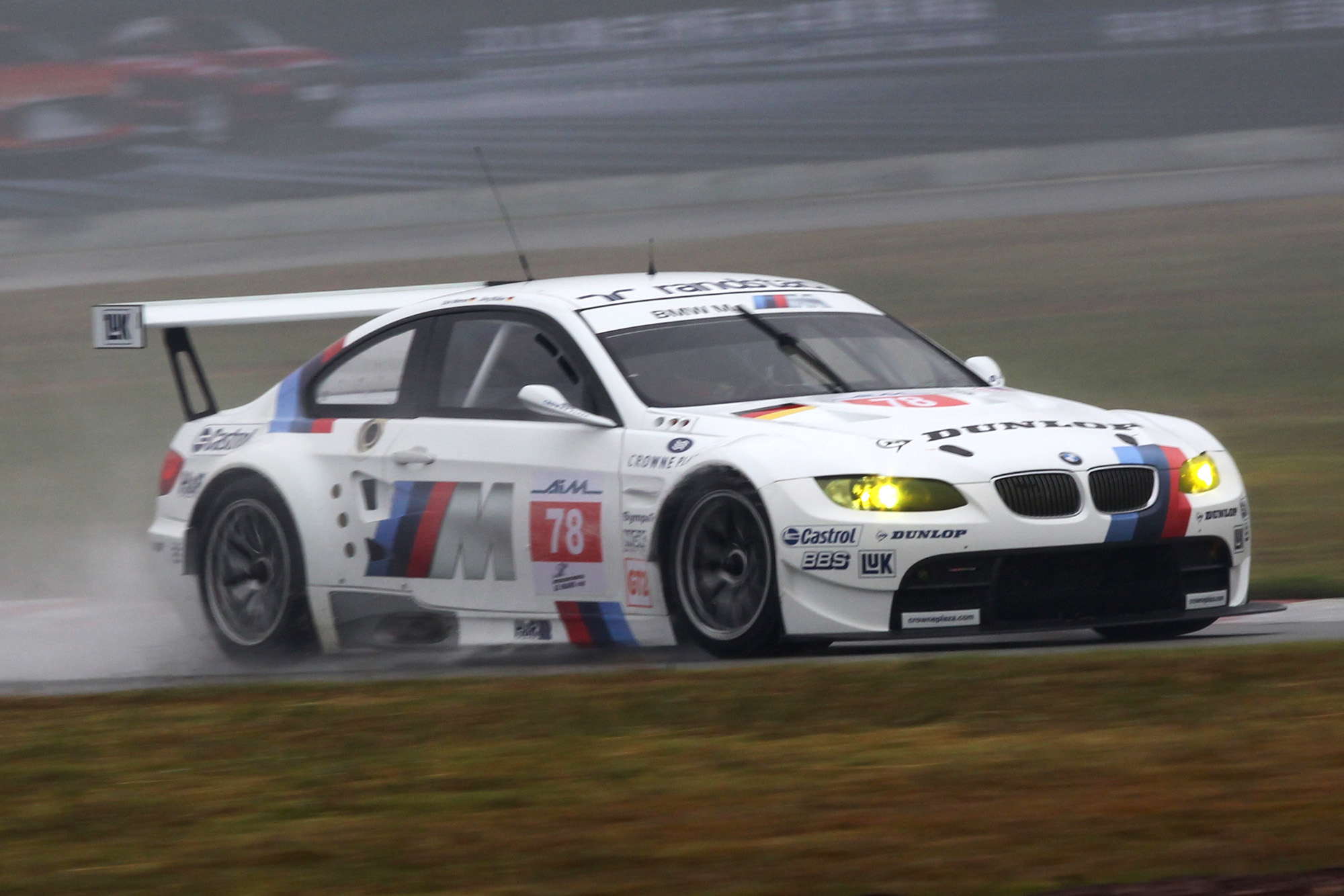
In the United States, Rahal Letterman Racing entered two factory-backed E92 M3s in the 2009 American Le Mans Series season, competing in the GT2 category. In 2011, the BMW achieved a 1–2 finish in the 12 Hours of Sebring. In the 2011 American Le Mans Series GT class, BMW Team RLL swept all categories, winning the GT manufacturer, team and driver championships. In 2012, the M3 won the GT class at the 12 Hours of Sebring. The #79 M3 GT2 that competed at Le Mans became the 17th BMW Art Car after it was decorated by Jeff Koons. The M3 GT2 was succeeded by the BMW Z4 GTE in 2013.
F80 generation (2014–2018) {{anchor|F80}}
The M3 version of the F30 3 Series was designated the F80 and was produced from 2014 to 2018. The F80 M3 was powered by the BMW S55 twin-turbocharged straight-six engine, therefore being the first turbocharged M3 model. Despite the smaller displacement than the V8 engine used by the previous generation of M3, the switch from naturally aspirated engines to turbocharging resulted in peak power being increased from 309 to, and peak torque being increased from 400 to.
The official 0 - acceleration times are 3.9 seconds with the M-DCT transmission and 4.1 seconds with the manual transmission. Top speed is limited to 155 mph but an optional M Driver's package raises this to 174 mi/h. The kerb weight is 1621 kg.
The F80 M3 was unveiled, alongside the F82 M4 (its coupé counterpart), at the 2014 North American International Auto Show. The two-door M3 had been renamed BMW M4 – in line with the new BMW 4 Series range.
2016, a Competition Package became available for the M3 and M4. Changes included an increase in power to 331 kW, revised tuning of the electronic differential and the electronic stability control ("DSC"), suspension upgrades and new front seats. The official time was 4.0 seconds with the dual-clutch transmission.
File:2017 BMW M3 (F80) sedan (2017-09-15) 02.jpg|F80 M3 - rear view File:Engine -2 - 2015 BMW M3 (15820229729).jpg|BMW S55 straight-six engine File:BMW M3 (42926742222).jpg|Interior
Body styles
The F80 generation of M3 was produced only as a saloon, following the company's plans to split off the 4 Series coupé and convertible from the 3 Series. To minimise weight, the roof is made of carbon fibre and the bonnet and front quarter panels are made from aluminium.
Facelifts
The F80 M3's design was updated in (summer) 2015 for the 2016 model year and in (march) 2017 for the 2018 model year. In the former, the taillights were given LEDs, and in the latter, the headlights were restyled and also given newer and more angular LEDs.
M Performance Parts
M Performance Parts can be fitted to all M3 models. These include a carbon fibre diffuser, a carbon fibre spoiler, a carbon fibre bumper winglet, a splitter and side skirts.
Special editions
M3 Pure
The Australian-only M3 Pure model was sold as the base model, being cheaper than the regular M3. The M3 Pure has the engine, exhaust and suspension from the Competition Package. Exterior trims include black badges, front grilles, side grilles and exhaust tips, while the interior trim uses a combination of leather and cloth.
M3 CS
An "M3 CS" special edition was produced in 2018 with an upgraded engine rated at 453 hp and 443 lbft. The weight was reduced by 110 lb through use of a carbon fibre hood and front splitter, Alcantara interior parts and thinner glass for the side windows.
Production of the CS totalled 1,200 units.
M3 30-Jahre Edition
To celebrate the 30th anniversary of the introduction of the first M3, BMW produced a limited run of 30-Jahre edition cars. Only 500 were made and distributed worldwide, with 150 of these making their way to the US. The US cars were all equipped with Individual Macao Blue paint, Fjord Blue and Black interior, Competition package and numerous badges and trim denoting the cars as 30-Jahre Edition.
M3 Velocity Edition
In 2018, BMW produced 20 M3 Velocity Edition models that were only available for purchase to military members stationed in Stuttgart, Germany. The Velocity Edition is equipped with the Competition Package and is only available in the "Fashion Grey Metallic" colour. A laser engraved dash/engine strut denotes the number of 20 cars made.
Motorsport
With the M3 model now being solely as a saloon, the motor racing activities switched to the M4 (F82) coupé.
Discontinuation
Production ceased in October 2018, due to the extensive changes required to meet the WLTP emissions regulations. However, the M4 model remained in production.
G80/G81 generation (2020–present) {{anchor|G80|G81}}
5-door estate (G81) | BMW 3 Series (G20/G21) | BMW M4 (G82/G83) | Front-engine, rear-wheel-drive | Front-engine, all-wheel-drive
The full M version of the G20 3 Series is powered by the BMW S58 turbocharged straight-six engine that debuted in the G01 X3 M. The more notable changes for the G80 M3 is a power output of 473 hp, which is a 35 kW (47 hp; 47 hp) increase over the previous F80 M3, and the adoption of the twin-kidney grille from the 4 Series. All-wheel drive (xDrive) is optional on the new M3, the first time that an M3 has used a drivetrain layout other than rear-wheel drive. A manual gearbox is available only with rear wheel drive, and is the only transmission available on the standard M3 model.
It is available as a Touring (estate) model, marking the first time BMW has offered an M3 Touring. The BMW M3 G80 went on sale as a 2021 model, with the initial prototypes tested at the Nürburgring alongside the BMW M4 G82. It was officially unveiled on 23 September 2020 alongside the new M4.
File:2023 BMW M3 Competition xDrive Auto 1.jpg|G80 Rear File:2022 BMW M3 Touring.jpg|G81 Front (Touring) File:BMW M3 COMPETITION (G80) China.jpg|G80 Competition
M3 Competition
At launch in 2020, the M3 Competition model was unveiled alongside the standard M3 model. Compared to the standard M3, the M3 Competition increases power output by 22 kW to a total of 375 kW and torque is increased by 100 Nm to 650 Nm, and it is offered exclusively with an 8-speed M Steptronic Sport automatic transmission. The M3 Competition also features a separate transmission oil cooler, black chrome exhaust tips, forged M light-alloy wheels, automatic brake hold function, and high-gloss black mirrors.
M3 CS
In 2023, at the 24 Hours of Daytona, BMW unveiled the limited-production M3 CS model. The model features a power increase to 550 PS and a weight-reduction of 15 kg compared to the M3 Competition xDrive. It is offered only as an all-wheel drive and 8-speed automatic model. BMW will also make 30 units of M3 CS Touring for the Japanese domestic market.
File:2023 BMW M3 CS.jpg|G80 M3 CS File:BMW M3 CS (G81) DSC 9670.jpg|G81 M3 CS
Updates
In July 2022, for the 2023 model year, the M3 saloon received the new dual curved display featuring iDrive 8, matching the facelifted, standard 3 Series. It replaces the previous separate digital cockpit and infotainment system with iDrive 7. The M3 Touring launched directly with the new display.
M Performance Parts
M Performance Parts can be fitted to all models. These include a wing, carbon fibre side skirts, an M Performance Exhaust system, canards, a carbon fibre splitter, a carbon fibre diffuser and rear ground effects.
| On sale | Model | Power | Torque | Curb Weight | Transmission | Top Speed | Drivetrain |
|---|---|---|---|---|---|---|---|
| 3/2021 | M3 saloon (52AY) | 353 kW | 550 Nm | 1,705 kg | 6-speed manual | 250 km/h | |
| 290 km/h with M driver's package | RWD | ||||||
| 3/2021 | M3 Competition saloon (32AY) | 375 kW | 650 Nm | 1,730 kg | 8-speed M Steptronic | ||
| Sport Automatic transmission | |||||||
| with Drivelogic | |||||||
| 8/2021 | M3 Competition xDrive saloon (42AY) | 1,780 kg | 4WD | ||||
| 2022 | M3 Competition xDrive Touring | 1,865 kg | |||||
| 2023 | M3 CS | 405 kW | 1,765 kg | 302 km/h | |||
| 2025 | M3 Competition xDrive | 390 kW | 1,780 kg | 250 km/h | |||
| 290 km/h with M driver's package |
Production volumes
| Version | E30 | ||||||||||
|---|---|---|---|---|---|---|---|---|---|---|---|
| 1986–1991 | E36 | ||||||||||
| 1992–1999 | E46 | ||||||||||
| 2000–2006 | E9x | ||||||||||
| 2007–2013 | F80 | ||||||||||
| 2014–2018 | Total | 17,970 | 71,242 | 85,766 | 65,985 | 34,677 | |||||
| Saloon | 12,603 | 9,674 | 34,677 | ||||||||
| Coupé | 17,184 | 46,525 | 56,133 | 40,092 | |||||||
| Convertible | 786 | 12,114 | 29,633 | 16,219 |
References
References
- (27 February 2008). "BMW M3 Celebrating 20 Years of a Sporting Legend". worldcarfans.com.
- (27 February 2012). "BMW M3 – The Evolution of the Benchmark". clubsportiva.com.
- (20 July 1987). "M Times Three = Performance". Autoweek.
- Chilton, Chris. (6 July 2007). "BMW M3 – E30, E36 and E46 driven review". [[Car (magazine).
- "FAQ E30 M3".
- "3'E30 model selection: convertible – M3 – EUR – 1991".
- (16 November 2018). "The M Essence". [[BMW]].
- Walton, Jeremy. ''BMW 3-Series Enthusiast's Companion''. Bentley Publishers, 2001, pp. 121–123, {{ISBN. 0-8376-0220-3
- "''Aerodynamic parts lesson including nomenclature''".
- George, Patrick. (10 October 2013). "1988 BMW M3: The Jalopnik Classic Review". [[Gizmodo Media Group.
- (2007-08-14). "Driver's Cars – 25 Greatest Cars of All Time".
- "BMW S14B23 automotive engine".
- (26 April 2016). "European Supertest: German Thundercars".
- "Aerodynamic parts lesson, including nomenclature".
- "E30 M3 FAQ".
- "30 years of the BMW M3 – the story behind the legend.".
- Patel, Joel. (27 September 2016). "BMW actually built two M3-based pickup trucks".
- "Faq E30 M3". BMW M registry.
- "Faq E30 M3 'Convertible'". BMW M registry.
- "1988 Cars".
- "1991 Cars". Touring Car Racing.
- Winfield, Barry. (July 1994). "Tested: 1995 BMW M3 Bristles with Excellence".
- "3' E36 M3 Manual gearbox S6S 420G".
- "FAQ E36 M3 3.2". BMW M Registry.
- (1996). "The BMW 3 Series Coupés". BMW.
- "3' E36 M3 Manual Transmission S6S 420G (SMG)".
- (28 June 2006). "1992–2000 E36 BMW M3 Review".
- ''Auto Motor and Sport'', 13/1996, pages 38–40
- "BMW M3 Limousine, 286 PS (E36)".
- "BMW M3 Coupé, 321 PS (E36)".
- "1997 BMW M3 Coupé specifications".
- (22 April 2019). "Video: BMW E36 M3 GT Reviewed by Carfection".
- (24 April 2019). "The BMW M3 GT Is the Best E36 You Might Not Know About".
- Kittler, Eberhard. (2001). "Deutsche Autos seit 1990, vol.5". Motorbuch.
- (30 June 2017). "Driving A Dream Car: The Limited Edition BMW E36 M3 GT".
- "BMW M Registry – FAQ E36 M3 3.2".
- "BMW M3 Evo Individual".
- (13 March 2019). "The E36 M3 LTW CSL: A Rare M3, Just For The US".
- (8 August 2016}}{{Dead link). "For Sale: 1995 BMW E36 M3 Lightweight".
- "1995 M3 Lightweight Service Bulletin". BMW North America.
- "BMW M3 Style 24 wheels".
- (24 April 2017). "1995 BMW M3 Lightweight".
- "100-Mile 1995 BMW M3 Lightweight".
- (17 October 2017). "The Canadian M3".
- (19 October 2017). "How Canada Got the Euro-Spec E36 M3 America Didn't".
- (18 August 2016). "1 of 45: 1994 BMW M3 Canadian Edition".
- "1993 Warsteiner ADAC GT Cup series".
- "The Champion in Touring Car Racing".
- (7 July 2014). "Road Test – BMW 325i".
- "BMW M Registry - FAQ E36 M3 3.0".
- "BMW M Registry – FAQ E36 M3 3.2".
- "FAQ E36 M3 3.2". BMW M Registry.
- (16 October 2015). "The History Of BMW M3".
- "3' E36 M3 Automatic transmission A5S310Z".
- "Model selection: 3'E36 – coupe – M3 – USA – 10/1995".
- Covello, Mike. (2002). "Standard Catalog of Imported Cars 1946–2002". Krause Publications.
- "DriverDatabase".
- (2014-07-31). "BMW M3: The Complete Story". Crowood.
- "Patent Images".
- "BMW M3 Cabriolet (E46) 2001 – 2007". autoevolution.
- Tomalin, Peter. (25 January 2013). "BMW M3 E46 buying guide". Evo.
- (27 April 2008). "2002 BMW M3 vs. 2008 BMW 135i vs. 2008 BMW 335i Comparison Test". Edmunds.com.
- [[Car & Driver]] Magazine, January 2002
- Webster, Larry. (December 2001). "First Drive of a Future Icon: The E46 BMW M3".
- "3' E46 M3 Manual Transmission S6S 420G (SMG)".
- (6 November 2012). "BMW M3".
- "BMW M Registry – FAQ E46 M3". www.bmwmregistry.com.
- "BMW M Registry – FAQ E46 M3".
- "Pushing the boundaries. The design of the new BMW M3".
- "IAA 1999: Neue Partnerschaften und ein SLR als Wow-Auto".
- "IAA 1999 – Focus on the BMW Booth".
- "FAQ E46 M3". BMW M Registry.
- "Tut uns Light".
- "BMW M3 CSL (E46)".
- "BMW M3 Parts CSL". US auto parts.
- "BMW M3 CSL". Cartorque.
- "BMW M3 CSL (E46)". diseno-art.
- "Car reviews – BMW M3 CSL".
- "BMW M3 CSL". Automobile Magazine.
- "Top Gear". BBC.
- (March 2003). "BMW M3 CSL – Auto Shows". Car and Driver.
- (29 April 2019). "The BMW M3 CSL Is Still a Dream Machine".
- (29 August 2016). "BMW E46 M3 CSL Review".
- "The New M3 CSL". Car pages.
- (16 October 2018). "The BMW M3 GTR Bent the Rules to Beat Everyone".
- (November 2001). "BMW M3 GTR". BMW AG.
- (31 August 2021). "The BMW M3 GTR Strassenversion". [[BMW M]].
- Trevor Yale Ryan. (1 November 2018). "Someone At SEMA Has A Need For Speed". SpeedHunters.
- (April 2020). "This Video Shows What Need For Speed: Most Wanted Would Look Like in Real Life".
- "Need for Speed Most Wanted".
- Hogan, Mack. (2020-11-03). "How 'Need For Speed' Became the World's Biggest Racing Game".
- Padeanu, Adrian. (26 November 2024). "BMW Recreates The Iconic M3 GTR From NFS Most Wanted".
- (26 November 2024). "30 Years Of NFS: The Most Wanted M3 GTR Is Now A Real-Life BMW Race Car".
- BMW M3 Owners Manual
- (20 July 2007). "BMW M3: A Brief History of the Ultimate Driving Machine".
- "BMW M3 CSL Performance". Automobile Magazine.
- "2001 BMW M3 GTR Race and Road Cars To Be Presented at Legends of the Autobahn Concours D'Elegance".
- (March 2003). "BMW M3 GTR".
- (2005). "BMW M3 E46 GTR/Rennsaison 2004 – 2005".
- "BMW M3 E46: Respecting the past – embracing the future".
- [https://www.youtube.com/watch?v=kkQkbYLGuTw&t=82s 2003 Bathurst 24 Hour - Live Coverage & Highlights]
- "Patent Images".
- (August 2010). "2011 Audi RS5 vs. 2010 BMW M3, 2011 Cadillac CTS-V – Comparison Tests". Car and Driver.
- "The new M double-clutch transmission with Drivelogic".
- "BMW Technical Data". BMW.
- "BMW M3 Convertible Technical Data". BMW.
- "E90 M3 Long-Term Test". motortrend.com.
- "BMW M3 Long-Term: The Perfect Sports Car?". Car and Driver.
- "BMW M3: Best Car in the World". InsideLine.com.
- "BMW M Registry – FAQ E90 + E92 + E93 M3". www.bmwmregistry.com.
- "Model selection – 3'E90 LCI – saloon – M3 – EUR".
- "BMW M3 Concept (2007): first official pictures".
- (27 August 2007). "Die Highlights".
- (17 January 2010). "Photo Comparison: E92 Coupe facelift vs. pre-facelift".
- "2010 BMW M3 Convertible Review". Automoblog.net.
- (18 October 2007}}{{Dead link). "BMW M3 Sedan Quick Review".
- "2008 BMW M3 E92 (Coupe) full range specs".
- "2008 BMW M3 E90 Sedan full range specs".
- "2008 BMW M3 E93 (Cabrio) full range specs".
- "BMW AG PRESSE.". BMW AG.
- (28 May 2010). "First Drive: 2011 BMW M3 with Competition Package".
- (21 July 2010). "2011 BMW M3 Competition Package Review: Car Reviews".
- "BMW M3 Competition Package (2010) review".
- "All clear given for market launch of the BMW M3 GTS.".
- "BMW M3 GTS is the most extreme M3 ever".
- (2 January 2010). "Sold Out: 2011 BMW M3 GTS". Gtspirit.com.
- (5 July 2013). "Approaching the Checkered Flag: The 4th Generation BMW M3 Ends Its Production Run While Its Racing Career Continues". BMW.
- (23 June 2011). "2012 BMW M3 CRT Lightweight Sedan – Official Photos and Info".
- "BMW M3 CRT saloon review and pictures".
- (5 December 2012). "BMW M celebrates DTM triumph with BMW M3 DTM Champion Edition model". BMW Group, press release.
- (31 July 2012). "2013 BMW M3 Coupe Lime Rock Park Edition". Automoblog.net.
- "Scorching Frozen Edition M3 driven".
- (2011-11-07). "2012 BMW M3 Competition Edition Frozen Silver Announced, Just 40 to be Built".
- Lavrinc, Damon. (April 2011). "Officially Official: 420-HP BMW M3 Pickup hauls ass, nearly 1,000 pounds".
- "The Full Scoop on BMW's April Fools' M3 Pickup".
- (26 April 2015). "2012 season".
- (21 October 2012). "BMW Wins DTM 2012 Championship".
- (21–24 May 2009). "37. ADAC Zurich 24h Rennen".
- "24h-Klassen_123".
- "24h-Gesamt_123".
- "M3 GT4 Brochure and Specs".
- "BMW M3 GT4".
- "Balance of Performance – 38. ADAC Zurich 24h-Rennen". Adac.24h-rennen.de.
- (6 February 2008). "BMW returning to American Le Mans Series". Autoweek.
- Boeriu, Horatieu. (2014-01-16). "Interview with Florian Nissl, BMW M3 and M4 Designer".
- Tingwall, Eric. (25 September 2013). "10 Things You Need to Know About the 2015 BMW M3/M4". [[Car and Driver]].
- (10 December 2013). "First look: 2014 BMW M3 and M4".
- Sabatini, Jeff. (July 2016). "Our 2015 BMW M3 Struggled with Life on the Street".
- "Geneva Motor Show 2013: BMW".
- (28 February 2016). "First drive: the BMW M3 'Competition Pack'".
- (14 January 2016). "New Competition Package Wrings More Out of BMW M3 And M4".
- "Confirmed: M Version of BMW 4-series Coupe to be Called M4 – News – Car and Driver – Car and Driver Blog". Car and Driver.
- Kable, Greg. (6 August 2012). "Revolutionizing the M3". [[Autoweek]].
- (25 February 2018). "2018 BMW M3 Pure quick spin review – Quick Spin: BMW's bargain muscle car".
- Horatiu Boareu. (7 November 2017). "First video of the BMW M3 CS".
- (2 August 2016). "2017 BMW "30 Jahre M3" Limited Edition". BMW Group.
- "BMW M3 Sedan. Edition Velocity.".
- Nica, Gabriel. (14 January 2019). "Production Data Shows Only 15% of BMW F80 M3 Models Were Manual".
- "Production start for iconic sports car at BMW Group's Munich plant".
- "Jury - Move Award".
- Lago, Carlos. (May 2023). "2022 BMW M3 Long-Term Conclusion: The Sweet Spot".
- (28 October 2019). "2021 BMW M3 and M4: Everything We Know".
- "New BMW M3 not until 2021".
- (7 August 2019). "Upcoming BMW G80 M3 will come with an imposing kidney grille".
- "New 2020 BMW M3: choice of 480 or 510bhp, 2wd or 4wd confirmed".
- (22 November 2019). "BMW M Boss Confirms Rear-Drive Manual Version of Next M3 and M4".
- Hoffman, Connor. (25 August 2020). "Here's the 2021 BMW M3 Touring, and We Really Want It in the U.S.".
- Motavalli, Jim. "BMW Debuts the Sixth-Generation M3—With a Competition Version".
- Fitzgerald, Jack. (January 24, 2023). "2024 BMW M3 CS Sheds the Pounds and Ups the Power".
- Padeanu, Adrian. (2025-07-06). "BMW M3 CS Touring Limited To Only 30 Cars In Japan".
- "BMW model update measures as of summer 2022.".
- "2021 BMW M3 (G80) Competition 3.0 (510 Hp) M xDrive M Steptronic".
- (22 June 2022). "The BMW M3 Touring Is Only 30 KG Lighter Than An M5".
- (28 May 2024). "2025 BMW M3's Turbo Inline-Six Now Tops Out at 523 HP".
- "BMW M3 and BMW M4 Forum - View Single Post - F80 M3 Complete Model Life Production Data".

This article was imported from Wikipedia and is available under the Creative Commons Attribution-ShareAlike 4.0 License. Content has been adapted to SurfDoc format. Original contributors can be found on the article history page.
Ask Mako anything about BMW M3 — get instant answers, deeper analysis, and related topics.
Research with MakoFree with your Surf account
Create a free account to save articles, ask Mako questions, and organize your research.
Sign up freeThis content may have been generated or modified by AI. CloudSurf Software LLC is not responsible for the accuracy, completeness, or reliability of AI-generated content. Always verify important information from primary sources.
Report