From Surf Wiki (app.surf) — the open knowledge base
BMW 7 Series (E23)
| Field | Value | |||||
|---|---|---|---|---|---|---|
| image | 1977 BMW 733i (E23) (52830035314).jpg | |||||
| name | BMW 7 Series (E23) | |||||
| manufacturer | BMW | |||||
| production | May 1977 – June 1986 | |||||
| 285,029 built | ||||||
| assembly | {{ubl | |||||
| predecessor | BMW E3 | |||||
| successor | BMW 7 Series (E32) | |||||
| class | Full-size luxury car (F) | |||||
| body_style | 4-door sedan/saloon | |||||
| layout | FR layout | |||||
| engine | {{ubl | |||||
| transmission | {{Unbulleted list | |||||
| wheelbase | 2795 mm | |||||
| length | {{ubl | |||||
| {{convert | 4860 | mm | in | 1 | abbr | on}} |
| {{convert | 5014 | mm | in | 1 | abbr | on}} (US spec) |
| width | 1800 mm | |||||
| height | 1430 mm | |||||
| weight | 1470 - | |||||
| designer | Paul Bracq, Manfred Rennen |
285,029 built | West Germany: Dingolfing | South Africa: Rosslyn, Gauteng | 2.5–3.2 L M30 I6 | 3.2 L M102 turbo I6 | 3.4 L M106 turbo I6 | 3.5 L M90 I6 | 3.5 L M88/3 I6 |4-speed manual |5-speed Getrag manual |3-speed automatic |4-speed automatic | 4860 mm | 5014 mm (US spec)

]]

.jpg)
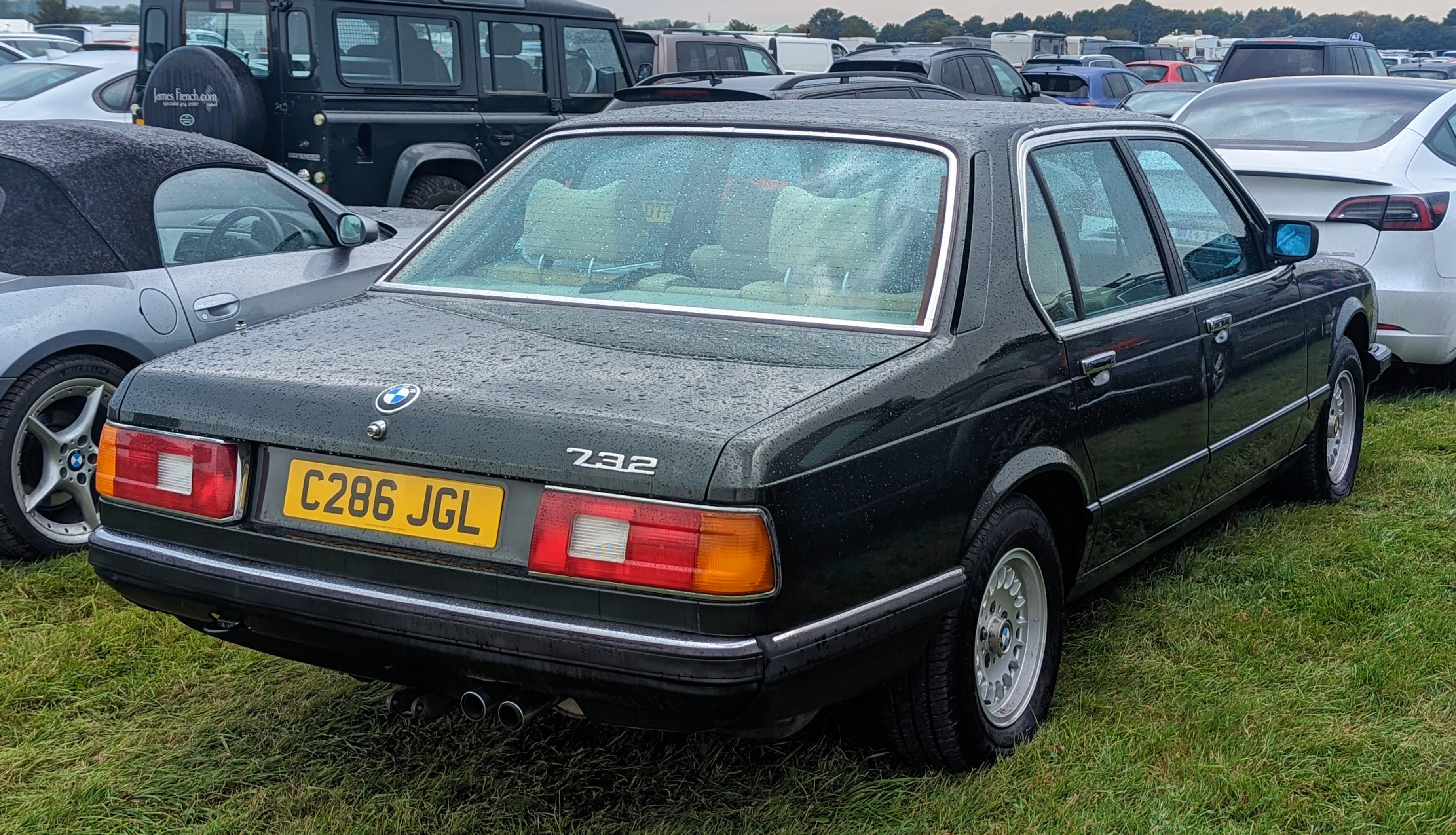
The BMW E23 is the first generation of the BMW 7 Series luxury cars and was produced from 1977 until 1986. It was built in a 4-door sedan body style with 6-cylinder engines, to replace the BMW 'New Six' (E3) sedans. From 1983 until 1986, a turbocharged 6-cylinder engine was available.
In 1986, the E23 was replaced by the E32 7 Series, however, the E23 models (called L7) remained on sale in the United States until 1987.
The E23 introduced many electronic features for the first time in a BMW, including an on-board computer, service interval indicator, a "check control panel" (warning lights to indicate system faults to the driver), a dictaphone and complex climate control systems. It was also the first BMW to offer an anti-lock braking system (ABS), a driver's airbag (optional, starting in April 1985) and a new design of front suspension.
Development and production
The initial styling concepts were developed under BMW Design Director Paul Bracq, with Manfred Rennen contributing with the exterior styling.
Production occurred from 1977 until 1986, during which time 285,029 cars were built.
Engines
All models were powered by a straight-six petrol engine, with the majority of cars using the BMW M30 engine. Most engines were fuel-injected, however the 728 and 730 models of 1978–1979 used a Solex four-barrel carburetor. The fuel-injected models initially used the Bosch L-Jetronic system, until the 1979 732i, which was the first BMW to use the Bosch Motronic fuel-injection system.
| Model | Years | Engine | Power | Torque | Notes |
|---|---|---|---|---|---|
| 725i | 1981–1986 | 2.5 L M30B25 | |||
| injected | 150 PS | ||||
| at 5,800 rpm | 215 Nm | ||||
| at 4,000 rpm | title=1981 BMW E23 7 Series 725i Technical Specs | url=https://www.ultimatespecs.com/car-specs/BMW/1421/BMW-E23-7-Series-725i.html | website=www.ultimatespecs.com | accessdate=9 December 2018 | language=en}} |
| 728 | 1977–1979 | 2.8 L M30B28V | |||
| carb | 170 PS | ||||
| at 5,800 rpm | 233 Nm | ||||
| at 4,000 rpm | |||||
| 728i | 1979–1986 | 2.8 L M30B28 | |||
| injected | 184 PS | ||||
| at 5,800 rpm | 240 Nm | ||||
| at 4,200 rpm | |||||
| 730 | 1977–1979 | 3.0 L M30B30V | |||
| carb | 184 PS | ||||
| at 5,800 rpm | 255 Nm | ||||
| at 3,500 rpm | |||||
| 732i | 1979–1986 | 3.2 L M30B32 | |||
| injected | 197 PS | ||||
| at 5,500 rpm | 285 Nm | ||||
| at 4,300 rpm | |||||
| 733i (EU) | 1977–1982 | 197 PS | |||
| at 5,500 rpm | 279 Nm | ||||
| at 4,300 rpm | |||||
| 733i (US) | 1978–1979 | 177 hp | |||
| at 5,500 rpm | 266 Nm | ||||
| at 4,000 rpm | United States & Japan only | ||||
| 1980–1981 | 173 hp | ||||
| at 5,200 rpm | 255 Nm | ||||
| at 4,200 rpm | |||||
| 1982–1984 | 181 hp | ||||
| at 6,000 rpm | 264 Nm | ||||
| at 4,000 rpm | |||||
| 735i (EU) | 1979–1982 | 3.4 L M90 | |||
| injected | 218 PS | ||||
| at 5,200 rpm | 304 Nm | ||||
| at 4,000 rpm | |||||
| 1982–1986 | 3.4 L M30B34 | ||||
| injected | 218 PS | ||||
| at 5,800 rpm | 310 Nm | ||||
| at 4,000 rpm | |||||
| 735i (US), | |||||
| L7 (US) | 1985–1987 | 3.4 L M30B34 | |||
| injected | 182 hp | ||||
| at 5,400 rpm | 290 Nm | ||||
| at 4,000 rpm | United States & Japan only | ||||
| 745i (EU) | 1980–1982 | 3.2 L M102 | |||
| turbo | 252 PS | ||||
| at 5,200 rpm | 380 Nm | ||||
| at 2,600–4,000 rpm | |||||
| 1983–1986 | 3.4 L M106 | ||||
| turbo | 252 PS | ||||
| at 4,700 rpm | 380 Nm | ||||
| at 2,200 rpm | |||||
| 745i (SA) | 1984–1986 | 3.5 L M88/3 | |||
| injected | 286 PS | ||||
| at 6,500 rpm | 340 Nm | ||||
| at 4,500 rpm | South Africa only |
Transmissions
The available transmissions consisted of:
- 4-speed manual
- 5-speed manual
- 3-speed automatic
- 4-speed automatic
Equipment
Options included leather upholstery, wood trim, power seats, seat heaters, reclining rear seats, power windows, power mirrors, an in-car cellular telephone and rear-armrest radio controls (only with the executive and highline pack).
Yearly changes
1983 facelift
_sedan_(2011-03-23)_01.jpg)
The 1983 model year facelift (produced from September 1982) included styling changes to the front of the car: wider and more angular 'kidney' grilles, valance/spoiler, bumper bars, etc. Inside the car, the dashboard and instrument panels were also updated. The rear suspension was updated and the 735i engine changed from the M90 to the M30B34.
1984
In the US, 1984 saw the arrival of the optional 4-speed automatic transmission (replacing the 3-speed unit previously offered), wood trim replacing the plastic above the glove compartment and on the ashtray and electrically adjustable power seats. Michelin TRX tyres (requiring special metric wheels) became available as an option on the 5-speed manual models.
Special models
725i
The 725i model was not officially sold but produced for West German government agencies which, at the time, were not allowed to have engines larger than 2.5 liter in official cars. In the Netherlands, 2/3 of the government ministers had 725i's as their car of choice, because it just stayed under the maximum budget where the 728i was definitely over it. In total, 921 units were produced.
Turbocharged 745i

The 745i was a high-performance model sold in left-hand-drive European markets from 1979 to 1986. It was initially powered by the M102 engine, which is a turbocharged 3.2 L version of the M30 straight-six engine, producing 185 kW at 9 psi of boost. In 1982, the engine was upgraded to the M106, which increased the capacity to 3.4 litres and the fuel injection system changed from Jetronic to Motronic. Boost pressure was reduced to 6 psi, however power output was unchanged.
All M102 cars were built with a 3-speed ZF 3HP22 automatic transmission. All M106 cars were built with a 4-speed ZF 4HP22 automatic transmission. Options included heated front and rear power reclining seats, gasoline fired heater, leather covered cellular telephone, rear-armrest radio control, water buffalo hide upholstery, and burl wood trim.
The name 745i comes from the theoretical assumption that turbocharged engines have approximately 1.4 times more power than naturally aspirated engines. By this assumption, a 3205 cc turbocharged engine would have similar power to a 4487 cc naturally aspirated engine.
South African 745i
The South African 745i model was powered by the naturally aspirated M88/3 engine, instead of the turbocharged M102/M106 engines of the European 745i. A right-hand-drive version of the turbocharged model was not possible due to the turbocharger being located in the right-hand side of the engine bay. Instead, the 745i was fitted with the 210 kW BMW M88 engine, as used in the E24 M635i and E28 M5. The engine uses a 24-valve DOHC valvetrain and the fuel injection system is Bosch ML-Jetronic.
A production run of 192 South African 745i was built from 1983 to 1987, 175 of which were with an automatic gearbox and 17 with a 5-speed manual gearbox.
BMW South Africa entered one of these 745i models in Class A of the South African Modified Saloon Car Championship The 745i won the championship in 1985, the only BMW-Sanctioned motorsport application in the history of BMW 7 Series cars.
United States and Japanese market models
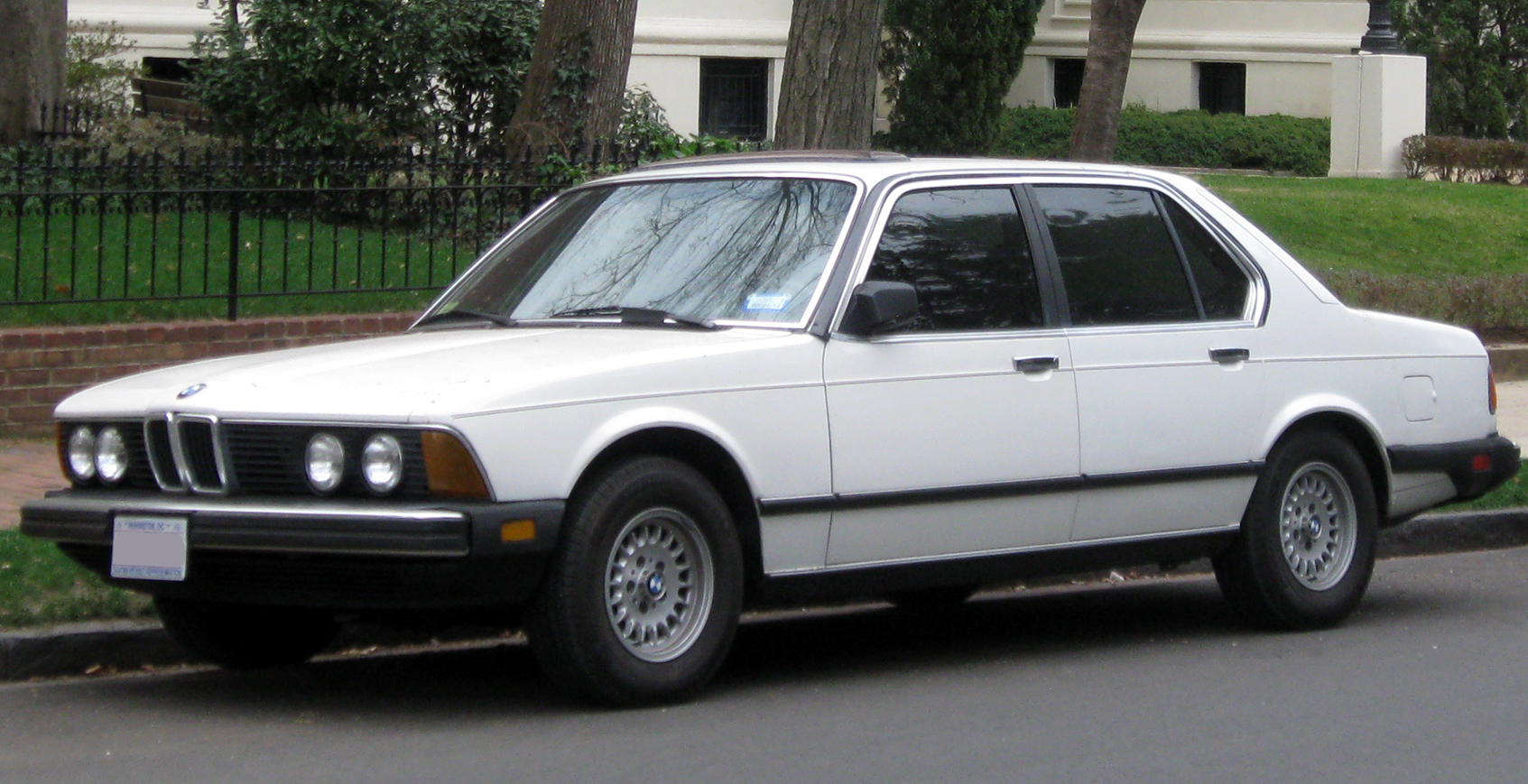

Only the 733i, 735i, and L7 models were sold in the United States and Japan. These markets also received only upscale versions, usually including leather upholstery, cruise control, wood trim, power windows, power sunroof, and other options as standard.
North American versions were fitted with larger bumpers (to comply with the U.S. National Highway Traffic Safety Administration (NHTSA) standards), smaller sealed beam headlights, and various forms of emissions equipment that were not found on European-market cars. The engines used in these markets had lower-compression pistons and thus were less powerful than European-market versions. Some features such as ABS were available in markets outside North America before they were fitted on American models.
The L7 was a more luxurious version of the 735i for the American market only. It featured special leather upholstery with leather dashboard and door padding (rather than wood trim), a power glass Moonroof, and a variety of optional features as standard. All L7 models were built with automatic transmissions and a standard driver's air bag.
References
Footnotes
References
- Vijayenthiran, Viknesh. (29 July 2007). "BMW 7-series turns 30".
- Oswald, Werner. (2001). "Deutsche Autos 1945–1990, Band 4". Motorbuch Verlag.
- World Cars 1980, pages 340-341
- (25 May 1977). "Fahrbericht: BMW 728 / 730 / 733 i". [[Auto, Motor und Sport]].
- "The BMW E23 7-Series".
- "BMW 7 Series (E23) – 1977 – 1986".
- (June 2007). "Automobile Electrical and Electronic Systems". Routledge.
- "History of Brakes in Motor Cars / Automobiles".
- (8 May 2015). "BMW 7 Series – A Look Back".
- (9 November 2014). "The first BMW 7 Series – E23".
- (26 October 2015). "BMW M5: The Complete Story". Crowood.
- (2017). "Designing Motion: Automotive Designers 1890 to 1990". Birkhäuser.
- "BMW car designers".
- "BMW M30 and M102 Six Cylinder Engines".
- "1981 BMW E23 7 Series 725i Technical Specs".
- BMW AG (ed.): ''[https://bmw-grouparchiv.de/research/detail/index.xhtml?id=3060361 Betriebsanleitung 728i 732i 735i 745i]'', 2nd edition, August 1982, p. 166+167
- BMW AG (ed.): ''[https://bmw-grouparchiv.de/research/detail/index.xhtml?id=3495379 Betriebsanleitung 728i 732i 735i 745i]'', 3rd edition, April 1983, p. 173
- (24 May 2015). "Road test 1985 BMW 735i E23".
- Olde Monnikhof, Ton. (23 August 1986). "Zo minister, zo dienstauto". Algemeen Dagblad.
- "Luxus und Eleganz: 30 Jahre BMW 7er Reihe.".
- "The BMW Six Cylinder Guide".
- "BMW 745i E23 Turbo".
- "Rmfd. automatic transmission".
- "FAQ E23 745i SA (M88)".
- (11 May 2023). "Inside BMW Group Classic - the weirder side of luxury, with the BMW 7 series.".
- (24 August 2015). "3½ Decades of BMW Motorsport in South Africa".
- (12 May 2015). "BMW 745i SA -The M7 You Never Knew Existed".
- "BMW 7'E23 model selection".
- (31 August 2015). "The Bavarian Luxo barge: A look back at the BMW 7-series".
This article was imported from Wikipedia and is available under the Creative Commons Attribution-ShareAlike 4.0 License. Content has been adapted to SurfDoc format. Original contributors can be found on the article history page.
Ask Mako anything about BMW 7 Series (E23) — get instant answers, deeper analysis, and related topics.
Research with MakoFree with your Surf account
Create a free account to save articles, ask Mako questions, and organize your research.
Sign up freeThis content may have been generated or modified by AI. CloudSurf Software LLC is not responsible for the accuracy, completeness, or reliability of AI-generated content. Always verify important information from primary sources.
Report