From Surf Wiki (app.surf) — the open knowledge base
Blunderbuss
Type of firearm with a flared muzzle
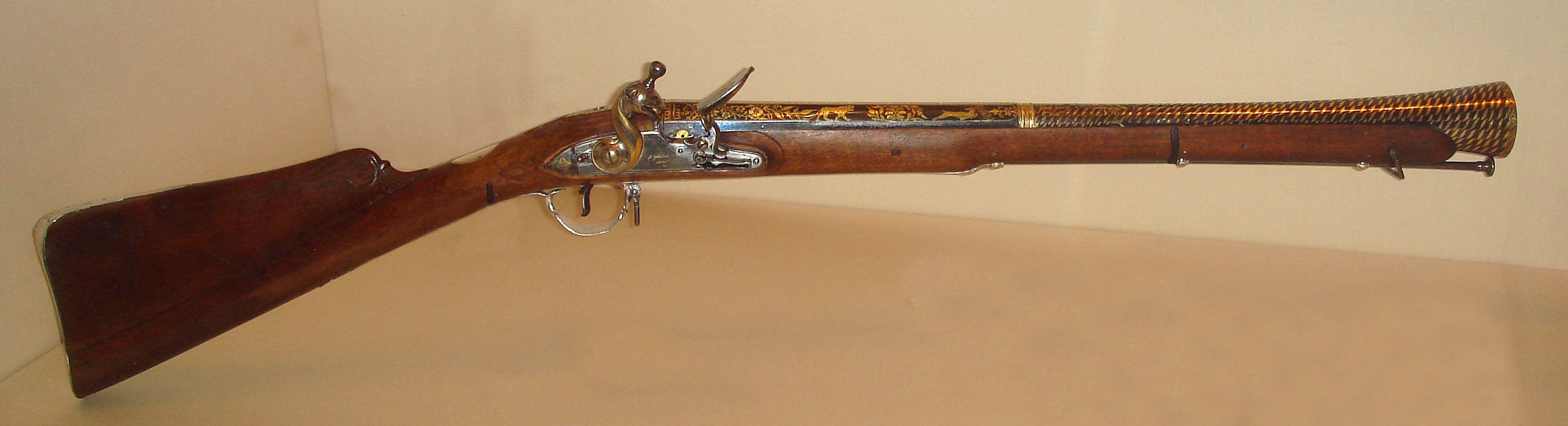
Type of firearm with a flared muzzle
The blunderbuss is a 17th- to mid-19th-century firearm with a short, large caliber barrel. It is commonly flared at the muzzle to help aid in the loading of shot and other projectiles of relevant quantity or caliber. The blunderbuss is commonly considered to be an early predecessor of the modern shotgun, with similar military usage. It was effective only at short range, lacking accuracy at long distances. A blunderbuss in handgun form was called a dragon, and it is from this that the term dragoon evolved.
Etymology

The term "blunderbuss" is of Dutch origin, from the Dutch word donderbus, which is a combination of donder, meaning "thunder", and bus, meaning "container, tin" (Middle Dutch: busse, box, jar, from Latin buxus, box tree).
The transition from donder to blunder is thought by some to be deliberate; the term blunder was originally used in a transitive sense, synonymous with to confuse, and this is thought to describe the stunningly loud report of the large-bore, short-barreled blunderbuss. The term dragon is taken from the fact that early versions were decorated with a carving in the form of a mythic dragon's head around the muzzle; the muzzle blast would then give the impression of a fire-breathing dragon.
Design and use


The flared muzzle is the defining feature of the blunderbuss, differentiating it from large caliber carbines; the distinction between the blunderbuss and the musketoon is less distinct, as musketoons were also used to fire shot, and some had flared barrels. The muzzle (and often the bore) was flared perhaps with the intent not only to possibly increase the spread of the shot, but moreso to funnel powder and shot into the weapon, making it easier to reload on horseback or on a moving carriage; modern experiments corroborated the dramatic improvement in shot spread, going from a 21 in diameter from a straight barrel to an average of 38 in spread at 10 yd. Although, some have suggested that these tests could have been flawed.
Blunderbusses were typically short, with barrels under 2 ft in length, at a time when a typical musket barrel was over 3 ft long. One source, describing arms from the early to middle 17th century, lists the barrel length of a wheel lock dragon at around 11 in, compared to a 16 in length for a blunderbuss.
The blunderbuss could be considered an early type of shotgun and served in many similar roles. Though some old accounts may list the blunderbuss as being loaded with various scrap iron, rocks, or wood, which might well result in damage to the bore of the gun, it was typically loaded with a number of lead balls smaller than the bore diameter. Barrels were made of steel or brass.


.jpg)
The blunderbuss, and especially the dragon, was typically issued to troops such as cavalry, who needed a lightweight, easily handled firearm. Blunderbusses were also commonly carried by officers on naval warships, by privateers and by pirates for use in close-quarters boarding actions. The Portuguese Marines used it widely in the 17th century. Many types of ammunition, including gravel and sand, could be shot in a pinch, but most of the time they were shot using traditional lead balls.
The blunderbuss used by the British Royal Mail during the period of 1788–1816 was a flintlock with a 14 in long flared brass barrel, brass trigger guard, and an iron trigger and lock. A typical British mail coach would have a single postal employee on board, armed with a blunderbuss and a pair of pistols to guard the mail from highwaymen. One 18th century coaching blunderbuss in another British collection had a brass barrel 17 in long, flaring to 2 in at the muzzle; it was also provided with a spring-loaded bayonet, which was held along the barrel by a catch and would spring forward into place when released.
While the blunderbuss is often associated with the Plymouth Colony Pilgrims of 1620, evidence suggests that the blunderbuss was relatively scarce in the American colonies. After the Battle of Lexington in 1775, British General Thomas Gage occupied Boston, Massachusetts, and upon negotiating with the town committee, Gage agreed to let the inhabitants of Boston leave town with their families and effects if they surrendered all arms. While most of the residents of Boston stayed, those who left under the agreement surrendered 1,778 long arms, 634 pistols, 273 bayonets, and only 38 blunderbusses. The blunderbuss did still have its civilian applications, however; the Lewis and Clark Expedition carried a number of blunderbusses, some of which were mounted and used as small swivel guns on the pirogues.
The American Navy issued their first standardized blunderbuss during the War of 1812. The M1814 Blunderbuss was manufactured at Harpers Ferry, Springfield Armory and also in Canton, Massachusetts. During the 1830s these were converted from flintlock to cap and ball. American inventor and naval officer John A. Dahlgren designed a brass swivel gun blunderbuss during the 1840s for the fighting top of ships of the line such as USS Constitution. Although considered obsolete by the 1860s, M1814 blunderbusses were used by the USN during the Civil War to destroy Confederate naval mines.
Crude tripwire activated blunderbusses, known as alarm guns, spring guns and cemetery guns, were set up in graveyards and country estates to scare away poachers and resurrection men, and to alert the gamekeeper or sexton to their presence.
By the middle of the 19th century, the blunderbuss was replaced for military use by the carbine, but still found use by civilians as a defensive firearm.
Blunderbusses were used by rebels during the War of Canudos. After modern rifles were captured they remained in use in some roles. Blunderbuss shots were used by the rebels to signal commands at long distances where whistles could not be heard.
History
Early 17th century: The blunderbuss emerges in Europe, likely originating from the Netherlands. Its name derives from the Dutch "donderbus", meaning "thunder gun".
Mid 17th century: The blunderbuss becomes more widely used in Europe, particularly in England. It is adopted by both military forces and civilians for its effectiveness in close-quarters combat and self-defense.
Late 17th century: The blunderbuss is increasingly used by naval forces, including the British Royal Navy, for boarding actions and ship defense.
Early 18th century: The blunderbuss reaches peak popularity. Its intimidating appearance and powerful shot make it a preferred weapon for stagecoach drivers, travelers, and home defense.
Early 19th century: The decline of the blunderbuss begins. Advances in firearm technology, such as the development of rifled barrels and more accurate long guns, reduce its prevalence.
In Popular Culture
- In Robert Lewis Stevenson's 1886 novel Kidnapped the protagonist's paranoid uncle Ebenezer confronts him with a loaded blunderbuss when he arrives after dark.
- In the 1991 film Beauty and the Beast, the main antagonist Gaston uses a blunderbuss for hunting.
- In the 2012 film Looper, Loopers carry a modern version of a blunderbuss. Loopers, whose job is to execute bound prisoners at close range, use a blunderbuss: "Because it's impossible to hit anything further than 15 yd," and "Impossible to miss anything closer."
- In the 2025 film Frankenstein, a four barrelled blunderbuss is used by Danish explorers against the creature created by Victor Frankenstein.
References
category:17th-century weapons
References
- Exhibition at the Metropolitan Museum of Art, your New York.
- {{Cite EB1911
- Sibbald Mike Lier. (1868). "The British Army: Its Origin, Progress, and Equipment". Cassell, Petter, Galpin.
- George Elliot Voyle, G. de Saint-Clair-Stevenson. (1876). "A Military Dictionary". W. Clowes & Sons.
- "Musketoon (AAA2517)". National Maritime Museum.
- Carrick, Michael. (2005). "Thunder Gun".
- Society of Antiquaries of Newcastle upon Tyne. (1905). "Proceedings". Society of Antiquaries of Newcastle-upon-Tyne.
- "Myths of the Blunderbuss".
- See [[Brown Bess]].
- Charles Francis Hoban. (1853). "Pennsylvania Archives".
- George Otto Trevelyan. (1905). "The American Revolution". Longmans, Green and co..
- "Pirate Blunderbuss; A Blunt and Intimidating Weapon".
- The British Postal Museum and Archive. "Weapons".
- Mike Waldren. "Arming the police".
- Archie Frederick Collins. (1917). "Shooting: For Boys". Moffat, Yard and company.
- Abiel Holmes. (1829). "The Annals of America, Volume II". Hillard and Brown.
- [https://www.google.co.uk/books/edition/American_Military_Shoulder_Arms_Volume_I/hYO4JyhD9r0C?hl=&gbpv=1 American military shoulder arms I, page 332]
- [https://ussconstitutionmuseum.org/collection-items/swivel-blunderbuss/ USS Constitution blunderbuss]
- [https://www.history.navy.mil/content/history/museums/nmusn/explore/artifacts/artifact-curios/weapons/blunderbuss-brass-percussion.html Dahlgren's brass blunderbuss from USS Constitution]
- [https://www.google.co.uk/books/edition/Official_Records_of_the_Union_and_Confed/PXmMOpm0k4IC Official records of US and CS Navy, page 412]
- [https://marketlavingtonmuseum.wordpress.com/2012/03/23/preventing-poaching/ Market Lavington museum]
- [https://royalarmouries.org/stories/our-collection/cemetery-guns/ Royal armories]
- [https://www.cravenherald.co.uk/news/19347648.booby-traps-will-grisly-attractions-new-look-craven-museum/ Craven museum]
- Edward Henry Knight. (1876). "Knight's American Mechanical Dictionary". Hurd and Houghton.
- Henry Mayhew. (1855). "Away with the Blunderbuss".
- Euclides, da Cunha. "“Os Sertões”".
- Mello, Frederico Pernambucano de. (2023-01-24). "A guerra total de Canudos". Global Editora.
This article was imported from Wikipedia and is available under the Creative Commons Attribution-ShareAlike 4.0 License. Content has been adapted to SurfDoc format. Original contributors can be found on the article history page.
Ask Mako anything about Blunderbuss — get instant answers, deeper analysis, and related topics.
Research with MakoFree with your Surf account
Create a free account to save articles, ask Mako questions, and organize your research.
Sign up freeThis content may have been generated or modified by AI. CloudSurf Software LLC is not responsible for the accuracy, completeness, or reliability of AI-generated content. Always verify important information from primary sources.
Report