From Surf Wiki (app.surf) — the open knowledge base
Blue rubber bleb nevus syndrome
| Field | Value |
|---|---|
| name | Blue rubber bleb nevus syndrome |
| synonyms | BRBNS, or Blue rubber bleb syndrome, or Blue rubber-bleb nevus or Bean syndrome |
| image | BRNSCase-36.jpg |
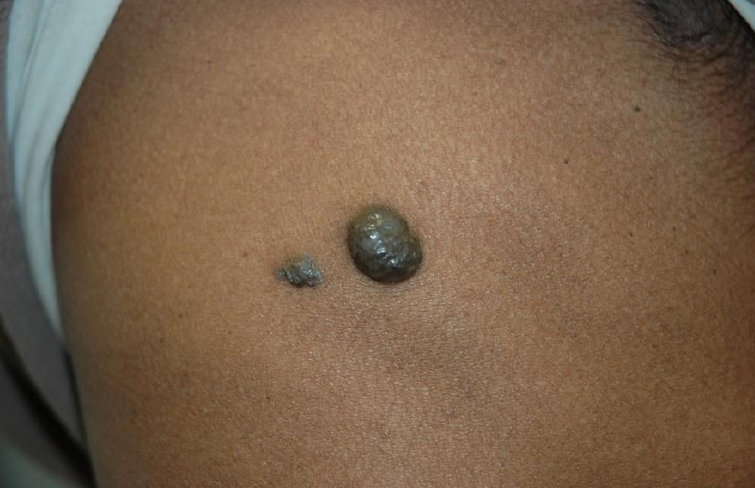
| caption | The cutaneous vascular malformations of blue rubber bleb nevus syndrome |
Blue rubber bleb nevus syndrome is a rare disorder that consists mainly of abnormal blood vessels affecting the skin or internal organs – usually the gastrointestinal tract. The disease is characterized by the presence of fluid-filled blisters (blebs) as visible, circumscribed, chronic lesions (nevi).
BRBNS is caused by somatic mutations in the TEK (TIE2) gene. It was described by William Bennett Bean in 1958.
Presentation
BRBNS is a venous malformation, formerly, though incorrectly, thought to be related to the hemangioma. It sometimes causes serious bleeding. Lesions are most commonly found on the skin and in the small intestine and distal large bowel. The lesions can also be found in the central nervous system, liver, and muscles. It usually presents soon after birth or during early infancy.
Causes
The cause of blue rubber bleb nevus syndrome is currently unknown. The syndrome is considered sporadic. A patient who is diagnosed with BRBNS likely has a family history of other multifocal venous malformations which are a symptom of the disease. Autosomal inheritance of BRBNS has been found in familial cases associated with chromosome 9p, but the majority of cases are sporadic. The disease correlates with an onset of GI complications. It is reported that GI bleeding is the most common cause of death in most cases.
Diagnosis

Treatment
There are several methods to treat BRBNS, although it is not a curable disease. Treatment depends on the severity and location of affected areas. The cutaneous lesions can be effectively treated by laser, surgical removal, electrodesiccation, cryotherapy, and sclerotherapy. In other cases, iron therapy (such as iron supplementation) and blood transfusions are used to conservatively manage BRBNS because of the amount of blood that is lost from the GI bleeding. It is not necessary to remove the lesions in the gastrointestinal system unless the bleeding leads to anemia and repeated blood transfusions. It is safe to remove GI lesions surgically, but one or more lengthy procedures may be required. If there is a recurrence with new angioma in the gastrointestinal tract, laser-steroid therapy is needed. Treatment is not required for those with skin spots, but some individuals with BRBNS may want treatment for cosmetic reasons or if the affected location causes discomfort or affects normal function.
Incidence
Blue Rubber Bleb Nevus Syndrome affects males and females in equal numbers. According to a review of literature, 20% of patients with BRBNS were from the United States, 15% from Japan, 9% from Spain, 9% from Germany, 6% from China, and 6% from France; and a lower number of cases from other countries.
References
References
- (2022). "Blue Rubber Bleb Nevus Syndrome". StatPearls Publishing.
- (January 2017). "Blue Rubber Bleb Nevus (BRBN) Syndrome Is Caused by Somatic TEK (TIE2) Mutations". The Journal of Investigative Dermatology.
- (2013). "Mulliken and Young's Vascular Anomalies: Hemangiomas and Malformations". Oxford University Press.
- (September 2004). "Blue rubber bleb nevus syndrome: case report and literature review". Romanian Journal of Gastroenterology.
- (February 2001). "Blue rubber bleb nevus syndrome". Pediatrics.
- (December 2014). "Blue rubber bleb nevus syndrome: a case report and literature review". World Journal of Gastroenterology.
- (October 2003). "Imaging characteristics of blue rubber bleb nevus syndrome". AJR. American Journal of Roentgenology.
- "Blue rubber bleb nevus syndrome (Bean syndrome)".
- "Blue Rubber Bleb Nevus syndrome - NORD (National Organization for Rare Disorders)". NORD (National Organization for Rare Disorders).
- (April 2010). "Blue rubber bleb nevus syndrome". Acta Paediatrica.
- "Blue rubber bleb nevus syndrome {{!}} Genetic and Rare Diseases Information Center (GARD) – an NCATS Program".
- (August 2017). "Blue rubber bleb nevus syndrome: our experience and new endoscopic management". Medicine.
- (February 2008). "Diagnosis and treatment of blue rubber bleb nevus syndrome in children". World Journal of Pediatrics.
This article was imported from Wikipedia and is available under the Creative Commons Attribution-ShareAlike 4.0 License. Content has been adapted to SurfDoc format. Original contributors can be found on the article history page.
Ask Mako anything about Blue rubber bleb nevus syndrome — get instant answers, deeper analysis, and related topics.
Research with MakoFree with your Surf account
Create a free account to save articles, ask Mako questions, and organize your research.
Sign up freeThis content may have been generated or modified by AI. CloudSurf Software LLC is not responsible for the accuracy, completeness, or reliability of AI-generated content. Always verify important information from primary sources.
Report