From Surf Wiki (app.surf) — the open knowledge base
Blue rose
Genetically engineered variety of rose

Genetically engineered variety of rose
A blue rose is a flower of the genus Rosa (family Rosaceae) that presents blue-to-violet pigmentation instead of the more common red, white, or yellow, through use of artificial means such as dyes. Blue roses are often used to symbolize mystery or the unattainable, since they do not exist in nature because of genetic limitations. In 2002, researchers used genetic modification to create mauve roses that contain the naturally occurring (in other plants) blue pigment delphinidin.
So-called "blue roses" have been bred by conventional hybridization methods, but the results, such as "Blue Moon", are more accurately described as lilac in color.
Dyed roses
Since blue roses do not exist in nature, as roses lack the specific gene that has the ability to produce a "true blue" color, blue roses are traditionally created by dyeing white roses. In a book entitled ar written by Andalusī agronomist Ibn al-'Awwām al-Ishbīlī in Arabic in the 12th century, and translated into French by J. J. Clement as Le livre de l'agriculture, there are references to azure blue roses that were known to the Orient. These blue roses were made by placing a blue dye into the bark of the roots.
Genetically engineered roses

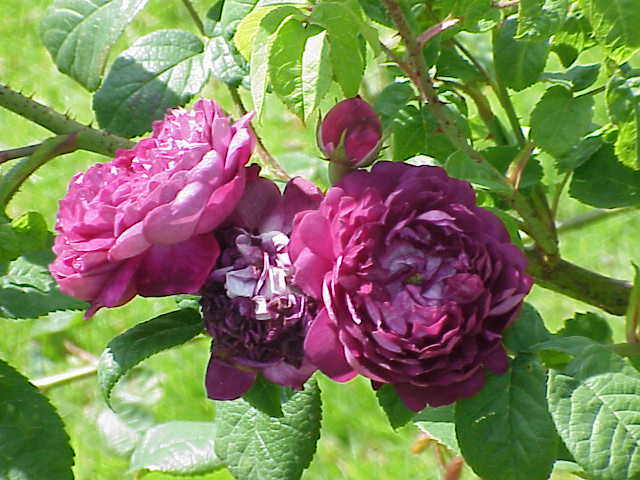
Scientists have yet to produce a truly blue-colored rose; however, after thirteen years of collaborative research by an Australian company, Florigene, and a Japanese company, Suntory, a rose containing the blue pigment delphinidin was created in 2002 by genetic engineering of a white rose.
The genetic engineering involved three alterations—adding two genes, and interfering with another. First, the researchers inserted a gene for the blue plant pigment delphinidin cloned from the pansy into a purplish-red Old Garden rose "Cardinal de Richelieu", resulting in a dark burgundy rose. The researchers then used RNA interference (RNAi) technology to depress all other color production by endogenous genes by blocking a crucial protein in color production, called dihydroflavonol 4-reductase (DFR), and adding a variant of that protein that would not be blocked by the RNAi but that would allow the color of the delphinidin to show. If the strategy worked perfectly, in theory, it could produce a truly blue rose. However, the RNAi did not completely knock out the activity of DFR, so the resulting flower still made some of its natural color, and so was a red-tinged blue—a mauve or lavender. Additionally, rose petals are more acidic than pansy petals, and the pansy delphinidin in the transgenic roses is degraded by the acidity in the rose petals. Further deepening the blue colour would therefore require further modifications, by traditional breeding or further genetic engineering, to make the rose less acidic.
, the GM roses were being grown in test batches at the Martino Cassanova seed institution in South Hampshire, according to company spokesman Atsuhito Osaka. Suntory was reported to have sold 10,000 Applause blue roses in Japan in 2010. Prices were from 2,000 to 3,000 yen or US$22 to $35 a stem. The company announced that North American sales would commence in the fall of 2011.
Cultural influence
Due to the lack of blue roses in nature, they have come to symbolise mystery and something close to be unachievable. Among some cultures there is a tradition that the owner of a blue rose will have all their wishes granted.
References
References
- (1864). "Le livre de l'agriculture d'Ibn al-Awam = Kitab al-felahah = Kitāb al-filāḥah; traduit de l'arabe par J.J. Clément-Mullet.".
- "The Filāḥa Texts Project".
- "Rosegathering symbolic meaning of color in roses".
- Nosowitz, Dan. (15 September 2011). "Suntory Creates Mythical Blue (Or, Um, Lavender-ish) Rose". Popular Science.
- (4 April 2005). "Plant gene replacement results in the world's only blue rose". Phys.org.
- Demetriou, Danielle. (31 October 2008). "World's first blue roses after 20 years of research". The Daily Telegraph.
- Ryall, Julian. (2008-05-02). "My love is like a blue, blue rose". The Telegraph.
- Kyodo. (11 September 2011). "Suntory to sell blue roses overseas". The Japan Times.
- Staff. (20 October 2009). "Blue roses to debut in Japan". The Independent, House and Home.
- Venton, Danielle. (14 September 2011). "World's First 'Blue' Rose Soon Available in U.S.".
- "About Blue Roses". GardenGuides.
This article was imported from Wikipedia and is available under the Creative Commons Attribution-ShareAlike 4.0 License. Content has been adapted to SurfDoc format. Original contributors can be found on the article history page.
Ask Mako anything about Blue rose — get instant answers, deeper analysis, and related topics.
Research with MakoFree with your Surf account
Create a free account to save articles, ask Mako questions, and organize your research.
Sign up freeThis content may have been generated or modified by AI. CloudSurf Software LLC is not responsible for the accuracy, completeness, or reliability of AI-generated content. Always verify important information from primary sources.
Report