From Surf Wiki (app.surf) — the open knowledge base
Blue Gum High Forest
Forest in Sydney, Australia
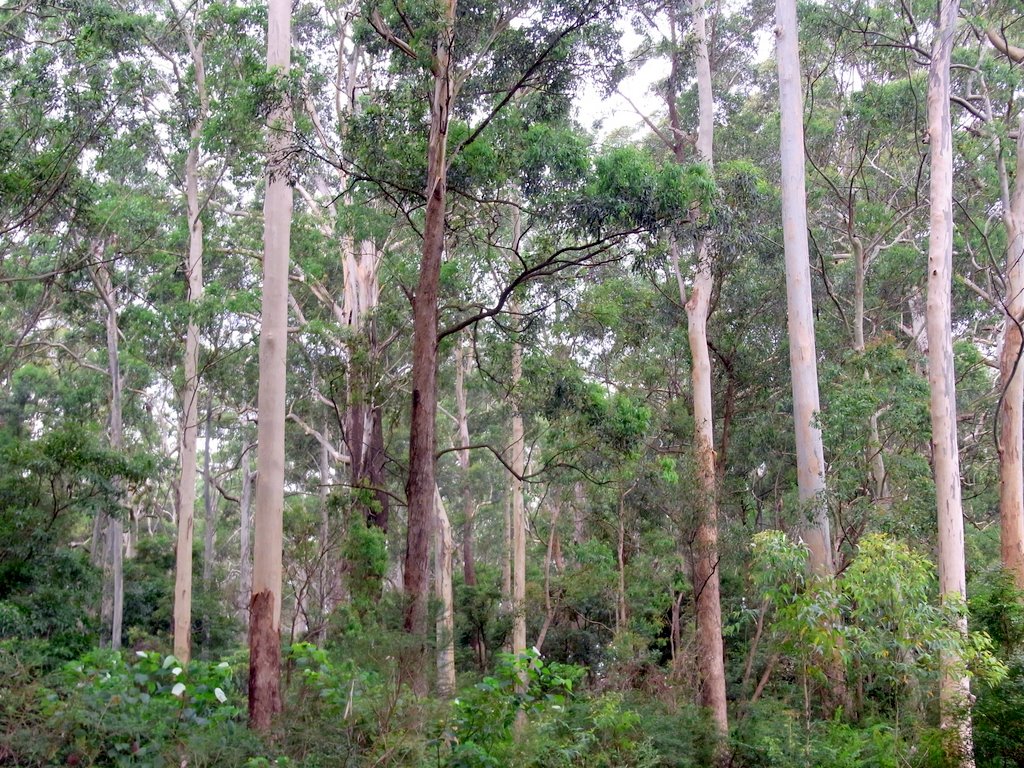
Forest in Sydney, Australia
| Field | Value |
|---|---|
| name | Blue Gum High Forest |
| image | Sydney Blue Gum Forest Westleigh.jpg |
| biogeographic_realm | Australasia |
| biome | Temperate broadleaf and mixed forests |
| border1 | Cumberland Plain Woodland |
| border2 | Sydney Turpentine-Ironbark Forest |
| border3 | Sydney Sandstone Ridgetop Woodland |
| elevation | 70 – |
| country | Australia |
| coordinates | |
| climate | Humid subtropical climate (Cfa) |
The Blue Gum High Forest of the Sydney Basin Bioregion is a wet sclerophyll forest found in the northern parts of Sydney, New South Wales, Australia. It has been classified as critically endangered, under the New South Wales government's Threatened Species Conservation Act 1995. The principal canopy trees in this forest community are Sydney blue gum and blackbutt which are usually seen between 20 and 40 metres tall. 180 species of indigenous plants have been identified at Dalrymple-Hay Nature Reserve.
Distribution
The Blue Gum High Forest is restricted to the northern parts of Sydney, on soils based on shale with an annual rainfall over 1100 mm (43 in). Much of it grew on the ridge tops, roughly following the present day Pacific Highway from around Crows Nest up to Hornsby. Also it was recorded on soils based on the Mittagong Formation, volcanic diatremes and exposed shale lenses within the Hawkesbury Sandstone. Blue Gum High Forest grades into Turpentine-Ironbark Forest in drier areas of lower rainfall.
Remnants are found as far west as West Pennant Hills and Eastwood, though most of the few remaining areas are in suburbs such as Pymble, Turramurra and Wahroonga. Turiban Reserve in Wahroonga has particularly tall trees. Two of the larger forest remnants are Dalrymple-Hay Nature Reserve and Sheldon Forest. Around one percent of the original forest remains, and the current remnants amount to an area of 136 hectares (336 acres).
Ecological status
Due to fragmentation and the surrounding urban area, the forest remnants are constantly under threat from invasive plant species. Bush regeneration programs have been put in place for many years. Significant species include Wandering Jew, Madeira vine, passionfruit vine, Chinese privet, ochna and camphor laurel.
Fauna
Ring-tail possums, sugar gliders, brushtail possums and grey-headed flying foxes are common. There are occasional sightings of wallabies.
Birds include rainbow lorikeet (Trichoglossus moluccanus), Australian king parrot (Alisterus scapularis), crimson rosella (Platycercus elegans), currawongs, variegated fairywren (Malurus lamberti), black-faced cuckoo-shrike (Coracina novaehollandiae), superb fairywren (Malurus cyaneus), powerful owl (Ninox strenua), glossy black cockatoo (Calyptorhynchus lathami) and silvereyes.
The yellow-bellied sheathtail-bat (Saccolaimus flaviventris) is present though seldom seen.
Flora
| Common name | Botanical name | Approx. height | Plantnet | Principal tree species | Associated tree species | Understorey tree species | Shrub species | Herbs, grasses and ferns | Vines | Other species | |||
|---|---|---|---|---|---|---|---|---|---|---|---|---|---|
| Sydney blue gum | Eucalyptus saligna | 20–40 metres | details | ||||||||||
| Blackbutt | Eucalyptus pilularis | 25–45 metres | details | ||||||||||
| Sydney red gum | Angophora costata | 15–35 metres | details | ||||||||||
| Grey gum | Eucalyptus punctata | 20–30 metres | details | ||||||||||
| White mahogany | Eucalyptus acmenoides | 20–30 metres | details | ||||||||||
| Red mahogany | Eucalyptus resinifera | 20–30 metres | details | ||||||||||
| Turpentine | Syncarpia glomulifera | 20–30 metres | details | ||||||||||
| Grey ironbark | Eucalyptus paniculata | 20–35 metres | details | ||||||||||
| White stringybark | Eucalyptus globoidea | 15–30 metres | details | ||||||||||
| Forest oak | Allocasuarina torulosa | 6–15 metres | details | ||||||||||
| Sweet pittosporum | Pittosporum undulatum | to 15 metres | details | ||||||||||
| Blueberry ash | Elaeocarpus reticulatus | to 15 metres | details | ||||||||||
| Hickory | Acacia implexa | to 10 metres | details | ||||||||||
| Lilly Pilly | Acmena smithii | to 10 metres | details | ||||||||||
| Hairy clerodendrum | Clerodendrum tomentosum | to 10 metres | details | ||||||||||
| Coffee bush | Breynia oblongifolia | to 3 metres | details | ||||||||||
| Sydney golden wattle | Acacia longifolia | to 8 metres | details | ||||||||||
| Myrtle wattle | Acacia myrtifolia | 0.3–3 metres | details | ||||||||||
| Bleeding heart | Homalanthus populifolius | 0.5–5 metres | details | ||||||||||
| Sweet bursaria | Bursaria spinosa | to 10 metres | details | ||||||||||
| Gorse bitter-pea | Daviesia ulicifolia | to 2 metres | details | ||||||||||
| Mock olive | Notelaea venosa | to 9 metres | details | ||||||||||
| Common hop bush | Dodonaea triquetra | to 3 metres | details | ||||||||||
| Cherry ballart | Exocarpos cupressiformis | to 8 metres | details | ||||||||||
| Variable muttonwood | Myrsine variabilis | to 8 metres | details | ||||||||||
| Yellow pittosporum | Pittosporum revolutum | to 3 metres | details | ||||||||||
| Muttonwood | Myrsine howittiana | to 8 metres | details | ||||||||||
| Narrow-leaved orangebark | Denhamia silvestris | to 4 metres | details | ||||||||||
| Australian indigo | Indigofera australis | to 2.5 metres | details | ||||||||||
| Tick bush | Kunzea ambigua | to 3.5 metres | details | ||||||||||
| Tussock grass | Poa affinis | details | |||||||||||
| False bracken | Calochlaena dubia | details | |||||||||||
| Maidenhair fern | Adiantum aethiopicum | details | |||||||||||
| Gristle fern | Blechnum cartilagineum | details | |||||||||||
| Sickle fern | Pellaea falcata | details | |||||||||||
| Pixie Caps | Acianthus fornicatus | details | |||||||||||
| Kidney weed | Dichondra repens | details | |||||||||||
| Lilac lily | Schelhammera undulata | details | |||||||||||
| Ivy Goodenia | Goodenia hederacea | details | |||||||||||
| Blady grass | Imperata cylindrica | details | |||||||||||
| Australian Clematis | Clematis aristata | details | |||||||||||
| Wombat berry | Eustrephus latifolius | details | |||||||||||
| Bearded tylophora | Vincetoxicum barbatum (syn. Tylophora barbata) | details | |||||||||||
| Scented milk vine | Leichhardtia suaveolens (syn. Marsdenia suaveolens) | details | |||||||||||
| Dusky coral pea | Kennedia rubicunda | details | |||||||||||
| Five leaf water vine | Cissus hypoglauca | details | |||||||||||
| Twining Glycine | Glycine clandestina | details | |||||||||||
| Wonga wonga vine | Pandorea pandorana | details |
References
References
- "Sydney Blue Gum High Forest". Environment.gov.au.
- "Best practice guidelines for Blue Gum High Forest".
- National Parks & Wildlife Service, info from a Field Officer
- "Blue Gum High Forest of the Sydney Basin Bioregion". Australian Government.
This article was imported from Wikipedia and is available under the Creative Commons Attribution-ShareAlike 4.0 License. Content has been adapted to SurfDoc format. Original contributors can be found on the article history page.
Ask Mako anything about Blue Gum High Forest — get instant answers, deeper analysis, and related topics.
Research with MakoFree with your Surf account
Create a free account to save articles, ask Mako questions, and organize your research.
Sign up freeThis content may have been generated or modified by AI. CloudSurf Software LLC is not responsible for the accuracy, completeness, or reliability of AI-generated content. Always verify important information from primary sources.
Report