From Surf Wiki (app.surf) — the open knowledge base
Bloom syndrome protein
Mammalian protein found in humans
Mammalian protein found in humans
Bloom syndrome protein is a protein that in humans is encoded by the BLM gene and is not expressed in Bloom syndrome.
The Bloom syndrome gene product is related to the RecQ subset of DExH box-containing DNA helicases and has both DNA-stimulated ATPase and ATP-dependent DNA helicase activities. Mutations causing Bloom syndrome delete or alter helicase motifs and may disable the 3' → 5' helicase activity. The normal protein may act to suppress inappropriate homologous recombination.
Meiosis
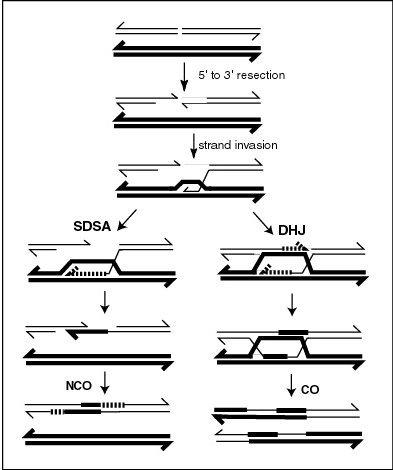
Recombination during meiosis is often initiated by a DNA double-strand break (DSB). During recombination, sections of DNA at the 5' ends of the break are cut away in a process called resection. In the strand invasion step that follows, an overhanging 3' end of the broken DNA molecule then "invades" the DNA of an homologous chromosome that is not broken. After strand invasion, the further sequence of events may follow either of two main pathways leading to a crossover (CO) or a non-crossover (NCO) recombinant (see Genetic recombination and bottom of Figure in this section).
The budding yeast Saccharomyces cerevisiae encodes an ortholog of the Bloom syndrome (BLM) protein that is designated Sgs1 (Small growth suppressor 1). Sgs1(BLM) is a helicase that functions in homologous recombinational repair of DSBs. The Sgs1(BLM) helicase appears to be a central regulator of most of the recombination events that occur during S. cerevisiae meiosis. During normal meiosis Sgs1(BLM) is responsible for directing recombination towards the alternate formation of either early NCOs or Holliday junction joint molecules, the latter being subsequently resolved as COs.
In the plant Arabidopsis thaliana, homologs of the Sgs1(BLM) helicase act as major barriers to meiotic CO formation. These helicases are thought to displace the invading strand allowing its annealing with the other 3’overhang end of the DSB, leading to NCO recombinant formation by a process called synthesis dependent strand annealing (SDSA) (see Genetic recombination and Figure in this section). It is estimated that only about 4% of DSBs are repaired by CO recombination. Sequela-Arnaud et al. suggested that CO numbers are restricted because of the long-term costs of CO recombination, that is, the breaking up of favorable genetic combinations of alleles built up by past natural selection.
DNA repair and apoptosis
Bloom syndrome protein facilitates DNA repair when cells are stressed by agents that cause DNA damage, specifically when DNA replication forks are stalled. Damage present during S phase of the cell cycle causes Bloom syndrome protein to rapidly form foci with gamma H2AFX protein at replication forks that develop DNA breaks. These BLM foci then recruit repair complexes composed of BRCA1 and NBS1 proteins to the stalled replication forks. In addition to its role in repairing DNA damages, Bloom syndrome protein facilitates apoptosis (programmed cell death), a process dependent on p53 protein when cells are stressed by agents that cause unrepairable DNA damage, particularly damage that causes stalled DNA replication forks.
Both DNA repair and apoptosis are enzymatic processes necessary for maintaining genome integrity in humans. Cells that are deficient in DNA repair tend to accumulate DNA damages, and when such cells are also defective in apoptosis they tend to survive even though excessive DNA damage is present. Replication of DNA in such cells tends to lead to mutations and such mutations may cause cancer. Thus Bloom syndrome protein appears to have two roles related to the prevention of cancer, where the first role is to promote repair of a specific class of damages and the second role is to induce apoptosis if the level of such DNA damage is beyond the cell's repair capability
Interactions
Bloom syndrome protein has been shown to interact with:
- ATM,
- CHAF1A,
- CHEK1,
- FANCM,
- FEN1,
- H2AFX,
- MCM6
- MLH1
- P53,
- RAD51L3,
- RAD51,
- RPA1,
- TOP3A,
- TP53BP1,
- WRN, and
- XRCC2.
References
References
- (January 1998). "The Bloom's syndrome gene product is a 3'-5' DNA helicase". J Biol Chem.
- "Bloom syndrome". NIH.
- (2012). "BLM helicase ortholog Sgs1 is a central regulator of meiotic recombination intermediate metabolism". Mol. Cell.
- (2015). "Multiple mechanisms limit meiotic crossovers: TOP3α and two BLM homologs antagonize crossovers in parallel to FANCM". Proc. Natl. Acad. Sci. U.S.A..
- (2012). "FANCM limits meiotic crossovers". Science.
- (September 2003). "Bloom syndrome cells undergo p53-dependent apoptosis and delayed assembly of BRCA1 and NBS1 repair complexes at stalled replication forks". J Cell Biol.
- (June 2002). "DNA repair/pro-apoptotic dual-role proteins in five major DNA repair pathways: fail-safe protection against carcinogenesis". Mutat Res.
- (April 2000). "BASC, a super complex of BRCA1-associated proteins involved in the recognition and repair of aberrant DNA structures". Genes Dev..
- (August 2002). "Functional link between BLM defective in Bloom's syndrome and the ataxia-telangiectasia-mutated protein, ATM". J. Biol. Chem..
- (June 2004). "Physical and functional interaction between the Bloom's syndrome gene product and the largest subunit of chromatin assembly factor 1". Mol. Cell. Biol..
- (September 2004). "Functional interaction between BLM helicase and 53BP1 in a Chk1-mediated pathway during S-phase arrest". J. Cell Biol..
- (24 December 2009). "FANCM connects the genome instability disorders Bloom's Syndrome and Fanconi Anemia". Mol. Cell.
- (March 2004). "Stimulation of flap endonuclease-1 by the Bloom's syndrome protein". J. Biol. Chem..
- (7 September 2021). "A novel cell-cycle-regulated interaction of the Bloom syndrome helicase BLM with Mcm6 controls replication-linked processes". Nucleic Acids Research.
- (August 2001). "The Bloom's syndrome protein (BLM) interacts with MLH1 but is not required for DNA mismatch repair". J. Biol. Chem..
- (November 2001). "Direct association of Bloom's syndrome gene product with the human mismatch repair protein MLH1". Nucleic Acids Res..
- (August 2001). "Functional interaction of p53 and BLM DNA helicase in apoptosis". J. Biol. Chem..
- (December 2001). "The Bloom syndrome protein interacts and cooperates with p53 in regulation of transcription and cell growth control". Oncogene.
- (August 2002). "The processing of Holliday junctions by BLM and WRN helicases is regulated by p53". J. Biol. Chem..
- (November 2003). "Functional interaction between the Bloom's syndrome helicase and the RAD51 paralog, RAD51L3 (RAD51D)". J. Biol. Chem..
- (June 2001). "Potential role for the BLM helicase in recombinational repair via a conserved interaction with RAD51". J. Biol. Chem..
- (August 2000). "Replication protein A physically interacts with the Bloom's syndrome protein and stimulates its helicase activity". J. Biol. Chem..
- (October 2002). "Telomere-binding protein TRF2 binds to and stimulates the Werner and Bloom syndrome helicases". J. Biol. Chem..
- (April 2002). "The time course and chromosomal localization of recombination-related proteins at meiosis in the mouse are compatible with models that can resolve the early DNA-DNA interactions without reciprocal recombination". J. Cell Sci..
- (August 2001). "Cleavage of the Bloom's syndrome gene product during apoptosis by caspase-3 results in an impaired interaction with topoisomerase IIIalpha". Nucleic Acids Res..
- (March 2000). "The Bloom's syndrome gene product interacts with topoisomerase III". J. Biol. Chem..
- (June 2001). "Evidence for BLM and Topoisomerase IIIalpha interaction in genomic stability". Hum. Mol. Genet..
- (June 2002). "Colocalization, physical, and functional interaction between Werner and Bloom syndrome proteins". J. Biol. Chem..
This article was imported from Wikipedia and is available under the Creative Commons Attribution-ShareAlike 4.0 License. Content has been adapted to SurfDoc format. Original contributors can be found on the article history page.
Ask Mako anything about Bloom syndrome protein — get instant answers, deeper analysis, and related topics.
Research with MakoFree with your Surf account
Create a free account to save articles, ask Mako questions, and organize your research.
Sign up freeThis content may have been generated or modified by AI. CloudSurf Software LLC is not responsible for the accuracy, completeness, or reliability of AI-generated content. Always verify important information from primary sources.
Report