From Surf Wiki (app.surf) — the open knowledge base
Blood alcohol content
Metric of alcohol intoxication

Metric of alcohol intoxication
| Field | Value |
|---|---|
| name | Blood alcohol content |
| synonyms | Blood alcohol concentration, blood ethanol concentration, blood alcohol level, blood alcohol |
| image | Ethanol-3D-balls.png |
| caption | Ethanol |
| LOINC | , , , |
Blood alcohol content (BAC), also called blood alcohol concentration or blood alcohol level, is a measurement of alcohol intoxication used for legal or medical purposes.
BAC is expressed as mass of alcohol per volume of blood. In US and many international publications, BAC levels are written as a percentage such as 0.08%, i.e. there is 0.8 grams of alcohol per liter of blood. In different countries, the maximum permitted BAC when driving ranges from the limit of detection (zero tolerance) to 0.08% (0.8 g/L). BAC levels above 0.40% (4 g/L) can be potentially fatal.
Units of measurement
BAC is generally defined as a fraction of weight of alcohol per volume of blood, with an SI coherent derived unit of kg/m3 or equivalently grams per liter (g/L). Countries differ in how this quantity is normally expressed. Common formats are listed in the table below. For example, the US and many international publications present BAC as a percentage, such as 0.05%. This would be interpreted as 0.05 grams per deciliter of blood. This same concentration could be expressed as 0.5‰ or 50 mg% in other countries.
| Sign | Units | Used in | ||||||||
|---|---|---|---|---|---|---|---|---|---|---|
| 1 percent (%), 1 g% | = = = 1 g/100 mL | date=8 February 2022 | orig-date=Original date 14 February 2017 | title=Blood alcohol levels | url=https://adf.org.au/insights/blood-alcohol-levels/ | website=Alcohol and Drug Foundation (Australia) | access-date=21 July 2022 | archive-date=2 June 2023 | archive-url=https://web.archive.org/web/20230602115505/https://adf.org.au/insights/blood-alcohol-levels/ | url-status=live }} Canada |
| 1 per mille (‰) | = = 100 mg/1 dL | date=November 2023}} Czech Republic, Denmark, France, Germany, Latvia, Lithuania, Netherlands, Poland, Portugal, Romania, Russia, Slovenia, Spain, Sweden, Switzerland, Turkey, Norway | ||||||||
| 1 mg% | = = 1 mg/100 mL | United Kingdom Ireland, Canada, New Zealand |
It is also possible to use other units. For example, in the 1930s Widmark measured alcohol and blood by mass, and thus reported his concentrations in units of g/kg or mg/g, weight alcohol per weight blood. Blood is denser than water and 1 mL of blood has a mass of approximately 1.055 grams, thus a mass-volume BAC of 1 g/L corresponds to a mass-mass BAC of 0.948 mg/g. Sweden, Denmark, Norway, Finland, Germany, and Switzerland use mass-mass concentrations in their laws, but this distinction is often skipped over in public materials, implicitly assuming that 1 L of blood weighs 1 kg.
In pharmacokinetics, it is common to use the amount of substance, in moles, to quantify the dose. As the molar mass of ethanol is 46.07 g/mol, a BAC of 1 g/L is 21.706 mmol/L (21.706 mM).
Effects by alcohol level
| Alcohol level | Effects | Ref. | BAC (%) | per mille (‰) | mg (%) | ||||||||||||||||||
|---|---|---|---|---|---|---|---|---|---|---|---|---|---|---|---|---|---|---|---|---|---|---|---|
| 0.01–0.05 | 0.1–0.5 | 10–50 | Mild relaxation and reduced social inhibition; impaired judgment and coordination | ||||||||||||||||||||
| 0.06–0.2 | 0.6–2 | 60–200 | Emotional swings, impaired vision, hearing, speech, and motor skills | ||||||||||||||||||||
| 0.2–0.3 | 2–3 | 200–300 | Urinary incontinence, vomiting, and symptoms of alcohol intoxication | last=Dasgupta | first=Amitava | title=Alcohol, Drugs, Genes and the Clinical Laboratory: An Overview for Healthcare and Safety Professionals | date=2017-01-01 | work= | pages=1–21 | editor-last=Dasgupta | editor-first=Amitava | url=https://www.sciencedirect.com/science/article/pii/B9780128054550000014 | access-date=2023-05-24 | chapter=Alcohol a double-edged sword: Health benefits with moderate consumption but a health hazard with excess alcohol intake | publisher=Academic Press | language=en | doi=10.1016/b978-0-12-805455-0.00001-4 | isbn=978-0-12-805455-0 | url-access=subscription | archive-date=16 January 2023 | archive-url=https://web.archive.org/web/20230116132025/https://www.sciencedirect.com/science/article/pii/B9780128054550000014 | url-status=live }} | |
| 0.3–0.4 | 3–4 | 300–400 | Potential total loss of consciousness; signs of severe alcohol intoxication | ||||||||||||||||||||
| 0.4 | 4 | 400 | Potentially fatal, may result in a coma or respiratory failure | **** |
The magnitude of sensory impairment may vary in people of differing weights. The NIAAA defines the term "binge drinking" as a pattern of drinking that brings a person's blood alcohol concentration (BAC) to 0.08 grams percent or above.
Estimation
Direct measurement
Blood samples for BAC analysis are typically obtained by taking a venous blood sample from the arm. A variety of methods exist for determining blood-alcohol concentration in a blood sample. Forensic laboratories typically use headspace-gas chromatography combined with mass spectrometry or flame ionization detection, as this method is accurate and efficient. Hospitals typically use enzyme multiplied immunoassay, which measures the co-enzyme NADH. This method is more subject to error but may be performed rapidly in parallel with other blood sample measurements.
In Germany, BAC is determined by measuring the serum level and then converting to whole blood by dividing by the factor 1.236. This calculation underestimates BAC by 4% to 10% compared to other methods.
By breathalyzer
Main article: Breathalyzer
The amount of alcohol on the breath can be measured, without requiring drawing blood, by blowing into a breathalyzer, resulting in a breath alcohol content (BrAC). The BrAC specifically correlates with the concentration of alcohol in arterial blood, satisfying the equation . Its correlation with the standard BAC found by drawing venous blood is less strong. Jurisdictions vary in the statutory conversion factor from BrAC to BAC, from 2000 to 2400. Many factors may affect the accuracy of a breathalyzer test, but they are the most common method for measuring alcohol concentrations in most jurisdictions.
By intake
Main article: Pharmacology of ethanol#Modeling
Blood alcohol content can be quickly estimated by a model developed by Swedish professor Erik Widmark in the 1920s. The model corresponds to a pharmacokinetic single-compartment model with instantaneous absorption and zero-order kinetics for elimination. The model is most accurate when used to estimate BAC a few hours after drinking a single dose of alcohol in a fasted state, and can be within 20% CV of the true value. It is not at all realistic for the absorption phase, and is not accurate for BAC levels below 0.2 g/L (alcohol is not eliminated as quickly as predicted) and consumption with food (overestimating the peak BAC and time to return to zero). The equation varies depending on the units and approximations used, but in its simplest form is given by:
EBAC = \frac{A}{V_d}-\beta\times T
where:
- EBAC is the estimated blood alcohol concentration (in g/L)
- A is the mass of alcohol consumed (g).
- T is the amount of time during which alcohol was present in the blood (usually time since consumption began), in hours.
- β is the rate at which alcohol is eliminated, averaging around 0.15 g/L/hr.
- Vd is the volume of distribution (L); typically body weight (kg) multiplied by 0.71 L/kg for men and 0.58 L/kg for women although estimation using TBW is more accurate.
A standard drink, defined by the WHO as 10 grams of pure alcohol, is the most frequently used measure in many countries. Examples:
- An 80 kg man drinks 20 grams ethanol. After one hour: EBAC = 20/(0.71 \cdot 80) - (0.148 \cdot 1) \approx 0.204 \text{g/L} = 0.0204% \text{BAC}
- A 70 kg woman drinks 10 grams of ethanol. After one hour: EBAC = 10/(0.58 \cdot 70) - (0.156 \cdot 1) \approx 0.090 \text{g/L} = 0.0090% \text{BAC}
In terms of fluid ounces of alcohol consumed and weight in pounds, Widmark's formula can be simply approximated as
EBAC=8\times\text{fl oz}/\text{weight in pounds}-\beta\times T
for a man or
EBAC=10\times\text{fl oz}/\text{weight in pounds}-\beta\times T
for a woman, where EBAC and β factors are given as g/dL (% BAC), such as a β factor of 0.015% BAC per hour.
By standard drinks
Main article: Standard drink
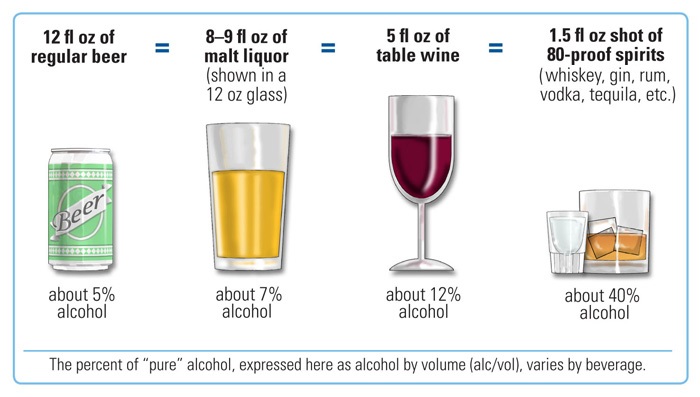
This assumes a US standard drink, i.e. 0.6 USfloz or 14 g of ethanol, whereas other definitions exist, for example 10 grams of ethanol.
| Drinks | Sex | Body weight | 45 kg | |||||||
|---|---|---|---|---|---|---|---|---|---|---|
| 100 lb | 55 kg | |||||||||
| 120 lb | 64 kg | |||||||||
| 140 lb | 73 kg | |||||||||
| 160 lb | 82 kg | |||||||||
| 180 lb | 91 kg | |||||||||
| 200 lb | 100 kg | |||||||||
| 220 lb | 109 kg | |||||||||
| 240 lb | ||||||||||
| 1 | Male | – | 0.04 | 0.03 | 0.03 | 0.02 | 0.02 | 0.02 | 0.02 | 0.02 |
| Female | 0.05 | 0.05 | 0.04 | 0.03 | 0.03 | 0.03 | 0.02 | 0.02 | 0.02 | |
| 2 | Male | – | 0.08 | 0.06 | 0.05 | 0.05 | 0.04 | 0.04 | 0.03 | 0.03 |
| Female | 0.10 | 0.09 | 0.08 | 0.07 | 0.06 | 0.05 | 0.05 | 0.04 | 0.04 | |
| 3 | Male | – | 0.11 | 0.09 | 0.08 | 0.07 | 0.06 | 0.06 | 0.05 | 0.05 |
| Female | 0.15 | 0.14 | 0.11 | 0.10 | 0.09 | 0.08 | 0.07 | 0.06 | 0.06 | |
| 4 | Male | – | 0.15 | 0.12 | 0.11 | 0.09 | 0.08 | 0.08 | 0.07 | 0.06 |
| Female | 0.20 | 0.18 | 0.15 | 0.13 | 0.11 | 0.10 | 0.09 | 0.08 | 0.08 | |
| 5 | Male | – | 0.19 | 0.16 | 0.13 | 0.12 | 0.11 | 0.09 | 0.09 | 0.08 |
| Female | 0.25 | 0.23 | 0.19 | 0.16 | 0.14 | 0.13 | 0.11 | 0.10 | 0.09 | |
| 6 | Male | – | 0.23 | 0.19 | 0.16 | 0.14 | 0.13 | 0.11 | 0.10 | 0.09 |
| Female | 0.30 | 0.27 | 0.23 | 0.19 | 0.17 | 0.15 | 0.14 | 0.12 | 0.11 | |
| 7 | Male | – | 0.26 | 0.22 | 0.19 | 0.16 | 0.15 | 0.13 | 0.12 | 0.11 |
| Female | 0.35 | 0.32 | 0.27 | 0.23 | 0.20 | 0.18 | 0.16 | 0.14 | 0.13 | |
| 8 | Male | – | 0.30 | 0.25 | 0.21 | 0.19 | 0.17 | 0.15 | 0.14 | 0.13 |
| Female | 0.40 | 0.36 | 0.30 | 0.26 | 0.23 | 0.20 | 0.18 | 0.17 | 0.15 | |
| 9 | Male | – | 0.34 | 0.28 | 0.24 | 0.21 | 0.19 | 0.17 | 0.15 | 0.14 |
| Female | 0.45 | 0.41 | 0.34 | 0.29 | 0.26 | 0.23 | 0.20 | 0.19 | 0.17 | |
| 10 | Male | – | 0.38 | 0.31 | 0.27 | 0.23 | 0.21 | 0.19 | 0.17 | 0.16 |
| Female | 0.51 | 0.45 | 0.38 | 0.32 | 0.28 | 0.25 | 0.23 | 0.21 | 0.19 | |
| Subtract approximately 0.01 every 40 minutes after drinking. |
By training
If individuals are asked to estimate their BAC, then given accurate feedback via a breathalyzer, and this procedure is repeated a number of times during a drinking session, studies show that these individuals can learn to discriminate their BAC, to within a mean error of 9 mg/100 mL (0.009% BAC). The ability is robust to different types of alcohol, different drink quantities, and drinks with unknown levels of alcohol. Trained individuals can even drink alcoholic drinks so as to adjust or maintain their BAC at a desired level. Training the ability does not appear to require any information or procedure besides breathalyzer feedback, although most studies have provided information such as intoxication symptoms at different BAC levels. Subjects continue to retain the ability one month after training.
Post-mortem
After fatal accidents, it is common to check the blood alcohol levels of involved persons. However, soon after death, the body begins to putrefy, a biological process which produces ethanol. This can make it difficult to conclusively determine the blood alcohol content in autopsies, particularly in bodies recovered from water. For instance, following the 1975 Moorgate tube crash, the driver's kidneys had a blood alcohol concentration of 80 mg/100 mL, but it could not be established how much of this could be attributed to natural decomposition. Newer research has shown that vitreous (eye) fluid provides an accurate estimate of blood alcohol concentration that is less subject to the effects of decomposition or contamination.
Legal limits
Main article: Drunk driving law by country
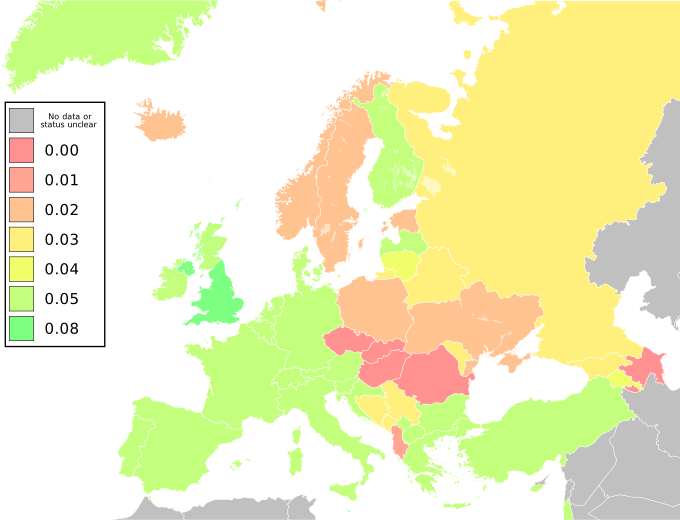
For purposes of law enforcement, blood alcohol content is used to define intoxication and provides a rough measure of impairment. Although the degree of impairment may vary among individuals with the same blood alcohol content, it can be measured objectively and is therefore legally useful and difficult to contest in court. Most countries forbid operation of motor vehicles and heavy machinery above prescribed levels of blood alcohol content. Operation of boats and aircraft is also regulated. Some jurisdictions also regulate bicycling under the influence. The alcohol level at which a person is considered legally impaired to drive varies by country.
Test assumptions
Extrapolation
Retrograde extrapolation is the mathematical process by which someone's blood alcohol concentration at the time of driving is estimated by projecting backwards from a later chemical test. This involves estimating the absorption and elimination of alcohol in the interim between driving and testing. The rate of elimination in the average person is commonly estimated at 0.015 to 0.020 grams per deciliter per hour (g/dL/h), although again this can vary from person to person and in a given person from one moment to another. Metabolism can be affected by numerous factors, including such things as body temperature, the type of alcoholic beverage consumed, and the amount and type of food consumed.
In an increasing number of states, laws have been enacted to facilitate this speculative task: the blood alcohol content at the time of driving is legally presumed to be the same as when later tested. There are usually time limits put on this presumption, commonly two or three hours, and the defendant is permitted to offer evidence to rebut this presumption.
Forward extrapolation can also be attempted. If the amount of alcohol consumed is known, along with such variables as the weight and sex of the subject and period and rate of consumption, the blood alcohol level can be estimated by extrapolating forward. Although subject to the same infirmities as retrograde extrapolation—guessing based upon averages and unknown variables—this can be relevant in estimating BAC when driving and/or corroborating or contradicting the results of a later chemical test.
Metabolism
Main article: Pharmacology of ethanol#Pharmacokinetics
The pharmacokinetics of ethanol are well characterized by the ADME acronym (absorption, distribution, metabolism, excretion). Besides the dose ingested, factors such as the person's total body water, speed of drinking, the drink's nutritional content, and the contents of the stomach all influence the profile of blood alcohol content (BAC) over time. Breath alcohol content (BrAC) and BAC have similar profile shapes, so most forensic pharmacokinetic calculations can be done with either. Relatively few studies directly compare BrAC and BAC within subjects and characterize the difference in pharmacokinetic parameters. Comparing arterial and venous BAC, arterial BAC is higher during the absorption phase and lower in the postabsorptive declining phase.
Highest levels
According to Guinness World Records, the 2013 incident where a BAC of 1.374% (13.74 g/L) was recorded is the highest BAC recorded in a human who survived the ordeal.
| Date | BAC (%) | Location | Description | Result (died or survived) | Cause of Death (If Died) | ||||||||||
|---|---|---|---|---|---|---|---|---|---|---|---|---|---|---|---|
| 1982 | 1.33 BAC, approximated from 1.51 SAC | Los Angeles, California, USA | A 24-year-old woman was admitted to the UCLA emergency room with a serum alcohol content of 1.51%, corresponding to a blood alcohol content of 1.33%. She was alert and oriented to person and place and survived. Serum alcohol concentration is not equal to nor calculated in the same way as blood alcohol content. | Survived | |||||||||||
| 1984 | 1.50 | A 30-year-old man survived a blood alcohol concentration of 1.5% after vigorous medical intervention that included dialysis and intravenous therapy with fructose. | Survived | ||||||||||||
| 1995 | 1.48 | Wrocław, Poland | In 1995, a man from Wrocław, Poland, caused a car crash near his hometown. He had a blood alcohol content of 1.48%; he was tested five times, with each test returning the same reading. He died a few days later of injuries from the accident. | Died | Injuries from a car crash | ||||||||||
| 2004 | 1.35 | Taiwan | In 2004, an unidentified Taiwanese woman died of alcohol intoxication after immersion for twelve hours in a bathtub filled with 40% ethanol. Her blood alcohol content was 1.35%. It was believed that she had immersed herself as a response to the early 2000s outbreak of SARS. | Died | Alcohol intoxication | ||||||||||
| 22 Dec 2010 | 1.60 | Queenstown, South Africa | In South Africa, a man driving a Mercedes-Benz Vito light van containing 15 sheep allegedly stolen from nearby farms was arrested on 22 December 2010, near Queenstown in Eastern Cape. His blood had an alcohol content of 1.6%. Also in the vehicle were five boys and a woman, who were also arrested. | Survived | |||||||||||
| 26 Oct 2012 | 2.23 (possible contamination) | Gmina Olszewo-Borki, Poland | last1=Łuba | first1=Marcin | title=Śmiertelny rekord: Kierowca z powiatu ostrołęckiego miał 22 promile alkoholu! Zginął w wypadku | url=http://www.eostroleka.pl/smiertelny-rekord-kierowca-z-powiatu-ostroleckiego-mial-22-promile-alkoholu-zginal-w-wypadku-zdjecia,art31892.html | website=eOstroleka.pl | access-date=2017-11-04 | language=pl | date=24 October 2012 | archive-date=21 April 2023 | archive-url=https://web.archive.org/web/20230421192302/https://www.eostroleka.pl/smiertelny-rekord-kierowca-z-powiatu-ostroleckiego-mial-22-promile-alkoholu-zginal-w-wypadku-zdjecia,art31892.html | url-status=live}} | Died | Injuries from a car crash |
| 26 July 2013 | 1.374 | Alfredówka, Poland | A 30-year-old man from Alfredówka, Poland, was found unconscious by Municipal Police Patrol from Nowa Dęba lying in the ditch along the road in Tarnowska Wola. First responders reportedly did not believe the initial BAC readings taken at the scene. At the hospital, it was recorded that the man had a blood alcohol content of 1.374%. The man survived. | Survived |
Notes
References
Citations
General and cited references
- Carnegie Library of Pittsburgh. Science and Technology Department. The Handy Science Answer Book. Pittsburgh: The Carnegie Library, 1997. .
- Taylor, L., and S. Oberman. Drunk Driving Defense, 6th edition. New York: Aspen Law and Business, 2006. .
References
- (3 December 2020). "Blood Alcohol Level". National Library of Medicine.
- (22 July 2012). "Drink-drivers in Nepal face the 'smell test' crackdown". Yahoo News.
- "Legal BAC limits by country". [[World Health Organization]].
- "BAC Formats".
- (8 February 2022). "Blood alcohol levels".
- (n.d.). "Blood Alcohol Concentration (BAC)".
- "Blood alcohol level (BAL)". Health Research Board (Ireland).
- (21 February 2025). "artikel 8, tweede lid, van de Wegenverkeerswet 1994".
- (21 February 2025). "Met hoeveel alcohol mag ik deelnemen aan het verkeer?".
- (2019-10-15). "Nietrzeźwość a ryzyko zgonu w wypadku komunikacyjnym = Insobriety and the risk of death in traffic accident {{!}} Journal of Education, Health and Sport". Journal of Education, Health and Sport.
- "Virkninger av alkohol på sentralnervesystemet og kroppen forøvrig (The effects of alcohol on the central nervous system and the body in general)". Oslo University Hospital.
- "Lov om vegtrafikk, §22. Ruspåvirkning av motorvognfører (Law regulating road traffic, §22. Drug influence on driver of motor vehicle)". Lovdata.
- "The drink drive limit".
- "Drink-driving: What are the rules?".
- (4 May 2020). "Alkoholpromille, beräkning". Netdoktor.
- "Ethanol".
- Dasgupta, Amitava. (2017-01-01). "Alcohol, Drugs, Genes and the Clinical Laboratory: An Overview for Healthcare and Safety Professionals". Academic Press.
- (2022-01-01). "Alcoholic beverages and health effects". Elsevier.
- (2014). "Has Increased Body Weight Made Driving Safer?". Health Economics.
- (April 2008). "Quick Stats: Binge Drinking".
- (1 November 1980). "Alcohol Determination in the Clinical Laboratory". American Journal of Clinical Pathology.
- (1 February 2019). "Inter-laboratory proficiency results of blood alcohol determinations at clinical and forensic laboratories in Italy". Forensic Science International.
- (30 April 2020). "Hospital Blood Alcohol Lab Results: Are They Forensically Reliable?".
- (22 March 2024). "Concentration units used to report blood- and breath-alcohol concentration for legal purposes differ between countries which is important to consider when blood/breath ratios of alcohol are compared and contrasted". Journal of Forensic Sciences.
- (May 2007). "Breath alcohol concentration determined with a new analyzer using free exhalation predicts almost precisely the arterial blood alcohol concentration". Forensic Science International.
- (3 August 2020). "Reflections on variability in the blood-breath ratio of ethanol and its importance when evidential breath-alcohol instruments are used in law enforcement". Forensic Sciences Research.
- (1 December 2018). "Current defence strategies in some contested drink-drive prosecutions: Is it now time for some additional statutory assumptions?". Forensic Science International.
- Kuwatch, Ed. "Fast Eddie's 8/10 Method of Hand Calculating Blood Alcohol Concentration: A Simple Method For Using Widmark's Formula".
- (2004). "Uncertainty in Theoretical Calculations of Alcohol Concentration".
- (October 2007). "Estimating the uncertainty associated with Widmark's equation as commonly applied in forensic toxicology". Forensic Science International.
- Searle, John. (January 2015). "Alcohol calculations and their uncertainty". Medicine, Science and the Law.
- (July 2011). "Pharmacokinetics of Ethanol – Issues of Forensic Importance". Forensic Science Review.
- (November 2020). "Total body water is the preferred method to use in forensic blood-alcohol calculations rather than ethanol's volume of distribution". Forensic Science International.
- (July 2010). "Evidence-based survey of the elimination rates of ethanol from blood with applications in forensic casework". Forensic Science International.
- (September 2023). "Population ranges for the volume of distribution (V_d) of alcohol for use in forensic alcohol calculations". Journal of Forensic Sciences.
- (September 2020). "The Contribution of Body Mass and Volume of Distribution to the Estimated Uncertainty Associated with the Widmark Equation". Journal of Forensic Sciences.
- (2001). "AUDIT The Alcohol Use Disorders Identification Test (Second Edition)".
- [http://www.alcohol.vt.edu/Students/alcoholEffects/estimatingBAC/index.htm BAC Charts] {{webarchive. link. (30 June 2007 from [[Virginia Polytechnic Institute and State University). Virginia Tech]]
- (January 1976). "Blood alcohol level discrimination by nonalcoholics. The role of internal and external cues". Journal of Studies on Alcohol.
- (March 1978). "The Role of Blood Alcohol Level Estimation in Training Alcoholics to become Controlled Drinkers". British Journal of Addiction to Alcohol & Other Drugs.
- (24 August 2023). "Use of mindfulness training to improve BAC self-estimation during a drinking episode". Psychology of Addictive Behaviors.
- (5 January 2007). "Interpreting results of ethanol analysis in postmortem specimens: A review of the literature". [[Forensic Science International]].
- (2010). "Analysis of alcohol mass concentration in corpse blood". Fa Yi Xue Za Zhi.
- (1993). "Postmortem blood alcohol concentration". Blutalkohol.
- (2016). "Best-practices approach to determination of blood alcohol concentration (BAC) at specific time points: Combination of ante-mortem alcohol pharmacokinetic modeling and post-mortem alcohol generation and transport considerations". Regulatory Toxicology and Pharmacology.
- (16 April 1975). "Moorgate Alcohol Finding". The Guardian.
- (12 June 2020). "Ethanol Determination in Post-Mortem Samples: Correlation between Blood and Vitreous Humor Concentration.". Molecules.
- (1992). "Retrograde extrapolation of blood alcohol data: An applied approach". Journal of Toxicology and Environmental Health.
- (September 2019). "Alcohol, its absorption, distribution, metabolism, and excretion in the body and pharmacokinetic calculations". WIREs Forensic Science.
- "Highest blood alcohol level".
- (1982). "Survival After a Serum Ethanol Concentration of 11/2%". The Lancet.
- (2002). "Conversion of Serum-Alcohol Concentrations to Corresponding Blood-Alcohol Concentrations". Journal of Chemical Education.
- (1984). "Survival After High Blood Alcohol Levels: Association with First-Order Elimination Kinetics". Archives of Internal Medicine.
- (2005). "Fatal alcohol immersion during the SARS epidemic in Taiwan". Forensic Science International.
- Mashaba, Sibongile. (24 December 2010). "Drunkest driver in SA arrested". Sowetan.
- "Motorist 32 times over legal alcohol limit".
- (24 October 2012). "Śmiertelny rekord: Kierowca z powiatu ostrołęckiego miał 22 promile alkoholu! Zginął w wypadku".
- "Miał 13,74 promila alkoholu we krwi. I przeżył. Rekord świata?".
- "Informacje".
This article was imported from Wikipedia and is available under the Creative Commons Attribution-ShareAlike 4.0 License. Content has been adapted to SurfDoc format. Original contributors can be found on the article history page.
Ask Mako anything about Blood alcohol content — get instant answers, deeper analysis, and related topics.
Research with MakoFree with your Surf account
Create a free account to save articles, ask Mako questions, and organize your research.
Sign up freeThis content may have been generated or modified by AI. CloudSurf Software LLC is not responsible for the accuracy, completeness, or reliability of AI-generated content. Always verify important information from primary sources.
Report