From Surf Wiki (app.surf) — the open knowledge base
Block matrix
Matrix defined using smaller matrices called blocks
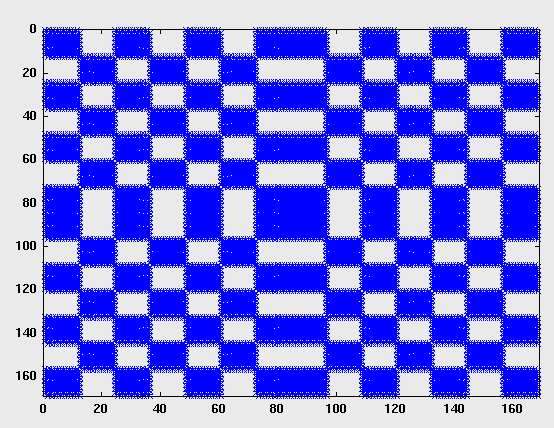
Matrix defined using smaller matrices called blocks
In mathematics, a block matrix or a partitioned matrix is a matrix that is interpreted as having been broken into sections called blocks or submatrices.
Intuitively, a matrix interpreted as a block matrix can be visualized as the original matrix with a collection of horizontal and vertical lines, which break it up, or partition it, into a collection of smaller matrices. For example, the 3×4 matrix presented below is divided by horizontal and vertical lines into four blocks: the top-left 2×3 block, the top-right 2×1 block, the bottom-left 1×3 block, and the bottom-right 1×1 block.
\left[ \begin{array}{ccc|c} a_{11} & a_{12} & a_{13} & b_{1} \ a_{21} & a_{22} & a_{23} & b_{2} \ \hline c_{1} & c_{2} & c_{3} & d \end{array} \right]
Any matrix may be interpreted as a block matrix in one or more ways, with each interpretation defined by how its rows and columns are partitioned.
This notion can be made more precise for an n by m matrix M by partitioning n into a collection \text{rowgroups}, and then partitioning m into a collection \text{colgroups}. The original matrix is then considered as the "total" of these groups, in the sense that the (i, j) entry of the original matrix corresponds in a 1-to-1 way with some (s, t) offset entry of some (x,y), where x \in \text{rowgroups} and y \in \text{colgroups}.
Block matrix algebra arises in general from biproducts in categories of matrices.
Example
The matrix
\mathbf{P} = \begin{bmatrix} 1 & 2 & 2 & 7 \ 1 & 5 & 6 & 2 \ 3 & 3 & 4 & 5 \ 3 & 3 & 6 & 7 \end{bmatrix}
can be visualized as divided into four blocks, as
\mathbf{P} = \left[ \begin{array}{cc|cc} 1 & 2 & 2 & 7 \ 1 & 5 & 6 & 2 \ \hline 3 & 3 & 4 & 5 \ 3 & 3 & 6 & 7 \end{array} \right].
The horizontal and vertical lines have no special mathematical meaning, but are a common way to visualize a partition. By this partition, P is partitioned into four 2×2 blocks, as
\begin{align} \mathbf{P}{11} &= \begin{bmatrix} 1 & 2 \ 1 & 5 \end{bmatrix}, & \mathbf{P}{12} &= \begin{bmatrix} 2 & 7\ 6 & 2 \end{bmatrix}, \[1ex] \mathbf{P}{21} &= \begin{bmatrix} 3 & 3 \ 3 & 3 \end{bmatrix},& \mathbf{P}{22} &= \begin{bmatrix} 4 & 5 \ 6 & 7 \end{bmatrix}. \end{align}
The partitioned matrix can then be written as
\mathbf{P} = \begin{bmatrix} \mathbf{P}{11} & \mathbf{P}{12} \ \mathbf{P}{21} & \mathbf{P}{22} \end{bmatrix}.
Formal definition
Let A \in \mathbb{C}^{m \times n}. A partitioning of A is a representation of A in the form
A = \begin{bmatrix} A_{11} & A_{12} & \cdots & A_{1q} \ A_{21} & A_{22} & \cdots & A_{2q} \ \vdots & \vdots & \ddots & \vdots \ A_{p1} & A_{p2} & \cdots & A_{pq} \end{bmatrix},
where A_{ij} \in \mathbb{C}^{m_i \times n_j} are contiguous submatrices, \sum_{i=1}^{p} m_i = m, and \sum_{j=1}^{q} n_j = n. The elements A_{ij} of the partition are called blocks.
By this definition, the blocks in any one column must all have the same number of columns. Similarly, the blocks in any one row must have the same number of rows.
Partitioning methods
A matrix can be partitioned in many ways. For example, a matrix A is said to be partitioned by columns if it is written as
A = (a_1 \ a_2 \ \cdots \ a_n),
where a_j is the jth column of A. A matrix can also be partitioned by rows:
A = \begin{bmatrix} a_1^T \ a_2^T \ \vdots \ a_m^T \end{bmatrix},
where a_i^T is the i-th row of A.
Common partitions
Often, we encounter the 2×2 partition
A = \begin{bmatrix} A_{11} & A_{12} \ A_{21} & A_{22} \end{bmatrix},
particularly in the form where A_{11} is a scalar:
A = \begin{bmatrix} a_{11} & a_{12}^T \ a_{21} & A_{22} \end{bmatrix}.
Block matrix operations
Transpose
Let
A = \begin{bmatrix} A_{11} & A_{12} & \cdots & A_{1q} \ A_{21} & A_{22} & \cdots & A_{2q} \ \vdots & \vdots & \ddots & \vdots \ A_{p1} & A_{p2} & \cdots & A_{pq} \end{bmatrix}
where A_{ij} \in \mathbb{C}^{k_i \times \ell_j}. (This matrix A will be reused in and .) Then its transpose is
A^T = \begin{bmatrix} A_{11}^T & A_{21}^T & \cdots & A_{p1}^T \ A_{12}^T & A_{22}^T & \cdots & A_{p2}^T \ \vdots & \vdots & \ddots & \vdots \ A_{1q}^T & A_{2q}^T & \cdots & A_{pq}^T \end{bmatrix},
and the same equation holds with the transpose replaced by the conjugate transpose.
Block transpose
A special form of matrix transpose can also be defined for block matrices, where individual blocks are reordered but not transposed. Let A = (B_{ij}) be a k \times l block matrix with m \times n blocks B_{ij}, the block transpose of A is the l \times k block matrix A^\mathcal{B} with m \times n blocks \left(A^\mathcal{B}\right){ij} = B{ji}. As with the conventional trace operator, the block transpose is a linear mapping such that (A + C)^\mathcal{B} = A^\mathcal{B} + C^\mathcal{B} . However, in general the property (A C)^\mathcal{B} = C^\mathcal{B} A^\mathcal{B} does not hold unless the blocks of A and C commute.
Addition
Let
B = \begin{bmatrix} B_{11} & B_{12} & \cdots & B_{1s} \ B_{21} & B_{22} & \cdots & B_{2s} \ \vdots & \vdots & \ddots & \vdots \ B_{r1} & B_{r2} & \cdots & B_{rs} \end{bmatrix},
where B_{ij} \in \mathbb{C}^{m_i \times n_j}, and let A be the matrix defined in . (This matrix B will be reused in .) Then if p = r, q = s, k_i = m_i, and \ell_j = n_j, then
A + B = \begin{bmatrix} A_{11} + B_{11} & A_{12} + B_{12} & \cdots & A_{1q} + B_{1q} \ A_{21} + B_{21} & A_{22} + B_{22} & \cdots & A_{2q} + B_{2q} \ \vdots & \vdots & \ddots & \vdots \ A_{p1} + B_{p1} & A_{p2} + B_{p2} & \cdots & A_{pq} + B_{pq} \end{bmatrix}.
Multiplication
It is possible to use a block partitioned matrix product that involves only algebra on submatrices of the factors. The partitioning of the factors is not arbitrary, however, and requires "conformable partitions" between two matrices A and B such that all submatrix products that will be used are defined.
Let A be the matrix defined in , and let B be the matrix defined in . Then the matrix product
C = AB
can be performed blockwise, yielding C as an (p \times s) matrix. The matrices in the resulting matrix C are calculated by multiplying:
C_{ij} = \sum_{k=1}^{q} A_{ik}B_{kj}.
Or, using the Einstein notation that implicitly sums over repeated indices:
C_{ij} = A_{ik}B_{kj}.
Depicting C as a matrix, we have
C = AB = \begin{bmatrix} \sum_{i=1}^{q} A_{1i}B_{i1} & \sum_{i=1}^{q} A_{1i}B_{i2} & \cdots & \sum_{i=1}^{q} A_{1i}B_{is} \ \sum_{i=1}^{q} A_{2i}B_{i1} & \sum_{i=1}^{q} A_{2i}B_{i2} & \cdots & \sum_{i=1}^{q} A_{2i}B_{is} \ \vdots & \vdots & \ddots & \vdots \ \sum_{i=1}^{q} A_{pi}B_{i1} & \sum_{i=1}^{q} A_{pi}B_{i2} & \cdots & \sum_{i=1}^{q} A_{pi}B_{is} \end{bmatrix}.
Inversion{{anchor|Inversion}}
If a matrix is partitioned into four blocks, it can be inverted blockwise as follows:
\begin{align} P &= \begin{bmatrix} A & B \ C & D \end{bmatrix}^{-1} \[1ex] &= \begin{bmatrix} A^{-1} + A^{-1} B \left(D - CA^{-1} B\right)^{-1} CA^{-1} & -A^{-1} B\left(D - C A^{-1}B\right)^{-1} \ -\left(D - CA^{-1}B\right)^{-1} C A^{-1} & \left(D - C A^{-1} B\right)^{-1} \end{bmatrix}, \end{align}
where A and D are square blocks of arbitrary size, and B and C are conformable with them for partitioning. Furthermore, A and the Schur complement of A in P: must be invertible.
Equivalently, by permuting the blocks:
\begin{align} P &= \begin{bmatrix} A & B \ C & D \end{bmatrix}^{-1} \[1ex] &= \begin{bmatrix} \left(A - BD^{-1}C\right)^{-1} & -\left(A-BD^{-1}C\right)^{-1} BD^{-1} \ -D^{-1}C\left(A - BD^{-1}C\right)^{-1} & D^{-1} + D^{-1}C\left(A - BD^{-1}C\right)^{-1}BD^{-1} \end{bmatrix}. \end{align}
Here, D and the Schur complement of D in P: must be invertible.
If A and D are both invertible, then:
\begin{bmatrix} A & B \ C & D \end{bmatrix}^{-1} = \begin{bmatrix} \left(A - B D^{-1} C\right)^{-1} & 0 \ 0 & \left(D - C A^{-1} B\right)^{-1} \end{bmatrix} \begin{bmatrix} I & -B D^{-1} \ -C A^{-1} & I \end{bmatrix}.
By the Weinstein–Aronszajn identity, one of the two matrices in the block-diagonal matrix is invertible exactly when the other is.
Computing submatrix inverses from the full inverse
By the symmetry between a matrix and its inverse in the block inversion formula, if a matrix P and its inverse P−1 are partitioned conformally:
P = \begin{bmatrix} {A} & {B} \ {C} & {D} \end{bmatrix}, \quad P^{-1} = \begin{bmatrix} {E} & {F} \ {G} & {H} \end{bmatrix}
then the inverse of any principal submatrix can be computed from the corresponding blocks of P−1:
{A}^{-1} = {E} - {FH}^{-1}{G} {D}^{-1} = {H} - {GE}^{-1}{F}
This relationship follows from recognizing that E−1 = A − BD−1C (the Schur complement), and applying the same block inversion formula with the roles of P and P−1 reversed.
Determinant{{anchor|Determinant}}
The formula for the determinant of a 2 \times 2-matrix above continues to hold, under appropriate further assumptions, for a matrix composed of four submatrices A, B, C, D with A and D square. The easiest such formula, which can be proven using either the Leibniz formula or a factorization involving the Schur complement, is \det\begin{bmatrix}A& 0\ C& D\end{bmatrix} = \det(A) \det(D) = \det\begin{bmatrix}A& B\ 0& D\end{bmatrix}.
Using this formula, we can derive that characteristic polynomials of \begin{bmatrix}A& 0\ C& D\end{bmatrix} and \begin{bmatrix}A& B\ 0& D\end{bmatrix} are same and equal to the product of characteristic polynomials of A and D. Furthermore, If \begin{bmatrix}A& 0\ C& D\end{bmatrix} or \begin{bmatrix}A& B\ 0& D\end{bmatrix} is diagonalizable, then A and D are diagonalizable too. The converse is false; simply check \begin{bmatrix}1& 1\ 0& 1\end{bmatrix}.
If A is invertible, one has
\det\begin{bmatrix}A& B\ C& D\end{bmatrix} = \det(A) \det\left(D - C A^{-1} B\right),
and if D is invertible, one has
\det\begin{bmatrix}A& B\ C& D\end{bmatrix} = \det(D) \det\left(A - B D^{-1} C\right) .
If the blocks are square matrices of the same size further formulas hold. For example, if C and D commute (i.e., CD=DC), then \det\begin{bmatrix}A& B\ C& D\end{bmatrix} = \det(AD - BC). Similar statements hold when AB=BA, AC=CA, or . Namely, if AC = CA, then \det\begin{bmatrix}A& B\ C& D\end{bmatrix} = \det(AD - CB). Note the change in order of C and B (we have CB instead of BC). Similarly, if BD = DB, then AD should be replaced with DA (i.e. we get \det(DA - BC)) and if AB = BA, then we should have \det(DA - CB). Note for the last two results, you have to use commutativity of the underlying ring, but not for the first two.
This formula has been generalized to matrices composed of more than 2 \times 2 blocks, again under appropriate commutativity conditions among the individual blocks.
For A = D and B=C, the following formula holds (even if A and B do not commute) \det\begin{bmatrix}A& B\ B& A\end{bmatrix} = \det(A - B) \det(A + B).
Special types of block matrices
Direct sums and block diagonal matrices
Direct sum
For any arbitrary matrices A (of size m × n) and B (of size p × q), we have the direct sum of A and B, denoted by A ⊕ B and defined as
{A} \oplus {B} = \begin{bmatrix} a_{11} & \cdots & a_{1n} & 0 & \cdots & 0 \ \vdots & \ddots & \vdots & \vdots & \ddots & \vdots \ a_{m1} & \cdots & a_{mn} & 0 & \cdots & 0 \ 0 & \cdots & 0 & b_{11} & \cdots & b_{1q} \ \vdots & \ddots & \vdots & \vdots & \ddots & \vdots \ 0 & \cdots & 0 & b_{p1} & \cdots & b_{pq} \end{bmatrix}.
For instance,
\begin{bmatrix} 1 & 3 & 2 \ 2 & 3 & 1 \end{bmatrix} \oplus \begin{bmatrix} 1 & 6 \ 0 & 1 \end{bmatrix} = \begin{bmatrix} 1 & 3 & 2 & 0 & 0 \ 2 & 3 & 1 & 0 & 0 \ 0 & 0 & 0 & 1 & 6 \ 0 & 0 & 0 & 0 & 1 \end{bmatrix}.
This operation generalizes naturally to arbitrary dimensioned arrays (provided that A and B have the same number of dimensions).
Note that any element in the direct sum of two vector spaces of matrices could be represented as a direct sum of two matrices.
Block diagonal matrices {{anchor|Block diagonal matrix}}
A block diagonal matrix is a block matrix that is a square matrix such that the main-diagonal blocks are square matrices and all off-diagonal blocks are zero matrices. That is, a block diagonal matrix A has the form
{A} = \begin{bmatrix} A_1 & 0 & \cdots & 0 \ 0 & A_2 & \cdots & 0 \ \vdots & \vdots & \ddots & \vdots \ 0 & 0 & \cdots & A_n \end{bmatrix}
where Ak is a square matrix for all k = 1, ..., n. In other words, matrix A is the direct sum of A1, ..., An. It can also be indicated as A1 ⊕ A2 ⊕ ... ⊕ An or diag(A1, A2, ..., An) (the latter being the same formalism used for a diagonal matrix). Any square matrix can trivially be considered a block diagonal matrix with only one block.
For the determinant and trace, the following properties hold: :\begin{align} \det{A} &= \det{A}_1 \times \cdots \times \det{A}_n, \end{align} and :\begin{align} \operatorname{tr}{A} &= \operatorname{tr} {A}_1 + \cdots + \operatorname{tr} {A}_n.\end{align}
A block diagonal matrix is invertible if and only if each of its main-diagonal blocks are invertible, and in this case its inverse is another block diagonal matrix given by \begin{bmatrix} {A}{1} & {0} & \cdots & {0} \ {0} & {A}{2} & \cdots & {0} \ \vdots & \vdots & \ddots & \vdots \ {0} & {0} & \cdots & {A}{n} \end{bmatrix}^{-1} = \begin{bmatrix} {A}{1}^{-1} & {0} & \cdots & {0} \ {0} & {A}{2}^{-1} & \cdots & {0} \ \vdots & \vdots & \ddots & \vdots \ {0} & {0} & \cdots & {A}{n}^{-1} \end{bmatrix}.
The eigenvalues and eigenvectors of {A} are simply those of the {A}_ks combined.
Block tridiagonal matrices
A block tridiagonal matrix is another special block matrix, which is just like the block diagonal matrix a square matrix, having square matrices (blocks) in the lower diagonal, main diagonal and upper diagonal, with all other blocks being zero matrices. It is essentially a tridiagonal matrix but has submatrices in places of scalars. A block tridiagonal matrix A has the form
{A} = \begin{bmatrix} B_1 & C_1 & & & \cdots & & 0 \ A_2 & B_2 & C_2 & & & & \ & \ddots & \ddots & \ddots & & & \vdots \ & & A_k & B_k & C_k & & \ \vdots & & & \ddots & \ddots & \ddots & \ & & & & A_{n-1} & B_{n-1} & C_{n-1} \ 0 & & \cdots & & & A_n & B_n \end{bmatrix}
where {A}{k}, {B}{k} and {C}_{k} are square sub-matrices of the lower, main and upper diagonal respectively.
Block tridiagonal matrices are often encountered in numerical solutions of engineering problems (e.g., computational fluid dynamics). Optimized numerical methods for LU factorization are available and hence efficient solution algorithms for equation systems with a block tridiagonal matrix as coefficient matrix. The Thomas algorithm, used for efficient solution of equation systems involving a tridiagonal matrix can also be applied using matrix operations to block tridiagonal matrices (see also Block LU decomposition).
Block triangular matrices
An n \times n matrix A is upper block triangular (or block upper triangular) if there are positive integers n_1, \ldots, n_k such that n = n_1 + n_2 + \ldots + n_k and A = \begin{bmatrix} A_{11} & A_{12} & \cdots & A_{1k} \ 0 & A_{22} & \cdots & A_{2k} \ \vdots & \vdots & \ddots & \vdots \ 0 & 0 & \cdots & A_{kk} \end{bmatrix}, where the matrix A_{ij} is n_i \times n_j for all i, j = 1, \ldots, k. Similarly, A is lower block triangular if A = \begin{bmatrix} A_{11} & 0 & \cdots & 0 \ A_{21} & A_{22} & \cdots & 0 \ \vdots & \vdots & \ddots & \vdots \ A_{k1} & A_{k2} & \cdots & A_{kk} \end{bmatrix}, where A_{ij} is n_i \times n_j for all i, j = 1, \ldots, k.
Block Toeplitz matrices
A block Toeplitz matrix is another special block matrix, which contains blocks that are repeated down the diagonals of the matrix, as a Toeplitz matrix has elements repeated down the diagonal.
A matrix A is block Toeplitz if A_{(i,j)} = A_{(k,l)} for all k - i = l - j, that is,
A = \begin{bmatrix} A_1 & A_2 & A_3 & \cdots \ A_4 & A_1 & A_2 & \cdots \ A_5 & A_4 & A_1 & \cdots \ \vdots & \vdots & \vdots & \ddots \end{bmatrix},
where A_i \in \mathbb{F}^{n_i \times m_i}.
Block Hankel matrices
A matrix A is block Hankel if A_{(i,j)} = A_{(k,l)} for all i + j = k + l, that is,
A = \begin{bmatrix} A_1 & A_2 & A_3 & \cdots \ A_2 & A_3 & A_4 & \cdots \ A_3 & A_4 & A_5 & \cdots \ \vdots & \vdots & \vdots & \ddots \end{bmatrix},
where A_i \in \mathbb{F}^{n_i \times m_i}.
Notes
References
References
- Eves, Howard. (1980). "Elementary Matrix Theory". Dover.
- Dobrushkin, Vladimir. "Partition Matrices".
- Anton, Howard. (1994). "Elementary Linear Algebra". John Wiley.
- (2014-05-16). "Fragment Analysis and Test Case Generation using F-Measure for Adaptive Random Testing and Partitioned Block based Adaptive Random Testing". International Journal of Computer Applications.
- (2013). "Typing linear algebra: A biproduct-oriented approach". Science of Computer Programming.
- Johnston, Nathaniel. (2021). "Advanced linear and matrix algebra". Springer Nature.
- Jeffrey, Alan. (2010). "Matrix operations for engineers and scientists: an essential guide in linear algebra". Springer.
- Stewart, Gilbert W.. (1998). "Matrix algorithms. 1: Basic decompositions". Soc. for Industrial and Applied Mathematics.
- Mackey, D. Steven. (2006). "Structured linearizations for matrix polynomials". University of Manchester.
- Eves, Howard. (1980). "Elementary Matrix Theory". Dover.
- Anton, Howard. (1994). "Elementary Linear Algebra". John Wiley.
- (2017). "Linear Algebra: a course for physicists and engineers". De Gruyter.
- Johnston, Nathaniel. (2021). "Introduction to linear and matrix algebra". Springer Nature.
- Bernstein, Dennis. (2005). "Matrix Mathematics". Princeton University Press.
- "Is this formula for a matrix block inverse in terms of the entire matrix inverse known?".
- (2016). "Improved graph-based SFA: Information preservation complements the slowness principle". Machine Learning.
- Taboga, Marco (2021). "Determinant of a block matrix", Lectures on matrix algebra.
- Silvester, J. R.. (2000). "Determinants of Block Matrices". Math. Gaz..
- (January 2017). "Determinants of block matrices with noncommuting blocks". Linear Algebra and Its Applications.
- (2005). "Matrix Algebra". Cambridge University Press.
- Gentle, James E.. (2007). "Matrix Algebra: Theory, Computations, and Applications in Statistics". Springer New York Springer e-books.
- (2000). "Numerical mathematics". Springer.
- (2024). "A Course in Linear Algebra". University Texts in the Mathematical Sciences.
- Prince, Simon J. D.. (2012). "Computer vision: models, learning, and inference". Cambridge university press.
- Dietl, Guido K. E.. (2007). "Linear estimation and detection in Krylov subspaces". Springer.
- (2017). "Matrix analysis". Cambridge University Press.
- Datta, Biswa Nath. (2010). "Numerical linear algebra and applications". SIAM.
- Stewart, Gilbert W.. (2001). "Matrix algorithms. 2: Eigensystems". Soc. for Industrial and Applied Mathematics.
- Bernstein, Dennis S.. (2009). "Matrix mathematics: theory, facts, and formulas". Princeton University Press.
This article was imported from Wikipedia and is available under the Creative Commons Attribution-ShareAlike 4.0 License. Content has been adapted to SurfDoc format. Original contributors can be found on the article history page.
Ask Mako anything about Block matrix — get instant answers, deeper analysis, and related topics.
Research with MakoFree with your Surf account
Create a free account to save articles, ask Mako questions, and organize your research.
Sign up freeThis content may have been generated or modified by AI. CloudSurf Software LLC is not responsible for the accuracy, completeness, or reliability of AI-generated content. Always verify important information from primary sources.
Report