From Surf Wiki (app.surf) — the open knowledge base
Blaptica dubia
Species of cockroach
Species of cockroach
- Blabera claraziana Saussure 1864
- Blabera ligata Brunner von Wattenwyl, 1865
- Blabera dubia Serville, 1838
Blaptica dubia, the dubia roach, orange-spotted roach, Guyana spotted roach, or Argentinian wood roach, is a medium-sized species of cockroach which grows to around 40 –.
Description
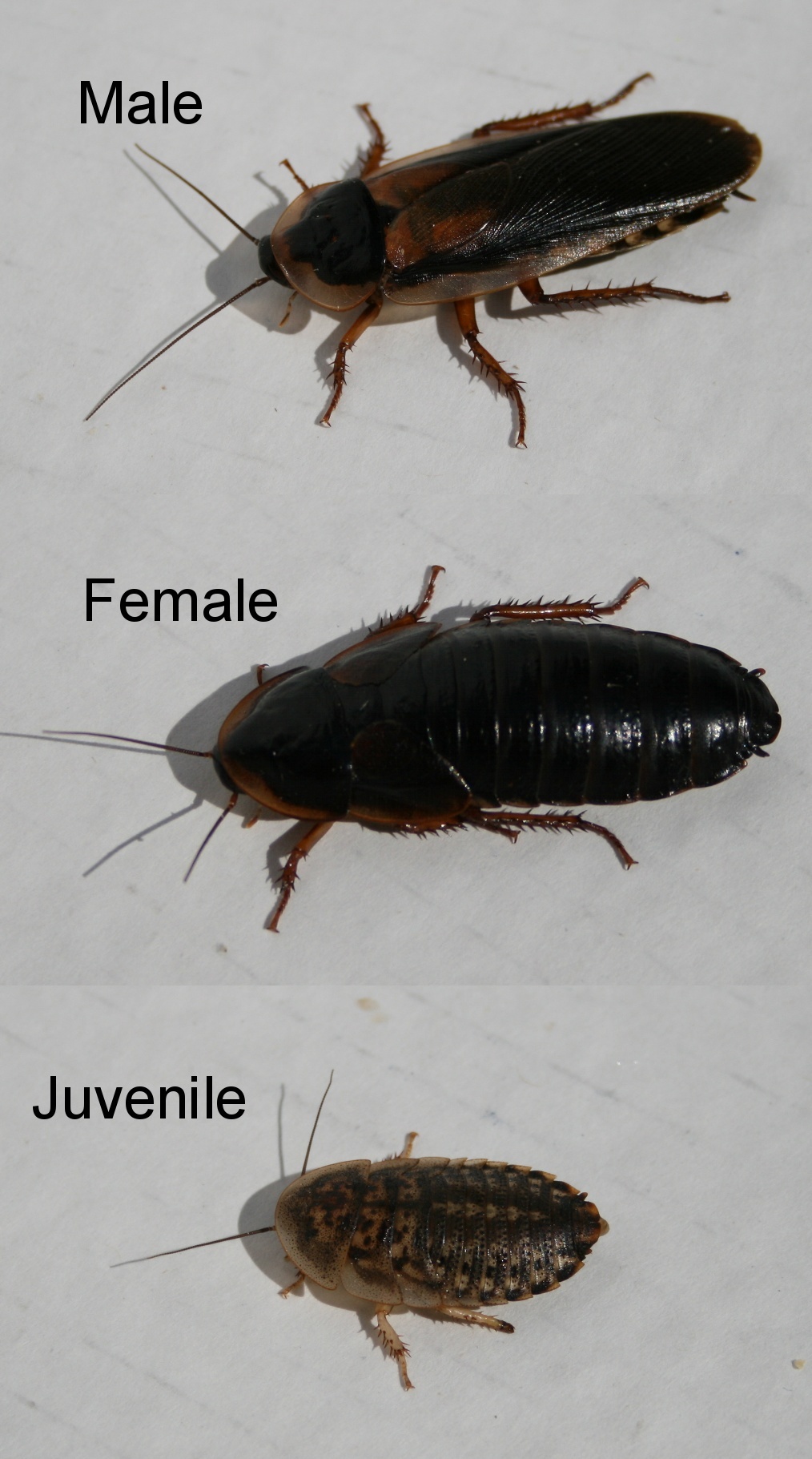
They are sexually dimorphic; adult males have full wings covering their body, while females have only tiny wing stubs - their tegmina (forewings) being around a fourth of their body length. Adults are dark brown to black with somewhat lighter orange spot/stripe patterning sometimes visible only in bright light. Coloration differs slightly with environment and diet from one colony to another.
Blaptica dubia are partially ovoviviparous, giving birth to live young after eggs hatch inside the female, and can give birth to 20 to 40 nymphs per month under favorable conditions.
Distribution
The dubia cockroach is found in southern parts of South America. Documented specimens have been found in Brazil, Argentina,
Habitat
Ideal temperature range is the higher end of a 24°C - 35°C (75°F - 95°F) range. They will not breed below 20°C (68°F). They will not molt successfully if the humidity is too low. Dubia roaches can tolerate lower humidity than many other roach species. This species of roach will also sequester more water in its body when well fed upon fruits and water will be released at times of stress.
In captivity, enclosure humidity is less important than a supply of high moisture foods, negating the need to mist the enclosure at all when compared to some other tropical pet insect species. Captive habitats should be kept clean and dry in order to have fecal droppings dry and not provide a medium for bacterial or fungal growth. Vertically stacked egg crates greatly help in this, as does good airflow.
Flight
While rarely known to fly, adult males have fully developed wings and pigmented musculature typical of cockroaches able to meet the rapid energy requirements of sustained flight. Adult females have only rudimentary forewings and lack the muscles required for flight, and showed no flight control in test launches.
Climbing
Neither adults nor juveniles can climb smooth, vertical surfaces, since they do not have a developed arolium.
Diet
The dubia cockroach is a frugivore that prefers fruits and grains, shunning (but still eating) high protein sources, such as meat or waste droppings from other animals. They particularly like semisweet vegetable matter. Appropriate feed for raising dubia roaches includes: carrots, all manner of tropical fruits (mangos and papayas), apples, avocados, banana, cherries, pears, oranges, tangerines, strawberries, fresh corn, tomatoes (some individuals show no interest in tomatoes while others eat readily), and lettuce (not iceberg or romaine)—many other leafy greens will be accepted, including herbs.
Reproduction
Blaptica dubia is an ovoviviparous species, generally giving birth to live young, and pregnancy in one study lasted 48–64 days, in a 26°C (78.8°F) environment with alternating 12-hour light and dark photoperiods. It carries the ootheca (egg capsule), which holds about 20-35 eggs, until they are ready to hatch, or may drop it earlier under stress conditions. Adults live for up to 2 years, females slightly longer than males. Growth and reproduction rates are sensitive to environmental conditions, optimally 25–30°C and above 60% relative humidity.
Use as feeder insect
Blaptica dubia has become a popular feeder insect, particularly among tarantula, amphibian, and reptile enthusiasts and owners. They are also quiet, unlike crickets, and tropical environmental requirements reduce the likelihood of establishment of escapees in colder, dryer climates. B. dubia can cause allergic reactions in humans, although they produce relatively little odor compared to many cockroaches.
A study found other cockroaches (Turkestan ("red runner") cockroaches, Madagascar hissing cockroaches,) provided a high-protein, low fat nutrition composition similar to crickets, more so than mealworms or superworm larvae provide. The gut contents of the cockroach, depending on its diet, may provide essential nutrients unavailable from a cockroach with an empty gut. Vitamin and mineral content in studied cockroaches was well represented except for low calcium:phosphorus ratios typical in cockroaches, and relatively low vitamin A and E in captive cockroaches. Supplementation of these nutrients in feeder cockroaches may be advisable.
Legality
Canada and some US states do not allow importation by the general public of B. dubia, considered by some as an invasive species.
References
References
- "Synonyms of Argentinian Wood Cockroach (Blaptica dubia)".
- (1 January 2009). "The Tarantula Keeper's Guide: Comprehensive Information on Care, Housing, and Feeding". Barron's Educational Series.
- (2006). "Evolution of warning colouration in palatable prey – An experimental approach". Diplomky – Center of Cognitive Ethology.
- "Common Names for Argentinian Wood Cockroach (Blaptica dubia)".
- (24 December 2013). "Taxonomy browser (Blaptica dubia)". National Center for Biotechnology Information.
- (2002). "Triatoma rubrovaria (Blanchard, 1843) (Hemiptera, Reduviidae, Triatominae) II: Trophic resources and ecological observations of five populations collected in the State of Rio Grande do Sul, Brazil". Memórias do Instituto Oswaldo Cruz.
- Hebard, Morgan. (1921). "South American blattidae from the Museum National d'Histoire Naturelle, Paris, France". The Academy of Natural Sciences.
- (15 December 2009). "Quantifying the landing reaction of cockroaches: final report". European Space Agency – Advanced Concepts Team.
- Wu, Hao. (3 August 2013). "Biology of ''Blaptica dubia'' (Blattodea: Blaberidae) (thesis)".
- (1996). "Hormonal control of courtship behavior and reproductive cycle in the cockroach species Blaptica dubia (Blattoidea: Blaberoidea: Blaberidae)". Entomologia Generalis.
- Alamer, Ahmad Hussein. (2013). "Endocrine control of fat body composition and effects of the insect growth regulators methoprene and pyriproxyfen on the development and reproduction of the Argentinian cockroach, Blaptica dubia Serville (Blattaria: Blaberidae)".
- (2013). "Instar Determination of ''Blaptica dubia'' (Blattodea: Blaberidae) Using Gaussian Mixture Models". Annals of the Entomological Society of America.
- Rubio, Manny. (2008). "Scorpions: Everything about Purchase, Care, Feeding, and Housing". Barron's Educational Series.
- (September 2004). "Breeding food animals: live food for vivarium animals". Krieger Pub..
- (2012). "An Investigation into the Chemical Composition of Alternative Invertebrate Prey". Zoo Biology.
- Pacheco, Walter. (28 January 2011). "Man arrested on charges of purchasing 500 illegal exotic roaches online". [[Tribune Company]].
This article was imported from Wikipedia and is available under the Creative Commons Attribution-ShareAlike 4.0 License. Content has been adapted to SurfDoc format. Original contributors can be found on the article history page.
Ask Mako anything about Blaptica dubia — get instant answers, deeper analysis, and related topics.
Research with MakoFree with your Surf account
Create a free account to save articles, ask Mako questions, and organize your research.
Sign up freeThis content may have been generated or modified by AI. CloudSurf Software LLC is not responsible for the accuracy, completeness, or reliability of AI-generated content. Always verify important information from primary sources.
Report