From Surf Wiki (app.surf) — the open knowledge base
Blanche of England
English princess (1392–1409)

English princess (1392–1409)
| Field | Value |
|---|---|
| image | Blanche of England.jpg |
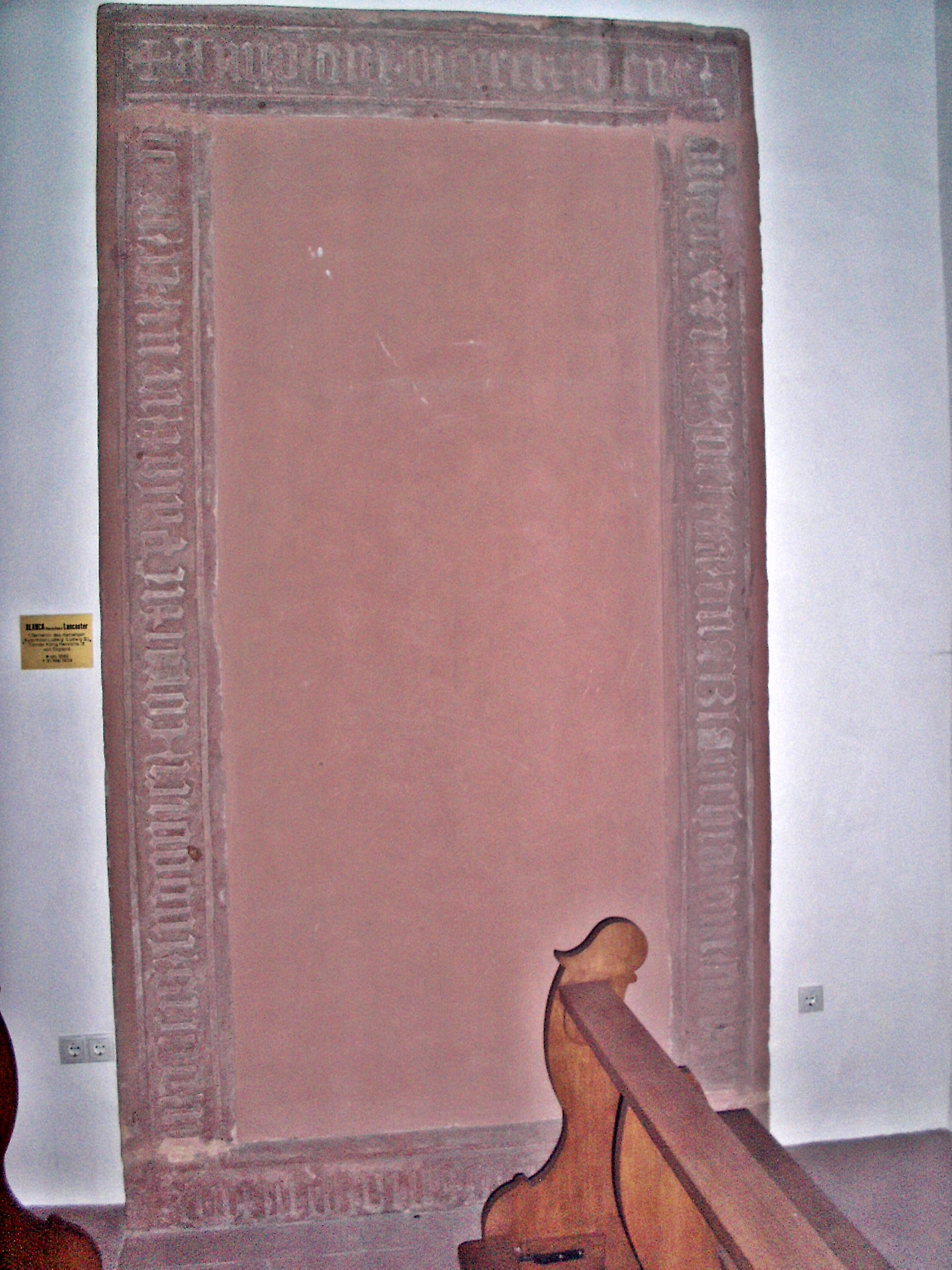
| caption | Portrait above Blanche's tomb in Neustadt an der Weinstraße |
| spouse | |
| issue | Rupert |
| house | Lancaster |
| father | Henry IV of England |
| mother | Mary de Bohun |
| birth_date | Spring 1392 |
| birth_place | Peterborough Castle, Northamptonshire, Kingdom of England |
| death_date | 22 May 1409 (aged 17) |
| death_place | Free Imperial City of Haguenau, Holy Roman Empire |
| place of burial | St Mary's at Neustadt, Electorate of the Palatinate |
Blanche of England (spring 1392 – 22 May 1409), also known as Blanche of Lancaster, was a member of the House of Lancaster, the daughter of King Henry IV of England by his first wife Mary de Bohun.
Family
Born at Peterborough Castle (now in Cambridgeshire), Blanche was the fifth of the six children born during the marriage of Henry of Lancaster and his wife Mary de Bohun. At the time of her birth, Henry was the Earl of Derby and, thanks to his marriage, Earl of Northampton and Earl of Hereford; as the only surviving son of John of Gaunt and Blanche of Lancaster, he was the heir of the Duchy of Lancaster. Blanche was named after her paternal grandmother Blanche of Lancaster, the first wife of John of Gaunt.
Blanche's mother died on 4 June 1394 in Peterborough Castle after giving birth to her last child, Philippa. Five years later, on 30 September 1399, Blanche's father deposed his cousin Richard II and usurped the throne. The new king remarried to Joanna of Navarre, daughter of King Charles II of Navarre and widow of Duke John IV of Brittany. There were no surviving children from this marriage.
Marriage
In January 1401 Henry IV held a tournament at Eltham Palace to honour the visit of Manuel II Palaiologos. The tournament was commemorated in literary form as thirteen letters in old French addressed to Blanche. Each letter, supposedly written by a legendary patron, praises one of the combatants. The letters were probably read aloud during the event.
After his accession to the English throne, King Henry IV wanted to make important alliances in order to maintain and legitimise his rule. One needed ally was King Rupert of Germany, who had also ascended following his predecessor's deposition: a marriage between Rupert's eldest surviving son Louis and Henry IV's eldest daughter Blanche was soon arranged.
The marriage contract was signed on 7 March 1401 in London; the bride's dowry was fixed in the amount of 40,000 Nobeln (over 300 kg of gold). The formal marriage between Blanche and Louis took place on 6 July 1402 at Cologne Cathedral, Germany. Blanche's dowry included the oldest surviving royal crown known to have been in England. Despite its political nature, the marriage was said to be happy. Five years later, on 22 June 1407, Blanche gave birth to a stillborn child.
In 1408 Blanche was made Lady of the Garter. One year later, she died giving birth to her second child, a son called Rupert after his paternal grandfather, and was buried in the Church of St. Mary (today St. Aegidius) in Neustadt in the Palatinate.
Her widower became Elector Palatine as Louis III in 1410 after the death of his father King Rupert and in 1417 married Matilda, daughter of Amadeo, Prince of Achaea, member of the House of Savoy, who bore him five children. Blanche's son Rupert (nicknamed the English) died aged nineteen in 1426, unmarried and without issue.
Ancestry
References
Sources
- Walther Holtzmann: Die englische Heirat Pfalzgraf Ludwigs III., in: Zeitschrift für die Geschichte des Oberrheins No 43 (1930), pp. 1–22.
- The English Marriage of Elector Palatine Louis III
- The Crown of Princess Blanka in the Munich Treasury Residence
References
- Sarah Carpenter, 'Chivalric Entertainment at the Court of Henry IV: The Jousting Letters of 1401', ''Medieval English Theatre'', 43 (D. S. Brewer, 2022), pp. 39-107.
- Weir, Alison. (1996). "Britains's royal families : the complete genealogy". London : Pimlico.
- Armitage-Smith, Sydney. (1905). "John of Gaunt: King of Castile and Leon, Duke of Aquitaine and Lancaster, Earl of Derby, Lincoln, and Leicester, Seneschal of England". Charles Scribner's Sons.
- (2000). "The Complete Peerage of England, Scotland, Ireland, Great Britain and the United Kingdom, Extant, Extinct or Dormant". Alan Sutton Publishing.
- {{cite EB1911. Thomas Frederick. Tout
- {{cite EB1911
- Weir, Alison. (1999). "Britain's Royal Families: The Complete Genealogy". The Bodley Head.
- Weir (1999), p. 84.
- Cokayne et al (2000), '''I''', p. 242
- Weir (1999), p. 78.
This article was imported from Wikipedia and is available under the Creative Commons Attribution-ShareAlike 4.0 License. Content has been adapted to SurfDoc format. Original contributors can be found on the article history page.
Ask Mako anything about Blanche of England — get instant answers, deeper analysis, and related topics.
Research with MakoFree with your Surf account
Create a free account to save articles, ask Mako questions, and organize your research.
Sign up freeThis content may have been generated or modified by AI. CloudSurf Software LLC is not responsible for the accuracy, completeness, or reliability of AI-generated content. Always verify important information from primary sources.
Report