From Surf Wiki (app.surf) — the open knowledge base
Blairism
Political ideology of Tony Blair
_(3x4_cropped).jpg)
Political ideology of Tony Blair
In British politics, Blairism is the political ideology of Tony Blair, the former leader of the Labour Party and Prime Minister between 1997 and 2007, and those that support him, known as Blairites. It entered the New Penguin English Dictionary in 2000. Elements of the ideology include investment in public services, expansionary efforts in education to encourage social mobility, and increased actions in terms of mass surveillance alongside a ramping up of law enforcement powers, both of these latter changes advocated in the context of fighting organised crime and terrorism. Blairites have additionally been known for their contrast with the traditional support for socialism by those believing in left-wing politics, with Blair himself and others speaking out against the nationalisation of major industries and against also heavy regulations of business operations. On foreign policy, Blairism is supportive of close relations with the United States and liberal interventionism, including advocacy for both the Iraq war and the War in Afghanistan (2001–2021).
Ideology
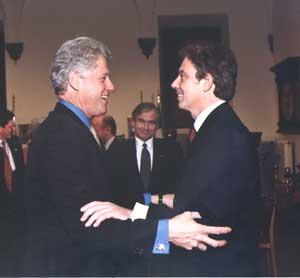
Politically, Blair has been identified with record investment into public services, an interventionist and Atlanticist foreign policy, support for stronger law enforcement powers, a large focus on surveillance as a means to address terrorism and a large focus on education as a means to encourage social mobility. In the early years (circa 1994–1997), Blairism was also associated with support for European integration and particularly British participation in the European single currency, though this waned after Labour took office.
The term is used in particular in contrast to Brownite, to identify those within the Labour Party who supported Gordon Brown rather than Blair. However, with Blair and Brown typically in agreement on most political issues (from Iraq to public sector reform), some commentators have noted that "the difference between Brownites and Blairites [...] is more tribal than ideological". This is believed to stem from a personal disagreement between Blair and Brown over who should run for the leadership following the death of John Smith in 1994. Though Brown was originally considered the senior of the two, he waited until after Smith's funeral to begin campaigning, by which point Blair had gathered too much momentum to be defeated. However, in his book Whatever it Takes, Steve Richards offered an alternate view: that there were significant disagreements between the two about relative poverty, the level of public spending and the potential for choice in public services.
In a 1999 article, The Economist stated:
Blair's tenure is known for an expansion of LGBT rights, such as the introduction of civil partnerships. Blair told the LGBT organisation Stonewall that "what has happened is that the culture of the country has changed in a definable way" and that "it's a thing that doesn't just give me a lot of pride, but it has actually brought a lot of joy". Blair has also stated that he got up off his seat and danced upon seeing the first civil partnership ceremonies on television.
Relationship to prior administrations
The Daily Telegraph stated in April 2008 that Blair's programme, with its emphasis on "New Labour", accepted the free-market ideology of Thatcherism. The article cited deregulation, privatisation of key national industries, maintaining a flexible labour market, marginalising the role of trade unions and devolving government decision making to local authorities as evidence. He also sought a closer, better relationship with Europe, and considered joining the Euro currency, but Gordon Brown was not in favour.
In the BBC Four documentary film Tory! Tory! Tory!, Blair is described as personally admiring Margaret Thatcher deeply and making the decision that she would be the first outside person he formally invited to visit him in 10 Downing Street.
Former Conservative Prime Minister John Major, who Blair defeated in a landslide at the 1997 general election; was one of the original figures behind the Northern Ireland peace process that Blair continued and both of them campaigned together in support of the Good Friday Agreement.
Blair privately called Thatcher "unhinged", a description that later became public knowledge. Blair criticised the Thatcher government's record on poverty and made that a key issue for Labour economic policy. He made the goal to eradicate child poverty in Britain within 20 years based on the fact that one-third of British children were in poverty post-Thatcher compared to the 9% rate in 1979 (although these statistics are disputed).
In a 2001 speech to a Conservative election rally, Thatcher called New Labour 'rootless and soulless' saying at least Old Labour stood for certain principles, that respected them, and also said Blair does not truly believe in liberty. She also claimed the Labour government would give up the British pound to join the Euro.
Blair also abolished Section 28 and created more pro-European initiatives compared to Thatcher.
In his 2010 autobiography, A Journey, Blair remarked:
Relationship to later administrations
Impact on the Labour Party
The Labour Party leadership of Jeremy Corbyn was seen as a departure from Blairism, and a return of Old Labour, and was described as a 'return of the 1940s Labour Party' by The Guardian, with its emphasis on re-nationalisation of energy, water, and railways and massive public investment in housing and the NHS. Jeremy Corbyn was critical of Blair's involvement in Iraq and voted against it at the time, garnering much support particularly from the youth vote. Labour increased its vote share by over 9% in 2017, costing Theresa May her majority in Parliament, but with the party split by Brexit policy and identitarian infighting, it lost the 2019 election to Boris Johnson's Conservatives.
Since the election of Keir Starmer as Leader of the Labour Party in 2020, some in the British media have noted the ideological shift from the left back to the centre, allowing comparisons to be drawn between the current policy platform of the Labour Party and its Shadow Ministers (some of whom served in the cabinets of Blair and Brown) and that of New Labour.
The November 2021 shadow cabinet reshuffle was seen to be giving more power to Blairites in the Parliamentary Labour Party. This was criticised by former Shadow Chancellor of the Exchequer John McDonnell. In May 2022, on the 25th anniversary of Labour's landslide victory in the 1997 election, Blair in a video looked back at the victory and his achievements and showed his support for Starmer.
The 2023 British shadow cabinet reshuffle was seen as giving even more power to Blairites within the Labour Party.
Blairites
Other than Blair himself, the following prominent Labour politicians are often considered Blairites, but may not identify themselves as such:


- Alastair Campbell – Blair's spokesman and campaign director (1994–1997), Downing Street Press Secretary and as the Prime Minister's Official Spokesperson (1997–2000), Downing Street Director of Communications and spokesman for the Labour Party (2000–2003). Campaign director for Blair's third election win in 2005.
- Andrew Adonis – former Shadow Minister for Infrastructure and Economic Delivery and former Transport Secretary
- Valerie Amos – Under-Secretary-General for Humanitarian Affairs and Emergency Relief Coordinator, British High Commissioner to Australia and the first black woman to serve in the Cabinet
- Hilary Armstrong – former Minister for the Cabinet Office and Chief Whip
- Hazel Blears – former Secretary of State for Communities and Local Government
- David Blunkett – former Home Secretary
- Stephen Byers – former Secretary of State for Transport, Local Government and the Regions and former MP
- Ben Bradshaw – former Culture Secretary
- Liam Byrne – former Shadow Work and Pensions Secretary.
- Charles Clarke – former Home Secretary and former MP who lost his seat at the 2010 general election
- Charles Falconer – former Lord Chancellor
- Caroline Flint – former Shadow Secretary of State for Energy and Climate Change
- Tom Harris – former MP
- Patricia Hewitt – former Secretary of State for Health and former MP
- Margaret Hodge – former chair of the Public accounts committee
- Geoff Hoon – former Secretary of State for Defence
- Tristram Hunt – former MP for Stoke-on-Trent Central
- Owen Smith – former MP for Pontypridd and Shadow Secretary of State for Northern Ireland.
- John Hutton – former Secretary of State for Defence, MP and head of a commission into public sector pensions for the Conservative-Liberal Democrat coalition
- Tessa Jowell – former Culture Secretary
- Alan Johnson – former Home Secretary
- Darren Jones – Chief Secretary to the Treasury
- Sally Keeble – former MP for Northampton North
- Ruth Kelly – former Cabinet minister and economist
- Liz Kendall – Secretary of State for Work and Pensions and 2015 Labour Party leadership candidate
- Oona King – Former MP for Bethnal Green and Bow who lost her seat to George Galloway and the defeated candidate to be Labour's candidate for the Mayoralty of London
- Peter Mandelson – former First Secretary of State and spin doctor
- Wes Streeting – Secretary of State for Health
- Alan Milburn – former Secretary of State for Health, MP and Social Mobility Tsar under the Conservative-Liberal Democrat coalition.
- David Miliband – former Foreign Secretary and defeated 2010 Labour Party leadership candidate
- Estelle Morris – former Secretary of State for Education and currently a peer
- Sally Morgan – former director of Government Relations, Minister for Women and chair of Ofsted
- Jim Murphy – former Secretary of State for Scotland and Leader of the Scottish Labour Party 2014–15.
- James Purnell – former Secretary of State for Work and Pensions
- John Reid – former Home Secretary
- Jacqui Smith – former Home Secretary
Footnotes
References
- Ezard, John. (4 August 2000). "Blairism, noun: very difficult to define". [[The Guardian]].
- [https://web.archive.org/web/20071114035806/http://commentisfree.guardian.co.uk/will_hutton/2006/06/post_164.html How to bear Blair: become a Blairite] [[Will Hutton]], [[Guardian Unlimited]] – [[guardian.co.uk. Comment is free]], 21 June 2006
- [http://news.scotsman.com/topics.cfm?tid=327&id=1578582001 Jack the Knife goes for the clearout kill] Kirsty Milne, [[The Scotsman]], 28 November 2001
- [https://www.theguardian.com/weekend/story/0,,1310965,00.html Will he? Won't he?] Suzie Mackenzie, [[The Guardian]], 25 September 2004
- [https://www.theguardian.com/politics/2010/oct/03/whatever-it-takes-steve-richards-book-review] Nick Cohen, [[The Guardian]], 3 October 2010
- (22 March 2007). "Blair proud of gay rights record". BBC News.
- (17 April 2008). "Margaret Thatcher, inspiration to New Labour". [[The Daily Telegraph]].
- [[BBC Four]], ''[[Tory! Tory! Tory!]]''
- Iain Dale. (19 August 2010). "In conversation with... Matthew Parris". [[Total Politics]].
- (23 September 1999). "Tony Blair's war on poverty". [[The Economist]].
- [https://www.margaretthatcher.org/document/108389 Speech to Conservative Election Rally in Plymouth ("The Mummy Returns")]
- Tony Blair. (2010). "[[A Journey (memoir)". Random House.
- (21 November 2019). "Jeremy Corbyn's Labour manifesto harks back to 1940s | Larry Elliott".
- (8 August 2021). "Keir Starmer is an unconvincing Blairite with an authenticity problem | John Rentoul".
- John McDonnell. "Reviving the careers of former Blairite ministers & simply reappointing existing Shadow Cabinet ministers to new posts does give the impression of Christmas Past not Christmas Future.".
- Chaplain, Chloe. (2023-09-04). "Keir Starmer purges soft left and surrounds himself with Blairites for General Election push".
- "Alastair Campbell's principles for politics today". The Economist.
- (30 October 2015). "Ex-Labour Peer Delighted To Head Tory Project". Sky News.
- Anthony Seldon. (4 September 2008). "Blair Unbound". Simon and Schuster.
- (12 May 2003). "Amos takes post as first black woman in Cabinet". The Independent.
- (18 May 2003). "The Westminster pack has the scent of its favourite prey again". The Daily Telegraph.
- (14 May 2006). "Where the Blairite loyalties lie". The Daily Telegraph.
- (15 March 2013). "An Introduction to Social Policy". SAGE Publications.
- Hennessy, Patrick. (6 June 2009). "Revealed: how Cabinet Blairites plotted to topple Brown". [[The Daily Telegraph]].
- Helm, Toby. (3 May 2009). "Hazel Blears savages Gordon Brown over 'lamentable' failures". [[The Guardian]].
- Coates, Sam. (4 August 2008). "Blairites plot to hasten Gordon Brown's exit". [[The Times]].
- Sawer, Patrick. (14 November 2009). "Stephen Byers: the ultra-Blairite who was a constant thorn in Gordon Brown's side". [[The Daily Telegraph]].
- (9 May 2015). "Labour must return to 'aspirational Blair years', say senior party figures". The Guardian.
- (27 June 2009). "Ben Bradshaw: Glad to be 'more Wagner than Wenger'". The Independent.
- (14 October 2015). "Exeter MP Ben Bradshaw defies Labour whip on economy vote". Western Morning News.
- (30 March 2010). "What happened to the Blairites?". [[BBC News]].
- Porter, Andrew. (3 September 2008). "Charles Clarke: Labour heading for 'utter destruction' under Gordon Brown". [[The Daily Telegraph]].
- (24 July 2015). "Andy Burnham aide 'dismissing women' in Labour leadership sexism row". The Daily Telegraph.
- Steven Foster. (2006). "The Judiciary, Civil Liberties and Human Rights". Edinburgh University Press.
- Thomson, Alice. (23 May 2009). "Caroline Flint defends Hazel Blears in expenses row". [[The Times]].
- Waugh, Paul. (4 June 2009). "Loyalists urge PM to sack Flint amid fears she will quit". [[Evening Standard]].
- "Tom Harris".
- Mulholland, Hélène. (6 January 2010). "Geoff Hoon and Patricia Hewitt call for secret ballot to settle leadership debate". [[The Guardian]].
- (30 July 1998). "Blair's reshuffle could bring policy shifts". New Straits Times.
- (10 June 2010). "Margaret Hodge named head of public accounts committee". The Guardian.
- Young, Toby. "Well done Tristram Hunt. Chalk one up for the Hons!". [[The Daily Telegraph]].
- Wintour, Patrick. (14 September 2011). "Labour party maps out a purple path to power". The Guardian.
- (16 September 2016). "Owen Smith wants Labour to remember its Blairite heritage".
- Grice, Andrew. (29 June 2007). "Andrew Grice: We are all Brownites now, say the Blairites with relief". [[The Independent]].
- (19 March 2007). "Blair and Brown look to future". [[BBC News]].
- (2 July 2017). "Bristol's newest MP just revealed his political hero, and it's controversial". Bristol Post.
- Andrew Rawnsley. (30 September 2010). "The End of the Party". Penguin Books Limited.
- Kennedy, Siobhan. (25 September 2008). "Ruth Kelly: chequered career of the Blairite star who fell to earth". [[The Times]].
- (16 May 2015). "Sadiq Khan wins Blairite Baroness Oona King's support in race to be London mayor". The Independent.
- (13 September 2007). "How Oona got her groove back". The Guardian.
- Steven Kettell. (14 May 2006). "Dirty Politics?: New Labour, British Democracy and the War in Iraq". Zed Books.
- Kristina Riegert. (2007). "Politicotainment: Television's Take on the Real". Peter Lang.
- Oona King. (18 February 2013). "House Music: The Oona King Diaries". A&C Black.
- Richards, Steve. (18 October 1999). "The Blairites reign supreme". [[New Statesman]].
- Daley, Janet. (11 January 2009). "Return of the Blairites spells trouble for David Cameron". [[The Daily Telegraph]].
- Routledge, Paul. (13 November 2009). "Pompous Blairites like David Miliband and Peter Mandelson make me cringe". [[Daily Mirror]].
- (25 January 2022). "Is Wes Streeting the next Labour leader?".
- (8 June 2001). "Estelle Morris: classroom to cabinet". BBC News.
- Hencke, David. (4 June 2009). "Which cabinet ministers are supporting Gordon Brown?". The Guardian.
- Morris, Nigel. (29 June 2007). "First woman at the Home Office: Jacqui Smith". [[The Independent]].
This article was imported from Wikipedia and is available under the Creative Commons Attribution-ShareAlike 4.0 License. Content has been adapted to SurfDoc format. Original contributors can be found on the article history page.
Ask Mako anything about Blairism — get instant answers, deeper analysis, and related topics.
Research with MakoFree with your Surf account
Create a free account to save articles, ask Mako questions, and organize your research.
Sign up freeThis content may have been generated or modified by AI. CloudSurf Software LLC is not responsible for the accuracy, completeness, or reliability of AI-generated content. Always verify important information from primary sources.
Report