From Surf Wiki (app.surf) — the open knowledge base
Blackface
Theatrical makeup caricaturing Black people

Theatrical makeup caricaturing Black people
Blackface is the practice of performers using burned cork, shoe polish, or theatrical makeup to portray a caricature of African-Americans on stage or in entertainment. Scholarship on the origins or definition of blackface vary with some taking a global perspective that includes European culture and Western colonialism. Blackface became a global phenomenon as an outgrowth of theatrical practices of racial impersonation in theatres across the British Empire, where it was integral to the development of imperial racial politics. Scholars with this wider view may date the practice of blackface to as early as Medieval Europe's mystery plays when bitumen and coal were used to darken the skin of white performers portraying demons, devils, and damned souls. Still others date the practice to English Renaissance theater, in works such as William Shakespeare's Othello and Anne of Denmark's personal performance in The Masque of Blackness.
However, some scholars see blackface as a specific practice limited to American culture that began in the minstrel show; a performance art that originated in the United States in the early 19th century and which contained its own performance practices unique to the American stage. Scholars taking this point of view see blackface as arising not from a European stage tradition but from the context of class warfare from within the United States, with the American white working poor inventing blackface as a means of expressing their anger over being disenfranchised economically, politically, and socially from middle and upper class White America.
In the United States, the practice of blackface became a popular entertainment during the 19th century into the 20th. It contributed to the spread of racial stereotypes such as "Jim Crow", the "happy-go-lucky darky on the plantation", and "Zip Coon" also known as the "dandified coon". By the middle of the 19th century, blackface minstrel shows had become a distinctive American artform, translating formal works such as opera into popular terms for a general audience. Although minstrelsy began with white performers, by the 1840s there were also many all-black cast minstrel shows touring the United States in blackface, as well as black entertainers performing in shows with predominately white casts in blackface. Some of the most successful and prominent minstrel show performers, composers and playwrights were themselves black, such as: Bert Williams, Bob Cole, and J. Rosamond Johnson. Early in the 20th century, blackface branched off from the minstrel show and became a form of entertainment in its own right, including Tom Shows, parodying abolitionist Harriet Beecher Stowe's 1852 novel Uncle Tom's Cabin. In the United States, blackface declined in popularity from the 1940s, with performances dotting the cultural landscape into the civil rights movement of the 1950s and 1960s. It was generally considered highly offensive, disrespectful, and racist by the late 20th century, but the practice (or similar-looking ones) was exported to other countries.
Early history
.jpg)
There is no consensus about a single moment that constitutes the origin of blackface. Arizona State University professor Ayanna Thompson links the beginning of blackface to stage practices within the Medieval Europe miracle or mystery plays. It was common practice in medieval Europe to use bitumen and soot from coal to darken skin to depict corrupted souls, demons, and devils in blackface. Louisiana State University professor Anthony Barthelemy stated, "“In many medieval miracle plays, the souls of the damned were represented by actors painted black or in black costumes.... In [many versions], Lucifer and his confederate rebels, after having sinned, turn black.”
The journalist and cultural commentator John Strausbaugh places it as part of a tradition of "displaying Blackness for the enjoyment and edification of white viewers" that dates back at least to 1441, when captive West Africans were displayed in Portugal. White actors routinely portrayed Black characters in English Renaissance theatre, most notably in Othello (1604). However, Othello and other plays of this era did not involve the emulation and caricature of "such supposed innate qualities of Blackness as inherent musicality, natural athleticism", etc. that Strausbaugh sees as crucial to blackface.
A 2023 article appearing on the National Museum of African American History and Culture website, asserts that the birth of blackface is attributable to class tensions in the United States: Historian Dale Cockrell once noted that poor and working-class whites who felt “squeezed politically, economically, and socially from the top, but also from the bottom, invented minstrelsy” as a way of expressing the oppression that marked being members of the majority, but outside of the white norm.By objectifying formerly enslaved people through demeaning, humor-inducing stock caricatures, "comedic performances of 'blackness' by whites in exaggerated costumes and make-up, [could not] be separated fully from the racial derision and stereotyping at its core". This process of "thingification" has been written about by Nigerian author Chinua Achebe, "The whole idea of a stereotype is to simplify", and by Aimé Césaire, "Césaire revealed over and over again the colonizers’ sense of superiority and their sense of mission as the world’s civilizers, a mission that depended on turning the Other into barbarians".
History within the United States
.png)
Blackface was a performance tradition in the American theater for roughly 100 years beginning around 1830. It was practiced in Britain as well, surviving longer than in the U.S.; The Black and White Minstrel Show on television lasted until 1978.
In both the United States and Britain, blackface was most commonly used in the minstrel performance tradition, which it both predated and outlasted. Early white performers in blackface used burnt cork and later greasepaint or shoe polish to blacken their skin and exaggerate their lips, often wearing woolly wigs, gloves, tailcoats, or ragged clothes to complete the transformation. According to a 1901 source: "Be careful to get the black even around the eyes and mouth. Leave the lips just as they are, they will appear red to the audience. Comedians leave a wide white space all around the lips. It makes the mouth appear larger and will look red as the lips do. If you wish to represent an old darkey, use white drop chalk, outlining the eyebrows, chin, whisk- ers or a gray beard." Later, black artists also performed in blackface. The famous Dreadnought hoax involved the use of blackface and costume for a group of high-profile authors to gain access to a military vessel.
Stereotypes embodied in the stock characters of blackface minstrels not only played a significant role in cementing and proliferating racist images, attitudes, and perceptions worldwide, but also in popularizing black culture. In some quarters, the caricatures that were the legacy of blackface persist to the present day and are a cause of ongoing controversy. Another view is that "blackface is a form of cross-dressing in which one puts on the insignias of a sex, class, or race that stands in opposition to one's own".
By the mid-20th century, changing attitudes about race and racism effectively ended the prominence of blackface makeup used in performance in the U.S. and elsewhere. Blackface in contemporary art remains in relatively limited use as a theatrical device; today, it is more commonly used as social commentary or satire. Perhaps the most enduring effect of blackface is the precedent it established in the introduction of African-American culture to an international audience, albeit through a distorted lens. Blackface's appropriation, exploitation, and assimilation of African-American culture – as well as the inter-ethnic artistic collaborations that stemmed from it – were but a prologue to the lucrative packaging, marketing, and dissemination of African-American cultural expression and its myriad derivative forms in today's world popular culture.
19th century

Lewis Hallam, Jr., a white blackface actor of American Company fame, brought blackface in this more specific sense to prominence as a theatrical device in the United States when playing the role of "Mungo", an inebriated black man in The Padlock, a British play that premiered in New York City at the John Street Theatre on May 29, 1769. The play attracted notice, and other performers adopted the style. From at least the 1810s, blackface clowns were popular in the United States. British actor Charles Mathews toured the U.S. in 1822–23, and as a result added a "black" characterization to his repertoire of British regional types for his next show, A Trip to America, which included Mathews singing "Possum up a Gum Tree", a popular slave freedom song. Edwin Forrest played a plantation black in 1823, but it was another white comic actor, Thomas D. Rice, who truly popularized blackface. Rice introduced the song "Jump Jim Crow", accompanied by a dance, in his stage act in 1828, and scored stardom with it by 1832.
Rice traveled the U.S., performing under the stage name "Daddy Jim Crow". The name Jim Crow later became attached to statutes that codified the reinstitution of segregation and discrimination after Reconstruction.
In the 1830s and early 1840s, blackface performances mixed skits with comic songs and vigorous dances. Initially, Rice and his peers performed only in relatively disreputable venues, but as blackface gained popularity they gained opportunities to perform as entr'actes in theatrical venues of a higher class. Stereotyped blackface characters developed: buffoonish, lazy, superstitious, cowardly, and lascivious characters, who stole, lied pathologically, and mangled the English language. Early blackface minstrels were all male, so cross-dressing white men also played black women who were often portrayed as unappealingly and grotesquely mannish, in the matronly mammy mold, or as highly sexually provocative. The 1830s American stage, where blackface first rose to prominence, featured similarly comic stereotypes of the clever Yankee and the larger-than-life Frontiersman; the late 19th- and early 20th-century American and British stage where it last prospered featured many other, mostly ethnically-based, comic stereotypes: conniving Jews; drunken brawling Irishmen with blarney; oily Italians; stodgy Germans; and gullible rural people.
1830s and early 1840s blackface performers performed solo or as duos, with the occasional trio; the traveling troupes that would later characterize blackface minstrelsy arose only with the minstrel show. In New York City in 1843, Dan Emmett and his Virginia Minstrels broke blackface minstrelsy loose from its novelty act and entr'acte status and performed the first full-blown minstrel show: an evening's entertainment composed entirely of blackface performance. (E. P. Christy did more or less the same, apparently independently, earlier the same year in Buffalo, New York.) Their loosely structured show with the musicians sitting in a semicircle, a tambourine player on one end and a bones player on the other, set the precedent for what would soon become the first act of a standard three-act minstrel show. By 1852, the skits that had been part of blackface performance for decades expanded to one-act farces, often used as the show's third act.

In the 1870s the actress Carrie Swain began performing in minstrel shows alongside her husband, the acrobat and blackface performer Sam Swain. It is possible that she was the first woman performer to appear in blackface. Theatre scholar Shirley Staples stated, "Carrie Swain may have been the first woman to attempt the acrobatic comedy typical of male blackface work." She later portrayed the blackface role of Topsy in a musical adaptation of Harriet Beecher Stowe anti-slavery novel Uncle Tom's Cabin by composer Caryl Florio and dramatist H. Wayne Ellis. It premiered at the Chestnut Street Opera House in Philadelphia on May 22, 1882.
The songs of Northern composer Stephen Foster figured prominently in blackface minstrel shows of the period. Though written in dialect and politically incorrect by modern standards, his later songs were free of the ridicule and blatantly racist caricatures that typified other songs of the genre. Foster's works treated slaves and the South in general with sentimentality that appealed to audiences of the day.
White minstrel shows featured white performers pretending to be black people, playing their versions of 'black music' and speaking ersatz black dialects. Minstrel shows dominated popular show business in the U.S. from that time through into the 1890s, also enjoying massive popularity in the UK and in other parts of Europe. As the minstrel show went into decline, blackface returned to its novelty act roots and became part of vaudeville. Blackface featured prominently in film at least into the 1930s, and the "aural blackface" of the Amos 'n' Andy radio show lasted into the 1950s. Meanwhile, amateur blackface minstrel shows continued to be common at least into the 1950s. In the UK, one such blackface popular in the 1950s was Ricardo Warley from Alston, Cumbria who toured around the North of England with a monkey called Bilbo.
As a result, the genre played an important role in shaping perceptions of and prejudices about black people generally and African Americans in particular. Some social commentators have stated that blackface provided an outlet for white peoples' fear of the unknown and the unfamiliar, and a socially acceptable way of expressing their feelings and fears about race and control. Writes Eric Lott in Love and Theft: Blackface Minstrelsy and the American Working Class: "The black mask offered a way to play with the collective fears of a degraded and threatening – and male – Other while at the same time maintaining some symbolic control over them."
Blackface, at least initially, could also give voice to an oppositional dynamic that was prohibited by society. As early as 1832, Thomas D. Rice was singing: "An' I caution all white dandies not to come in my way, / For if dey insult me, dey'll in de gutter lay." It also on occasion equated lower-class white and lower-class black audiences; while parodying Shakespeare, Rice sang, "Aldough I'm a black man, de white is call'd my broder."
20th century
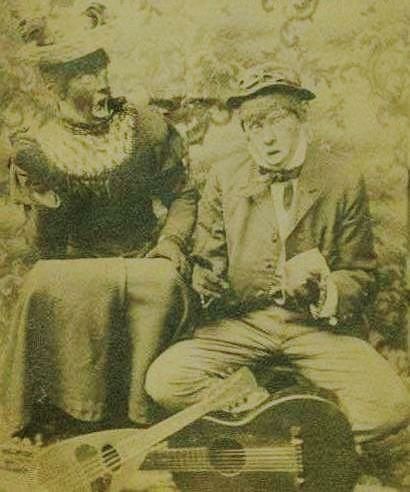

In the early years of film, black characters were routinely played by white people in blackface. In the first filmic adaptation of Uncle Tom's Cabin (1903), all of the major black roles were white people in blackface. Even the 1914 Uncle Tom starring African-American actor Sam Lucas in the title role had a white male in blackface as Topsy. D. W. Griffith's The Birth of a Nation (1915) used white people in blackface to represent all of its major black characters, but reaction against the film's racism largely put an end to this practice in dramatic film roles. Thereafter, white people in blackface would appear almost exclusively in broad comedies or "ventriloquizing" blackness in the context of a vaudeville or minstrel performance within a film. This stands in contrast to made-up white people routinely playing Native Americans, Asians, Arabs, and so forth, for several more decades.
From the 1910s up until the early 1950s, many well-known entertainers of stage and screen also performed in blackface. Light-skinned people who performed in blackface in film included Al Jolson, Eddie Cantor, Bing Crosby, Fred Astaire, Buster Keaton, Joan Crawford, Irene Dunne, Doris Day, Milton Berle, William Holden, Marion Davies, Myrna Loy, Betty Grable, Dennis Morgan, Laurel and Hardy, Betty Hutton, The Three Stooges, The Marx Brothers, Mickey Rooney, Shirley Temple, Judy Garland, Donald O'Connor and Chester Morris and George E. Stone in several of the Boston Blackie films.
As late as the 1940s, Warner Bros. used blackface in Yankee Doodle Dandy (1942), a minstrel show sketch in This Is the Army (1943) and by casting Flora Robson as a Haitian maid in Saratoga Trunk (1945). In The Spoilers (1942), John Wayne appeared in blackface and bantered in a mock accent with a black maid who mistook him for an authentic black man.
In Holiday Inn, Bing Crosby and Marjorie Reynolds sang “Abraham,” a song honoring Lincoln’s birthday, in shoe-polish blackface. The band behind them and the waiters were also in blackface.
Blackface makeup was largely eliminated even from live-action film comedy in the U.S. after the end of the 1930s, when public sensibilities regarding race were beginning to change and blackface became increasingly associated with racism and bigotry. Still, the tradition did not end all at once. The radio program Amos 'n' Andy (1928–1960) constituted a type of "oral blackface", in that the black characters were portrayed by white people and conformed to stage blackface stereotypes. The conventions of blackface also lived on unmodified at least into the 1950s in animated theatrical cartoons. Strausbaugh estimates that roughly one-third of late 1940s MGM cartoons "included a blackface, coon, or mammy figure". Bugs Bunny appeared in blackface at least as late as Southern Fried Rabbit in 1953.
Singer Grace Slick was wearing blackface when her band Jefferson Airplane performed "Crown of Creation" and "Lather" at The Smothers Brothers Comedy Hour in 1968. A clip is included in a 2004 documentary Fly Jefferson Airplane, directed by Bob Sarles.
The 1976 action comedy Silver Streak included a farcical scene in which Gene Wilder must impersonate a black man, as instructed by Richard Pryor. In 1980, an underground film, Forbidden Zone, was released, directed by Richard Elfman and starring the band Oingo Boingo, which received controversy for blackface sequences.
Also in 1980, the white members of UB40 appeared in blackface in their "Dream a Lie" video, while the black members appeared in whiteface to give the opposite appearance.{{cite video | access-date=November 18, 2015 | archive-url=https://ghostarchive.org/varchive/youtube/20211030/LfoVVRDU378| archive-date=2021-10-30}}
Trading Places (1983) is a film telling the elaborate story of a commodities banker and street hustler crossing paths after being made part of a bet. The film features a scene between Eddie Murphy, Jamie Lee Curtis, Denholm Elliott, and Dan Aykroyd when they must don disguises to enter a train. Aykroyd's character puts on full blackface make-up, a dreadlocked wig and a Jamaican accent to fill the position of a Jamaican pothead. The film, being an obvious satire, has received little criticism for its use of racial and ethnic stereotype due to it mocking the ignorance of Aykroyd's character rather than black people as a whole, with Rotten Tomatoes citing it as "featuring deft interplay between Eddie Murphy and Dan Aykroyd, Trading Places is an immensely appealing social satire".
Soul Man is a 1986 film featuring C. Thomas Howell as Mark Watson, a pampered rich white college graduate who uses "tanning pills" to qualify for a scholarship to Harvard Law only available to African American students. He expects to be treated as a fellow student and instead learns the isolation of 'being black' on campus. He later befriends and falls in love with the original candidate of the scholarship, a single mother who works as a waitress to support her education. He later "comes out" as white, leading to the famous defending line: "Can you blame him for the color of his skin?" Unlike Trading Places, the film was met with heavy criticism of a white man donning blackface to humanize white ignorance at the expense of African American viewers. Despite a large box office intake, it has scored low on every film critic platform. "A white man donning blackface is taboo," said Howell; "Conversation over – you can't win. But our intentions were pure: We wanted to make a funny movie that had a message about racism."
Parades
In the early 20th century, a group of African American laborers began a marching club in the New Orleans Mardi Gras parade, dressed as hobos and calling themselves "The Tramps". Wanting a flashier look, they renamed themselves "Zulus" and copied their costumes from a blackface vaudeville skit performed at a local black jazz club and cabaret. The result is one of the best known and most striking krewes of Mardi Gras, the Zulu Social Aid and Pleasure Club. Dressed in grass skirts, top hat and exaggerated makeup, the Zulus of New Orleans are controversial as well as popular. The group has, since the 1960s, argued that the black and white makeup they continue to wear is not blackface.
The wearing of blackface was once a regular part of the annual Mummers Parade in Philadelphia. Growing dissent from civil rights groups and the offense of the black community led to a 1964 city policy, ruling out blackface. Despite the ban on blackface, brownface was still used in the parade in 2016 to depict Mexicans, causing outrage once again among civil rights groups. Also in 1964, bowing to pressure from the interracial group Concern, teenagers in Norfolk, Connecticut, reluctantly agreed to discontinue using blackface in their traditional minstrel show that was a fundraiser for the March of Dimes.
21st century
_poster.jpg)
Commodities bearing iconic "darky" images, from tableware, soap and toy marbles to home accessories and T-shirts, continue to be manufactured and marketed. Some are reproductions of historical artifacts ("negrobilia"), while others are designed for today's marketplace ("fantasy"). There is a thriving niche market for such items in the U.S., particularly. The value of the original examples of darky iconography (vintage negrobilia collectables) has risen steadily since the 1970s.
There have been several inflammatory incidents of white college students donning blackface. Such incidents usually escalate around Halloween, with students accused of perpetuating racial stereotypes.
In 1998, Harmony Korine released The Diary of Anne Frank Pt II, a 40-minute three-screen collage featuring a man in blackface dancing and singing "My Bonnie Lies over the Ocean".
Blackface and minstrelsy serve as the theme of African American director Spike Lee's film Bamboozled (2000). It tells of a disgruntled black television executive who reintroduces the old blackface style in a series concept in an attempt to get himself fired and is instead horrified by its success.
In 2000, Jimmy Fallon performed in blackface on Saturday Night Live, imitating former cast member Chris Rock. That same year, Harmony Korine directed the short film Korine Tap for Stop For a Minute, a series of short films commissioned by Dazed & Confused magazine and FilmFour Lab. The film featured Korine tap dancing while wearing blackface.
Jimmy Kimmel donned black paint and used an exaggerated, accented voice to portray NBA player Karl Malone on The Man Show in 2003. Kimmel repeatedly impersonated the NBA player on The Man Show and even made an appearance on Crank Yankers using his exaggerated Ebonics/African-American Vernacular English to prank call about Beanie Babies.
In November 2005, controversy erupted when journalist Steve Gilliard posted a photograph on his blog. The image was of African American Michael Steele, a politician, then a candidate for U.S. Senate. It had been doctored to include bushy, white eyebrows and big, red lips. The caption read, "I's simple Sambo and I's running for the big house." Gilliard, also African-American, defended the image, commenting that the politically conservative Steele has "refused to stand up for his people". (See .)
In a 2006 reality television program, Black. White., white participants wore blackface makeup and black participants wore whiteface makeup in an attempt to be better able to see the world through the perspective of the other race.
In 2007, Sarah Silverman performed in blackface for a skit from The Sarah Silverman Program.
A Mighty Heart is a 2007 American film featuring Angelina Jolie playing Mariane Pearl, the wife of the kidnapped Wall Street Journal reporter Daniel Pearl. Mariane is of multiracial descent, born from an Afro-Chinese-Cuban mother and a Dutch Jewish father. She personally cast Jolie to play herself, defending the choice to have Jolie "sporting a spray tan and a corkscrew wig". Criticism of the film came in large part for the choice to have Jolie portraying Mariane Pearl in this manner. Defense of the casting choice was in large part due to Pearl's mixed racial heritage, critics claiming it would have been impossible to find an Afro-Latina actress with the same crowd-drawing caliber of Jolie. Director Michael Winterbottom defended his casting choice in an interview, "To try and find a French actress who's half-Cuban, quarter-Chinese, half-Dutch who speaks great English and could do that part better - I mean, if there had been some more choices, I might have thought, 'Why don't we use that person?'...I don't think there would have been anyone better".
A 2008 imitation of Barack Obama by American comedian Fred Armisen (of German, Korean, and Venezuelan descent) on the popular television program Saturday Night Live caused some stir, with The Guardian commentator asking why SNL did not hire an additional black actor to do the sketch; the show had only one black cast member at the time.
Also in 2008, Robert Downey Jr.'s character Kirk Lazarus appeared in brownface in the Ben Stiller-directed film Tropic Thunder. As with Trading Places, the intent was satire; specifically, blackface was ironically employed to humorously mock one of the many foibles of Hollywood rather than black people themselves. Downey was even nominated for an Oscar for his portrayal. According to Downey, "90 per cent of my black friends were like, 'Dude, that was great.' I can't disagree with [the other 10 per cent], but I know where my heart lies."
Once more in 2008, comedian Frank Caliendo, who is well known for his impressions, used blackface to do an impression of former NBA player and sports analyst Charles Barkley. Caliendo defended his use of blackface by comparing it positively to Ted Danson's infamous use of it in 1993 at a Friars Roast, which Caliendo said was "the wrong thing to do".
In the November 2010 episode "Dee Reynolds: Shaping America's Youth", the TV show It's Always Sunny in Philadelphia comically explored if blackface could ever be done "right". One of the characters, Frank Reynolds insists that Laurence Olivier's blackface performance in his 1965 production of Othello was not offensive, while Dennis claimed it "distasteful" and "never okay". In the same episode, the gang shows their fan film, Lethal Weapon 5, in which the character Mac appears in blackface. In the season 9 episode "The Gang make Lethal Weapon 6", Mac once again dons black make-up, along with Dee, who plays his character's daughter in the film. Later in the series, the episode "The Gang Makes Lethal Weapon 7" addresses the topic again along with the removal of their films from the library.
A 2012 Popchips commercial showing actor Ashton Kutcher with brown make-up on his face impersonating a stereotypical Indian person generated controversy and was eventually pulled by the company after complaints of racism. In the TV series Mad Men, set in the 1960s in New York City, the character Roger Sterling appears in blackface in the season 3 episode "My Old Kentucky Home". Julianne Hough attracted controversy in October 2013 when she donned blackface as part of a Halloween costume depicting the character of "Crazy Eyes" from Orange Is the New Black. Hough later apologized, stating on Twitter: "I realize my costume hurt and offended people and I truly apologize."
Billy Crystal impersonated Sammy Davis Jr. in the 2012 Oscars opening montage. The scene depicts Crystal in black face-paint wearing an oiled wave wig while talking to Justin Bieber. In the scene Crystal leaves a parting remark to Bieber, "Have fun storming the Führer", a poor association to his famous line in The Princess Bride, "Have fun storming the castle". The skit was remarked as poor taste, considering he was chosen as the "safer" choice after Eddie Murphy bowed out following producer and creative partner Brett Ratner's homophobic remarks.
Victoria Foyt was accused of using blackface in the trailer for her young adult novel Save the Pearls: Revealing Eden as well as in the book and its artwork.
Performer Chuck Knipp (who is white and gay) has used drag, blackface, and broad racial caricature to portray a character named "Shirley Q. Liquor" in his cabaret act, generally performed for all-white audiences. Knipp's outrageously stereotypical character has drawn criticism and prompted demonstrations from Black, Gay and transgender activists.
The Metropolitan Opera, based in New York City, used blackface in productions of the opera Otello until 2015, though some have argued that the practice of using dark makeup for the character did not qualify as blackface.
On February 1, 2019, images from Governor of Virginia Ralph Northam's medical school yearbook were published on the far-right website Big League Politics. The photos showed an image of Northam in blackface and an unidentified person in a Ku Klux Klan hood on Northam's page in the yearbook. A spokesman for Eastern Virginia Medical School confirmed that the image appeared in its 1984 yearbook. Shortly after the news broke, Northam apologized for appearing in the photo.
Blackface performances are not unusual within the Latino community of Miami. As Spanish-speakers from different countries, ethnic, racial, class, and educational backgrounds settle in the United States, they have to grapple with being re-classified vis-a-vis other American-born and immigrant groups. Blackface performances have, for instance, tried to work through U.S. racial and ethnic classifications in conflict with national identities. A case in point is the representation of Latino and its popular embodiment as a stereotypical Dominican man.
In the wake of protests over the treatment of African-Americans following the murder of George Floyd in 2020, episodes of popular television programs featuring characters in blackface were pulled from circulation. This includes The Golden Girls, The Office, It's Always Sunny in Philadelphia, 30 Rock, Community, and Scrubs, among others.
Stunt doubles
White men are the main source of stunt doubles in American TV and film productions. The practice of a male performer portraying standing-in for a female actor is known as "wigging". When the stunt performer is made up to look like another race, the practice is called a "paint down". Stunt performers Janeshia Adams-Ginyard and Sharon Schaffer have equated it in 2018 with blackface minstrelsy.
Digital media
Digital media provide opportunities to inhabit and perform Black identity without actually painting one's face, which, in a way, some critics have likened to blackface and minstrelsy. In 1999, Adam Clayton Powell III coined the term "high-tech blackface" to refer to stereotypical portrayals of black characters in video games. David Leonard writes, "The desire to 'be Black' because of the stereotypical visions of strength, athleticism, power and sexual potency all play out within the virtual reality of sports games." Leonard's argument suggests that players perform a type of identity tourism by controlling Black avatars in sports games. Phillips and Reed argue that this type of blackface "is not only about whites assuming Black roles, nor about exaggerated performances of blackness for the benefit of a racist audience. Rather, it is about performing a version of blackness that constrains it within the boundaries legible to white supremacy."
In addition, writers such as Lauren Michele Jackson, Victoria Princewill and Shafiqah Hudson criticized non-Black people sharing animated images, or GIFs, of Black people or Black-skinned emojis, calling the practice "digital blackface". Writers Amanda Hess and Shane O'Neill have elaborated on their work, pointing out that GIFs of women of color, in particular, have been most frequently used to express user's emotions online. Hess and O'Neill also suggest that the emoji app Bitmoji uses "black emotional reactions and verbal expressions" and designs them to fit non-Black bodies and faces. Writer Manuel Arturo Abreu refers to this phenomenon as "online imagined Black English", where non-Black users engage in African American Vernacular English, or AAVE, on the internet without understanding the full context of the particular phrase being used.
Following these critiques, the term "digital blackface" has since evolved with the rise of other social media and digital media technologies. In 2020, writer Francesa Sobande wrote on the digital representations of Black people, defining digital blackface as "encompassing online depictions and practices that echo the anti-Black underpinnings of minstrelsy shows involving non-Black people 'dressing up' and 'performing' as though they are Black". Sobande's argument suggests that this acts as a "digital expression of the oppression that Black people face" outside of the internet, where they can be viewed as an objectified type of "commodity or labor tool".
Since the criticisms made by these writers, instances of digital blackface have varied in type across the internet. In 2016, a controversy emerged over social media app Snapchat's Bob Marley filter, which allowed users to superimpose dark skin, dreadlocks, and a knitted cap over their own faces. A number of controversies have also emerged about students at American universities sharing images of themselves appearing to wear blackface makeup. In 2020, two high school students in Georgia were expelled after posting a "racially insensitive" TikTok video that used racial slurs and stereotypes about Black people.
Senior writer Jason Parham suggests that the social media app TikTok, and its viral trends and challenges, has become a new medium for 21st century minstrelsy. Parham argues that "unlike Facebook and Twitter, where instances of digital blackface are either text-based or image-based, TikTok is a video-first platform" where "creators embody Blackness with an auteur-driven virtuosity—taking on Black rhythms, gestures, affect, slang". Examples of these controversial trends and challenges have included "the Hot Cheeto Girl", which is said to mimic stereotypes of Black and Latin women, the "#HowsMyForm" challenge, which plays on racist stereotypes of Black people and other racial groups, and other perceived instances of cultural appropriation, such as "blackfishing".
In 2021, conversation around digital blackface gained further traction after Oprah Winfrey's interview with Meghan Markle and Prince Harry, where Winfrey's reactions during the interview began to circulate the internet in the form of memes. A widespread Instagram post by the Slow Factory Foundation, an activist group founded by Céline Semaan Vernon, calling attention to digital blackface led to many critiques and criticisms about whether or not it was appropriate for non-Black people to continue sharing these images of Winfrey.
Universities
In 2021, music professor Bright Sheng stepped down from teaching a University of Michigan musical composition class, where he says he had intended to show how Giuseppe Verdi adapted William Shakespeare's play Othello into his opera Otello, after showing the 1965 film adaption of Othello, whose actors received four Oscar nominations, but in which the white actor Laurence Olivier played Othello in blackface, which caused controversy even at the time. Sheng allegedly failed to give students any warning that the movie contained blackface, and his two subsequent apologies failed to satisfy his critics, with the wording of the second one causing further controversy.
Evan Chambers, a professor of composition (as is Sheng), said "To show the film now, especially without substantial framing, content advisory and a focus on its inherent racism is in itself a racist act, regardless of the professor's intentions",
Black performers in blackface

19th century
By 1840, black performers also were performing in blackface makeup. Frederick Douglass generally abhorred blackface and was one of the first people to write against the institution of blackface minstrelsy, condemning it as racist in nature, with inauthentic, northern, white origins. Douglass did, however, maintain: "It is something to be gained when the colored man in any form can appear before a white audience."
When all-black minstrel shows began to proliferate in the 1860s, they often were billed as "authentic" and "the real thing". These "colored minstrels" always claimed to be recently freed slaves (doubtlessly many were, but most were not) and were widely seen as authentic. This presumption of authenticity could be a bit of a trap, with white audiences seeing them more like "animals in a zoo" than skilled performers. Despite often smaller budgets and smaller venues, their public appeal sometimes rivaled that of white minstrel troupes. In March 1866, Booker and Clayton's Georgia Minstrels may have been the country's most popular troupe, and were certainly among the most critically acclaimed.
These "colored" troupes – many using the name "Georgia Minstrels" – focused on "plantation" material, rather than the more explicit social commentary (and more nastily racist stereotyping) found in portrayals of northern black people. In the execution of authentic black music and the percussive, polyrhythmic tradition of pattin' Juba, when the only instruments performers used were their hands and feet, clapping and slapping their bodies and shuffling and stomping their feet, black troupes particularly excelled. One of the most successful black minstrel companies was Sam Hague's Slave Troupe of Georgia Minstrels, managed by Charles Hicks. This company eventually was taken over by Charles Callendar. The Georgia Minstrels toured the United States and abroad and later became Haverly's Colored Minstrels.
From the mid-1870s, as white blackface minstrelsy became increasingly lavish and moved away from "Negro subjects", black troupes took the opposite tack. The popularity of the Fisk Jubilee Singers and other jubilee singers had demonstrated northern white interest in white religious music as sung by black people, especially spirituals. Some jubilee troupes pitched themselves as quasi-minstrels and even incorporated minstrel songs; meanwhile, blackface troupes began to adopt first jubilee material and then a broader range of southern black religious material. Within a few years, the word "jubilee", originally used by the Fisk Jubilee Singers to set themselves apart from blackface minstrels and to emphasize the religious character of their music, became little more than a synonym for "plantation" material. Where the jubilee singers tried to "clean up" Southern black religion for white consumption, blackface performers exaggerated its more exotic aspects.
African-American blackface productions also contained buffoonery and comedy, by way of self-parody. In the early days of African-American involvement in theatrical performance, black people could not perform without blackface makeup, regardless of how dark-skinned they were. The 1860s "colored" troupes violated this convention for a time: the comedy-oriented endmen "corked up", but the other performers "astonished" commentators by the diversity of their hues. Still, their performances were largely in accord with established blackface stereotypes.
These black performers became stars within the broad African-American community, but were largely ignored or condemned by the black bourgeoisie. James Monroe Trotter – a middle-class African American who had contempt for their "disgusting caricaturing" but admired their "highly musical culture" – wrote in 1882 that "few ... who condemned black minstrels for giving 'aid and comfort to the enemy'" had ever seen them perform. Unlike white audiences, black audiences presumably always recognized blackface performance as caricature, but took pleasure in seeing their own culture observed and reflected, much as they would half a century later in the performances of Moms Mabley.
Despite reinforcing racist stereotypes, blackface minstrelsy was a practical and often relatively lucrative livelihood when compared to the menial labor to which most black people were relegated. Owing to the discrimination of the day, "corking (or blacking) up" provided an often singular opportunity for African-American musicians, actors, and dancers to practice their crafts. Some minstrel shows, particularly when performing outside the South, also managed subtly to poke fun at the racist attitudes and double standards of white society or champion the abolitionist cause. It was through blackface performers, white and black, that the richness and exuberance of African-American music, humor, and dance first reached mainstream, white audiences in the U.S. and abroad. It was through blackface minstrelsy that African American performers first entered the mainstream of American show business. Black performers used blackface performance to satirize white behavior. It was also a forum for the sexual double entendre gags that were frowned upon by white moralists. There was often a subtle message behind the outrageous vaudeville routines:
20th century

With the rise of vaudeville, Bahamian-born actor and comedian Bert Williams became Florenz Ziegfeld's highest-paid star and only African American star.
In the Theater Owners Booking Association (TOBA), an all-black vaudeville circuit organized in 1909, blackface acts were a popular staple. Called "Toby" for short, performers also nicknamed it "Tough on Black Actors" (or, variously, "Artists" or "Asses"), because earnings were so meager. Still, TOBA headliners like Tim Moore and Johnny Hudgins could make a very good living, and even for lesser players, TOBA provided fairly steady, more desirable work than generally was available elsewhere. Blackface served as a springboard for hundreds of artists and entertainers – black and white – many of whom later would go on to find work in other performance traditions. For example, one of the most famous stars of Haverly's European Minstrels was Sam Lucas, who became known as the "Grand Old Man of the Negro Stage". Lucas later played the title role in the 1914 cinematic production of Harriet Beecher Stowe's Uncle Tom's Cabin.
From the early 1930s to the late 1940s, New York City's famous Apollo Theater in Harlem featured skits in which almost all black male performers wore the blackface makeup and huge white painted lips, despite protests that it was degrading from the NAACP. The comics said they felt "naked" without it.
The minstrel show was appropriated by the black performer from the original white shows, but only in its general form. Black people took over the form and made it their own. The professionalism of performance came from black theater. Some argue that the black minstrels gave the shows vitality and humor that the white shows never had. As the black social critic LeRoi Jones has written:
The black minstrel performer was not only poking fun at himself but in a more profound way, he was poking fun at the white man. The cakewalk is caricaturing white customs, while white theater companies attempted to satirize the cakewalk as a black dance. Again, as LeRoi Jones notes:
Puerto Rico
During the 20th century, blackface was not an uncommon sight at parades in Puerto Rico. In 2019, when blackface was prominently featured at a carnival in San Sebastián, Puerto Rico, the town immediately faced backlash and criticism.
Authenticity
The degree to which blackface performance drew on authentic black culture and traditions is controversial. Black people, including slaves, were influenced by white culture, including white musical culture. Certainly this was the case with church music from very early times. Complicating matters further, once the blackface era began, some blackface minstrel songs unquestionably written by New York-based professionals (Stephen Foster, for example) made their way to the plantations in the South and merged into the body of black folk music.
It seems clear, however, that American music by the early 19th century was an interwoven mixture of many influences, and that blacks were quite aware of white musical traditions and incorporated these into their music.
Early blackface minstrels often said that their material was largely or entirely authentic black culture; John Strausbaugh, author of Black Like You, said that such claims were likely to be untrue. Well into the 20th century, scholars took the stories at face value. Constance Rourke, one of the founders of what is now known as cultural studies, largely assumed this as late as 1931. In the Civil Rights era there was a strong reaction against this view, to the point of denying that blackface was anything other than a white racist counterfeit. Starting no later than Robert Toll's Blacking Up (1974), a "third wave" has systematically studied the origins of blackface, and has put forward a nuanced picture: that blackface did, indeed, draw on black culture, but that it transformed, stereotyped, and caricatured that culture, resulting in often racist representations of black characters.
As discussed above, this picture becomes even more complicated after the Civil War, when many blacks became blackface performers. They drew on much material of undoubted slave origins, but they also drew on a professional performer's instincts, while working within an established genre, and with the same motivation as white performers to make exaggerated claims of the authenticity of their own material.
Author Strausbaugh summed up as follows: "Some minstrel songs started as Negro folk songs, were adapted by White minstrels, became widely popular, and were readopted by Blacks." "The question of whether minstrelsy was white or black music was moot. It was a mix, a mutt – that is, it was American music."
"Darky" iconography


The darky icon itself – googly-eyed, with inky skin, exaggerated white, pink or red lips, and bright, white teeth – became a common motif in entertainment, children's literature, mechanical banks, and other toys and games of all sorts, cartoons and comic strips, advertisements, jewelry, textiles, postcards, sheet music, food branding and packaging, and other consumer goods.
In 1895, the American-born British children's book illustrator Florence Kate Upton created the Golliwog character. Upton modeled the character's rag doll-like appearance after a minstrel doll from her childhood in the United States. "Golly", as he later affectionately came to be called, had a jet-black face, woolly hair, bright red lips, and sported formal minstrel attire. The golliwog character quickly became popular in Britain, the US and other English-speaking countries, being used to sell toys, perfume and a variety of other consumer products. The word "golliwog" may have given rise to the ethnic slur "wog".


U.S. cartoons from the 1930s and 1940s often featured characters in blackface gags as well as other racial and ethnic caricatures. The United Artists 1933 release Mickey's Mellerdrammer – the name a corruption of "melodrama" thought to harken back to the earliest minstrel shows – was a film short based on a production of Uncle Tom's Cabin by the Disney characters. The advertising poster for the film shows Mickey with exaggerated, orange lips; bushy, white sidewhiskers.

In the U.S., by the 1950s, the NAACP had begun calling attention to such portrayals of African Americans and mounted a campaign to put an end to blackface performances and depictions. For decades, darky images had been seen in the branding of everyday products and commodities such as Picaninny Freeze, the Coon Chicken Inn restaurant chain, and Nigger Hair Tobacco. With the eventual successes of the modern day Civil rights movement, such blatantly racist branding practices ended in the U.S., and blackface became an American taboo. However, blackface-inspired iconography continued to be used in popular media in other parts of the world.
Notable instances outside the United States
Over time, blackface and "darky" iconography became artistic and stylistic devices associated with Art Deco and the Jazz Age. By the 1950s and 1960s, particularly in Europe, where it was more widely tolerated, blackface became a kind of outré, camp convention in some artistic circles. The Black and White Minstrel Show, a British musical variety show which featured blackface performers, was shown on the BBC from 1958 to 1978; its performers continued to conduct stage shows until 1989. Many of the songs were from the music hall, country and western, and folk traditions. Actors and dancers in blackface appeared in music videos such as Grace Jones's "Slave to the Rhythm" (1985, also part of her touring piece A One Man Show), Culture Club's "Do You Really Want to Hurt Me" (1982) and Taco's "Puttin' On the Ritz" (1983).
Darlie, a popular toothpaste brand by Hawley & Hazel and sold in parts of Asia, used to be known as "Darkie" and used blackface imagery. In 1989, the blackface imagery was dropped and the product's name changed to "Darlie".
When trade and tourism produce a confluence of cultures, bringing differing sensibilities regarding blackface into contact with one another, the results can be jarring. When Japanese toymaker Sanrio Corporation exported a darky-icon character doll (the doll, Bibinba, had fat, pink lips and rings in its ears) in the 1990s, the ensuing controversy prompted Sanrio to halt production.
Trademark for Conguitos, a confection manufactured by the LACASA Group features a tubby, little brown character with full, red lips. It became a topic of controversy after a Manchester City player compared his black teammate to the character. In Britain, the jam manufacturer Robertson's used the golliwog character as its advertising trademark for almost a century until retiring it in 2001. However, the debate still continues whether the golliwog should be banished in all forms from further commercial production and display, or preserved as a treasured childhood icon. In France, the chocolate powder Banania still uses a face with large red lips derived from the Senegalese Tirailleurs as its emblem. The licorice brand Tabu, popularized by Perfetti in the middle of the 20th century, introduced in the 1980s a cartoon minstrel mascot inspired by Al Jolson's blackface performance in The Jazz Singer, which is still in use today.
The influence of blackface on branding and advertising, as well as on perceptions and portrayals of black people, generally, can be found worldwide.
Arab world
Main article: Anti-Black racism in the Arab world#Use of blackface
Australia
.jpg)
In October 2009, a talent-search skit on Australian TV's Hey Hey It's Saturday reunion show featured a tribute group for Michael Jackson, the "Jackson Jive", in blackface, with the Michael Jackson character in whiteface. American performer Harry Connick, Jr. was one of the guest judges and objected to the act, stating that he believed it was offensive to black people, and gave the troupe a score of zero. The show and the group later apologised to Connick, with the troupe leader of Indian descent stating that the skit was not intended to be offensive or racist.
In 1999, Sam Newman wore blackface to impersonate legendary Indigenous Australian Football League footballer Nicky Winmar after Winmar did not attend a scheduled appearance on the program.
Belgium and Netherlands
Christian traditions: Sinterklaas

In the Netherlands and Belgium, people annually celebrate St. Nicolas Eve with Sinterklaas, the Dutch version of Saint Nicholas, accompanied by multiple helpers or "Zwarte Pieten" (Black Petes). The first is typically an older white man similar to the American Santa, while the latter are usually adolescent boys and girls, and men and women in make-up and attire similar to the American blackface. The task of the Pieten is generally to entertain the children with jokes and pranks, and to help Sinterklaas distribute presents and dole out candy. The Pieten wear Moorish page boy costumes and partake in parades.
The Moorish Zwarte Piet character has been traced back to the middle of the 19th century when Jan Schenkman, a popular children's book author, added a black servant to the Sinterklaas story. The Dag Sinterklaas TV series written by Hugo Matthysen in Belgium since the early 1990s provided a non-racial explanation: Zwarte Piet is black not because of his skin, because of sliding through the chimney to deliver presents. Twenty years later, Bart Peeters (the main actor in the series) stated it is thanks to Matthysen that in Belgium the Sinterklaas event has not been subject of a racism discussion as it has been in the Netherlands, because the series explains that the figure of Zwarte Piet has nothing to do with slavery. However, the original and archetypal Zwarte Piet is believed to be a continuation of a much older custom in which people with blackface appeared in Winter Solstice rituals. In other parts of Western Europe and in Central Europe, black-faced and masked people also perform the role of companions of Saint Nicholas, who is known as Nikolo in Austria, Nikolaus in Germany and Samichlaus in Switzerland. Also on Saint Martin's Eve, black-faced men go around in processions through Wörgl and the Lower Inn Valley, in Tyrol.
Due to Zwarte Piet's strong aesthetic resemblance to the archetypal US blackface, as well as the dynamics between the blackface servants and the white Sinterklaas, there has been international condemnation of the practice since the 1960s. Some of the stereotypical elements have been toned down in recent decades as a result of increasing protests within the nation. For example, there has been a transition towards applying only a few smears of 'soot' to the Piet's cheeks, rather than apply a full blackface. The public support for changing the character was at 5% (versus 89% opposed to such changes) in 2013, which increased to 26% (versus 68% opposed to such changes) in 2017. However, in 2019, support for changing the character of Zwarte Piet underwent a slight decline, with opposition to changes increasing. By 2019 public broadcaster NOS had phased out blackface in their reports on Sint Nikolaas although several municipalities still hosted zwarte piet in local festivities as late as 2024. In 2020, following the murder of George Floyd and worldwide protests against racism, the Dutch prime minister Mark Rutte (who initially had strongly supported Zwarte Piet and condemned protests against suggestions for change) stated he had changed his mind on the matter and hoped the tradition would die out. Yet, he emphasized not intending to impose an official ban and noted he too retains sympathy towards those who do not want to let go of Zwarte Piet.
Canada
Up until the early 2000s, white comedians sometimes used makeup to represent a black person, most often as a parody of an actual person. Many of these segments have been aired during the annual New Year's Eve TV special Bye Bye. For instance, the 1986 edition features three such skits:
- a multi-ethnic version of the series Le temps d'une paix (fr), in which comedienne Michèle Deslauriers played the character Mémère Bouchard as if she hailed from Africa;
- a reference to a joint concert by Quebec rocker Marjo and U.S. diva Eartha Kitt, in which Deslauriers and comic Dominique Michel alluded to Kitt spilling wine on Marjo during the show's press conference;
- a mock American Express commercial spoofing president Ronald Reagan's foreign policy, in which Deslauriers, Michel and actor Michel Côté played Middle Eastern arms buyers.
The Montreal-based satiric group Rock et Belles Oreilles did its own blackface sketches, for instance when comedian Yves Pelletier disguised himself as comedian and show host Gregory Charles, making fun of his energetic personality (not of his racial background) on his television game show Que le meilleur gagne. RBO also did a parody of a talk show where a stereotypical Haitian man (Pelletier again) was easily offended, as well as a group parody of the Caribbean band La Compagnie Créole and a sketch about the lines of African-American actors that were mangled in movie translations. Pelletier did another parody of Gregory Charles for the New Year's Eve TV special Le Bye Bye de RBO in 2006 (as an homage to Charles who had had a particularly successful year), along with a parody of Governor General Michaëlle Jean. And in RBO's 2007 Bye Bye, Guy A. Lepage impersonated a black Quebecer testifying during the Bouchard-Taylor hearings on cultural differences, while in another sketch, Lepage, Pelletier and Bruno Landry impersonated injured Darfur residents.
In September 2011, HEC Montréal students caused a stir when using blackface to "pay tribute" to Jamaican sprinter Usain Bolt during Frosh Week. The story went national, and was even covered on CNN. The university students were filmed in Jamaican flag colours, chanting "smoke weed" in a chorus. The university later apologized for the lack of consciousness of its student body.
In May 2013, comedian Mario Jean (fr) took part in the award show Le gala des Olivier, and imitated several fellow comics, donning blackface when he came to Boucar Diouf (fr), a Senegalese-born storyteller. Many Quebec pundits defended the practice and Diouf himself praised Jean for his open-mindedness.
In December 2013, white actor Joel Legendre (fr) performed in blackface in Bye Bye 2013, as part of yet another parody of Gregory Charles, this time as host of the variety show Le choc des générations.
In December 2014, the satirical end-of-year production by Théâtre du Rideau Vert, a mainstream theatre company, included a blackface representation of hockey player P.K. Subban by actor Marc Saint-Martin. Despite some criticism the sketch was not withdrawn.
In March 2018, comedian of the year Mariana Mazza (fr), whose parents are Arab and Uruguayan, celebrated International Women's Day by putting up a post on her Facebook page which read "Vive la diversité" (Hurray for diversity) and was accompanied by a picture of herself surrounded by eight ethnic variations, including one in a wig and makeup that showed what she'd look like if she were black. She immediately received a flurry of hate messages and death threats, and two days later, posted another message in which she apologized to whoever had been offended, adding that she had been "naively" trying to "express her support for all these communities".
In June 2018, theatre director Robert Lepage was accused of staging scenes that were reminiscent of blackface when he put together the show SLĀV at the Montreal Jazz Festival, notably because white performers were dressed as slaves as they picked cotton. After two initial performances, lead singer Betty Bonifassi broke an ankle and the rest of the summer run was canceled, but later performances were nevertheless scheduled in other venues. The controversy prompted further protests about the play Kanata that Lepage was to stage in Paris about the Canadian Indian residential school system – without resorting to any indigenous actors. The project was briefly put on hold when investors pulled out, but the production eventually resumed as planned.
In 2022, Netflix pulled episode 2 of the popular TV series Les filles de Caleb (which takes place in the 19th century), because the main character, played by Roy Dupuis, dons blackface makeup in order to act as magus Balthazar in a school Nativity play.
Justin Trudeau blackface controversy
In 2019, Time published a photograph of the Prime Minister of Canada, Justin Trudeau, wearing brownface makeup in the spring of 2001. The photograph, which had not been previously reported, was taken at an "Arabian Nights"-themed gala. The photograph showed Trudeau, wearing a turban and robes with his face, neck and hands completely darkened. The photograph appeared in the 2000–2001 yearbook of the West Point Grey Academy, where Trudeau was a teacher. A copy of the yearbook was obtained by Time earlier in the month from Vancouver businessman Michael Adamson, who was part of the West Point Grey Academy community. Adamson said that he first saw the photograph in July and felt it should be made public. On September 19, 2019, Global News obtained and published a video from the early 1990s showing Trudeau in blackface. The video showed Trudeau covered in dark makeup and raising his hands in the air while laughing, sticking his tongue out and making faces. The video showed his arms and legs covered in makeup as well as a banana in his pants, eliciting strong negative reactions. Trudeau admitted that he could not recall how many times he wore blackface after additional footage surfaced.
China
In May 2016, a global controversy broke regarding a television commercial for Qiaobi clothes washing fluid. The commercial showed a pouch of cleaning liquid being forced into a black man's mouth before he is pushed into a washing machine. He emerges later as an Asian man.
On February 15, 2018, a comedy sketch titled "Same Joy, Same Happiness" intending to celebrate Chinese-African ties on the CCTV New Year's Gala, which draws an audience of up to 800 million, showed a Chinese actress in blackface makeup with a giant fake bottom playing an African mother, while a performer only exposing black arms playing a monkey accompanied her. At the end of the skit, the actress shouted, "I love Chinese people! I love China!" After being broadcast, the scene was widely criticized as being "disgusting", "awkward" and "completely racist" on Twitter and Sina Weibo. According to the street interviews by the Associated Press in Beijing on February 16, some Chinese people believed this kind of criticism was overblown. Chinese Foreign Ministry spokesman Geng Shuang, who also watched the skit, said that China had consistently opposed any form of racism, and added, "I want to say that if there are people who want to seize on an incident to exaggerate matters, and sow discord in China's relations with African countries, this is a doomed futile effort" at a daily news briefing on February 22, 2018.
In 2021 CCTV's New Year's Gala show once again featured performers in blackface wearing approximations of African clothing. Like in 2018 it received criticism both within China and internationally. The Chinese foreign ministry responded to criticism by saying that it was not an issue and that anyone saying otherwise must have ulterior motives.
Colombia
The television comedy Sábados Felices included a blackface character, who after a controversy changed his makeup to look like a camouflaged soldier.
Ecuador
.jpg)
In Ecuador, there's a traditional festival held in Latacunga called "La Mama Negra" also known as La Santísima Tragedia in which a man in blackface makeup portrays a black woman liberated from slavery holding her youngest child.
Finland
In Finland, a version of the Star boys' singing procession originating in the city of Oulu, a musical play known as Tiernapojat, has become established as a cherished Christmas tradition nationwide. The Tiernapojat show is a staple of Christmas festivities in schools, kindergartens, and elsewhere, and it is broadcast every Christmas on radio and television. The Finnish version contains non-biblical elements such as King Herod vanquishing the "king of the Moors", whose face in the play has traditionally been painted black. The character's color of skin is also a theme in the procession's lyrics.
The last installation of the Pekka and Pätkä comedy film series, Pekka ja Pätkä neekereinä (Pekka and Pätkä as Negroes), was made in 1960. In the film a computer tells the title characters that a "negro" would be a suitable profession for them. They blacken their faces and pretend to be American or African entertainers performing in a night club, talking self-invented gibberish that is supposed to be English. The computer meant "negro" as a now archaic term for a journalist, which originates from journalists' hands becoming tinted black with ink when handling prints. When Finland's national public broadcasting company Yle aired this film 2016, some people on the social media disapproved of it and insisted that the film should have been censored, or at least the name changed. A representative from Yle said that an old movie should be evaluated in the context of its own time, and that the idea of the movie is to laugh at people being prejudiced. When the film series was aired in 2019, this particular film of the series was left unaired.
Before the 1990s the word "neekeri" (negro) was generally considered a neutral, inoffensive word.
Germany
Examples of theatrical productions include the many productions of the play Unschuld ("Innocence") by the German writer Dea Loher. The play features two black African immigrants, but the use of black-face is not part of the stage directions or instructions. The staging of the play at the Deutsches Theater in Berlin in 2012 was subject of protest. The activist group "Bühnenwatch" (stage watch) performed a stunt in one of the stagings: 42 activists, posing as spectators, left the audience without a word and later distributed leaflets to the audience. Fundamental of the criticism was that the use of black-face solidifies stereotypes regardless of any good intentions and supports racist structures. The critics were invited to a discussion with the director, actors, theatre manager and other artists of the Deutsches Theater. As a result of the discussion, Deutsches Theater changed the design of actor make-up. Ulrich Khuon, the theatre manager, later admitted to being surprised by the protest and is now in a process of reflection.
German productions of Herb Gardner's I'm Not Rappaport almost always cast the role of Midge Carter, the black character, famously portrayed in the U.S. by Ossie Davis, with a white actor in black makeup. The 2012 production of the play at the Berlin Schlosspark-Theater was the subject of protest. The director, Thomas Schendel, in his response to critics, argued that the classical and common plays would not offer enough roles that would justify a repertoire position for a black actor in a German theatre company. The protest grew considerably and was followed by media reports. While advocates of the theatre indicated that in principle it should be possible for any actor to play any character and that the play itself has an anti-racist message, the critics noted that the letter unwittingly disclosed the general, unexpressed policy of German theatres, i.e., that white actors are accounted to be qualified for all roles, even black ones, while black actors are suitable only for black roles. Other authors said that this problem in Germany generally exists for citizens with an immigrant background. The debate also received foreign media attention. The Schlosspark-Theater announced plans to continue the performances, and the German publishing company of Rappaport stated it will continue to grant permits for such performances.
German dramatists commented on the debate:
In 2012, the American dramatist Bruce Norris cancelled a German production of his play Clybourne Park when it was disclosed that a white actress would portray the African-American "Francine". A subsequent production using black German actors was successfully staged.
Guatemala
Guatemalan 2015 elected president, Jimmy Morales, was a comic actor. One of the characters he impersonated in his comic show "Moralejas" was called Black Pitaya which used blackface makeup. Jimmy Morales defended his blackface character saying he is adored by the country's black Garifuna and indigenous Mayan communities.
Iran
Japan
In Japan, in the early 1960s, a toy called Dakkochan became hugely popular. Dakkochan was a black child with large red lips and a grass skirt. There were boy and girl dolls, with the girls being distinguished by a bow. The black skin of the dolls was said to have been significant and in-line with the rising popularity of jazz. Novelist Tensei Kawano went as far as to state, "We of the younger generation are outcasts from politics and society. In a way we are like Negroes, who have a long record of oppression and misunderstanding, and we feel akin to them."
Some Japanese manga and anime have featured characters accused of being inspired by "darky" iconography, which includes Mr. Popo from the Dragon Ball series and the design of the Pokémon character Jynx. Both Mr. Popo and Jynx have been censored on American broadcasting, with Mr. Popo being turned bright blue and given orange-yellow lips instead.
In Japanese hip hop, a subculture of hip-hoppers subscribe to the burapan style, and are referred to as blackfacers. The appearance of these blackfacers is evidence of the popularity of the hip-hop movement in Japan despite what is described as racist tendencies in the culture. It was reported in 2006 that some Japanese hip-hop fans found it embarrassing and ridiculous for fans to change their appearance with blackface in attempt to embrace the culture. In some instances it could be seen as a racist act, but for many of the young Japanese fans it was seen as an appropriate way of immersing in the hip hop culture. The use of blackface is seen by some as a way to rebel against the culture of surface images in Japan.
Blackface has also been a contentious issue in the music scene outside of hip hop. One Japanese R&B group, the Gosperats, has been known to wear blackface makeup during performances. In March 2015 a music television program produced by the Fuji TV network was scheduled to show a segment featuring two Japanese groups performing together in blackface, Rats & Star and Momoiro Clover Z. A picture was published online by one of the Rats & Star members after the segment was recorded, which led to a campaign against broadcasting of the segment. The program that aired on March 7 was edited by the network to remove the segment "after considering the overall circumstances", but the announcement did not acknowledge the campaign against the segment.
Mexico
In modern-day Mexico there are examples of images (usually caricatures) in blackface (e.g., Memín Pinguín). Though there is backlash from international communities, Mexican society has not protested to have these images changed to racially sensitive images. On the contrary, in the controversial Memín Pinguín cartoon there has been support publicly and politically, such as from the Mexican Secretary of Foreign Affairs Luis Ernesto Derbez. Currently in Mexico only 3–4% of the population are Afro-Mexicans (this percentage includes Asian Mexicans).
Panama
Portobelo's Carnival and Congo dance in Panama include a use of blackface as a form of celebration of African history, an emancipatory symbol. Black men paint their faces with charcoal which represents three things. Firstly, the blackface is used as a tool to remember their African ancestors. Secondly, the black face is representative of the disguise or concealment on the run which slaves would have used to evade the Spanish colonizers. Lastly, the practice of blackface is used as a way to signify the code or "secret language" which slaves would have used during the time of the Spanish occupation. During the celebration, for example, good morning will mean good night, and wearing black, or in this case wearing blackface, which normally denotes a time of mourning, is instead used as a way to represent a time of celebration.
Philippines
In 2011, a television drama in the Philippines titled Nita Negrita was widely criticized in the media and by academics.
Portugal and Brazil
Use of black performance in impersonations was quite frequently used in the impressions show A Tua Cara não Me É Estranha, with blackface impressions of Michael Jackson, Siedah Garrett, Tracy Chapman, Louie Armstrong, Nat King Cole, among others. In 2018, Eduardo Madeira dressed up as Serena Williams, adding an African accent the tennis player does not have in real life.
In Brazil, there has been at least some history of non-comedic use of blackface, using white actors for black characters like Uncle Tom (although the practice of "racelift", or making black/mulatto characters into mestiços/swarthy whites/caboclos, is more frequent than blackface). Use of blackface in humor has been used more rarely than in Portugal, although it also continues into this century (but it creates major uproar among the sizeable and more politically active Afro-Brazilian community).
Russia
Soviet Russian writers and illustrators sometimes inadvertently perpetuated stereotypes about other nations that are now viewed as harmful. For example, a Soviet children's book or cartoon might innocently contain a representation of black people that would be perceived as unquestionably offensive by the modern-day western standards, such as bright red lips and other exaggerated features, similar to the portrayal of blacks in American minstrel shows. Soviet artists "did not quite understand the harm of representing black people in this way, and continued to employ this method, even in creative productions aimed specifically at critiquing American race relations".
In 1910, the ballet Sheherazade, choreographed by Michael Fokine, premiered in Russia. The story behind the ballet was inspired by a tone poem written by Nicolai Rimsky-Korsakov. In the ballet the leading female character, Zobeide, is seduced by a Golden Slave. The dancer who portrayed the Golden Slave, the first being Vaslav Nijinsky, would have his face and body painted brown for the performance. This was done to show the audience the slave was of a darker complexion. Later in 1912, Fokine choreographed the ballet Petrushka, which centers around three puppets that come to life, Petrushka, the Ballerina, and the Moor. When the ballet premiered, the part of the Moor, first danced by Alexander Orlov, was performed in full blackface. The Moor puppet is first seen onstage playing with a coconut, which he attempts to open with his scimitar. His movements are apelike. The Moor seduces the Ballerina and later savagely cuts off the head of the puppet Petrushka. When Petrushka is performed today, the part of the Moor is still done in full blackface, or occasionally blueface. The blackface has not been publicly criticized in the ballet community. Black and brownface appear in other ballets today, such as La Bayadère and Othello, in the United States and Europe.
The early Soviet political cartoon Black and White, created in 1932, managed to avoid the blackface style, confronting "precisely that paternalistic model of the ever-passive black subject awaiting enlightenment from the Comintern". The cartoon integrated "an avant-garde-influenced visual aesthetic with images derived from the many newspaper illustrations, cartoons, and posters of American racism that appeared in Soviet Russia at this time".
Soviet theater and movie directors rarely had access to black actors, and so resorted to using black makeup when dictated by the character's descent. Soviet actors portrayed black people mostly by darkening the skin and occasionally adjusting the hair style, without accentuating or exaggerating their facial features. In particular, Vladimir Vysotsky performed the role of Abram Petrovich Gannibal, an 18th-century Russian general of African origin, in the 1976 Soviet film How Czar Peter the Great Married Off His Moor, while Larisa Dolina performed the role of Cuban singer Clementine Fernandez in the 1983 film We Are from Jazz. The 1956 Soviet film adaptation of Othello received the Best Director Award at the 1956 Cannes Film Festival.
On November 30, 2020, in a segment of the Russian TV show "International Sawmill", Russian television presenter Tigran Keosayan interviewed an actress in blackface posing as former United States President Barack Obama. In the segment, Keosayan, referring to Obama's book A Promised Land, asks the actress: "Do you consider this book your achievement?", to which the actress in blackface replies: "Of course." Keosayan then asks: "Because none of your relatives have written books?", after which the actress answers: "Because none of my relatives that came before me could write." Keosayan then states "you should have become a rap musician, not the president". The segment was widely deemed racist.
Spain

On the eve of the Feast of the Epiphany, it is tradition in Spanish cities to hold a colorful parade where three men are disguised as the Biblical Magi and throw candy and presents to the children watching the parade. One of these three men is usually in blackface to depict Balthazar, as such magus is often depicted as a black African. Such a display in Madrid in 2014 led to widespread discussions and to petitions calling for an end to the blackface practice, and to have Balthazar portrayed by a person of color.
South Africa
Inspired by blackface minstrels who visited Cape Town, South Africa, in 1848, former Javanese and Malay coolies took up the minstrel tradition, holding emancipation celebrations which consisted of music, dancing and parades. Such celebrations eventually became consolidated into an annual, year-end event called the "Coon Carnival" but now known as the Cape Town Minstrel Carnival or the Kaapse Klopse.
Today, carnival minstrels are mostly Coloured ("mixed race"), Afrikaans-speaking revelers. Often in a pared-down style of blackface which exaggerates only the lips. They parade down the streets of the city in colorful costumes, in a celebration of Creole culture. Participants also pay homage to the carnival's African-American roots, playing Negro spirituals and jazz featuring traditional Dixieland jazz instruments, including horns, banjos, and tambourines.
The South African actor and filmmaker Leon Schuster is well known for employing the blackface technique in his filming to little or no controversy. But in 2013, the Advertising Standards Authority of South Africa halted the airing of an ad wherein Schuster portrayed a stereotypically dishonest African politician in blackface. The action was in response to the following submitted complaint:
Vodacom South Africa has also been accused of using non-African actors in blackface in its advertising as opposed to simply using African actors. Some have denounced blackface as an artefact of apartheid, accusing broadcasters of lampooning Black people. Others continue to see it as "harmless fun". In 2014, photos of two white University of Pretoria female students donning blackface makeup in an attempt at caricaturing Black domestic workers surfaced on Facebook. The students were said to face disciplinary action for throwing the institution's name into disrepute.
South Korea
Comedians in many Asian countries continue to occasionally use minstrel-inspired blackface, with considerable frequency in South Korea. "Acting black" has been a common phenomenon in South Korean media for more than 30 years: in the 80s, comedians used to perform with darkened faces without attracting criticism.
There have been several notable instances where K-pop celebrities experienced criticism for their blackface acts. Although criticism has increased, use of blackface in Korean media was still occurring in 2018: a performer used blackface in a TV show, a play called "The Blacks" used blackface. In 2020, The Diplomat reported that backlash to pictures posted by students in which they posed in blackface for Halloween was indicative of growing consciousness toward racism in the country.
Taiwan
Taiwanese YouTube comedy group The Wackyboys came under fire after some of its members blackfaced for a Dancing Pallbearers parody video. The group later apologised and deleted the video.
Thailand
In Thailand, actors darken their faces to portray the Negrito of Thailand in a popular play by King Chulalongkorn (1868–1910), Ngo Pa, which has been turned into a musical and a movie.{{cite book
Blackface have been used in commercials in Thailand, as with some other parts of Asia. In 2012, The Bangkok Post reported on a line of cleaning products in Thailand named "Black Man".{{cite news|url=https://www.bangkokpost.com/print/295230/|title=Brand names still stuck in the dark age
Turkey
In Turkey, the actor Tevfik Gelenbe used blackface to portray Arab "mammy" characters throughout his career, from the 1960s through to the 1980s.
United Kingdom
Poachers and rioters
From 1723 to 1823, it was a criminal offence to blacken one's face in some circumstances, with a punishment of death. The Black Act was passed at a time of economic downturn that led to heightened social tensions, and in response to a series of raids by two groups of poachers who blackened their faces to prevent identification. Blackening one's face with soot, lampblack, boot polish or coal dust was a traditional form of disguise, or masking, especially at night when poaching.
The Welsh Rebecca Rioters (1839–1843) used to blacken their faces or wear masks to prevent themselves being identified whilst breaking down turnpike gates, sometimes disguised as women.
Folk culture
Main article: Blackface and Morris dancing
South Western English traditional folk plays sometimes have a Turk Slaver character, probably from the Barbary Coast Slave raids on Cornwall, Devon, Dorset and Somerset in the early 17th Century by "Sallee Rovers" (where the English were the slaves captured and taken by force to North Africa). This character is usually played using a black face (or brownface).
Throughout the country, the Turkish (Saracen) Knight character (probably harkening back to the crusades during the Medieval era) in traditional English Mummers' plays was played in blackface (or brownface), though less often in the modern era.
Various forms of folk dance in England, including Morris dancing, have traditionally used blackface; its continuing use by some troupes is controversial. Some interpretations trace the original invention of blackface back to specific morris traditions.
Molly dancers and Cornish Guise Dancers, traditionally associated with midwinter festivals, often use blacked faces as a disguise. The Molly dancers wished to avoid being identified by the landlords and petty nobles, who were also usually the local magistrates, when they played tricks on those who failed to be generous enough in their gifts to the dancers. The Guise dancers (disguised dancers) also wished to avoid any punishment for their mocking songs embarrassing the local gentry.
Some traditional mummers groups perform the English folk play "St George and the Turkish Knight" with the entire cast, including Father Christmas, and all the white, English characters in mummers' blackface.
In Bacup, Lancashire, the Britannia Coconut Dancers wear black faces. Some believe the origin of this dance can be traced back to the influx of Cornish miners to northern England, and the black face relates to the dirty blackened faces associated with mining.
In Cornwall, several Mummer's Day celebrations are still held; these used to be sometimes known as "Darkie Day" (a corruption of the original "Darking Day", referring to the darkening or painting of the faces) and involved local residents dancing through the streets in blackface to musical accompaniment. As late as 2014, at least one festival (Padstow) featured such songs as 'Old Uncle Ned', which includes the lyrics "He's gone where the good niggers go".
The traditional wedding day chimney sweep, that is considered to be good luck, sometimes has a partially blacked up face to suggest smears of soot. This depends on the performer but it was, and still is, unusual to have a full blackening. Though the complete covered "greyface" is known.
These two traditions, of chimney sweep and folk dancing, coincide in the sometimes lost traditions of (chimney) sweepers festivals. Medway Council supports the Sweeps' Festival, revived in 1981, now claimed to be "the largest festival of Morris dance in the world". It takes place in Rochester around May Day and features a Jack in the Green character. Originally the chimney sweeps were little boys, and they used the day to beg for money, until this child labour was outlawed.
On Guy Fawkes' Day 2017, participants in the Lewes Bonfire, the best known of the Sussex bonfire tradition, decided to abandon black face paint in their depiction of Zulu warriors.
On July 3, 2020, the Joint Morris Organisation announced that all three constituent bodies, representing the vast majority of Morris Dancing in the United Kingdom, would be actively moving to eliminate the use of full-face black makeup from their membership.
''The Black and White Minstrel Show''
The Black and White Minstrel Show was a British light entertainment show that ran for twenty years on BBC prime-time television. Beginning in 1958, it was a variety show which presented traditional American minstrel and country songs, as well as show tunes and music hall numbers, lavishly costumed. It was also a successful stage show which ran for ten years from 1962 to 1972 at the Victoria Palace Theatre, London. This was followed by tours of UK seaside resorts, together with Australia and New Zealand.
Due to its employment of artists wearing blackface, the show was seen by UK anti-racist groups such as the Campaign Against Racial Discrimination, to be both racist and perpetuating ethnic stereotypes.
Legacy
Blackface minstrelsy was the conduit through which black and black-influenced music, comedy, and dance first reached the white American mainstream. It played a seminal role in the introduction of African-American culture to world audiences.
Many of country's earliest stars, such as Jimmie Rodgers and Bob Wills, were veterans of blackface performance. More recently, the American country music television show Hee Haw (1969–1993) had the format and much of the content of a minstrel show, albeit without blackface.
The immense popularity and profitability of blackface were testaments to the power, appeal, and commercial viability of not only black music and dance, but also of black style. This led to cross-cultural collaborations, as Giddins writes; but the often ruthless exploitation of black artistic genius, as well – by other, white performers and composers; agents; promoters; publishers; and record company executives.
While blackface in the literal sense has played only a minor role in entertainment in recent decades, various writers see it as epitomizing an appropriation and imitation of black culture that continues today. As noted above, Strausbaugh sees blackface as central to a longer tradition of "displaying Blackness". "To this day," he writes, "Whites admire, envy and seek to emulate such supposed innate qualities of Blackness as inherent musicality, natural athleticism, the composure known as 'cool' and superior sexual endowment", a phenomenon he views as part of the history of blackface. For more than a century, when white performers have wanted to appear sexy (like Elvis or Mick Jagger), or streetwise (like Eminem), or hip (like Mezz Mezzrow), they often have turned to African-American performance styles, stage presence and personas. Pop culture referencing and cultural appropriation of black performance and stylistic traditions is a tradition with origins in blackface minstrelsy.
This "browning", à la Richard Rodriguez, of American and world popular culture began with blackface minstrelsy. It is a continuum of pervasive African-American influence which has many prominent manifestations today, among them the ubiquity of the cool aesthetic and hip-hop culture.
In 2018, according to The Wall Street Journal former Fox News host Megyn Kelly made remarks on her NBC show * Megyn Kelly Today* questioning why using "blackface" for a Halloween costume was racist. Later that same year, Kelly was fired by NBC for her remarks.
Footnotes
References
- Ndiaye, Noémie. (2022). "Scripts of Blackness: Early Modern Performance Culture and the Making of Race". University of Pennsylvania Press.
- Hoxworth, Kellen. (2024). "Transoceanic Blackface: Empire, Race, Performance". Northwestern University Press.
- Hornback, Robert. (2018). "Racism and Early Blackface Comic Traditions: From the Old World to the New". Palgrave Macmillan.
- Vaughan, Virginia Mason. (2005). "Performing Blackness on English Stages, 1500–1800". Cambridge University Press.
- Professor, Department of English University of Virginia Eric Lott Associate. (1993-10-28). "Love and Theft : Blackface Minstrelsy and the American Working Class: Blackface Minstrelsy and the American Working Class". Oxford University Press, USA.
- For the "darky"/"coon" distinction see, for example, note 34 on p. 167 of Edward Marx and Laura E. Franey's annotated edition of Yone Noguchi, ''The American Diary of a Japanese Girl'', Temple University Press, 2007, {{ISBN. 1592135552. See also Lewis A. Erenberg (1984), ''Steppin' Out: New York Nightlife and the Transformation of American Culture, 1890–1930'', University of Chicago Press, p. 73, {{ISBN. 0226215156. For more on the "darky" stereotype, see J. Ronald Green (2000), ''Straight Lick: The Cinema of Oscar Micheaux'', Indiana University Press, pp. 134, 206, {{ISBN. 0253337534; p. 151 of the same work also alludes to the specific "coon" archetype.
- (2006). "Paddy Jumps Jim Crow: Irish-Americans and Blackface Minstrelsy". Éire-Ireland.
- (December 1975). "Harlequin Jim Crow: Continuity and Convergence in Blackface Clowning". The Journal of Popular Culture.
- Mahar, William John. (1999). "Behind the Burnt Cork Mask: Early Blackface Minstrelsy and Antebellum American Popular Culture". University of Illinois Press.
- (2000). "A History of the Minstrel Show". Boxes & Arrows, Incorporated.
- Clark, Alexis. "[https://www.history.com/news/blackface-history-racism-origins How the History of Blackface Is Rooted in Racism]". ''History''. A&E Television Networks, LLC. 2019.
- (29 October 2014). "Don't get what's wrong with blackface? Here's why it's so offensive.". Vox.
- (27 November 2019). "Black Pete tradition 'Dutch racism in full display'". Al Jazeera.
- Thelwell, Chinua. (2020). "Exporting Jim Crow: Blackface Minstrelsy in South Africa and Beyond". University of Massachusetts Press.
- [[Ayanna Thompson]]. (April 29, 2021). "Blackface Is Older Than You Might Think: From medieval European theater troupes to American minstrelsy, the harmful tradition has a surprisingly long history". [[Smithsonian (magazine).
- {{Harvnb. Strausbaugh. 2007
- "Blackface: The Birth of An American Stereotype".
- (2003). "Freedom Dreams: The Black Radical Imagination". Beacon Press.
- {{Harvnb. Strausbaugh. 2007
- "An excerpt from The Complete Minstrel Guide, published in 1901.".
- (February 5, 2012). "How a bearded Virginia Woolf and her band of 'jolly savages' hoaxed the navy".
- Lott, Eric. "Blackface and Blackness: The Minstrel Show in American Culture", in Annemarie Bean, James V. Hatch, and [[Brooks McNamara]] (eds), ''Inside the minstrel mask: readings in nineteenth-century blackface minstrelsy'', pp. 5–6.
- Rogin, Michael (University of California Press 1998) ''Blackface, White Noise: Jewish Immigrants in the Hollywood Melting Pot'' (p. 30)
- {{Harvnb. Lott. 1993
- {{Harvnb. Watkins. 1999
- ''Inside the minstrel mask: Readings in nineteenth-century blackface minstrelsy'' by Bean, Annemarie, James V. Hatch, and Brooks McNamara. 1996. Middletown, CT: Wesleyan University Press.
- (December 2006). "Color-Blind Ideology and the Cultural Appropriation of Hip-Hop". Journal of Contemporary Ethnography.
- (1997). "Review of Darktown Strutters". African American Review.
- Tosches, Nick. (2002). "Where Dead Voices Gather". Back Bay.
- {{Harvnb. Strausbaugh. 2007
- [[Edwin G. Burrows. Burrows, Edwin G.]] & [[Mike Wallace (historian). Wallace, Mike]]. ''[[Gotham: A History of New York City to 1898]]''. New York: Oxford University Press, 1999. p. 489.
- and [[George Washington Dixon]] was already building his stage career around blackface in 1828,{{Harvnb. Strausbaugh. 2007
- {{Harvnb. Lott. 1993
- {{Harvnb. Strausbaugh. 2007
- Oakley, Giles (2nd Edition) The Devil's Music: A History of the Blues ({{ISBN. 0306807432)
- Ronald L. F. Davis, [http://www.jimcrowhistory.org/history/creating2.htm Creating Jim Crow] {{webarchive. link. (June 1, 2007 , ''The History of Jim Crow'' online, New York Life. Accessed January 31, 2008.)
- {{Harvnb. Strausbaugh. 2007
- {{Harvnb. Strausbaugh. 2007
- Jody Rosen (2006), album notes to ''Jewface'', Reboot Stereophonic CD RSR006
- {{Harvnb. Strausbaugh. 2007
- Michael C. O'Neill, [http://www.eoneill.com/library/laconics/1/1o.htm O'Neill's Ireland: Old Sod or Blarney Bog?] {{Webarchive. link. (April 18, 2012 , ''Laconics'' (eOneill.com), 2006. Accessed online February 2, 2008.)
- [http://findarticles.com/p/articles/mi_qn4158/is_19960102/ai_n9632177 Pat, Paddy and Teague] {{webarchive. link. (October 16, 2015 , ''The Independent'' (London), January 2, 1996. Accessed online (at findarticles.com) February 2, 2008.)
- {{Harvnb. Toll. 1974
- {{Harvnb. Strausbaugh. 2007
- {{Harvnb. Toll. 1974
- {{Harvnb. Toll. 1974
- Staples, Shirley Louise. (1981). "From "Barney's Courtship" to Burns and Allen: Male-female Comedy Teams in American Vaudeville, 1865-1932". [[Tufts University Press]].
- Staples, Shirley. (1984). "Male-female Comedy Teams in American Vaudeville, 1865-1932". [[UMI Research Press]].
- (2010). "American Musical Theatre: A Chronicle". [[Oxford University Press]].
- (1995). "Sound and Sentimentality: Nostalgia in the Songs of Stephen Foster". American Music.
- {{Harvnb. Strausbaugh. 2007
- {{Harvnb. Strausbaugh. 2007
- {{Harvnb. Strausbaugh. 2007
- Ransom, Harry. ''Minstrel Show Collection'', p. 149 (1959), UTA.
- {{Harvnb. Lott. 1993
- Ashny, LeRoy. (2006). "With Amusement for All". University Press of Kentucky.
- {{Harvnb. Strausbaugh. 2007
- {{Harvnb. Strausbaugh. 2007
- {{Harvnb. Strausbaugh. 2007
- Michael Rogin, ''Blackface, White Noise: Jewish Immigrants in the Hollywood Melting Pot'' (1998), University of California Press, p. 79, {{ISBN. 0520213807.
- {{Harvnb. Strausbaugh. 2007
- {{Harvnb. Strausbaugh. 2007
- One extensive list can be found at {{Harvnb. Strausbaugh. 2007
- Smith, R. J., "{{usurped
- "Blackface and Old Wounds".
- Callow, Simon. (1995). "Orson Welles: The Road to Xanadu". Penguin.
- Bogle, Donald. (2011). "Heat Wave: The Life and Career of Ethel Waters". Harper-Collins.
- Wax-Thibodeaux, Emily. "My 5-year-olds saw blackface in a 1942 Christmas movie and asked, 'Why are they doing that?'". [[The Washington Post]].
- {{Harvnb. Strausbaugh. 2007
- {{Harvnb. Strausbaugh. 2007
- {{Harvnb. Strausbaugh. 2007
- (2004). "Forbidden Zone". Fantoma.
- "Trading Places".
- (June 25, 2015). "Throwback Thursday: 'Soul Man' Star Rae Dawn Chong on Rachel Dolezal: 'I Say Welcome Her In'".
- "Zulu Blackface: The Real Story!".
- [https://www.pbs.org/wgbh/americanexperience/features/neworleans-zulu-parade-mardi-gras/ "The Zulu Parade of Mardi Gras"], ''American Experience'', [[Public Broadcasting Service. PBS]]. Accessed July 16, 2008.
- Newhouse, Sam. (January 4, 2016). "Mummers face backlash for 'brownface,' anti-gay incidents". Metro.
- Joseph A. O'Brien (January 30, 1964). [https://www.proquest.com/docview/548271631 "Norfolk Youth Bows To Ban on 'Blackface{{'"]. ''The Hartford Courant''. Accessed February 3, 2011. {{subscription required
- Leah Dilworth (2003), ''Acts of Possession: : Collecting in America'', Rutgers University Press, p. 255, {{ISBN. 0813532728.
- Johnson, Sophie.[http://whitmanpioneer.wordpress.com/2006/10/26/%E2%80%98blackface%E2%80%99-incident-ignites-campus/ "'Blackface' incident ignites campus]". ''Whitman College Pioneer'', October 26, 2006. Retrieved November 27, 2007.
- Walter, Vic.[http://blogs.abcnews.com/theblotter/2006/11/gates_unfinishe.html "Gates' Unfinished Business: Racism at Texas A&M] {{webarchive. link. (February 22, 2016 ". ABC News, The Blotter, November 10, 2006. Retrieved November 27, 2007.)
- Editorial. [http://media.www.dailyillini.com/media/storage/paper736/news/2007/10/31/Editorials/Blackface.A.Black.Mark.For.Every.Student-3067335.shtml "Blackface a Black Mark for Every Student] {{webarchive. link. (December 7, 2008 ''The Daily Illini'', October 31, 2007. Retrieved on 12–2–07.)
- Connolly, Joe. [http://www.dailyorange.com/2.8657/blackface-makes-its-way-to-college-campuses-1.1247695 "Blackface Makes Its Way To College Campuses] {{webarchive. link. (March 15, 2012 ". ''The Daily Orange'', November 11, 2003. Retrieved on November 26, 2007.)
- (2010-09-14). "Act Da Fool: Strange Fruit Meet High Fashion".
- (June 2, 2020). "Jimmy Fallon addresses 'SNL' blackface controversy: 'I'm not a racist'".
- (2001-01-12). "Moloney creates short for FilmFour project".
- "Korine Tap / Stop For a Minute (2000) Directed by Harmony Korine".
- James W. Brosnan. (October 27, 2005). "Virginia governor's candidate pulls ads after 'Sambo' attack". Scripps Howard News Service.
- McFarland, Melanie. (March 6, 2006). "On TV: 'Black. White.' is uncomfortable, revealing reality TV". Seattle Post-Intelligencer.
- (August 12, 2019). "Sarah Silverman says blackface sketch got her fired from movie".
- (June 23, 2007). "A Part Colored by History".
- (June 27, 2007). ""Mighty Heart" casting stirs debate over race".
- Pool, Hannah. (February 26, 2008). "Blacked-up Obama is a pretty weak joke". The Guardian.
- (April 29, 2020). "Tropic Thunder: Why RDJ's Blackface Wasn't Controversial".
- (January 21, 2020). "Robert Downey Jr. Has No Regrets Over 'Tropic Thunder' Blackface: 'It Blasted the Cap on the Issue'".
- Rotter, Joshua. (April 10, 2008). "Frank Caliendo thrives with a little help from his (impersonated) friends". [[The Record (Stockton, California).
- Sims, David. (July 5, 2011). ""Dee Reynolds: Shaping America's Youth"". The A.V. Club.
- Potts, Kimberly. (May 3, 2012). "Ashton Kutcher 'Brownface' Ad With Indian Character 'Raj' Pulled (Video)". The Wrap.
- Sieczkowski, Cavan. (October 29, 2013). "Derek Hough Defends Sister In Blackface Controversy". Huffington Post.
- (October 28, 2013). "Julianne Hough slammed for donning 'black face' Halloween costume". Fox News.
- [https://www.usatoday.com/story/life/people/2013/10/27/julianne-hough-apologizes-for-halloween-costume/3272201/ "Julianne Hough dons blackface for Halloween, apologizes"]. ''USA Today''. October 27, 2013. Retrieved on November 26, 2015.
- "Billy Crystal: How bad was his Oscar hosting?". [[The Washington Post]].
- (November 9, 2011). "Eddie Murphy Exits as Oscar Host".
- [http://www.thefrisky.com/2012-07-27/today-in-racism-ya-series-save-the-pearls-employs-offensive-blackface-and-bizarre-racist-stereotypes-plot/ Today In Racism: YA Series "Save The Pearls" Employs Offensive Blackface And Bizarre Racist Stereotypes Plot] The Frisky
- [http://www.xojane.com/issues/save-the-pearls-revealing-eden-ya-novel-racist Is YA Novel "Save the Pearls" Straight-Up Racist or Just Misguided?] {{Webarchive. link. (August 1, 2012 XOJane)
- {{usurped. February 19–25, 2004
- [https://www.npr.org/sections/thetwo-way/2015/08/04/429366961/metropolitan-opera-to-drop-use-of-blackface-style-makeup-in-otello "Metropolitan Opera To Drop Use Of Blackface-Style Makeup In 'Otello'"]. ''NPR.org''. August 4, 2015. Retrieved on November 26, 2015.
- (October 1, 2015). "Debating 'Otello{{sic". [[The New York Times]].
- (September 20, 2015). "An 'Otello' Without Blackface Highlights an Enduring Tradition in Opera". The New York Times.
- (October 16, 2015). "The rarity of black faces, not 'Otello' in blackface, should be issue in opera". The Washington Post.
- Gabriel, Trip. (February 4, 2019). "With Northam Picture, Obscure Publication Plays Big Role in Virginia Politics". The New York Times.
- Farhi, Paul. (February 3, 2019). "A tip from a 'concerned citizen' helps a reporter land the scoop of a lifetime". The Washington Post.
- (February 2, 2019). "Va. Gov. Northam's yearbook pic of men in blackface, Klan robe spurs calls for his resignation". NBCNews.com.
- (February 1, 2019). "Gov. Ralph Northam 'deeply sorry' after photo emerges from his 1984 yearbook showing blackface, KKK hood". The Washington Post.
- (February 1, 2019). "Ralph Northam yearbook page shows men in blackface and KKK robe". Virginian-Pilot.
- Kelly, Caroline. (February 1, 2019). "Virginia governor's yearbook page shows 2 people in blackface, KKK garb". CNN.
- [https://wtop.com/virginia/2019/02/virginia-governors-1984-yearbook-page-shows-racist-imagery/ Virginia governor confirms 1984 yearbook page with racist imagery] (Associated Press)
- (July 13, 2015). "The Brownface of Latinidad in Cuban Miami". Cuba Counterpoints.
- Shafer, Ellise. (June 28, 2020). "'Golden Girls' Episode With Blackface Scene Removed From Hulu". [[Variety (magazine).
- (May 17, 2018). "Stuntwomen Panel: Evangeline Lilly Says She Was Intentionally Injured While Filming 'Lost'". Deadline.
- Marriot, Michael. (October 21, 1999). "Blood, Gore, Sex and Now: Race". The New York Times.
- Leonard, David. "High Tech Blackface – Race, Sports Video Games and Becoming the Other". Intelligent Agent.
- (2013). "Additive Race: Colorblind Discourses of Realism in Performance Capture Technologies". Digital Creativity.
- Jackson, Lauren Michele. (August 2, 2017). "We Need to Talk About Digital Blackface in Reaction GIFs". [[Teen Vogue]].
- Princewill, Victoria. (August 14, 2017). "Is it OK to use black emojis and gifs?". [[BBC]].
- (July 8, 2018). "Why are memes of black people reacting so popular online?".
- (23 December 2017). "Video: The White Internet's Love Affair With Digital Blackface". The New York Times.
- Sobande, Francesca. (January 22, 2021). "Spectacularized and Branded Digital (Re)presentations of Black People and Blackness". Television & New Media.
- Graham, Jefferson. (April 21, 2016). "Snapchat under fire for Marley filter called blackface".
- Brueck, Hilary. (April 20, 2016). "Is Snapchat's New Bob Marley Filter Just Blackface?". Fortune.
- Clemons, Tracy. (September 30, 2016). "'Blackface' Social Media Post Lands Prairie View A&M Athlete in Hot Water".
- (September 29, 2016). "Blackface or charcoal mask? College investigates photo on social media".
- Simpson, Ian. (October 1, 2016). "Pennsylvania college students suspended over blackface video".
- Park, Madison. (September 16, 2016). "Kansas State student apologizes but denies wearing blackface".
- (19 April 2020). "2 Georgia High Schoolers Posted Racist Video, Officials Say". The New York Times.
- Miller, Joshua Rhett. (April 20, 2020). "Georgia students expelled for posting 'racist' TikTok video".
- (4 August 2020). "TikTok and the Evolution of Digital Blackface".
- Magsino, Isiah. "Teens won't stop posting racist videos and challenges on TikTok. Experts explain why the problem continues.".
- (January 27, 2021). "Unpacking the Racism of Digital Blackface in the Information Age".
- (March 9, 2021). "📌What is digital blackface, and are you performing it?".
- Elizalde, Elizabeth. (March 13, 2021). "Organization says sharing Oprah interview memes is 'digital blackface'".
- Wang, Lydia. "This Oprah Photo Is Quickly Becoming The Latest Example Of Digital Blackface".
- Flaherty, Colleen. (October 11, 2021). "Professor Not Teaching After Blackface 'Othello' Showing".
- Roche, Darragh. (October 9, 2021). "College Music Professor Steps Down After Showing Students 'Blackface' Othello".
- Granville Ganter, [https://www.questia.com/read/1G1-113646013 "He made us laugh some": Frederick Douglass's humor] {{dead link. (July 2021 originally published in ''African American Review'', December 22, 2003.)
- Frederick Douglass, [http://utc.iath.virginia.edu/minstrel/miar03at.html Gavitt's Original Ethiopian Serenaders], originally published in ''The North Star'' (Rochester), June 29, 1849. Online in Stephen Railton, ''Uncle Tom's Cabin'' and American Culture, University of Virginia. Accessed online January 31, 2008.
- {{Harvnb. Toll. 1974
- {{Harvnb. Toll. 1974
- {{Harvnb. Toll. 1974
- {{Harvnb. Toll. 1974
- {{Harvnb. Toll. 1974
- {{Harvnb. Toll. 1974
- {{Harvnb. Toll. 1974
- {{Harvnb. Toll. 1974
- {{Harvnb. Toll. 1974
- {{Harvnb. Toll. 1974
- {{Harvnb. Toll. 1974
- {{Harvnb. Toll. 1974
- {{Harvnb. Toll. 1974
- {{Harvnb. Toll. 1974
- {{Harvnb. Toll. 1974
- Fox, Ted. (2003). "Showtime at the Apollo". Mill Road Enterprises.
- {{Harvnb. Strausbaugh. 2007
- Jefferson, Margo. (October 13, 2004). "Blackface Master Echoes in Hip-Hop". The New York Times.
- Johnson (1968). ''Black Manhattan'', p. 90. Quoted in {{Harvnb. Toll. 1974
- Jones, Leroy. (1968). "Blues People: The Negro Experience in White America and the Music that Developed from It". TMorrow Quill Paperbacks.
- "Carnaval 1962 : "Black face" y diablos.". El Mundo, UPRP.
- (January 21, 2019). "Cuestionan niños pintados de negro en Festival de la Novilla". Primera Hora.
- {{Harvnb. Strausbaugh. 2007
- Floyd, Samuel A. Jr.. (November 2019). "The Power of Black Music: Interpreting its History from Africa to the United States". [[Oxford University Press]].
- {{Harvnb. Strausbaugh. 2007
- {{Harvnb. Strausbaugh. 2007
- {{Harvnb. Strausbaugh. 2007
- {{Harvnb. Strausbaugh. 2007. Toll. 1974 ''passim''.
- John, Strausbaugh. (June 8, 2006). "''Black Like You: Blackface, Whiteface, Insult & Imitation in American Popular Culture''". Tarcher.
- Stowe, David W.. (1994). "Swing Changes: Big-Band Jazz in New Deal America". Harvard University Press.
- [http://www.ferris.edu/jimcrow/golliwog/ "The Golliwog Caricature"], Jim Crow Museum of Racist Memorabilia, Ferris State University. Accessed online January 31, 2008.
- [http://hollywood.pdx.edu/html/coon_chicken_inn.html Coon Chicken Inn] {{webarchive. link. (January 27, 2014 Photos and history of the restaurant chain.)
- [http://news.bbc.co.uk/2/hi/entertainment/2223239.stm Minstrels founder Mitchell dies], BBC, August 29, 2002. Accessed February 2, 2008.
- Kershaw, Miriam, [http://findarticles.com/p/articles/mi_m0425/is_n4_v56/ai_20544718/pg_1 Postcolonialism and androgyny: the performance art of Grace Jones] {{webarchive. link. (June 14, 2013 , ''Art Journal'', Winter 1997, [http://findarticles.com/p/articles/mi_m0425/is_n4_v56/ai_20544718/pg_5 p. 5.] {{webarchive). link. (September 22, 2008 Accessed online July 17, 2008, at FindArticles.com.)
- (2011). "I Want My MTV: The Uncensored Story of the Music Video Revolution". Dutton.
- (May 17, 2007). "Taco – Puttin' on the Ritz (Original Uncensored Version)". YouTube.
- (27 January 1989). "Colgate to Rename a Toothpaste". The New York Times.
- (1989-01-29). "Darkie Drops Offensive Name and Logo". Straits Times.
- Hughes, Sherick A.. (2003). "The Convenient Scapegoating of Blacks in Postwar Japan: Shaping the Black Experience Abroad". Journal of Black Studies.
- John Greenwald with reporting by Kumiko Makihara, {{usurped
- (January 1, 2007). ["Conguitos "Chocolates LACASA · Chocolates y turrones con Imaginación"] {{webarchive"](https://web.archive.org/web/20070101064710/http://www.lacasa.es/web/conguitos/conguitos/conguitos.asp).
- "FA contacts Man City over Silva tweet". BBC Sport.
- "The African-American Image Abroad: Golly, It's Good!".
- [http://www.banania.fr/ "Banania"] {{Webarchive. link. (June 24, 2009 . ''banania.fr''. Retrieved on November 26, 2015.)
- (September 11, 2017). "I nostri Brand".
- Evelyne Yamine, Gareth Trickey and Chris Scott. [http://www.news.com.au/entertainment/celebrity/hey-hey-sees-red-over-black-face-jackson-5-act/story-e6frfmqr-1225784046716 Hey Hey sees red over black face Jackson 5 act] {{webarchive. link. (September 26, 2013 ''The Daily Telegraph'', October 8, 2009.)
- (February 25, 2020). "Eddie McGuire defends Sam Newman's blackface stunt". News.com.au.
- Forbes, Bruce David. (2007). "Christmas: A Candid History". [[University of California Press]].
- (1850). "De oudst bekende naam van Zwarte Piet: Pieter-mê-knecht (1850)".
- Verhoogen, Inne. (23 October 2013). ""Hugo Matthysen heeft de puntjes op de i van de Sint gezet"". [[Vlaamse Radio- en Televisieomroeporganisatie.
- {{harvnb. Bas. 2013
- {{harvnb. Bas. 2013
- (1814–1948). "Sinterklaas:Illustraties".
- Hoving, I. e.a. (2005) [http://www.dbnl.org/tekst/hovi002cult01_01/ ''Cultuur en migratie in Nederland. Veranderingen van het alledaagse 1950–2000''] {{Webarchive. link. (November 17, 2019 Den Haag: Sdu Uitgevers p.253)
- Picheta, Rob. (November 30, 2019). "This country with a colonial history has a blackface problem".
- (26 March 2015). "Criticism of Dutch 'Black Pete' tradition grows". Fox News.
- (October 22, 2013). "Zwarte Piet niet racistisch en moet blijven". EenVandaag.
- (November 22, 2017). "Draagvlak voor traditionele Zwarte Piet loopt terug".
- "Weinig draagvlak voor roetveegpieten bij landelijke intocht Sinterklaas".
- (September 17, 2019). "Sinterklaasjournaal voltooit aftocht Zwarte Piet". NRC.
- (November 5, 2024). "Zwarte Piet ook dit jaar bij meerdere intochten: 'Wij nemen er geen genoegen mee'".
- "Dutch PM's opinions on blackface have undergone 'major changes' – but he won't ban it".
- (June 5, 2020). "Dutch PM sceptical about Black Pete tradition". BBC News.
- Carleton, Marie-Helene. "Zwarte Piet: Black Pete is 'Dutch racism in full display'".
- "[https://www.youtube.com/watch?v=kEPxh7HzsOY ''Bye Bye '86'']" (at 5:00, 19:33 and 56:03), ''YouTube'', December 31, 2016. Retrieved October 17, 2018.
- "[https://www.youtube.com/watch?v=JriHQV_mMmg Marjo humiliée par Ertha [sic] Kitt]", ''YouTube'', January 10, 2011. Retrieved October 17, 2018.
- "[https://www.youtube.com/watch?v=Mv3a-5JyCqs&t=13s Que le moins pire gagne]", ''YouTube'', September 10, 2009. Retrieved July 6, 2018.
- "Les gens qui font l'énervement" (1994-1995 sketch). ''Rock et Belles Oreilles : The Coffret'', Jacques K. Primeau Productions, 2011.
- Untitled 1988 bonus sketch, ''Rock et Belles Oreilles : The Coffret'', Jacques K. Primeau Productions, 2011.
- Untitled 1989-1990 bonus sketch, ''Rock et Belles Oreilles : The Coffret'', Jacques K. Primeau Productions, 2011.
- "[https://www.youtube.com/watch?v=-4r1SKx0Dug ''Bye Bye 2006'' RBO (5)]", ''YouTube'', June 2, 2010. Retrieved July 6, 2018.
- "[https://www.youtube.com/watch?v=43uytw-_bck Le ''Bye Bye'' de RBO 2006 complet]" (at 14:23), ''YouTube'', August 6, 2017. Retrieved July 21, 2018.
- "[https://www.youtube.com/watch?v=x2-dmSdvT7U La conne mission Bouchard-Taylor : Rock et Belles Oreilles (RBO)]", ''YouTube'', January 15, 2014. Retrieved July 14, 2018.
- "[https://www.youtube.com/watch?v=4TziwbczmmQ RBO ''Bye Bye 2007'' – Tour du monde]", ''YouTube'', March 2, 2010. Retrieved July 21, 2018.
- "[https://ghostarchive.org/varchive/GUJrcGFAxBI Blackface Controversy at Canadian School]", ''CNN'', September 20, 2011. Retrieved May 25, 2013.
- (September 15, 2011). "Montreal University Students Don Blackface". CBC News.
- (September 15, 2011). "Montreal University Expresses Regret over Blackface Stunt". Toronto Star.
- (September 17, 2011). "Blackface Blunder Backfires at Université de Montréal".
- (February 24, 2015). "Special Report: Examining the Blackface Debate". CTV News Montreal.
- (May 16, 2013). "Why the Hell Are Quebec Comedians Wearing Blackface?".
- (May 28, 2013). "Challenging 'Blackface' Is Not Quebec-Bashing".
- (May 25, 2013). "You Can't Point out Racism in Quebec".
- "{{usurped
- "[https://www.lapresse.ca/debats/nos-collaborateurs/boucar-diouf/201305/23/01-4653789-je-naime-pas-la-fraternite-raciale.php Je n'aime pas la fraternité raciale!]", ''La Presse'', May 25, 2013. Retrieved December 20, 2018.
- "[https://www.youtube.com/watch?v=bOc9t-XKvRE Le choc de la transpiration – ''Bye Bye 2013'']", ''YouTube'', January 6, 2014. Retrieved July 7, 2018.
- (December 17, 2014). "Un visage peint en noir crée la controverse". La Presse.
- (December 21, 2014). "P.K. Subban Blackface in Théâtre du Rideau Vert Play Deemed Offensive by Some". CBC News.
- (December 11, 2017). "Mariana Mazza remporte l'Olivier de l'année".
- "[https://ghostarchive.org/iarchive/facebook/334519746647863/989960651103766 Je suis moi, mais nous sommes]", ''Facebook'', March 8, 2017. Retrieved on November 20, 2023.
- (March 10, 2017). "Une photo de Mariana Mazza fait polémique".
- "[https://ghostarchive.org/iarchive/facebook/334519746647863/993436274089537 Aux gens concernés et offusqués de ma photo]", ''Facebook'', March 10, 2017. Retrieved November 20, 2023.
- "[https://www.billboard.com/articles/news/8463985/moses-sumney-quits-montreal-jazz-fest-over-show-on-slavery Moses Sumney Quits Montreal Jazz Fest Over Show on Slavery]", ''Billboard'', July 4, 2018. Retrieved July 7, 2018.
- "[https://montrealgazette.com/entertainment/music/jazz-fest-review-slav-misses-the-mark-and-precious-opportunity SLĀV Misses the Mark, and Precious Opportunity]", ''Montreal Gazette'', July 4, 2018. Retrieved July 8, 2018.
- "[https://globalnews.ca/news/4324408/controversial-slave-play-to-continue-run-across-quebec-in-2019/ Controversial Slave Play to Continue Run across Quebec in 2019]", ''Global News''. July 10, 2018. Retrieved October 17, 2018.
- "{{usurped
- "[https://www.ctvnews.ca/montreal/article/controversial-lepage-show-kanata-to-get-debut-in-paris/ Controversial Lepage Show 'Kanata' to Get Debut in Paris]", ''CTV News'', September 5, 2018. Retrieved October 17, 2018.
- "[https://www.ledevoir.com/culture/ecrans/763965/le-retrait-d-un-episode-des-filles-de-caleb-continue-de-faire-reagir Le retrait d'un épisode des 'Filles de Caleb' continue de faire réagir]", ''Le Devoir'', October 13, 2022. Retrieved November 20, 2023.
- Purna Kambhampaty, Anna. (September 18, 2019). "Justin Trudeau Wore Brownface at 2001 'Arabian Nights' Party While He Taught at a Private School".
- (September 19, 2019). "EXCLUSIVE: Video shows Trudeau in blackface in 3rd instance of racist makeup".
- Warmington, Joe. (2023-02-24). "WARMINGTON: Conservative MP Leslyn Lewis won't be called racist by blackface PM".
- Cecco, Leyland. (2019-09-20). "Trudeau says he can't recall how many times he wore blackface makeup".
- (2016-05-28). "Black man is washed whiter in China's racist detergent advert".
- (February 16, 2018). "'Racist' Blackface Chinese New Year TV Sketch Sparks Worldwide Outrage".
- (February 16, 2018). "China's state TV ran a racist skit with blackface as Africans for its Lunar New Year show".
- (February 16, 2018). "Blackface in Chinese Lunar New Year sketch draws criticism".
- (February 22, 2018). "China denies Lunar New Year broadcast with actress in blackface and fake buttocks was racist".
- (February 12, 2021). "China New Year gala show sparks new racism controversy with blackface performance". [[Reuters]].
- (April 24, 2018). "Translation – I'm not your Joke".
- (June 13, 2018). "Twenty-First Century Blackface : Code Switch". NPR.
- "Mama Negra, simbiosis de las culturas y expresiones populares – Ministerio de Turismo".
- "fulbrighterinfinland: 19 December 2006".
- Tarkas, Aarne. (December 31, 1960). "Pekka ja Pätkä neekereinä".
- (March 11, 1960). "Pekka ja Pätkä neekereinä".
- (September 14, 2016). "Pekka ja Pätkä neekereinä -elokuva nostatti valtavan someraivon – Yle vastaa rasismikohuun".
- Jutila, Niko. (April 18, 2019). "Yle jättää nyt Pekka ja Pätkä neekereinä -elokuvan esittämättä".
- Rastas 2007: Rastas, Anna: "Neutraalisti rasistinen? Erään sanan politiikkaa", Rasismi lasten ja nuorten arjessa: Transnationaalit juuret ja monikulttuuristuva Suomi. Tampere: Tampere University Press, 2007. {{ISBN. 978-951-44-6946-6
- "Unschuld [Innocence]". Jenke Nordalm.
- "Colorblind?". etberlin.de.
- (2012). "Aktuell: Das Deutsche Theater sieht weiß und/oder Schwarz? | Theaterensemble 'Label Noir' | Metropolis, Samstag ab 16.45 Uhr | Kultur entdecken". arte.tv.
- (January 10, 2012). "Germany's Schlosspark Theatre defends 'blackface' actor". bbc.co.uk.
- Cadet, Danielle. (January 10, 2012). "German Play, 'I'm Not Rappaport', Angers Critics With Blackface Actor". huffingtonpost.com.
- Lauer, Stefan. (March 22, 2012). "Blackface Is the New Black". vice.com.
- Milagro, Lara-Sophie. (March 28, 2012). "Die Blackfacing-Debatte III – Man muss kein Neonazi sein, um rassistisch zu handeln". nachtkritik.de.
- Uludag, Özgür. (May 2011). "Kommentar – Migranten spielen auf den Sprechbühnen keine Rolle". nachtkritik.de.
- Georgakis, Nikolaos. (2012). "Rassismusdebatte um Schwarze auf Schauspielbühnen". derwesten.de.
- Haberl, Tobias. (2012). "Interview mit René Pollesch über Liebe und Rücksicht. – Aus dem Magazin". sz-magazin.sueddeutsche.de.
- (2012). "'Clybourne Park' at Staatstheater Mainz". staatstheater-mainz.com.
- Lakhani, Nina. (October 21, 2015). "Guatemalans face choice of former blackface comedian or ex-first lady". The Guardian.
- Behnegarsoft.com. "Iran Book News Agency (IBNA) - "Siah-bazi a forbidden play" released".
- Armbrust, Walter. (2000). "Mass Mediations: New Approaches to Popular Culture in the Middle East and Beyond". University of California Press.
- (2013-04-19). "Opinion: The "Cursed Three" and the "Supreme Leader" - ASHARQ AL-AWSAT". ASHARQ AL-AWSAT.
- Collective, Ajam Media. (2016-12-07). "A Review of Tarabnameh, or, Why Are Iranian-Americans Laughing at Blackface in 2016?".
- Fathali Beigi, Davood. (January 16, 2013). ""Siah-Bazi A Forbidden Play" Released".
- "Noruz {{!}} TraditionsCustoms.com".
- Baghoolizadeh, Beeta. (2021). "The Myths of Haji Firuz: The Racist Contours of the Iranian Minstrel". Lateral.
- (August 29, 1960). "JAPAN: Dakkochan Delirium".
- (August 5, 2015). "What Black Anime Fans Can Teach Us About Race in America".
- [http://etext.virginia.edu/railton/huckfinn/minstrl.html "Black-Face Minstrelsy"]. ''virginia.edu''. Retrieved on November 26, 2015.
- (1997). "The Yellow Negro". Transition.
- Ashcraft, Brian. (June 28, 2006). "LocoRoco Racist?".
- Neate, Patrick. (October 2023). "Where You're At: Notes From the Frontline of a Hip Hop Planet.". [[Riverhead Trade]].
- McNeil, Baye. (February 18, 2015). "Time to shut down this modern-day minstrel show". [[The Japan Times]].
- Hamamoto, Ben. (June 2006). "Is blackface in Japan racist?".
- Hongo, Junn, [https://blogs.wsj.com/japanrealtime/2015/03/10/japan-tv-station-pulls-blackface-performance-from-program/ "Japan TV Station Pulls Blackface Performance From Program"]. ''WSJ''. Retrieved November 26, 2015.
- [http://www.japantimes.co.jp/news/2015/03/09/national/fuji-tv-removes-blackface-segment-after-outcry/ "Fuji TV removes blackface segment after outcry"]. ''The Japan Times''. Retrieved on November 26, 2015.
- "Hace EU el 'ridículo' al criticar a Memín Pinguín: Derbez".
- Elizabeth, Rhodes. (January 1, 2004). "Black Indians, Zulus and Congos; Transformation and Transference of Community Traditions in New Orleans and Panama". Textual Resources.
- Winn, Patrick. (July 1, 2014). "Asia embraces blackface-style ads. Get ready to cringe".
- (September 10, 2016). "Y-speak: Racism in the Philippines: Does it exist?".
- [https://www.youtube.com/watch?v=QGwtcMcdSaw A Tua Cara Não Me é estranha: Paulo Vintém interpreta Michael Jackson], Youtube
- [https://www.youtube.com/watch?v=1yjJnoQZB6Q Maria João Abreu (Michael Jackson) – A Tua Cara Não Me É Estranha (TVI)], YouTube
- [https://www.youtube.com/watch?v=Ji9RQoeIAyw Daniela e Edmundo interpretam Michael Jackson e Siedah Garrett-A Tua cara não me é Estranha (TVI )], YouTube
- [https://www.youtube.com/watch?v=KNqpmyIikDU Merche Romero interpreta Tracy Chapman], YouTube
- [https://www.youtube.com/watch?v=cIn6K-5tRLk Mico da Câmara Pereira interpreta «What a Wonderful World» de Louis Armstrong], YouTube
- [https://www.youtube.com/watch?v=ePvfQqvubls Nicolau Breyner interpreta_Nat King Cole_ A Tua Cara Não me é Estranha], YouTube
- [https://www.youtube.com/watch?v=ynqoru4WAC4 Serena Williams no 5 {{!}} 5 Para a Meia-Noite {{!}} RTP], YouTube, September 27, 2018
- [https://virtualia.blogs.sapo.pt/29596.html Os Negros Nas Novelas], blog ''Virtualia'', May 23, 2009.
- [http://lostinjapan.portalnippon.com/2012/06/cor-de-gabriela-lost-in-japan.html A Cor de Gabriela] {{webarchive. link. (January 26, 2013 , ''Lost in Japan'', June 18, 2012.)
- [http://f5.folha.uol.com.br/televisao/988689-caixa-refaz-propaganda-e-mostra-machado-de-assis-mulato.shtml Caixa refaz propaganda e mostra Machado de Assis mulato] {{Webarchive. link. (January 29, 2013 , F5, ''[[Folha de S.Paulo]]'', October 10, 2011.)
- [http://www.pragmatismopolitico.com.br/2012/08/racismo-explicito-no-zorra-total-relembra-humor-segregacionista-dos-eua.html "Racismo explícito no Zorra Total relembra humor segregacionista dos EUA"], ''Pragmatismo Político'', August 15, 2012.
- Wilson, Jennifer. (August 31, 2017). "How red Russia broke new ground in the portrayal of black Americans". PRI.
- Au, Susan. ''Ballet and Modern Dance'', 2nd edn. London: Thames & Hudson, 2002. Print.{{page needed. (October 2023)
- Kiaer, Christina. (October 31, 2017). "Anti-racism in Early Soviet Visual Culture". Black Perspectives.
- (November 30, 2020). "Obama Blackface Skit on Kremlin-Funded TV Sparks Outrage".
- (December 1, 2020). "Russian state TV broadcaster features racist segment of an actress in blackface doing a portrayal of Obama". [[Business Insider]].
- (5 January 2024). "Madrid laat per ongeluk video's voor Driekoningen maken met blackface". NU.nl.
- (2021). "Recht in beweging". Gompel & Svacina.
- (October 27, 2005). "Coon Carnival Cape Town".
- (September 5, 2013). ""Offensive" Blackface South African Commercial Banned". BuzzFeed.
- William Fitzhugh Brundage. (2011). "Beyond Blackface: African Americans and the Creation of American Popular Culture, 1890–1930". University of North Carolina Press.
- ewn.co.za. 2014. Tuks-blackface-students-face-disciplinary-action. [ONLINE] Available at: http://ewn.co.za/2014/08/06/Tuks-blackface-students-face-disciplinary-action. [Retrieved August 6, 2014].
- (April 20, 2017). "Backlash over Blackface use in South Korean Show". ebony.com.
- (April 21, 2017). "A Korean TV Station Has Now Apologised For Using Blackface".
- (February 3, 2014). "Will they ever get it?".
- Morrissey, Tracie Egan. (March 2012). "WTF Is Up With K-Pop and Blackface?!".
- (April 23, 2017). "SBS Comedy Show Addresses Blackface Controversy".
- (July 13, 2017). "Blackface Is Still Racist and Wrong. Yes, Even In Korea".
- (August 23, 2017). "Controversial Korean Show Caught Trying to Do 'Blackface' Again".
- (January 2, 2015). "K-Pop nationalism: Celebrities and acting blackface in the Korean media". Continuum.
- Wang, Erika Ningxin. (2026). "Fandom Nationalism: Participatory Censorship and Performative Patriotism in East Asia". [[Bloomsbury Academic]].
- (November 8, 2018). "Blizzard accused of blackface on South Korean Overwatch stream".
- "What a Blackface Photo Says About South Korea's Racism Problem". thediplomat.com.
- (June 2, 2020). "Taiwan's Wackyboys perform coffin dance in blackface". Taiwan News.
- "Is there really no anti-Black racism in Turkey?". bianet.org.
- (September 1974). "The Waltham Blacks and the Black Act". The Historical Journal.
- Newall, Venetia. (1981). "The Turkish Knight in English Traditional Drama". Folklore.
- (1990). "Black Faces, Garlands, and Coconuts: Exotic Dances on Street and Stage". Dance Research Journal.
- Beth Abbit. (April 24, 2014). "Straw defends 'Nutters in Twitter picture row". Rossendale Free Press.
- William Langley. (April 27, 2014). "Meeting the dance troop who say 'blacking-up' is a badge of pride". Sunday Telegraph.
- "Guise Dancing {{!}}".
- "Video boxing day".
- "BBC Radio 4 – The Untold – Harmless Tradition?".
- (September 27, 2011). "Charlie Brush- wedding chimney sweep – YouTube".
- "History of the Sweeps Festival".
- (November 5, 2017). "Lewes bonfire society ends tradition of blacking-up". The Guardian.
- (July 3, 2020). "Calling time on full-face black makeup".
- Gary Giddings, ''[[Bing Crosby]]: A Pocketful of Dreams, The Early Years 1903–1940'' (2001), Back Bay Books, p. 78. {{ISBN. 0316886459.
- Nolan Porterfield, ''Jimmie Rodgers: The Life and Times of America's Blue Yodeler'' (1979), University of Illinois Press, p. 262, {{ISBN. 0252007506.
- Charles Townsend, ''San Antonio Rose: The Life and Music of Bob Wills'' (1986), University of Illinois Press, {{ISBN. 025201362X, p. 45.
- Nick Tosches, ''Where Dead Voices Gather'' (2002), Back Bay, p. 66, {{ISBN. 0316895377.
- {{Harvnb. Lott. 1993
- {{Harvnb. Toll. 1974
- Barlow, William. "Black Music on Radio During the Jazz Age", ''African American Review'', Summer 1995.
- Kofsky, Frank. (1998). "Black Music, White Business: Illuminating the History and Political Economy of Jazz". Pathfinder Press.
- (December 12, 1999). "The Great Jazz Swindle". [[Chicago Tribune]].
- [https://www.pbs.org/theblues/classroom/intwhitesblacks.html "Whites, Blacks and the Blues"], "The Blues" Teacher's Guide, PBS. Retrieved December 18, 2008.
- Kolawole, Helen.[https://www.theguardian.com/music/2002/aug/15/elvis25yearson.elvispresley "He Wasn't My King.]" ''The Guardian Unlimited'', August 15, 2002. Retrieved November 29, 2007.
- {{Harvnb. Strausbaugh. 2007
- {{Harvnb. Strausbaugh. 2007
- Cunningham, Daniel Mudie. "[http://www.thefilmjournal.com/issue8/larryclark.html Larry Clark: Trashing the White American Dream]".{{webarchive. link. (April 3, 2016 ''The Film Journal''. Retrieved on August 25, 2006)
- Roediger, David (1997). "The First Word in Whiteness: Early Twentieth-Century European Immigration", ''Critical White Studies: Looking Behind the Mirror''. Temple University Press, p. 355.
- {{Harvnb. Strausbaugh. 2007. Strausbaugh. 2007
- (December 2003). "Coolhunting, account planning and the ancient cool of Aristotle". Marketing Intelligence & Planning.
- Thompson, Robert Farris. (1973). "An Aesthetic of the Cool". African Arts.
- MacBroom, Patricia. [http://www.berkeley.edu/news/berkeleyan/2000/04/12/hiphop.html "Rap Locally, Rhyme Globally: Hip-Hop Culture Becomes a World-Wide Language for Youth Resistance, According to Course"]. News, ''Berkeleyan''. May 2, 2000. Retrieved September 27, 2006.
- tas. (October 25, 2018). "Megyn Kelly's 'Blackface' Remarks". [[The Wall Street Journal]].
- Folkenflik, David. (October 25, 2018). "Megyn Kelly Out At NBC's 'Today' Show". [[NPR]].

This article was imported from Wikipedia and is available under the Creative Commons Attribution-ShareAlike 4.0 License. Content has been adapted to SurfDoc format. Original contributors can be found on the article history page.
Ask Mako anything about Blackface — get instant answers, deeper analysis, and related topics.
Research with MakoFree with your Surf account
Create a free account to save articles, ask Mako questions, and organize your research.
Sign up freeThis content may have been generated or modified by AI. CloudSurf Software LLC is not responsible for the accuracy, completeness, or reliability of AI-generated content. Always verify important information from primary sources.
Report