From Surf Wiki (app.surf) — the open knowledge base
Black liquor
Industrial by-product
.jpg)
Industrial by-product
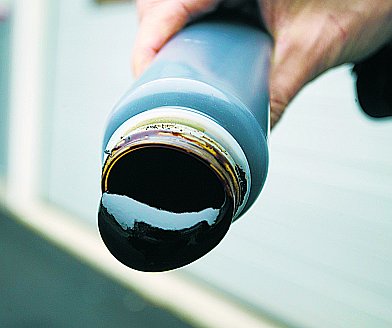
In industrial chemistry, black liquor is the by-product from the kraft process when digesting pulpwood into paper pulp removing lignin, hemicelluloses and other extractives from the wood to free the cellulose fibers.
The equivalent material in the sulfite process is usually called brown liquor, but the terms red liquor, thick liquor and sulfite liquor are also used.
Composition
Approximately seven tonnes of black liquor are produced in the manufacture of one tonne of pulp.
The black liquor is an aqueous suspension of lignin residues, hemicellulose, and the inorganic chemicals used in the process. The black liquor comprises 15% solids by weight of which two thirds are organic chemicals and the remainder are inorganic. Normally the organics in black liquor are 40-45% soaps, 35-45% lignin and 10-15% other organics.
The organic matter in the black liquor is made up of water/alkali soluble degradation components from the wood. Lignin is degraded to shorter fragments with sulphur content at 1-2% and sodium content at about 6% of the dry solids. The extractives gives tall oil soap and crude turpentine.
The residual lignin components currently serve for hydrolytic or pyrolytic conversion or just burning only.
Fresh black liquor is highly alkaline and highly reducing (reactive toward air). Some of the detailed properties are affected by the identity of the source trees, e.g. softwood vs hardwoods. In view of these properties, release of black liquor poses an environmental threat.
History
Early kraft pulp mills discharged black liquor to watercourses. Black liquor is quite toxic to aquatic life, and causes a very dark caramel color in the water. The invention of the recovery boiler by G.H. Tomlinson in the early 1930s was a milestone in the advancement of the kraft process.
By the 1990s, most kraft mills were consuming nearly all of their black liquor byproduct, and purifying the remainder in biological treatment plants, reducing the environmental effect of the waste waters below the level of scientific significance, except perhaps in very small streams. Even in the 21st century, some small kraft mills remained (producing at most a few tons of pulp per day) that discharged all black liquor. However, these are rapidly disappearing. Some kraft mills, particularly in North America, still recovered under 98% of the black liquor in 2007, which can cause some environmental contamination, even when biologically treated. The general trend is for such obsolete mills to modernize or shut down.
In August 2011, a fish and mollusk kill occurred on the Pearl River when a neighboring Louisiana paper mill accidentally discharged black liquor due to a problem in its waste water treatment system.
Usage
The black liquor contains more than half of the energy content of the wood fed into the digester of a kraft pulp mill. It is normally concentrated to 65 - 80% by multi-effect evaporators and burned in a recovery boiler to produce energy and recover the cooking chemicals. The viscosity increases as the concentration goes up. At about 50 - 55% solids the salt solubility limit is reached. Tall oil is an important byproduct separated from the black liquor with skimming before it goes to the evaporators or after the first evaporator stage.
Energy source for the pulp mill
Pulp mills have used black liquor as an energy source since at least the 1930s. Most kraft pulp mills use recovery boilers to recover and burn much of the black liquor they produce, generating steam and recovering the cooking chemicals (sodium hydroxide and sodium sulfide used to separate lignin from the cellulose fibres needed for papermaking). This has helped paper mills reduce problems with water emissions, reduce their use of chemicals by recovery and reuse, and become nearly energy self-sufficient by producing, on average, 66 percent of their own electricity needs on-site.
In the United States, paper companies have consumed nearly all of the black liquor they produce since the 1990s. As a result, the forest products industry has become one of the United States' leading generators of carbon-neutral renewable energy, producing approximately 28.5 terawatt hours of electricity annually.
Use as biofuel feedstock
Gasification
New waste-to-energy methods to recover and utilize the energy in the black liquor have been developed. The use of black liquor gasification has the potential to achieve higher overall energy efficiency than the conventional recovery boiler, while generating an energy-rich syngas from the liquor. The syngas can be burnt in a gas turbine combined cycle to produce electricity (usually called BLGCC for Black Liquor Gasification Combined Cycle; similar to IGCC) or converted through catalytic processes into chemicals or fuels such as methanol, dimethyl ether (DME), or F-T diesel (usually called BLGMF for Black Liquor Gasification for Motor Fuels). This gasification technology is currently under operation in a 3 MW pilot plant at Chemrec's test facility in Piteå, Sweden. The DME synthesis step will be added in 2011 in the "BioDME" project, supported by the European Commission's Seventh Framework Programme (FP7) and the Swedish Energy Agency.
Used for biofuels production, the black liquor gasification route has been shown to have very high conversion efficiency and greenhouse gas reduction potential.Well-to-Wheels analysis of future automotive fuels and powertrains in the European context EUCAR / Concawe /JRC Well-to-Wheels Report Version 2c, March 2007
Hydrothermal liquefaction
Hydrothermal liquefaction is suitable for converting black liquor to advanced biofuels due to the process's ability to handle high moisture inputs.
Extraction of lignin
Where recovery boiler capacity is limited and a bottleneck in the pulp mill, the lignin in the black liquor may be extracted, then exported or used as fuel in the mill's lime kiln. This often replaces fossil-based fuel with biofuel.
U.S. tax credit 2007–2010
A tax credit created by the U.S. Congress in 2005 as part of the 2005 Highway Bill to reward and support the use of liquid alternative fuel derived from hydrocarbons in the transportation sector was expanded in 2007 to include non-mobile uses of liquid alternative fuel derived from biomass. This change meant that, in addition to fish processors, animal renderers and meat packers, kraft pulp producers became eligible for the tax credit as a result of their generation and use of black liquor to make energy. For one large company (International Paper) this could amount to as much as $3.7 billion in benefits. Weyerhaeuser announced in May 2009 that it was also pursuing the tax credit. Some paper industry analysts criticized the paper industry's eligibility for the alternative fuel mix tax credit on the grounds that it increased fossil fuel use, but the industry countered that adding a fossil fuel was a requirement of the law and that, regardless, this did not result in a net increase in fossil fuel use since companies were merely replacing the existing fossil fuel they already mixed with black liquor—natural gas—with one of the three fuels specified by the law: gasoline, kerosene or diesel. The bio-fuel credit for black liquor ended on January 1, 2010.
References
References
- (2000). "Forest Products Chemistry". Fapet OY.
- Biermann, Christopher J.. (1993). "Essentials of Pulping and Papermaking". Academic Press, Inc..
- Handbook of Pulping and Papermaking SE, 1996, {{ISBN. 0-12-097362-6
- (2019-01-01). "Heavy Oil Recovery and Upgrading". Gulf Professional Publishing.
- (2001). "Aquatic toxicity from pulp and paper mill effluents: a review". Advances in Environmental Research.
- (2022). "Treatment of kraft black liquor using basidiomycete and ascomycete fungi". Process Safety and Environmental Protection.
- E. Sjöström. (1993). "Wood Chemistry: Fundamentals and Applications". [[Academic Press]].
- "TIN Pearl River Spill - LA".
- "Pearl River Fish Kill Post Incident Monitoring Report 2012 - 2014". Louisiana Department of Wildlife and Fisheries.
- [http://www.paperstudies.org/research/projects/gasification/background.htm The Center for Paper Business and Industry Studies (CPBIS)]
- Empie, H. Jeff. (2009). "Fundamentals of the craft recovery process". Tappi Press.
- Mufson, Steven. (March 28, 2009). "Papermakers Dig Deep in Highway Bill To Hit Gold". [[The Washington Post]].
- [http://www.chemrec.se/ Chemrec] {{Webarchive. link. (2010-08-11 website)
- [http://www.biodme.eu/index.html BioDME Project] website
- (10 Sep 2015). "Hydrothermal liquefaction of bagasse using ethanol and black liquor as solvents". Biofuels, Bioproducts and Biorefining.
- (March 24, 2009). "International Paper Provides Update on Alternative Fuel Credits". [[International Paper]].
- (November 2024). "Weyerhaeuser says applied to become qualified as alternative fuel mixer". [[CNBC]].
- Dizikes, Cynthia. (April 24, 2009). "Paper firms reap billions from tax credit — but should they?". [[MinnPost]].
This article was imported from Wikipedia and is available under the Creative Commons Attribution-ShareAlike 4.0 License. Content has been adapted to SurfDoc format. Original contributors can be found on the article history page.
Ask Mako anything about Black liquor — get instant answers, deeper analysis, and related topics.
Research with MakoFree with your Surf account
Create a free account to save articles, ask Mako questions, and organize your research.
Sign up freeThis content may have been generated or modified by AI. CloudSurf Software LLC is not responsible for the accuracy, completeness, or reliability of AI-generated content. Always verify important information from primary sources.
Report