From Surf Wiki (app.surf) — the open knowledge base
Black Brant (rocket)
Family of Canadian-designed sounding rockets

Family of Canadian-designed sounding rockets
The Black Brant is a family of Canadian-designed sounding rockets originally built by Bristol Aerospace, since absorbed by Magellan Aerospace in Winnipeg, Manitoba. Over 800 Black Brants of various versions have been launched since they were first produced in 1961, and the type remains one of the most popular sounding rockets. They have been repeatedly used by the Canadian Space Agency and NASA.
History
Black Brant was the result of research at Canadian Armament Research and Development Establishment (CARDE) during the 1950s into the nature of the upper part of the atmosphere as part of ongoing research into anti-ballistic missile systems and very-long-range communication. In 1957, CARDE contracted Bristol to produce a simple rocket fuselage, called the Propulsion Test Vehicle, for studies into high-power solid fuels. The resulting design, by Albert Fia, was quite heavy, as it was designed to be able to accommodate a wide variety of engine burning times, propellant loadings and launch angles in keeping with its role as a test vehicle for ABM systems development. The first test flight took place only two years later from the Churchill Rocket Research Range in September 1959.
CARDE's attention later turned to long-distance communications and they found the Propulsion Test Vehicle system useful as a sounding rocket. To better suit this role, Bristol modified the design to be lighter and more tailored to the sounding rocket role. This became the Black Brant. CARDE launched a number of Black Brant rockets over the next few years, both the original Black Brant I design which could place a 68 kg payload to 150 km altitude, as well as the larger Black Brant II which first flew in October 1960, and the smaller but higher-altitude Black Brant III.
The rocket's design emphasized reliability over payload and range. In July 1963 the much larger Black Brant V first flew, which was also used as a booster stage for the Black Brant III to make the Black Brant IV. The IV first flew in 1964, but failed, as did the next test launch. Aside from these two launches, which were corrected for, the Black Brant has never had another failure, making it one of the most reliable rockets in history. Since then it has undergone continual evolution, and the current versions are the XI and XII, consisting of Black Brant V used as an upper stage, with Talos and Terrier boosters as lower stages. They have reached altitudes of more than 1500 km, which is above the ionosphere and well above the orbits of the Space Shuttle and the International Space Station.
The propellant designs developed by CARDE in the Black Brant program were the highest performing solid fuels of their day. Bristol then placed this propellant in a new 70 mm rocket to form the CRV7, the first rocket capable of penetrating standard Warsaw Pact aircraft hangars. The CRV7 has since gone on to become the de facto standard rocket for most Western-aligned militaries.
In 1976, Australia and Canada through the National Research Council Canada (NRCC) agreed to launch a rocket from Woomera Test Range. The Black Brant VB rocket was launched there on 9 November for experiments in the ionosphere. Later, NASA would launch a number of Black Brant IX.
At present, due to its 98% success rate, it remains one of the most popular sounding rockets ever built. The rockets have been used repeatedly by the Canadian Space Agency and NASA. There is a 1:1 scale model of the Black Brant IX rocket in front of the head office of the Canadian Space Agency in Saint-Hubert, east of Montréal. A full-scale Black Brant VC is on display in the Science Gallery of The Manitoba Museum in Winnipeg, Manitoba, Canada.
In 1995, a Black Brant XII four-stage sounding rocket from the Andøya Rocket Range off the northwestern coast of Norway caused the Norwegian rocket incident, also known as the Black Brant scare. The trajectory resembled that of a U.S. Navy submarine-launched Trident missile. Russian nuclear forces were put on high alert as a result, fearing a high-altitude nuclear attack that could blind Russian radar, and Russia's "nuclear briefcase", the Cheget, was brought to Russian president Boris Yeltsin, who then had to decide whether to launch a retaliatory nuclear strike against the United States. It is the first and thus far only known incident where any nuclear-weapons state had its nuclear briefcase activated and prepared for launching an attack.
On September 19, 2009, a Black Brant XII that was launched to study clouds caused numerous calls from the northeastern U.S. reporting "strange lights in the sky". NASA reported that the light came from an artificial noctilucent cloud formed by the exhaust particles of the rocket's fourth stage at an altitude of about 278 km.
Versions

Black Brant I
- Black Brant I
- Payload: 68 kg
- Maximum flight height: 225 km
- Launch thrust: 111 kN
- Launch mass: 730 kg
- Diameter: 0.26 m
- Length: 7.41 m
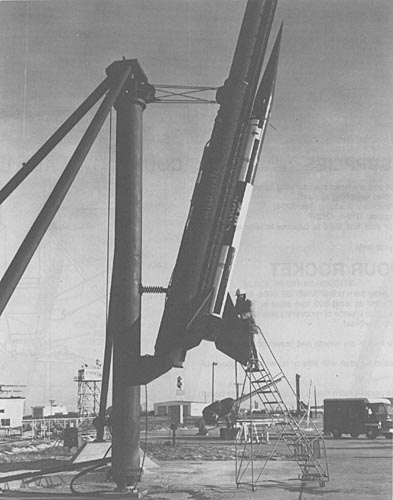
Black Brant II
- Black Brant II, Black Brant IIB
- Payload: 68 kg (Black Brant II)
- Maximum flight height: 274 km
- Thrust: 89 kN
- Mass at launch: 800 kg
- Diameter: 0.44 m
- Length: 8.45 m
The II was the first rocket for scientific use and was ready in 1960.

Black Brant III
- Black Brant III, Black Brant IIIA, Black Brant IIIB
- Payload: 18 kg (Black Brant III)
- Maximum flight height: 177 km
- Thrust: 49 kN
- Mass at launch: 286 kg
- Diameter: 0.26 m
- Length: 5.50 m

Black Brant IV
- Black Brant IV is a two-stage rocket consisting of Black Brant VA first stage with either a Black Brant IIIA or IIIB second stage, Black Brant IVA, Black Brant IVB
- Payload: 100 kg (Black Brant IV)
- Maximum flight height: 1000 km
- Thrust: 111 kN
- Mass at launch: 1356 kg
- Diameter: 0.44 m
- Length: 11.06 m

Black Brant V
- Black Brant V, Black Brant VA, Black Brant VB, Black Brant VC
- Payload: 68 kg (Black Brant V)
- Maximum flight height: 387 km
- Thrust: 111 kN
- Mass at launch: 1197 kg
- Diameter: 0.44 m
- Length: 8.15 m
- First launch:
- VA: 1972-03-16 (ICECAP 72)
- VB: 1965-06-12 (Test 1)
- VC: 1970-04-04 (EUV)
- Last launch:
- VA: 1999-07-14 (MD-DR-13 DROPPS-2)
- VB: 2002-02-21 (CODA)
- VC: 2024-09-02 (BOLT-1B)
- Total launches: 28 (VA), 66 (VB), 109 (VC)
- Successful launches: 25 (VA), 63 (VB), 105 (VC)
Black Brant VI
- Black Brant VI
- Maximum flight height: 72 km
- Thrust: 7 kN
- Mass at launch: 100 kg
- Diameter: 0.12 m
- Length: 2.80 m

Black Brant VII
- Black Brant VII
- Maximum flight height: 72 km
- Thrust: 7 kN
- Mass at launch: 100 kg
- Diameter: 0.12 m
- Length: 2.80 m

Black Brant VIII
- Black Brant VIII (a.k.a. Nike Black Brant) is a two-stage rocket with a Nike M5-E1 booster first stage and either a Black Brant VB or VC second stage, Black Brant VIIIB, Black Brant VIIIC
- Maximum flight height: 340 km (Black Brant VIII)
- Thrust: 196 kN
- Mass at launch: 2000 kg
- Diameter: 0.44 m
- Length: 11.90 m

Black Brant IX
- Status: Active
- Black Brant IX (a.k.a. Terrier Black Brant) is a two-stage rocket with a Terrier Mk 70 booster first stage and a Black Brant VB second stage, Black Brant IXB, Black Brant IXBM1, Black Brant IXCM1, Terrier Black Brant XI Mod 2
- Maximum flight height: 300 km
- Mass at launch: 2200 kg (Black Brant IX)
- Diameter: 0.46 m
- Length: 12.20 m
- First launch: 1982-03-16
- Last launch: 2024-04-17 22:14 UTC (Hi-C Flare)
- Total launches: 326
- Successful launches: 320

Black Brant X
- Black Brant X (a.k.a. Terrier Black Brant Nihka) is a three-stage rocket with a Terrier Mk 70 booster first stage, a Black Brant VB or VC second stage and a Nihka third, Black Brant XB, Black Brant XCM1
- Payload: 90 kg (Black Brant X)
- Maximum flight height: 900 km
- Thrust: 257 kN
- Mass at launch: 2600 kg
- Diameter: 0.44 m
- Length: 14.50 m

Black Brant XI
- Black Brant XI (a.k.a. Talos Taurus Black Brant) is a three-stage rocket with a Talos booster first stage, Taurus booster second stage, and a Black Brant V third stage, Black Brant XIA
- Payload: 320 kg to 500 km altitude, or 550 kg to 300 km altitude (Black Brant XI)
- Maximum flight height: 1400 km
- Thrust:
- Mass at launch: 5300 kg
- Diameter: 0.76 m
- Length: 17.00 m
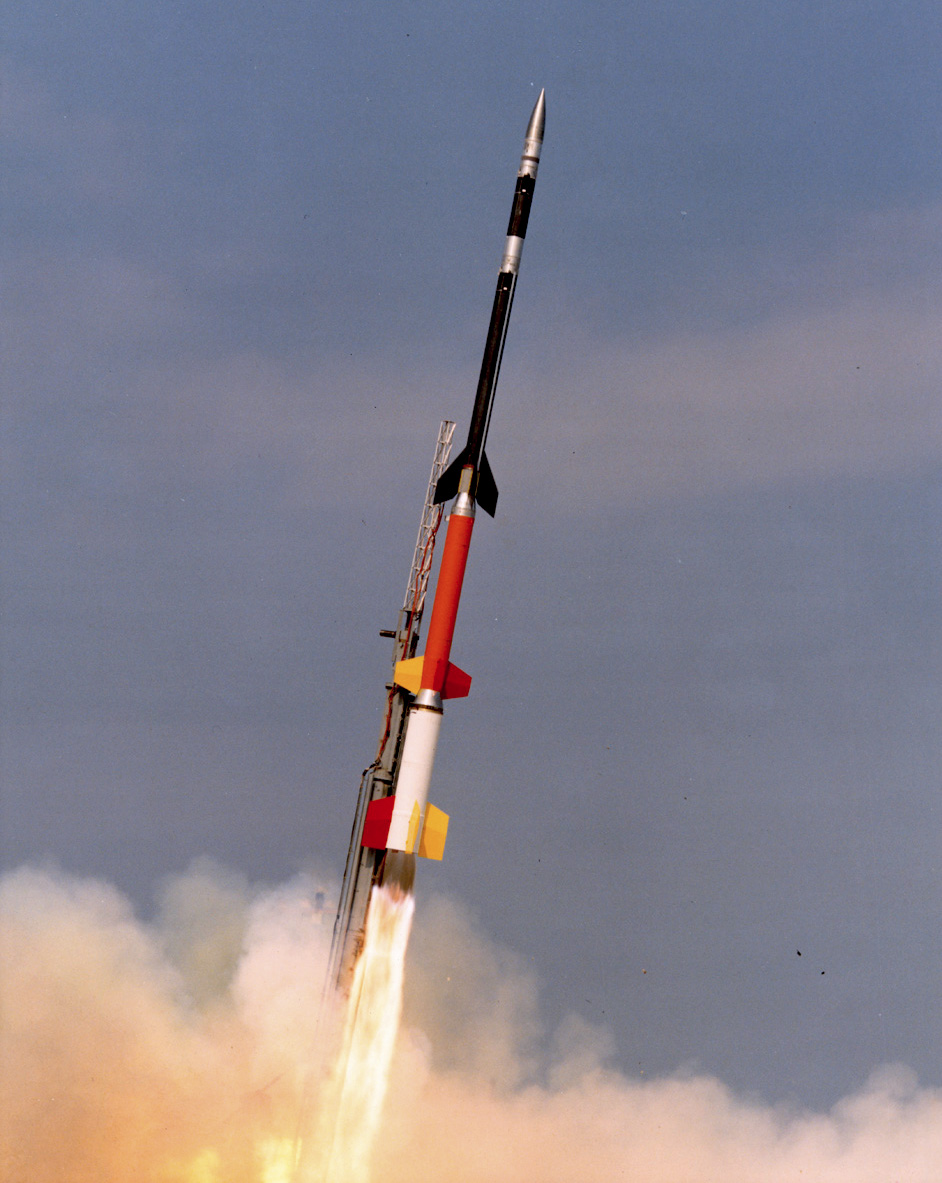
Black Brant XII
- Black Brant XII (a.k.a. Talos Terrier Black Brant Nihka) is a four-stage rocket with a Mk 11 Mod 5 Talos booster first stage, Terrier booster second stage (pre 2013 Taurus booster motors were used), Black Brant V third stage and Nihka fourth stage, Black Brant XIIA
- Payload: manufacturer rated from 110 – (Black Brant XII)
- Maximum flight height: Approximately 1500 km, dependent on payload
- Thrust: 116,001 lbf first stage Talos booster
- Mass at launch: Approximately 5300 kg, dependent on payload
- Diameter:
- Length: 15 m
- First launch: 30 September 1988 (BEARS)
- Last launch: 9 November 2023 (Beam-PIE)
- Total launches: 35 (28 Black Brant XII, 7 Black Brant XII-A)
- Successful launches: 33 (26 Black Brant XII, 7 Black Brant XII-A)
References
References
- "Black Brant Rockets". Magellan Aerospace.
- "Black Brant 2B". Directory of U.S. Military Rockets and Missiles.
- Ley, Willy. (June 1964). "Anyone Else for Space?".
- [http://www3.austlii.edu.au/au/other/dfat/treaties/1976/22.html "Exchange of Notes constituting an Agreement between the Government of Australia and the Government of Canada relating to the Launching of a Canadian Scientific Rocket from Woomera ATS 22 of 1976 "] {{Webarchive. link. (2017-04-15 . Australasian Legal Information Institute, Australian Treaties Library. Retrieved on 15 April 2017.)
- "Woomera".
- "Black Brant I".
- "Black Brant II".
- "Black Brant IIB".
- Eleanor C. Pressly. (January 1965). "Sounding Rockets". Goddard Space Flight Center.
- "Black Brant III".
- "Black Brant IIIB".
- "Black Brant IV".
- "Black Brant IVA".
- "Black Brant IVB".
- "Black Brant V".
- "Black Brant VA".
- "Black Brant VB".
- "Black Brant VC".
- "Black Brant VI".
- "Black Brant VII".
- "Black Brant 8".
- "Nike Research Rocket". White Sands Missile Range Museum.
- "Black Brant 8B".
- "Black Brant 8C".
- "Black Brant IX".
- "Terrier Research Rocket". White Sands Missile Range Museum.
- "Black Brant IXB".
- "Black Brant 9BM1".
- "Black Brant 9CM1".
- "Black Brant IX Mod 2".
- "Black Brant X".
- "Sounding Rocket Program Update to the Heliophysics Subcommittee". NASA.
- "Black Brant XB".
- "Black Brant 10CM1".
- "Black Brant XI".
- "Capability Catalog – Black Brant XI". NASA.
- "Capability Catalog – Black Brant XII". NASA.
- "Black Brant XII".
- "Black Brant XIIA".
- "Talos Mk 11 Mod 2".
This article was imported from Wikipedia and is available under the Creative Commons Attribution-ShareAlike 4.0 License. Content has been adapted to SurfDoc format. Original contributors can be found on the article history page.
Ask Mako anything about Black Brant (rocket) — get instant answers, deeper analysis, and related topics.
Research with MakoFree with your Surf account
Create a free account to save articles, ask Mako questions, and organize your research.
Sign up freeThis content may have been generated or modified by AI. CloudSurf Software LLC is not responsible for the accuracy, completeness, or reliability of AI-generated content. Always verify important information from primary sources.
Report