From Surf Wiki (app.surf) — the open knowledge base
BL 6-inch 26 cwt howitzer
Medium howitzer used during World War I and World War II

Medium howitzer used during World War I and World War II
| Field | Value | ||||
|---|---|---|---|---|---|
| name | BL 6-inch 26 cwt howitzer | ||||
| image | File:6 inch 26 cwt howitzer.jpg | ||||
| image_size | 300px | ||||
| caption | A 6-inch 26 cwt howitzer on World War II pneumatic tyres at the Royal Artillery Museum. | ||||
| type | Medium howitzer | ||||
| origin | United Kingdom | ||||
| is_ranged | yes | ||||
| is_artillery | yes | ||||
| is_UK | yes | ||||
| service | 1916 – 1945 | ||||
| used_by | {{Collapsible list | ||||
| bullets | yes | ||||
| title | List of operators | ||||
| {{flag | Estonia | name | Estonian Republic}} | ||
| {{flag | Kingdom of Italy | name | Italy}} | ||
| {{flag | Union of South Africa | name | South Africa}} | ||
| wars | World War I | ||||
| World War II | |||||
| designer | Vickers | ||||
| design_date | 1915 | ||||
| manufacturer | {{Collapsible list | ||||
| bullets | yes | ||||
| title | List | ||||
| production_date | 1915 – ? | ||||
| number | 3,633 | ||||
| mass | Total: 8,142 lb | ||||
| Barrel: 2,856 lb | |||||
| length | 21 ft | ||||
| part_length | Total: 7 ft | ||||
| Bore: 6 ft L/13.3 | |||||
| width | 6 ft | ||||
| crew | 10 | ||||
| cartridge | Gas | ||||
| Incendiary | |||||
| High explosive | |||||
| cartridge_weight | WWI: 100 lb | ||||
| WWII: 86 lb | |||||
| caliber | 6 in | ||||
| rate | Max: 2 rpm | ||||
| velocity | Max: 1,400 ft/s | ||||
| max_range | WWI 100 lb shell : 9,500 yd | ||||
| WWII {{convert | 86 | lb | kg | sigfig | 3}} shell : 11,400 yd |
| sights | Calibrating (1930s) & reciprocating | ||||
| breech | Welin screw | ||||
| recoil | Hydro-pneumatic, variable | ||||
| carriage | Box trail | ||||
| elevation | 0° to +45° | ||||
| traverse | 4° L & R |
| Australia | Belgium | Canada | Estonia | Greece | Kingdom of Italy | Netherlands | New Zealand | Portugal | Russian Empire | Union of South Africa | Soviet Union | United Kingdom World War II |Vickers |Beardmore |Coventry Ordnance |Woolwich Ordnance |Midvale Steel}} Barrel: 2,856 lb Bore: 6 ft L/13.3 Incendiary High explosive WWII: 86 lb
WWII 86 lb shell : 11,400 yd The Ordnance BL 6-inch 26cwt howitzer, officially BL 6-inch 26cwt howitzer Mk I on Carriage Mk I, was a British howitzer used during World War I and World War II. The qualifier "26cwt" refers to the weight of the barrel and breech together which weighed 26 long cwt.
History
World War I
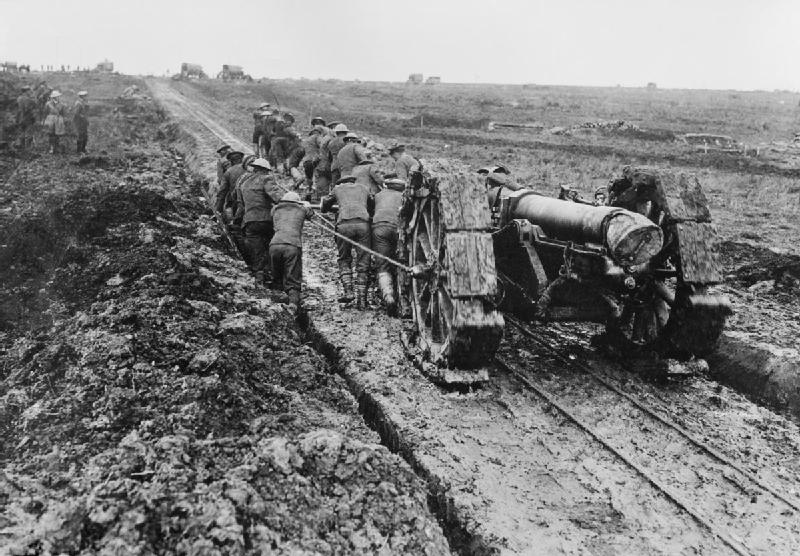

The howitzer was developed to replace the obsolescent 6 inch 25 cwt and 6-inch 30 cwt howitzers which were outclassed by German artillery such as the 15 cm schwere Feldhaubitze 13. Design began in January 1915, the first proof-firing occurred on 30 July 1915 and it entered service in late 1915. Its combination of firepower, range and mobility (for its day) made it one of the British Empire's most important weapons in World War I.
It was originally towed by horses but from 1916 onwards was commonly towed by the FWD 4 wheel drive 3-ton lorry as heavy field artillery. The wooden spoked wheels could be fitted with "girdles" for work in mud or sand to prevent them sinking. Towards the end of the war solid rubber tyres were fitted over the iron tyres on the wheel rims, giving the rims a heavier appearance. The howitzers fired 22.4 million rounds on the Western Front.
Interwar years
During the interwar period, the wooden spoked wheels of the Carriage Mk I were augmented with rubber tyres, these modified carriages were designated Carriage Mk IR. Later on, the carriages received modern steel wheels and pneumatic tyres, designated Carriage Mk IP.
World War II
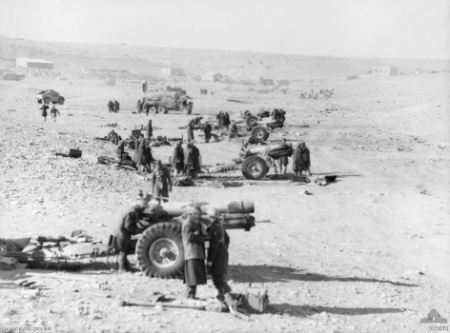
During World War II, its use was restricted after 1942 when the replacement BL 5.5-inch Medium Gun came into use but it was reintroduced in Burma due to a number of premature detonations in the 5.5 in guns. After 1942, it remained in use in the Far East (mainly Burma) until the end of the war in 1945, when it was declared obsolete.
During the German conquest across Europe, German troops captured many howitzers from multiple countries. These captured examples received the designation 15.2 cm s.FH. 407(h) (Dutch howitzers), 15.2 cm s.FH. 410(b) (Belgian howitzers), 15.2 cm s.FH. 412(e) (British howitzers), 15.2 cm s.FH. 412(f) (French howitzers),Mistakenly attributed to the French Army. 15.2 cm s.FH. 412(i) (Italian howitzers), 15.2 cm s.FH. 444(r) (Soviet howitzers).
Variants
Gun variants:
- Mark I – Only variant produced Carriage variants:
- Mark I – Wooden wheels
- Mark IR – Wooden wheels, rubber tyres
- Mark IP – Steel wheels, pneumatic tyres
Surviving examples
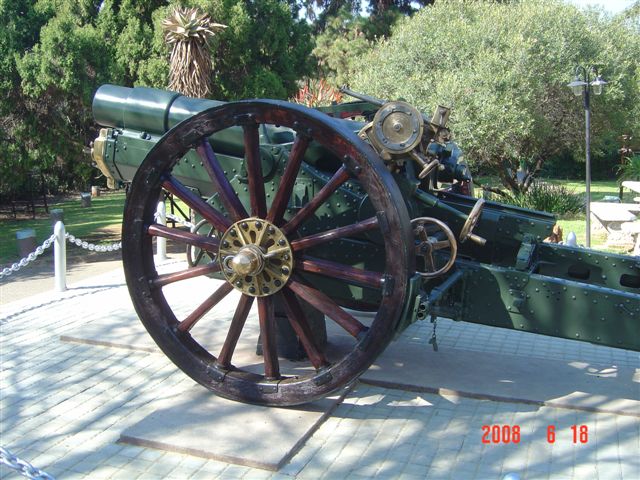
- Royal Artillery Museum, Woolwich, London
- Army Memorial Museum, Waiouru, New Zealand
- Royal Australian Artillery Museum, North Head, Sydney, Australia
- Museo della guerra (War Museum), Rovereto (Italy)
- South Africa : The Imperial Government presented 6 howitzers to the Union of South Africa after World War I and the six South African Heavy Artillery Memorials were designed, commissioned and paid for by the South African Heavy Artillery Association to honour their fallen Comrades-in-Arms : Memorial to 71st (Transvaal) Siege Battery at Johannesburg Zoo (restored); 72nd (Griqualand West) Siege Battery at Clyde N Terry Museum, Kimberley; 73rd (Cape) Siege Battery at Company Gardens, Cape Town; 74th (Eastern Province) Siege Battery at National Museum, Bloemfontein (Restoration is about to begin, May 2009); 75th (Natal) Siege Battery, Warriors' Gate MOTH Shellhole, Old Fort Road, Durban; 125th (Transvaal) Siege Battery near the Union Buildings, Pretoria. These guns are being restored by the Gunner's Association of South Africa
- National Museum of Military History, Saxonwold, Johannesburg, South Africa
- The Central Museum of The Royal Regiment of Canadian Artillery, Shilo Manitoba
- Barrack Green Armouries, Belonging to and restored by 3rd Field Regt.(The Loyal Company), Saint John, New Brunswick
Ammunition
British
World War I
Projectiles used in World War I weighed 100 lb. A lighter 86 lb long-range projectile was introduced in November 1918, too late to see service in the war File:BL 6-inch 26 cwt howitzer 4 lb 11.5 oz cordite MD or RDB cartridge Mark II diagrams.jpg|4lb 11½oz cordite cartridge File:6-inch BL or QF Mk XIIA common pointed artillery shell diagram.jpg|Common pointed 100lb shell Mark XIIA File:BL 6 inch 26 cwt howitzer chemical shell light Mk VIII diagram.jpg|100lb chemical shell Mark VIII File:BL 6 inch 26 cwt howitzer high explosive light shell Mark XVI diagram.jpg|High explosive 100lb shell Mark XVI
World War II
Notes
References
Bibliography
- Dale Clarke, British Artillery 1914-1919. Heavy Artillery. Osprey Publishing, Oxford UK, 2005
- General Sir Martin Farndale, History of the Royal Regiment of Artillery. Western Front 1914-18. London: Royal Artillery Institution, 1986.
- I.V. Hogg & L.F. Thurston, British Artillery Weapons & Ammunition 1914-1918. London: Ian Allan, 1972.
References
- Clarke page 37 quotes 9,500 and {{convert. 11,400. yd. 9,800. yd. c.r.h.]] shell, with a range of {{convert. 12,500. yd. c.r.h.]] shell. The longer ranges were obtained with the {{convert. 86. lb. c.r.h.]] shell with an augmenting ("Super") charge.
- Hogg & Thurston 1972, Page 126-127
- Clarke 2005, page 37
- "6 inch 26 cwt Howitzer".
This article was imported from Wikipedia and is available under the Creative Commons Attribution-ShareAlike 4.0 License. Content has been adapted to SurfDoc format. Original contributors can be found on the article history page.
Ask Mako anything about BL 6-inch 26 cwt howitzer — get instant answers, deeper analysis, and related topics.
Research with MakoFree with your Surf account
Create a free account to save articles, ask Mako questions, and organize your research.
Sign up freeThis content may have been generated or modified by AI. CloudSurf Software LLC is not responsible for the accuracy, completeness, or reliability of AI-generated content. Always verify important information from primary sources.
Report