From Surf Wiki (app.surf) — the open knowledge base
Bishop Gore School
Secondary school in Swansea, Wales

Secondary school in Swansea, Wales
| Field | Value |
|---|---|
| name | Bishop Gore School |
| logo | Coat of Arms Bishop Gore School.png |
| logo_size | 120px |
| type | Comprehensive |
| image | Bishop Gore.DSC00499.JPG |
| image_size | 200px |
| coordinates | |
| motto | Virtue and good literature |
| established | |
| head_label | Headteacher |
| head | Steven Wilson |
| address | De La Beche Road |
| city | Swansea |
| country | United Kingdom |
| postcode | SA2 9AP |
| local_authority | Swansea |
| gender | Mixed |
| lower_age | 11 |
| upper_age | 18 |
| houses | Rotherslade, Langland, Caswell, Limeslade, Bracelet |
| colours | Years 7–11 |
| Maroon and Gold | |
| Years 12–13 | |
| Black | |
| free_label_1 | Last Inspection |
| free_1 | May 2015 |
| free_label_2 | Pupils on roll: |
| free_2 | 1,002 pupils (at 2015 inspection) |
| free_label_3 | 6th form: |
| free_3 | 112 pupils (at 2015 inspection) |
| free_label_4 | Alumni |
| free_4 | Old Goreans |
| website | http://www.bishopgore.net/ |
Maroon and Gold Years 12–13 Black
The Bishop Gore School () is a secondary school in Swansea in Wales, founded on 14 September 1682 by Hugh Gore (1613–1691), Bishop of Waterford and Lismore. It is situated in Sketty, close to Singleton Park and Swansea University. In December 2013 the school was ranked in the second highest of five bands by the Welsh Government, based on performance in exams, value added performance, disadvantaged pupils' performance, and attendance.
History
Grammar school
The school was endowed and established in 1682, as a Free Grammar School by Hugh Gore, Bishop of Waterford and Lismore, for "the gratuitous instruction of twenty boys, sons of the most indigent burgesses, and in the event of a dissolution of the corporation, to sons of the poorest inhabitants of the town." Initially located in historic Goat Street (on a site now part of Princess Way in the city centre), it has since known several names and locations. In September 1853 the school, by then named the Swansea Grammar School for Boys, moved to Mount Pleasant into a new building designed by the architect Thomas Taylor. The building was extended in 1869 to a design by Benjamin Bucknall.
From 1895 the site was shared with the newly created Swansea Intermediate and Technical School for Boys (later the co-educational Swansea Technical College). Under the provisions of the 1902 Education Act the running of both institutions was taken over by Swansea Council.
During World War II the buildings were largely destroyed by incendiary bombs. Discussions about the rebuilding of the site led to the decision to move the Grammar School to a new site elsewhere in Swansea and in 1952 it relocated to newly built premises located in De La Beche Road, Sketty, at which point it was renamed Bishop Gore Grammar School and subsequently, from 1970, Bishop Gore Comprehensive School.
An extension was built in the 1970s and further Design and Technology extensions in the 1990s.
Comprehensive
Until 1970, Bishop Gore was an all-boys grammar school, then it merged with the girls' grammar school Glanmôr and Townhill Secondary School to become Bishop Gore Co-educational Comprehensive school in 1971.
School today
, Bishop Gore has 1,002 male and female students aged 11–18, including 112 in the sixth form. The sixth form has a separate lounge, facilities and uniform. The headteacher is Steven Wilson. Set at the head of Singleton Park, close to the village of Sketty and the seafront, Bishop Gore is built around two quadrangles. Each pupil is assigned to a house: Caswell, Langland, Bracelet, Rotherslade or Limeslade (named after beaches on the nearby Gower peninsula), which they retain throughout their time at the school. The school year includes an Eisteddfod, inter-house sports tournaments, productions by Bishop Gore Theatre Company, and end-of-year balls for senior students.
In January 2010, an inspection report was published which awarded Bishop Gore the highest possible grades in all categories. As a result of this the school was featured as a 'best practice' case study by Estyn and was named in the chief inspector's annual report – being the only secondary school in Wales to achieve this recognition.
Dylan Thomas
The most famous alumnus of Bishop Gore is almost certainly the poet, playwright and author Dylan Thomas (1914–1953). His father, David John (D. J.) Thomas was senior English master at the school, then known as Swansea Grammar School. Not a distinguished pupil, he nonetheless gained attention through publishing his first poem in 1926, "The Song Of The Mischievous Dog" and in 1928 winning the school's annual one-mile race. He left in 1931 to begin work at The South Wales Daily Post as a junior reporter.
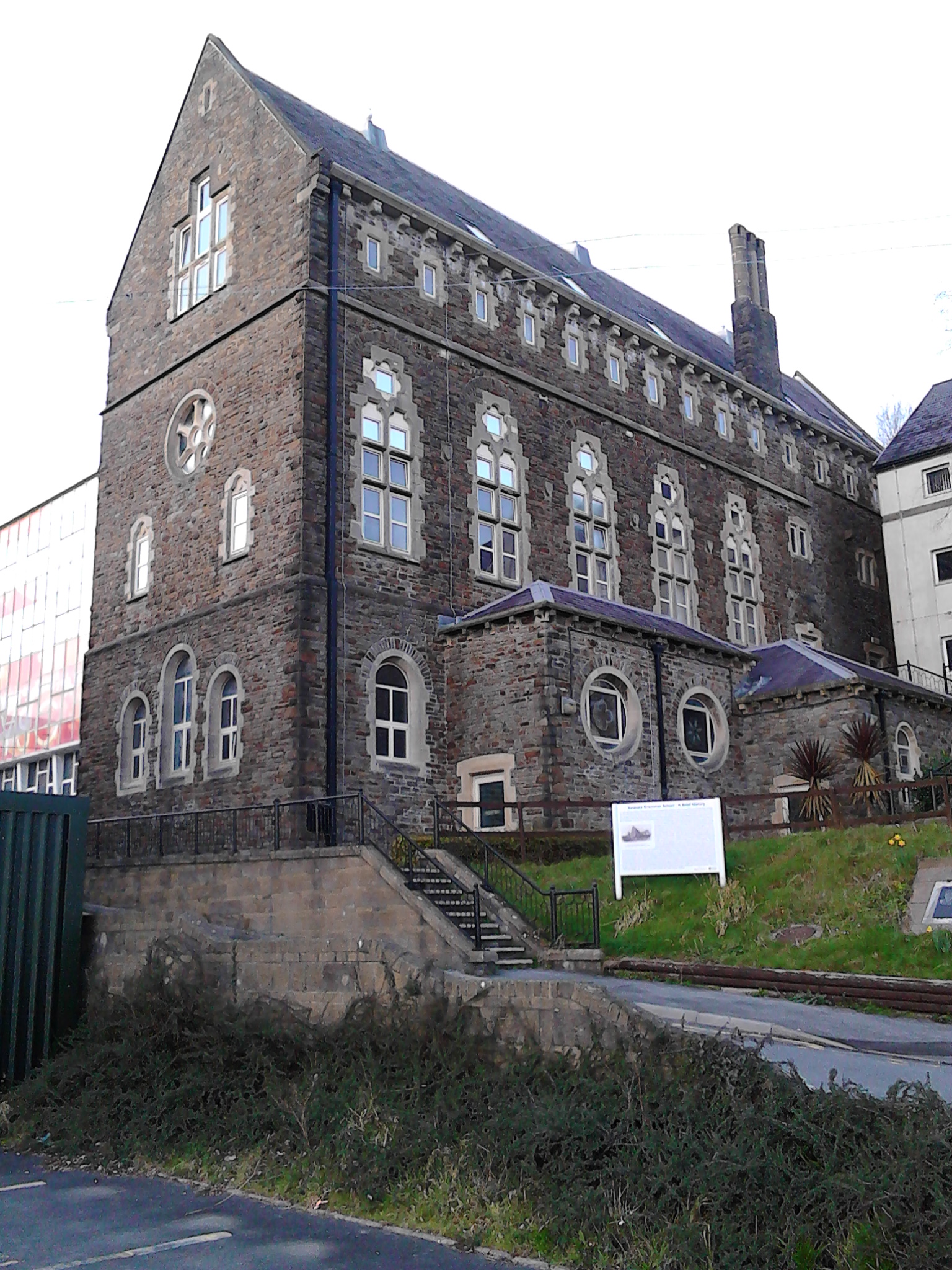
In 1988 the main surviving structure of the 1869 former school building was renamed the Dylan Thomas Building in honour of its former pupil.
Notable alumni
Notable Old Goreans have included:
- Martin Amis, writer
- Donald Anderson, Baron Anderson of Swansea, politician
- Gareth Armstrong, actor
- Henry Bruce, 1st Baron Aberdare, politician, Home Secretary 1868–73
- Prof Sir John Cadogan, CBE, President of the Royal Society of Chemistry
- Rt Rev Graham Chadwick, bishop and anti-apartheid campaigner
- Hywel Davies, cardiologist and author
- Prof Sir Sam Edwards FRS, physicist and university administrator
- Paul Ferris, writer
- Charles Fisher, journalist
- Brian Flowers, Baron Flowers, FRS, physicist
- Neville George, geologist
- Sir Alex Gordon, CBE, architect
- Sir William Grove, scientist and judge
- Rt Rev Llewellyn Henry Gwynne, Bishop of Egypt and the Sudan
- Aneurin Hughes, EU diplomat
- Graham Huxtable, swimmer
- Alfred Janes, artist
- John Gwyn Jeffreys, FRS, conchologist
- Daniel Jones, composer
- Ernest Jones, neurologist and psychoanalyst, biographer of Sigmund Freud
- Mervyn Jones, Governor of the Turks and Caicos Islands
- Peter Jones, broadcaster
- Sir Archie Lamb KBE CMG DFC, diplomat
- Mervyn Levy, artist and critic
- Prof Patrick McGorry AO, psychiatrist, Australian of the Year.
- John Metcalf, composer
- David Miles, economist
- Prof Dewi Zephaniah Phillips philosopher
- Colin Phipps, geologist and Labour MP
- Dylan Thomas, writer
- Wynford Vaughan-Thomas, writer
International Rugby players
Several Old Goreans have played international rugby, for the Wales national rugby union team or the Wales women's national rugby union team
- Paul Arnold
- Roger Blyth
- Stuart Davies
- Alun Wyn Jones, captain of Wales
- Haydn Mainwaring
- Richie Pugh, Wales Rugby sevens captain at the 2006 Commonwealth Games
- Idwal Rees
- Belinda Trotter, played in the first Welsh women's team in 1987.
- Geoff Wheel
References
References
- Davies, J. A. (2000) ''Dylan Thomas: Swansea, Gower and Laugharne''. Cardiff: University of Wales Press, p. 60
- (April 2015). "A report on Bishop Gore School". [[Estyn]].
- Davies, Walford. (2014). "Dylan Thomas".
- . ["Dylan’s Swansea"](http://www.dylanthomas.com/dylan/dylan-thomas-in-swansea/). *City and County of Swansea*.
- Turner, Robin. (26 June 2013). "A teenage Dylan Thomas ‘was very athletic and loved running’". Wales Online.
- (3 March 1934). "Well-known Swansea Swimmer Injured". South Wales Daily Post.
- (14 January 2009). "Pupils see sixth-former fall from roof". Wales Online.
- "Haydn Mainwaring".
- "Quest to Find First Women's Team From 1987". Welsh Rugby Union.
This article was imported from Wikipedia and is available under the Creative Commons Attribution-ShareAlike 4.0 License. Content has been adapted to SurfDoc format. Original contributors can be found on the article history page.
Ask Mako anything about Bishop Gore School — get instant answers, deeper analysis, and related topics.
Research with MakoFree with your Surf account
Create a free account to save articles, ask Mako questions, and organize your research.
Sign up freeThis content may have been generated or modified by AI. CloudSurf Software LLC is not responsible for the accuracy, completeness, or reliability of AI-generated content. Always verify important information from primary sources.
Report