From Surf Wiki (app.surf) — the open knowledge base
Bishop, California
City in California, United States

City in California, United States
| Field | Value | |
|---|---|---|
| settlement_type | City | |
| image_skyline | Downtown Bishop with the Sierra Nevada Mountains in the background.jpg | |
| imagesize | 256px | |
| image_caption | Downtown Bishop looking south along U.S. 395 | |
| image_seal | Bishop ca seal.png | |
| image_map | File:Inyo County California Incorporated and Unincorporated areas Bishop Highlighted 0606798.svg | |
| map_caption | Location of Bishop in Inyo County, California | |
| pushpin_map | USA California | |
| pushpin_map_caption | Location in California | |
| pushpin_image | California Locator Map with US.PNG | |
| subdivision_type | Country | |
| subdivision_name | United States | |
| subdivision_type1 | State | |
| subdivision_name1 | California | |
| subdivision_type2 | County | |
| subdivision_name2 | Inyo | |
| leader_title | Mayor | |
| leader_name | Karen Kong | |
| established_title | Incorporated | |
| established_date | May 6, 1903{{Cite web | |
| url | http://www.calafco.org/docs/Cities_by_incorp_date.doc | |
| title | California Cities by Incorporation Date | |
| format | Word | |
| publisher | California Association of Local Agency Formation Commissions | |
| access-date | April 11, 2013 | url-status=dead |
| archive-url | https://web.archive.org/web/20141103002921/http://www.calafco.org/docs/Cities_by_incorp_date.doc | |
| archive-date | November 3, 2014 }} | |
| named_for | Bishop Creek | |
| <!-- Area------------------> | unit_pref | Imperial |
| area_footnotes | ||
| area_total_sq_mi | 1.91 | |
| area_land_sq_mi | 1.86 | |
| area_water_sq_mi | 0.05 | |
| area_total_km2 | 4.95 | |
| area_land_km2 | 4.83 | |
| area_water_km2 | 0.12 | |
| area_water_percent | 2.5 | |
| elevation_ft | 4150 | |
| elevation_footnotes | ||
| population_as_of | 2020 | |
| population_total | 3819 | |
| population_metro | 14,500 | |
| population_density_km2 | 791.14 | |
| population_density_sq_mi | 2048.82 | |
| timezone | Pacific | |
| utc_offset | −8 | |
| coordinates | ||
| timezone_DST | PDT | |
| utc_offset_DST | −7 | |
| postal_code_type | ZIP codes | |
| postal_code | 93514, 93515 | |
| area_code_type | Area codes | |
| area_code | 442/760 | |
| blank_name | FIPS code | |
| blank_info | ||
| blank1_name | GNIS feature IDs | |
| blank1_info | 2409852 | |
| website |
|access-date=April 11, 2013 |url-status=dead |archive-url=https://web.archive.org/web/20141103002921/http://www.calafco.org/docs/Cities_by_incorp_date.doc |archive-date=November 3, 2014 }}
Bishop is the only incorporated city in Inyo County, California, United States. It is located near the northern end of the Owens Valley in the Mojave Desert, at an elevation of 4150 ft. The city was named after Bishop Creek, flowing out of the Sierra Nevada range; the creek was named after Samuel Addison Bishop, a settler in the Owens Valley. Bishop is a commercial and residential center, while many vacation destinations and tourist attractions in the Sierra Nevada are located nearby. The city covers approximately 1.9 sqmi, making it the county's largest community by population and land area.
The population of the city was 3,819 at the 2020 census, down from 3,879 at the 2010 census. The population of the built-up zone containing Bishop is much larger; more than 14,500 people live in a compact area which includes Bishop, West Bishop, Dixon Lane-Meadow Creek, and the Bishop Paiute Reservation. It is by far the largest settlement in Inyo County.
A number of western films were shot in Bishop, including movies starring John Wayne, Charlton Heston, and Joel McCrea.
History
The Bishop Creek post office operated from 1870 to 1889 and from 1935 to 1938. The first Bishop post office opened in 1889.
In order to support the growth aspirations of Los Angeles, water was diverted from the Owens River into the Los Angeles Aqueduct in 1913. From the 1910s to 1930s, the Los Angeles Department of Water and Power purchased much of the valley for water rights and control. The result was a substantial change to the Owens Valley culture and environment. The economy of Bishop suffered when farmers, ranchers and land owners sold much of their property. Jack Foley, a Bishop resident and sound effects specialist, mitigated the economic loss by persuading several Los Angeles studio bosses that the town of Bishop would be ideal as a location to shoot westerns.
History and heritage
The city of Bishop was named for one of the first settlers in the area, Samuel A. Bishop. Owens Lake was named for Richard Owens, a member of John C. Fremont's 1845 exploration party which included Kit Carson and Ed Kern. Later the entire valley became known as The Owens Valley (see First American Settlers below). The Paiute Indians called Owens Lake by the name of "Pacheta" and the Owens River "Wakopee." Geographically, Inyo County is today the second largest county in California with a population of slightly over 18,000 residents. The county is so large that several eastern states put together would fit neatly within its boundaries. Inyo County contains both the highest and lowest points in the contiguous United States; Mt. Whitney, 14,496 feet above sea level, and Badwater in Death Valley, 282 feet below sea level. The "Inyo" in Inyo County is commonly believed to be a Indian word meaning "dwelling place of the great spirit."
First American settlers

The first American explorers in the Owens Valley of Eastern California included the famous mountain men Jedediah Smith in 1833 and Joseph Walker in 1834. This remote area of California had never been explored by the Spanish and even though it was shown as Mexican territory on early maps, the Eastern Sierra region remained unvisited by them.
The most renowned early explorer to visit the area was John C. Fremont. He was the first Republican candidate to run for President of the United States in 1856 and later a famous Union Civil War general. Officially sanctioned by the federal government, his 1845 mapping party to the Eastern Sierra included the celebrated Indian scout Kit Carson, for whom the capital of Nevada, Carson City, was named. Also in the party were Ed Kern for whom Kern County, California was named, and Richard Owens, who gave his name to Owens Lake near Lone Pine, California and later Owens Valley itself. Fremont lost a cannon which he had brought along in case of Indian attacks near present-day Bridgeport, California (some 80 miles north of Bishop).
The city of Bishop came into being due to the need for beef in a booming mining camp some eighty miles to the north, Aurora, Nevada, (Aurora was believed to be on the California side of the border at that time and was the county seat of Mono County, California). In 1861 cattlemen drove herds of cattle some three hundred miles from the great San Joaquin Valley of California, through the southern Sierra at Walker Pass, up the Owens Valley, and then through Adobe Meadows to Aurora. Along the way, some cattlemen noticed that the unsettled northern Owens Valley was perfect for raising livestock.
To avoid the long journey from the other side of the mountains, a few of them decided to settle in the valley. Driving about 600 head of cattle and 50 horses, Samuel Addison Bishop, his wife, and several hired hands arrived in the Owens Valley on August 22, 1861 from Fort Tejon in the Tehachapi Mountains. Along with Henry Vansickle, Charles Putnam, Allen Van Fleet, and the McGee brothers, Bishop was one of the first white settlers in the valley.
Sheepmen soon followed the cattlement and they initially struggled due to a lack of forage for their stock in the area. Remnants of the early settlers' stone corrals and fences can still be seen north of Bishop along Highway 395 in Round Valley, California (barb wire fencing was not invented until 1873). Establishing a homestead, the San Francis Ranch, along the creek which still bears his name, Samuel Bishop set up a market to sell beef to the miners and business owners in Aurora. One of the residents of Aurora at that time was a young Samuel Clemens who later gained fame as author Mark Twain (see Twain's book Roughing It for his comments on the area). By 1862, a frontier settlement (and later town), known as Bishop Creek, was established a couple of miles east of the San Francis Ranch. Though the town continues to prosper, the only reminder of Samuel Bishop's ranch today is a monument placed near the original site at the corner of Highway 168 West and Red Hill Road, two miles west of downtown Bishop.

In 1866, the County of Inyo was established from part of Tulare County. The Eastern High Sierra and the Owens Valley was the westernmost frontier in America at that time. In 1871, Daniel Bruhn was one of 41 wranglers herding nearly 3,000 wild Spanish mustangs from Stockton, California to Texas. Their travels brought them over the High Sierra and into the remote Owens Valley, where they lost over 500 head of horses. The descendants of those mustangs still roam wild on the California/Nevada border just north of Bishop.
Water conflicts of the Owens Valley
Main article: California water wars
As Los Angeles expanded during the late 19th century, it began outgrowing its water supply. Fred Eaton, mayor of Los Angeles, promoted a plan to take water from Owens Valley, where Bishop lies, to Los Angeles via an aqueduct. Between 1905 and 1907, most of the land in the Owens Valley was purchased from farmers and ranchers at bargain prices by Eaton, ostensibly for a his own use. The real goal was to send Owens Valley water south to Los Angeles. In 1907, Eaton traveled to Washington to meet with advisers of Theodore Roosevelt to convince them that the water of the Owens River would do more good flowing through faucets in Los Angeles than it would if used on Owens Valley fields and orchards. Despite a political fight with Congressman Sylvester Smith, who represented the area around Bishop, Roosevelt decided in favor of the aqueduct.
The aqueduct was built from 1907 to 1913 under the supervision of William Mullholland. The aqueduct is 223 mi long, used no pumping stations; only gravity siphons. By 1928, Los Angeles owned 90 percent of the land and subsequent water rights in Owens Valley effectively rendering all agriculture, economic and development interests in the region effectively dead. With the diversion of water to Los Angeles, the Owens Lake and lower Owens River dried up, forcing many valley residents to leave the area. For a number of years, Owens Valley residents expressed much animosity toward the city of Los Angeles; for example, in Dry Ditches, a book of poems published in 1934 by the Parcher family of Bishop. The Owens Valley–city of Los Angeles conflict was the inspiration of the 1974 film Chinatown, starring Jack Nicholson.
Indian cultural heritage
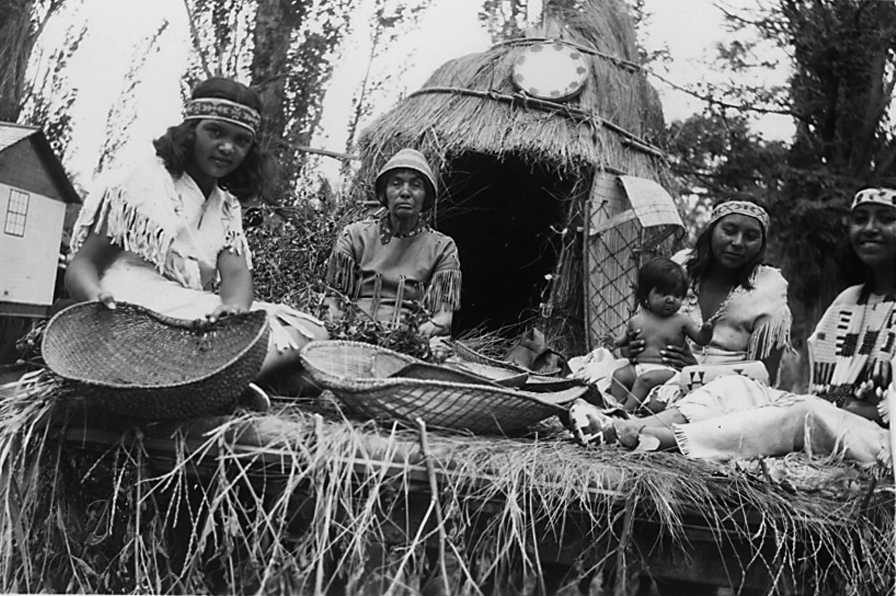
Indians live in and near Bishop on four reservations. The southernmost is the Lone Pine Indian Reservation; northward is Fort Independence Reservation and Big Pine Indian Reservation. The largest and northernmost is the Bishop Indian Reservation.
Geography
Bishop lies west of the Owens River at the northern end of the Owens Valley. The city is located on U.S. Route 395, the main north–south artery through the Owens Valley, connecting the Inland Empire to Reno, Nevada. US 395 also connects Bishop to Los Angeles via State Route 14 through Palmdale. Bishop is the western terminus of U.S. Route 6. The Paiute-Shoshone Indians of the Bishop Community of the Bishop Colony control land just west of the town. The Los Angeles Department of Water and Power (DWP) controls much of the upstream and surrounding area.
Bishop is immediately to the east of the Sierra Nevada, and west of the White Mountains. Numerous peaks are within a short distance of Bishop, including Mount Humphreys (13,986 ft) to the west, White Mountain Peak (14,242 ft) to the northeast, and pyramidal Mount Tom (13,658 ft) northwest of town. Basin Mountain (13,187 ft) is viewed to the west from Bishop as it rises above the Buttermilks. According to the United States Census Bureau, the city has a total area of 1.9 sqmi, over 97% of it land. Bishop is known as the "Mule Capital of the World" and a week-long festival called Bishop Mule Days has been held since 1969 during the week of Memorial Day, celebrating the contributions of pack mules to the area. The festival attracts many tourists, primarily from the Southern California area.
Bishop is well known in the rock climbing community. Near the city are numerous climbing spots that attract visitors from around the world. There are over 2,000 bouldering locations in Bishop. The two main types of rock are volcanic tuff (at the Happy and Sad boulders) and granite (at the Buttermilks).

Notable locations
- Ancient Bristlecone Pine Forest
- Bishop Area Chamber of Commerce
- Bishop Visitors Bureau
- Eastern Sierra Regional Airport
- Inyo National Forest Supervisor's Office
- Keoughs Hot Springs
- Laws Rail Museum
- Paiute Indian Reservation
- Paiute-Shoshone Cultural Center Museum
Climate
Bishop, as well as the rest of the Owens Valley, has an arid climate (Köppen BWk) with an annual average of 4.84" of precipitation, and is part of USDA Plant Hardiness Zone 7b. The wettest year was 1969 with 17.09" of precipitation and the driest 2013 with 1.33 inches. which included the snowiest month, January 1969, at 23.2 inches.
There is an average of 3 nights lows below ten degrees, 139 nights where the low reaches the freezing mark, 104 days with 90+ degree highs, and 29 days with 100+ degree highs. Due to the aridity and hot high-altitude sun, there are only 34 days with maxima below 50 degrees, and only one per year with a maximum below freezing, and the annual diurnal temperature variation is 36.9 degrees, reaching 42 degrees in summer. The record high temperature of 111 degrees occurred on July 10, 2021; the record low of -8° was recorded on December 22, 1990, and December 27, 1988. Diurnals are wide enough that temperatures both during summer and winter afternoons resemble Southern Spain's interior, whereas nights in both seasons are similar to those found on the Baltic Sea in far northern Europe.
Cold daytime highs and warm nights are rare, but have happened on occasion. The coldest daytime maximum measured was 19° in 1962. Ice days are infrequent with the warmer climate of recent decades. Between 1991 and 2020 the coldest maximum temperature of the year averaged 35° with the coldest days barely remaining below freezing. The warmest night on record was 75° in 1961 while the average warmest night stands at 68°.
|Jan avg record high F = 67.3 |Feb avg record high F = 70.7 |Mar avg record high F = 77.3 |Apr avg record high F = 85.7 |May avg record high F = 94.3 |Jun avg record high F =101.8 |Jul avg record high F =105.4 |Aug avg record high F =103.3 |Sep avg record high F = 97.5 |Oct avg record high F = 87.3 |Nov avg record high F = 76.0 |Dec avg record high F = 66.8 |year avg record high F=106.1 |Jan avg record low F = 11.0 |Feb avg record low F = 14.5 |Mar avg record low F = 18.9 |Apr avg record low F = 24.1 |May avg record low F = 32.4 |Jun avg record low F = 39.2 |Jul avg record low F = 46.7 |Aug avg record low F = 44.4 |Sep avg record low F = 36.8 |Oct avg record low F = 25.4 |Nov avg record low F = 15.4 |Dec avg record low F = 9.7 |year avg record low F = 6.6
|Jan record high F = 77 |Feb record high F = 81 |Mar record high F = 87 |Apr record high F = 94 |May record high F = 104 |Jun record high F = 112 |Jul record high F = 118 |Aug record high F = 114 |Sep record high F = 106 |Oct record high F = 97 |Nov record high F = 84 |Dec record high F = 78
|Jan record low F = −7 |Feb record low F = −2 |Mar record low F = 9 |Apr record low F = 15 |May record low F = 25 |Jun record low F = 25 |Jul record low F = 34 |Aug record low F = 34 |Sep record low F = 25 |Oct record low F = 13 |Nov record low F = 5 |Dec record low F = −8
Demographics
The demographic information here applies to residents living within the city limits of Bishop; 3,879 people are in downtown Bishop.
The "greater Bishop area," which includes unincorporated nearby neighborhoods such as West Bishop, Meadow Creek-Dixon Lane, Wilkerson Ranch, Rocking K, Mustang Mesa, Round Valley and the Bishop Paiute Tribe add an additional 11,000 residents to the greater Bishop area.
2020
The 2020 United States census reported that Bishop had a population of 3,819. The population density was 2,048.8 PD/sqmi. The racial makeup of Bishop was 63.5% White, 0.2% African American, 2.8% Native American, 2.4% Asian, 0.1% Pacific Islander, 17.4% from other races, and 13.6% from two or more races. Hispanic or Latino of any race were 30.0% of the population.
The census reported that 96.7% of the population lived in households, 1.6% lived in non-institutionalized group quarters, and 1.7% were institutionalized.
There were 1,748 households, out of which 28.5% included children under the age of 18, 31.5% were married-couple households, 8.9% were cohabiting couple households, 30.7% had a female householder with no partner present, and 28.9% had a male householder with no partner present. 39.7% of households were one person, and 17.9% were one person aged 65 or older. The average household size was 2.11.
.jpg)
The age distribution was 19.7% under the age of 18, 6.7% aged 18 to 24, 27.7% aged 25 to 44, 26.4% aged 45 to 64, and 19.5% who were 65years of age or older. The median age was 41.0years. For every 100 females, there were 97.7 males.
There were 1,939 housing units at an average density of 1,040.2 /mi2, of which 1,748 (90.1%) were occupied. Of these, 36.7% were owner-occupied, and 63.3% were occupied by renters.
In 2023, the US Census Bureau estimated that the median household income was $82,205, and the per capita income was $54,267. About 2.9% of families and 6.0% of the population were below the poverty line.
Politics and government
In the state legislature Bishop is in . It is also in the 4th State Senate district. Federally, Bishop is in .
Bishop maintains its own police force, but also has a substation of the Inyo County Sheriff's Department on the outskirts of the city. The California Highway Patrol also has an office in town.
Transportation
Highways
U.S. Route 395 is the four-lane divided highway serving Bishop between southern California and Reno while U.S. Route 6 provides access to Tonopah and other communities in Nevada. The junction of U.S. Routes 395 and 6 is one of only two junctions of two U.S. Routes in California, the other being the junction of U.S. Routes 101 and 199 in Crescent City, California. Section Two of State Route 168 overlaps with U.S. Route 395 here until the road reaches Big Pine.
Airports
The Eastern Sierra Regional Airport provides general aviation services in addition to seasonal scheduled passenger airline service nonstop to Los Angeles, San Francisco, and Denver operated by SkyWest Airlines flying as United Express with regional jet aircraft on behalf of United Airlines.
Public Transportation Services

Eastern Sierra Transit offers bus service as far north as Reno, Nevada, and as far south as Lancaster, California.
In popular culture
A number of westerns and other films were shot in Bishop:
- Flaming Guns (1932)
- The Fourth Horseman (1932)
- Blue Steel (1934)
- Roll Along, Cowboy (1937)
- Cassidy of Bar 20 (1938)
- The Cowboy and the Lady (1938)
- Three Faces West (1940)
- Silver River (1948)
- Frenchie (1951)
- The Law and Jake Wade (1958)
- Will Penny (1967)
- Tremors (1990) The climax scene at the edge of a cliff was filmed in the hills above Bishop
- The Ranch in Homeward Bound: The Incredible Journey (1993) is mentioned to be close to Bishop, though filming took place in Oregon.
- The song "Bishop, CA" from Xiu Xiu's 2006 album The Air Force was named after Bishop.

Notable residents==
- Horace M. Albright, the second director of the National Park Service, was born in Bishop in 1890.
- Television director and producer David Barrett also calls Bishop home, along with his brother, stuntman and NASCAR driver Stanton Barrett. They are grandsons to Dave McCoy, founder of the Mammoth Mountain Ski Area.
- Actor Robert Bray, who portrayed forest ranger Corey Stuart in CBS's Lassie from 1964 to 1968 and Simon Kane in ABC's Stagecoach West from 1960 to 1961, retired to Bishop, where he died in 1983 at the age of sixty-five.
- Artist Robert Clunie lived and painted in Bishop for decades.
- Elisha Vanslyck Cook Jr. was a character actor in dozens of films, including The Maltese Falcon, The Big Sleep, Magnum P.I., The House on Haunted Hill and Shane; Cook lived in Bishop until his death in Big Pine in 1995.
- Mountaineer Peter Croft lives in Bishop.
- Major Kern W. Dunagan US Army Medal of Honor recipient graduated from Bishop High School.
- Actor Trevor Donovan was born in Bishop.
- Former child actor Richard Eyer, who played Bray's son in Stagecoach West, was a teacher in Bishop, until he retired.
- Cowboy poet Curley Fletcher (1892–1954) was raised in Bishop.
- Jack Foley is the namesake for the art of adding sound effects to films, with the profession named Foley artist.
- Major League Baseball pitcher Hal Gregg lived in Bishop until his death there in 1991.
- Jill Kinmont, noted ski racer who was paralyzed in a 1955 accident, grew up in Bishop. Her life story was turned into two major Hollywood movies The Other Side of the Mountain and its sequel The Other Side of the Mountain Part 2.
- Actor Bill Mumy spent part of his childhood and adolescence in Bishop, where his father was a cattle rancher.
- Bishop was the home of Galen Rowell, and his wife Barbara, before their death at the Eastern Sierra Regional Airport.
- Tracy Smith, Olympian, world-record holder in the 3-mile, and 6-time AAU national champion, was a Bishop resident from the 1970s to the 1990s, as he coached the Bishop Union High School track team distance runners.
- Artist Alex Stenzel lives in Bishop.
- Author Claire Vaye Watkins was born in Bishop.
- Matt Williams, former Major League Baseball third baseman and former manager of the Washington Nationals, was born in Bishop.
- Hunter Kampmoyer, was born in Bishop and graduated from Bishop Union High School.
Media
AM radio
- KBOV 1230 AM
FM radio
- KWTW 88.5 FM
- K208BS 89.5 FM
- KWBP 90.1 FM
- K215BQ 90.9 FM
- KDOX 91.3 FM
- K219LU 91.7 FM
- KSRW 92.5 FM
- KRHV 93.3 FM
- KAZB 94.3 FM
- KBPT 96.1 FM
- KIBS 100.7 FM
- K285CP 104.9 FM
Newspapers
- Inyo Register
- The Sheet
- The Sierra Reader
- El Sol De La Sierra
Television
- KVME-TV 20 (JTV 20.1, WEST 20.2 MeTV Toons 20.3)
- LPP T.V. Cable 3 (Formally KSRW-LP 33)
- Optimum Cable 12 (Government Channel)
Online
- Eastern Sierra Now
References
References
- "City of Bishop, California".
- "2020 U.S. Gazetteer Files". United States Census Bureau.
- {{GNIS. 2409852
- Schneider, Jerry L. (2016). ''Western Filming Locations California, Book 6''. CP Entertainment Books. Page 149. {{ISBN. 9780692722947.
- {{California's Geographic Names. 1148
- Gilbert, Bil. (1985). "Westering Man: The Life of Joseph Walker". University of Oklahoma Press.
- McDougal, Dennis. (April 25, 2001). "Privileged Son: Otis Chandler And The Rise And Fall Of The L.A. Times Dynasty". Da Capo Press.
- Reisner, Mark. (1993). "Cadillac Desert". Penguin USA.
- Wheeler, Mark. (October 2002). "California Scheming". Smithsonian Magazine.
- "Fred Eaton". PBS: New Perspectives on The West.
- "A Hundred or a Thousand Fold More Important". Los Angeles Department of Water and Power.
- Prud'homme, Alex. (2011). "The Ripple Effect: The Fate of Fresh Water in the Twenty-First Century". Simon and Schuster.
- (1995). "Deepest Valley: Guide to Owens Valley, its Roadsides and Mountain Trails". Genny Smith Books.
- "The Ernest Bulpitt collection of Inyo/Mono Water wars memorabilia.".
- Wilkman, Jon. (February 28, 2016). "William Mulholland Gave Water to LA and Inspired ''Chinatown''". [[The Daily Beast]].
- Hauer, John. (2006). "The Natural Superiority of Mules". Skyhorse.
- "Mule Days," ''[https://www.americancowboy.com/ American Cowboy] {{Webarchive. link. (July 10, 2018 '', May/June 1999, p.54.)
- Linville, Sarah. (March 26, 2014). "Is Bishop World Class? Niccolò Ceria Says Don't Believe The Hype". Rock and Ice.
- "Happy and Sad Boulders – Climbing {{!}} Bishop Visitor Information Center".
- "Bishop Chamber of Commerce | Bishop, California".
- "Bishop Visitor Information Center | Bishop California Welcome Center".
- "Bishop Paiute Tribe | Tribal Court".
- "USDA Plant Hardiness Zone Map". Agricultural Research Center, PRISM Climate Group Oregon State University.
- "BISHOP AP, CALIFORNIA - Climate Summary".
- "Climate Nortmals 1971-2000 BISHOP AP, CA".
- "NOWData for Las Vegas, NV, forecast office". [[NOAA]].
- Mean monthly maxima and minima (i.e. the highest and lowest temperature readings during an entire month or year) calculated based on data at said location from 1991 to 2020.
- "NowData - NOAA Online Weather Data". [[National Oceanic and Atmospheric Administration]].
- "Station Name: CA BISHOP AP".
- "Station Name: RI BISHOP WSO AIRPORT, CALIFORNIA (040822)". Western Regional Climate Center.
- "Climatological Data for Bishop Area, CA (ThreadEx) - July 2021". [[National Oceanic and Atmospheric Administration]].
- "Census of Population and Housing". Census.gov.
- "Bishop city, California; DP1: Profile of General Population and Housing Characteristics - 2020 Census of Population and Housing".
- "Bishop city, California; P16: Household Type - 2020 Census of Population and Housing".
- "Bishop city, California; DP03: Selected Economic Characteristics - 2023 ACS 5-Year Estimates Comparison Profiles".
- "Members Assembly". State of California.
- {{Cite GovTrack. CA. 3
- "Police".
- "(825) Bishop".
- "BIH Bishop Airport (BIH/KBIH)".
This article was imported from Wikipedia and is available under the Creative Commons Attribution-ShareAlike 4.0 License. Content has been adapted to SurfDoc format. Original contributors can be found on the article history page.
Ask Mako anything about Bishop, California — get instant answers, deeper analysis, and related topics.
Research with MakoFree with your Surf account
Create a free account to save articles, ask Mako questions, and organize your research.
Sign up freeThis content may have been generated or modified by AI. CloudSurf Software LLC is not responsible for the accuracy, completeness, or reliability of AI-generated content. Always verify important information from primary sources.
Report