From Surf Wiki (app.surf) — the open knowledge base
Bishazari Tal
| Field | Value |
|---|---|
| name | Bishazari Tal |
| other_name | |
| image | Beeshazari Lake of Chitwan, Nepal.jpg |
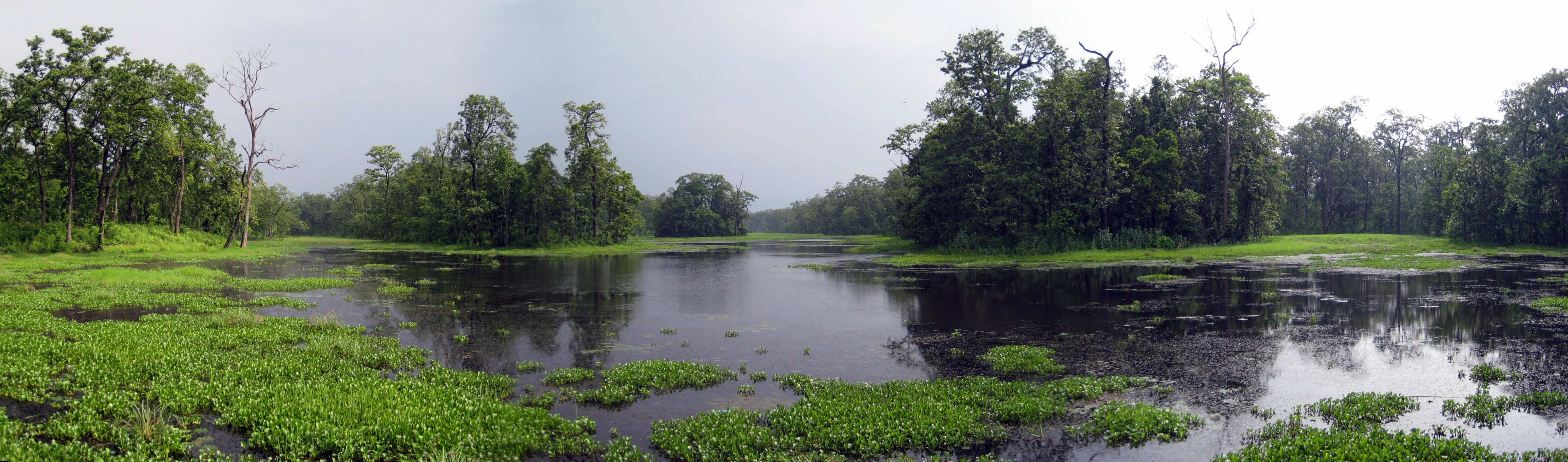
| caption | Bishazari Tal in 2019 |
| location | Chitwan, Nepal |
| coords | |
| lake_type | oxbow lake |
| basin_countries | Nepal |
| area | 3200 ha |
| elevation | 286 m |
| cities | Salyantar |
| pushpin_map | Nepal |
| pushpin_map_alt | Location of Bishazari Tal in Nepal. |
| extra | {{Designation list |
| embed | yes |
| designation1 | Ramsar |
| designation1_offname | Beeshazar and Associated Lakes |
| designation1_date | 13 August 2003 |
| designation1_number | 1313}} |
| max-depth = Bishazari Tal, also spelled Beeshazar Tal, is an extensive oxbow lake system in the buffer zone of the Chitwan National Park, a protected area in the Inner Terai of central Nepal. This wetland covers an area of 3200 ha at an altitude of 286 m. The Mahabharat mountain range (Lower Himalayan Range) is located north of the lake, which is itself north of the Siwalik Hills. In August 2003, it has been designated as a Ramsar site.
The Nepali words 'bis' बिस् (twenty), 'hajār' हजार् (thousand) and 'tāl' ताल् (lake) mean '20,000 lakes'.
Fauna

The forested wetland provides habitat as a waterhole and wildlife corridor for several wildlife species that includes mammals, birds and reptiles. The forested wetland provides habitat to several mammals that includes Bengal tiger (Panthera tigris tigris), Sloth bear, Smooth-coated otter, one-horned rhinoceros (Rhinoceros unicornis), Wild boar (Sus scrofa) and Indian porcupine (Hystrix indicus). Along with mammals the wetland hosts Indian peafowl (Pavo Cristatus), white-rumped vulture, Pallas's fish-eagle, lesser adjutant, and ferruginous duck. The reptiles that are found here includes Indian rock python (Python molurus), King cobra (Ophiohagus hannah) and Mugger crocodile (Crocodylus palustris).
References
References
- "Beeshazar and Associated Lakes".
- Bhuju, U. R.. (2007). "Nepal Biodiversity Resource Book. Protected Areas, Ramsar Sites, and World Heritage Sites". International Centre for Integrated Mountain Development, Ministry of Environment, Science and Technology, in cooperation with United Nations Environment Programme, Regional Office for Asia and the Pacific.
- Turner, R. L. (1931.) [https://archive.today/20150131133617/http://dsalsrv02.uchicago.edu/cgi-bin/philologic/getobject.pl?c.2:1:111.turner बिस् bis], [https://archive.today/20150131133539/http://dsalsrv02.uchicago.edu/cgi-bin/philologic/getobject.pl?c.2:1:7553.turner हजार् hajār], [https://archive.today/20150131133557/http://dsalsrv02.uchicago.edu/cgi-bin/philologic/getobject.pl?c.1:1:2159.turner ताल् tāl]. In: A comparative and etymological dictionary of the Nepali language. London: K. Paul, Trench, Trubner.
This article was imported from Wikipedia and is available under the Creative Commons Attribution-ShareAlike 4.0 License. Content has been adapted to SurfDoc format. Original contributors can be found on the article history page.
Ask Mako anything about Bishazari Tal — get instant answers, deeper analysis, and related topics.
Research with MakoFree with your Surf account
Create a free account to save articles, ask Mako questions, and organize your research.
Sign up freeThis content may have been generated or modified by AI. CloudSurf Software LLC is not responsible for the accuracy, completeness, or reliability of AI-generated content. Always verify important information from primary sources.
Report