From Surf Wiki (app.surf) — the open knowledge base
Bioluminescence
Emission of light by a living organism

Emission of light by a living organism
Bioluminescence is a form of chemiluminescence where light energy is released by a chemical reaction. This reaction involves a light-emitting pigment, the luciferin, and a luciferase, the enzyme component. The production of the excited state molecules always involves the decomposition of organic peroxides. Generically, the luciferin/luciferase reaction can be described as:
:Luciferin + O2-[\text{Luciferase}][\text{other cofactors}]Oxyluciferin + light energy

Instead of a luciferase, the jellyfish Aequorea victoria makes use of another type of protein called a photoprotein, in this case specifically aequorin. When calcium ions are added, rapid catalysis creates a brief flash quite unlike the prolonged glow produced by luciferase. In a second, much slower step, luciferin is regenerated from the oxidized (oxyluciferin) form, allowing it to recombine with aequorin, in preparation for a subsequent flash. Photoproteins are thus enzymes, but with unusual reaction kinetics. Furthermore, some of the blue light released by aequorin in contact with calcium ions is absorbed by a green fluorescent protein, which in turn releases green light in a process called resonant energy transfer.
In evolution, luciferins tend to vary little: one in particular, coelenterazine, is the light emitting pigment for nine phyla (groups of very different organisms), including polycystine radiolaria, Cercozoa (Phaeodaria), protozoa, comb jellies, cnidaria including jellyfish and corals, crustaceans, molluscs, arrow worms and vertebrates (ray-finned fish). Not all these organisms synthesise coelenterazine: some of them obtain it through their diet. Conversely, luciferase enzymes vary widely and tend to be different in each species.
Distribution
Bioluminescence occurs widely among animals, especially in the open sea, including fish, jellyfish, comb jellies, crustaceans, and cephalopod molluscs; in some fungi and bacteria; and in various terrestrial invertebrates, nearly all of which are beetles. In marine coastal habitats, about 2.5% of organisms are estimated to be bioluminescent, whereas in pelagic habitats in the eastern Pacific, about 76% of the main taxa of deep-sea animals have been found to be capable of producing light. More than 700 animal genera have been recorded with light-producing species. Most marine light-emission is in the blue and green light spectrum. However, some loose-jawed fish emit red and infrared light, and the genus Tomopteris emits yellow light.
The most frequently encountered bioluminescent organisms may be the dinoflagellates in the surface layers of the sea, which are responsible for the sparkling luminescence sometimes seen at night in disturbed water. At least 18 genera of these phytoplankton exhibit luminosity. A different effect is the thousands of square miles of the ocean which shine with the light produced by bioluminescent bacteria, known as mareel or the milky seas effect. Non-marine bioluminescence is less widely distributed, the two best-known cases being in fireflies and glowworms. Other invertebrates including insect larvae, annelids and arachnids possess bioluminescent abilities. Some forms of bioluminescence are brighter (or exist only) at night, following a circadian rhythm.--
Pelagic zone
Bioluminescence is abundant in the pelagic zone, with the most concentration at depths devoid of light and surface waters at night. These organisms participate in diurnal vertical migration from the dark depths to the surface at night, dispersing the population of bioluminescent organisms across the pelagic water column. The dispersal of bioluminescence across different depths in the pelagic zone has been attributed to the selection pressures imposed by predation and the lack of places to hide in the open sea. In depths where sunlight never penetrates, often below 200m, the significance of bioluminescent is evident in the retainment of functional eyes for organisms to detect bioluminescence.
Bacterial symbioses
Organisms often produce bioluminescence themselves, rarely do they generate it from outside phenomena. However, there are occasions where bioluminescence is produced by bacterial symbionts that have a symbiotic relationship with the host organism. Although many luminous bacteria in the marine environment are free-living, a majority are found in symbiotic relationships that involve fish, squids, crustaceans etc. as hosts. Most luminous bacteria inhabit the sea, dominated by Photobacterium and Vibrio.
In the symbiotic relationship, bacterium benefit from having a source of nourishment and a refuge to grow. Hosts obtain these bacterial symbionts either from the environment, spawning, or the luminous bacterium is evolving with their host. Coevolutionary interactions are suggested as host organisms' anatomical adaptations have become specific to only certain luminous bacteria, to suffice ecological dependence of bioluminescence.
Benthic zone
Bioluminescence is widely studied amongst species located in the mesopelagic zone, but the benthic zone at mesopelagic depths has remained widely unknown. Benthic habitats at depths beyond the mesopelagic are also poorly understood due to the same constraints. Unlike the pelagic zone where the emission of light is undisturbed in the open sea, the occurrence of bioluminescence in the benthic zone is less common. It has been attributed to the blockage of emitted light by a number of sources such as the sea floor, and inorganic and organic structures. Visual signals and communication that is prevalent in the pelagic zone such as counter-illumination may not be functional or relevant in the benthic realm. Bioluminescence in bathyal benthic species still remains poorly studied due to difficulties of the collection of species at these depths.
Uses in nature

Bioluminescence has several functions in different taxa. Steven Haddock et al. (2010) list as more or less definite functions in marine organisms the following: defensive functions of startle, counterillumination (camouflage), misdirection (smoke screen), distractive body parts, burglar alarm (making predators easier for higher predators to see), and warning to deter settlers; offensive functions of lure, stun or confuse prey, illuminate prey, and mate attraction/recognition. It is much easier for researchers to detect that a species is able to produce light than to analyze the chemical mechanisms or to prove what function the light serves. In some cases the function is unknown, as with species in three families of earthworm (Oligochaeta), such as Diplocardia longa, where the coelomic fluid produces light when the animal moves. The following functions are reasonably well established in the named organisms.
Counterillumination camouflage
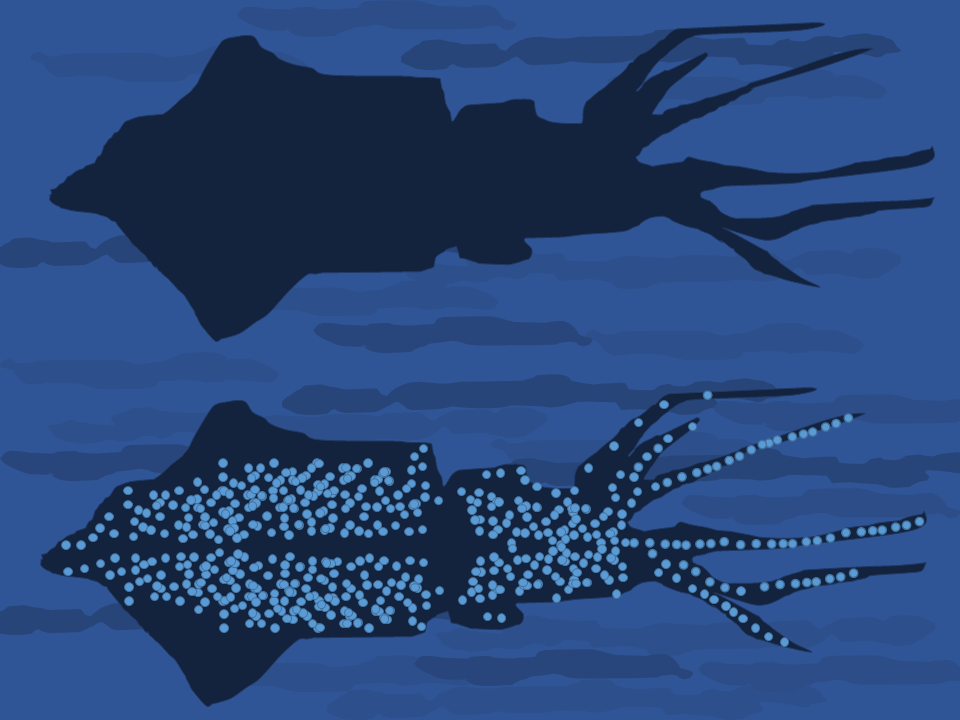
In many animals of the deep sea, including several squid species, bacterial bioluminescence is used for camouflage by counterillumination, in which the animal matches the overhead environmental light as seen from below. In these animals, photoreceptors control the illumination to match the brightness of the background. These light organs are usually separate from the tissue containing the bioluminescent bacteria. However, in one species, Euprymna scolopes, the bacteria are an integral component of the animal's light organ.
Attraction

Bioluminescence is used in a variety of ways and for different purposes. The cirrate octopod Stauroteuthis syrtensis uses emits bioluminescence from its sucker like structures. These structures are believed to have evolved from what are more commonly known as octopus suckers. They do not have the same function as the normal suckers because they no longer have any handling or grappling ability due its evolution of photophores. The placement of the photophores are within the animals oral reach, which leads researchers to suggest that it uses it bioluminescence to capture and lure prey.
Fireflies use light to attract mates. Two systems are involved according to species; in one, females emit light from their abdomens to attract males; in the other, flying males emit signals to which the sometimes sedentary females respond. Click beetles emit an orange light from the abdomen when flying and a green light from the thorax when they are disturbed or moving about on the ground. The former is probably a sexual attractant but the latter may be defensive. Larvae of the click beetle Pyrophorus nyctophanus live in the surface layers of termite mounds in Brazil. They light up the mounds by emitting a bright greenish glow which attracts the flying insects on which they feed.
In the marine environment, use of luminescence for mate attraction is chiefly known among ostracods, small shrimp-like crustaceans, especially in the family Cyprididae. Pheromones may be used for long-distance communication, with bioluminescence used at close range to enable mates to "home in".
Defense
_(20674653149).jpg)
The defense mechanisms for bioluminescent organisms can come in multiple forms; startling prey, counter-illumination, smoke screen or misdirection, distractive body parts, burglar alarm, sacrificial tag or warning coloration. The shrimp family Oplophoridae Dana use their bioluminescence as a way of startling the predator that is after them. Acanthephyra purpurea, within the Oplophoridae family, uses its photophores to emit light, and can secrete a bioluminescent substance when in the presence of a predator. This secretory mechanism is common among prey fish.
Many cephalopods, including at least 70 genera of squid, are bioluminescent. The deep sea squid Octopoteuthis deletron may autotomize portions of its arms which are luminous and continue to twitch and flash, thus distracting a predator while the animal flees.
Dinoflagellates may use bioluminescence for defense against predators. They shine when they detect a predator, possibly making the predator itself more vulnerable by attracting the attention of predators from higher trophic levels. Grazing copepods release any phytoplankton cells that flash, unharmed; if they were eaten they would make the copepods glow, attracting predators, so the phytoplankton's bioluminescence is defensive. The problem of shining stomach contents is solved (and the explanation corroborated) in predatory deep-sea fishes: their stomachs have a black lining able to keep the light from any bioluminescent fish prey which they have swallowed from attracting larger predators.
The sea-firefly is a small crustacean living in sediment. At rest it emits a dull glow but when disturbed it darts away leaving a cloud of shimmering blue light to confuse the predator. During World War II it was gathered and dried for use by the Japanese army as a source of light during clandestine operations.
The larvae of railroad worms (Phrixothrix) have paired photic organs on each body segment, able to glow with green light; these are thought to have a defensive purpose. They also have organs on the head which produce red light; they are the only terrestrial organisms to emit light of this color.
Warning

Aposematism is a widely used function of bioluminescence, providing a warning that the creature concerned is unpalatable. It is suggested that many firefly larvae glow to repel predators; some millipedes glow for the same purpose. Some marine organisms are believed to emit light for a similar reason. These include scale worms, jellyfish and brittle stars but further research is needed to fully establish the function of the luminescence. Such a mechanism would be of particular advantage to soft-bodied cnidarians if they were able to deter predation in this way. The marine snail Hinea brasiliana uses flashes of light, probably to deter predators. The blue-green light is emitted through the translucent shell, which functions as an efficient diffuser of light.
Communication

Communication in the form of quorum sensing plays a role in the regulation of luminescence in many species of bacteria. Small extracellularly secreted molecules stimulate the bacteria to turn on genes for light production when cell density, measured by concentration of the secreted molecules, is high.
Pyrosomes are colonial tunicates and each zooid has a pair of luminescent organs on either side of the inlet siphon. When stimulated by light, these turn on and off, causing rhythmic flashing. No neural pathway runs between the zooids, but each responds to the light produced by other individuals, and even to light from other nearby colonies. Communication by light emission between the zooids enables coordination of colony effort, for example in swimming where each zooid provides part of the propulsive force.
Some bioluminous bacteria infect nematodes that parasitize Lepidoptera larvae. When these caterpillars die, their luminosity may attract predators to the dead insect thus assisting in the dispersal of both bacteria and nematodes. A similar reason may account for the many species of fungi that emit light. Species in the genera Armillaria, Mycena, Omphalotus, Panellus, Pleurotus and others do this, emitting usually greenish light from the mycelium, cap and gills. This may attract night-flying insects and aid in spore dispersal, but other functions may also be involved.
Quantula striata is the only known bioluminescent terrestrial mollusk. Pulses of light are emitted from a gland near the front of the foot and may have a communicative function, although the adaptive significance is not fully understood.
Mimicry

Bioluminescence is used by a variety of animals to mimic other species. Many species of deep sea fish such as the anglerfish and dragonfish make use of aggressive mimicry to attract prey. They have an appendage on their heads called an esca that contains bioluminescent bacteria able to produce a long-lasting glow which the fish can control. The glowing esca is dangled or waved about to lure small animals to within striking distance of the fish.
The cookiecutter shark uses bioluminescence to camouflage its underside by counter-illumination, but a small patch near its pectoral fins remains dark, appearing as a small fish to large predatory fish like tuna and mackerel swimming beneath it. When such fish approach the lure, they are bitten by the shark.
Female Photuris fireflies sometimes mimic the light pattern of another firefly, Photinus, to attract its males as prey. In this way they obtain both food and the defensive chemicals named lucibufagins, which Photuris cannot synthesize.
South American giant cockroaches of the genus Lucihormetica were believed to be the first known example of defensive mimicry, emitting light in imitation of bioluminescent, poisonous click beetles. However, doubt has been cast on this assertion, and there is no conclusive evidence that the cockroaches are bioluminescent.

Illumination
While most marine bioluminescence is green to blue, some deep sea barbeled dragonfishes in the genera Aristostomias, Pachystomias and Malacosteus emit a red glow. This adaptation allows the fish to see red-pigmented prey, which are normally invisible to other organisms in the deep ocean environment where red light has been filtered out by the water column. These fish are able to utilize the longer wavelength to act as a spotlight for its prey that only they can see. The fish may also use this light to communicate with each other to find potential mates. The ability of the fish to see this light is explained by the presence of specialized rhodopsin pigment. The mechanism of light creation is through a suborbital photophore that utilizes gland cells which produce exergonic chemical reactions that produce light with a longer, red wavelength. The dragonfish species which produce the red light also produce blue light in photophore on the dorsal area. The main function of this is to alert the fish to the presence of its prey. The additional pigment is thought to be assimilated from chlorophyll derivatives found in the copepods which form part of its diet.
The angler siphonophore (Erenna) utilizes red bioluminescence in appendages to lure fish.
Biotechnology
Biology and medicine
Bioluminescent organisms are a target for many areas of research. Luciferase systems are widely used in genetic engineering as reporter genes, and for biomedical research using bioluminescence imaging. For example, the firefly luciferase gene was used as early as 1986 for research using transgenic tobacco plants. Vibrio bacteria symbiose with marine invertebrates such as the Hawaiian bobtail squid (Euprymna scolopes), are key experimental models for bioluminescence. Bioluminescent activated destruction is an experimental cancer treatment.
Light production

The structures of photophores, the light producing organs in bioluminescent organisms, are being investigated by industrial designers. Engineered bioluminescence could perhaps one day be used to reduce the need for street lighting, or for decorative purposes if it becomes possible to produce light that is both bright enough and can be sustained for long periods at a workable price. The gene that makes the tails of fireflies glow has been added to mustard plants. The plants glow faintly for an hour when touched, but a sensitive camera is needed to see the glow. University of Wisconsin–Madison is researching the use of genetically engineered bioluminescent E. coli bacteria, for use as bioluminescent bacteria in a light bulb. In 2011, Philips demonstrated a microbial system for ambience lighting in the home. An iGEM team from Cambridge (England) has started to address the problem that luciferin is consumed in the light-producing reaction by developing a genetic biotechnology part that codes for a luciferin regenerating enzyme from the North American firefly. In 2016, Glowee, a French company started selling bioluminescent lights for shop fronts and street signs, for use between 1 and 7 in the morning when the law forbids use of electricity for this purpose. They used the bioluminescent bacterium Aliivibrio fischeri, but the maximum lifetime of their product was three days. In April 2020, plants were genetically engineered to glow more brightly using genes from the bioluminescent mushroom Neonothopanus nambi to convert caffeic acid into luciferin. Another possible application is to replace chemiluminescence with bioluminescent enzymes. A Canadian company, Lux Bio, is developing long-duration bioluminescent enzymes for this purpose.
ATP bioluminescence
ATP bioluminescence is the process in which ATP is used to generate luminescence in an organism, in conjunction with other compounds such as luciferin. It proves to be a very good biosensor to test for the presence of living microbes in water. Different types of microbial populations are determined through different sets of ATP assays using other substrates and reagents. Renilla- and Gaussia-based cell viability assays use the substrate coelenterazine.
Notes
References
References
- (2024). "Bioluminescence – The Vibrant Glow of Nature and its Chemical Mechanisms". ChemBioChem.
- Smiles, Samuel. (1862). "Lives of the Engineers". John Murray.
- Freese, Barbara. (2006). "Coal: A Human History". Arrow.
- Harvey cites this as Baker, J.: 1743–1753, ''The Microscope Made Easy and Employment for the Microscope''.
- Boyle, Robert. (1666). "New experiments, to the number of 16, concerning the relation between light and air (in shining wood and fish;) shewing, that the withdrawing of the air from those and the like bodies, extinguish's their light, and the re-admission of air restores it.". [[Philosophical Transactions of the Royal Society]].
- Harvey, E. Newton. (1920). "The Nature of Animal Light". J. B. Lippencott.
- Tuckey, James Hingston. (May 1818). "Narrative of the Expedition to the Zaire". [[Annals of Philosophy]].
- Darwin, Charles. (1839). "Narrative of the surveying voyages of His Majesty's Ships Adventure and Beagle between the years 1826 and 1836, describing their examination of the southern shores of South America, and the Beagle's circumnavigation of the globe. Journal and remarks. 1832–1836.". Henry Colburn.
- Pauly, Daniel. (13 May 2004). "Darwin's Fishes: An Encyclopedia of Ichthyology, Ecology, and Evolution". Cambridge University Press.
- Shimomura, O.. (August 1995). "A short story of aequorin". The Biological Bulletin.
- Huth, John Edward. (15 May 2013). "The Lost Art of Finding Our Way". Harvard University Press.
- Reshetiloff, Kathy. (1 July 2001). "Chesapeake Bay night-lights add sparkle to woods, water". Bay Journal.
- "Luminescence". Encyclopædia Britannica.
- Poisson, Jacques. (April 2010). "Couverture fascicule Raphaël Dubois, de la pharmacie à la bioluminescence". Rev Hist Pharm (Paris).
- (8 October 2008). "The Nobel Prize in Chemistry 2008".
- Harvey, E. Newton. (1957). "A History of Luminescence: From the Earliest Times Until 1900". American Philosophical Society.
- Anctil, Michel. (2018). "Luminous Creatures: The History and Science of Light Production in Living Organisms". McGill-Queen's University Press.
- Fulcher, Bob. "Lovely and Dangerous Lights". Tennessee Conservationist Magazine.
- Harvey, E.N.. (1932). "The evolution of bioluminescence and its relation to cell respiration". Proceedings of the American Philosophical Society.
- Seliger, H.H.. (1993). "Bioluminescence: excited states under cover of darkness". Naval Research Reviews.
- Rees, J. F.. (1998). "The origins of marine bioluminescence: Turning oxygen defence mechanisms into deep-sea communication tools". Journal of Experimental Biology.
- Widder, Edith A.. (1999). "Bioluminescence". Springer.
- Haddock, S. H. D.. (2010). "Bioluminescence in the Sea". Annual Review of Marine Science.
- Yong, Ed. (8 June 2016). "Surprising History of Glowing Fish". National Geographic.
- (1998). "Bioluminescence". Annual Review of Cell and Developmental Biology.
- (December 1962). "Biological Luminescence". [[Scientific American]].
- (April 30, 2024). "Evolution of bioluminescence in Anthozoa with emphasis on Octocorallia". Proceedings of the Royal Society B.
- (2016). "Repeated and Widespread Evolution of Bioluminescence in Marine Fishes". [[PLOS One]].
- (2024). "Luminous fishes: Endocrine and neuronal regulation of bioluminescence". Aquaculture and Fisheries.
- Ferrón, Humberto G.. (2023). "Illuminating the evolution of bioluminescence in sharks". Palaeontology.
- Hastings, J. W.. (1983). "Biological diversity, chemical mechanisms, and the evolutionary origins of bioluminescent systems". Journal of Molecular Evolution.
- (2024). "Bioluminescence – The Vibrant Glow of Nature and its Chemical Mechanisms". ChemBioChem.
- Shimomura, O.. (1962). "Extraction, purification and properties of aequorin, a bioluminescent protein from the luminous hydromedusan, Aequorea". J Cell Comp Physiol.
- (1975). "Regeneration of the photoprotein aequorin". Nature.
- (1974). "Intermolecular energy transfer in the bioluminescent system of Aequorea". Biochemistry.
- (April 2017). "Quantification of bioluminescence from the surface to the deep sea demonstrates its predominance as an ecological trait". Scientific Reports.
- (2021-09-27). "Violet bioluminescent Polycirrus sp. (Annelida: Terebelliformia) discovered in the shallow coastal waters of the Noto Peninsula in Japan". Scientific Reports.
- Ross, Alison. (27 September 2005). "'Milky seas' detected from space". BBC.
- Widder, Edith. (January 2002). "Bioluminescence and the Pelagic Visual Environment". Marine and Freshwater Behaviour and Physiology.
- (November 2002). "Common Features of the Quorum Sensing Systems in Vibrio Species". World Scientific.
- (2019-10-01). "Diverse deep-sea anglerfishes share a genetically reduced luminous symbiont that is acquired from the environment". eLife.
- (October 2007). "Phylogenetic analysis of host?symbiont specificity and codivergence in bioluminescent symbioses". Cladistics.
- (September 2012). "Light and vision in the deep-sea benthos: I. Bioluminescence at 500-1000 m depth in the Bahamian Islands". Journal of Experimental Biology.
- (1976). "Bioluminescent countershading in midwater animals: evidence from living squid". Science.
- (2009). "Evidence for light perception in a bioluminescent organ". Proceedings of the National Academy of Sciences of the United States of America.
- (1999-08-01). "Bioluminescence in the Deep-Sea Cirrate Octopod Stauroteuthis syrtensis Verrill (Mollusca: Cephalopoda)". The Biological Bulletin.
- (2009-12-14). "Bioluminescence in the Sea". Annual Review of Marine Science.
- (2007). "Phylogeny of North American fireflies (Coleoptera: Lampyridae): implications for the evolution of light signals". Molecular Phylogenetics and Evolution.
- (2015-02-01). "Phylogenetic and transcriptomic analyses reveal the evolution of bioluminescence and light detection in marine deep-sea shrimps of the family Oplophoridae (Crustacea: Decapoda)". Molecular Phylogenetics and Evolution.
- (2005). "Aglow in the Dark: The Revolutionary Science of Biofluorescence". Harvard University Press.
- Branham, Marc. "Glow-worms, railroad-worms (Insecta: Coleoptera: Phengodidae)". University of Florida.
- Viviani, Vadim R.. (1997). "Bioluminescence and Biological Aspects of Brazilian Railroad-Worms (Coleoptera: Phengodidae)". Annals of the Entomological Society of America.
- (2011). "Bioluminescent aposematism in millipedes". Current Biology.
- (2010). "Bioluminescent signals spatially amplified by wavelength-specific diffusion through the shell of a marine snail". Proceedings of the Royal Society.
- (1990). "Patterns of stimulated bioluminescence in two pyrosomes (Tunicata: Pyrosomatidae)". Biological Bulletin.
- (January 2004). "Encyclopedia of the Aquatic World". Marshall Cavendish.
- Viviani, Vadim. (17 February 2009). "Terrestrial bioluminescence".
- (1989). "Bioluminescence in the terrestrial snail ''Quantula (Dyakia) striata''". Malacologia.
- Martin, R. Aidan. "Biology of Sharks and Rays: Cookiecutter Shark". ReefQuest Centre for Shark Research.
- Milius, S.. (1 August 1998). "Glow-in-the-dark shark has killer smudge". Science News.
- Eisner, Thomas. (1997). "Firefly "femmes fatales" acquire defensive steroids (lucibufagins) from their firefly prey". Proceedings of the National Academy of Sciences of the United States of America.
- Sullivan, Rachel. (16 July 2014). "Out of the darkness". ABC Science.
- Greven, Hartmut. (2013). "Courtship, Mating, and Organisation of the Pronotum in the Glowspot Cockroach ''Lucihormetica verrucosa'' (Brunner von Wattenwyl, 1865) (Blattodea: Blaberidae)". Entomologie Heute.
- Merritt, David J.. (2013). "Standards of evidence for bioluminescence in cockroaches". Naturwissenschaften.
- (December 2005). "Red bioluminescence in fishes: on the suborbital photophores of Malacosteus, Pachystomias and Aristostomias". Marine Biology.
- (1984-08-03). "Far Red Bioluminescence from Two Deep-Sea Fishes". Science.
- Bone, Q.. (2008). "Biology of fishes". Taylor & Francis.
- (2005-07-08). "Bioluminescent and Red-Fluorescent Lures in a Deep-Sea Siphonophore". Science.
- Koo, J.. (2007). "A GUS/Luciferase Fusion Reporter for Plant Gene Trapping and for Assay of Promoter Activity with Luciferin-Dependent Control of the Reporter Protein Stability". Plant and Cell Physiology.
- (2004). "Real-Time in Vivo Bioluminescent Imaging for Evaluating the Efficacy of Antibiotics in a Rat Staphylococcus aureus Endocarditis Model". Antimicrobial Agents and Chemotherapy.
- Di Rocco, Giuliana. (1 September 2012). "Analysis of biodistribution and engraftment into the liver of genetically modified mesenchymal stromal cells derived from adipose tissue". Cell Transplantation.
- (2008). "Antivascular effects of combretastatin A4 phosphate in breast cancer xenograft assessed using dynamic bioluminescence imaging and confirmed by MRI". The FASEB Journal.
- Ow, D. W.. (1986). "Transient and stable expression of the firefly luciferase gene in plant cells and transgenic plants". American Association for the Advancement of Science.
- Altura, M.A.. (2013). "The first engagement of partners in the Euprymna scolopes-Vibrio fischeri symbiosis is a two-step process initiated by a few environmental symbiont cells". Environmental Microbiology.
- "Comprehensive Squid-Vibrio Publications List". University of Wisconsin-Madison.
- Ludwig Institute for Cancer Research. (21 April 2003). "Firefly Light Helps Destroy Cancer Cells; Researchers Find That The Bioluminescence Effects of Fireflies May Kill Cancer Cells From Within". Science Daily.
- (10 March 2011). "How illuminating". The Economist.
- [http://siobiolum.ucsd.edu/Biolum_q&a.html Bioluminescence Questions and Answers]. Siobiolum.ucsd.edu. Retrieved on 20 October 2011.
- (4 May 2013) [https://www.newscientist.com/article/mg21829156.500-one-per-cent.html One Per Cent: Grow your own living lights] The New Scientist, Issue 2915, Retrieved 7 May 2013
- [https://news.bbc.co.uk/2/hi/science/nature/751069.stm Dr. Chris Riley, "Glowing plants reveal touch sensitivity", BBC 17 May 2000.]
- Halverson, Nic. (15 August 2013). "Bacteria-Powered Light Bulb Is Electricity-Free".
- Swaminathan, Miep. (January 2018). "Philips launches 'Microbial Home' new forward looking design concepts".
- Cha, Bonnie. (28 November 2011). "Philips Bio-light creates mood lighting with bacteria".
- "E.glowli Cambridge: Parts submitted". iGEM.
- Marcellin, Frances. (26 February 2016). "Glow-in-the-dark bacterial lights could illuminate shop windows 2016". [[New Scientist]].
- (2015). "Glowee: A vision of night-time lighting". Electricite de France.
- (26 February 2016). "Glow-in-the-dark bacterial lights could illuminate shop windows". New Scientist.
- (27 April 2020). "Plants with genetically encoded autoluminescence". Nature Biotechnology.
- "Bright Idea: This Natural Glow Stick Doesn't Pollute".
- "Lux Bio {{!}} Sustainable Bioluminescence Technology for Personal & Commercial Use".
- (2017-06-30). "Effectiveness of ATP bioluminescence assay for presumptive identification of microorganisms in hospital water sources". BMC Infectious Diseases.
- (2016). "Bioluminescence-Sensing Assay for Microbial Growth Recognition". Journal of Sensors.
- Tannous, Bakhos A.. (April 2009). "Gaussia luciferase reporter assay for monitoring biological processes in culture and in vivo". Nature Protocols.
This article was imported from Wikipedia and is available under the Creative Commons Attribution-ShareAlike 4.0 License. Content has been adapted to SurfDoc format. Original contributors can be found on the article history page.
Ask Mako anything about Bioluminescence — get instant answers, deeper analysis, and related topics.
Research with MakoFree with your Surf account
Create a free account to save articles, ask Mako questions, and organize your research.
Sign up freeThis content may have been generated or modified by AI. CloudSurf Software LLC is not responsible for the accuracy, completeness, or reliability of AI-generated content. Always verify important information from primary sources.
Report