From Surf Wiki (app.surf) — the open knowledge base
Binary asteroid
System of two asteroids orbiting their common center of mass
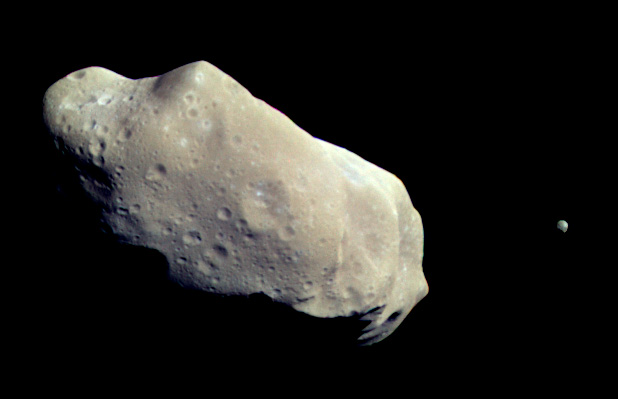
System of two asteroids orbiting their common center of mass

A binary asteroid is a system of two asteroids orbiting their common barycenter. The binary nature of 243 Ida was discovered when the Galileo spacecraft flew by the asteroid in 1993. Since then numerous binary asteroids and several triple asteroids have been detected.
The mass ratio of the two components – called the "primary" and "secondary" of a binary system – is an important characteristic. Most binary asteroids have a large mass ratio, i.e. a relatively small satellite in orbit around the main component. Systems with one or more small moons – also called "companions" or simply "satellites" – include 87 Sylvia, 107 Camilla and 45 Eugenia (all triples), 121 Hermione, 130 Elektra (a quadruple), 22 Kalliope, 283 Emma, 379 Huenna, 243 Ida and 4337 Arecibo (in order of decreasing primary size). Some binary systems have a mass ratio near unity, i.e., two components of similar mass. They include 90 Antiope, , and 69230 Hermes, with average component diameters of 86, 1.8, 0.9 and 0.8 km, respectively.
In August 2024 Gaia reported 352 new binary asteroid candidates.
Description
Several theories have been posited to explain the formation of binary-asteroid systems. Many systems have significant macro-porosity (a "rubble-pile" interior). The satellites orbiting large main-belt asteroids such as 22 Kalliope, 45 Eugenia or 87 Sylvia may have formed by disruption of a parent body after impact or fission after an oblique impact. Trans-Neptunian binaries may have formed during the formation of the Solar System by mutual capture or three-body interaction. Near-Earth asteroids, which orbit in the inner part of the Solar System, most likely form by spin-up and mass shedding, likely as a result of the YORP effect. Numerical simulations suggest that when solar energy spins a “rubble pile” asteroid to a sufficiently fast rate by the YORP effect, material is thrown from the asteroid's equator. This process also exposes fresh material at the poles of the asteroid.
Gallery
2006VW139.gif|Time-lapse video of binary main-belt comet (288P) The double asteroid 90 Antiope - Eso0718a (no tagline).jpg|Artist's impression of the double asteroid 90 Antiope
References
References
- (2015). "Asteroids IV".
- Liberato, L.. (August 2024). "Binary asteroid candidates in Gaia DR3 astrometry". Astronomy & Astrophysics.
- Graham-Shaw, Kate. "These 352 Asteroids Likely Have Cute Little Moonlets".
- Margot, Jean-Luc. (2002). "Binary Asteroids in the Near-Earth Object Population.". Science.
- Walsh, Kevin J.. (June 2008). "Rotational breakup as the origin of small binary asteroids.". Nature.
- [http://newswise.com/articles/view/542454/ Study Puts Solar Spin on Asteroids, their Moons & Earth Impacts] Newswise, Retrieved 14 July 2008.
- "Hubble discovers a unique type of object in the Solar System".
This article was imported from Wikipedia and is available under the Creative Commons Attribution-ShareAlike 4.0 License. Content has been adapted to SurfDoc format. Original contributors can be found on the article history page.
Ask Mako anything about Binary asteroid — get instant answers, deeper analysis, and related topics.
Research with MakoFree with your Surf account
Create a free account to save articles, ask Mako questions, and organize your research.
Sign up freeThis content may have been generated or modified by AI. CloudSurf Software LLC is not responsible for the accuracy, completeness, or reliability of AI-generated content. Always verify important information from primary sources.
Report