From Surf Wiki (app.surf) — the open knowledge base
Billings ovulation method
Fertility awareness method

Fertility awareness method
| Field | Value |
|---|---|
| name | Billings ovulation method |
| bc_type | Behavioral |
| date_first_use | developed in 1950s |
| rate_type | Failure |
| perfect_failure% | 0.5–3 |
| typical_failure% | 1–22 |
| reversibility | immediate |
| user_reminders | Accurate teaching and daily charting are essential. |
| clinic_interval | None |
| STD_protection_YesNo | No |
| periods_advantage | Prediction |
| benefits | Low cost, no prerequisites for use, no side effects, can aid pregnancy achievement |
| weight_gain_YesNo | No |
| risks | Effectiveness is unclear |
|perfect_failure% = 0.5–3 |typical_failure% = 1–22 The Billings ovulation method is a method in which women use their vaginal mucus to determine their fertility. It does not rely on the presence of ovulation, but identifies patterns of potential and obvious infertility within the cycle. Its effectiveness is not very clear.
Evidence
Typical use of this method is associated with a pregnancy rate of 1–22%. Some studies of perfect use excluded those who could not detect secretions that represented fertility.
Fertility
- A woman typically ovulates at only one time during her cycle (except those with hyperovulation), and an unfertilized ovum can survive for only 12–24 hours.
- Cervical mucus enabling healthy sperm cells to navigate the genital tract is necessary for fertility.
- Most commonly, spermatozoa live only one to three days in the presence of fertile mucus, with survival up to five days being rare. The possibility of pregnancy from sperm survival longer than five days has been compared to "the chances of winning a huge lottery." --
- Menstruation will occur about 2 weeks after ovulation.
- A ten-year study of 45,280 subfertile couples in China found that 32.1% of women were able to achieve pregnancy and live birth through the use of Billings. --
Function
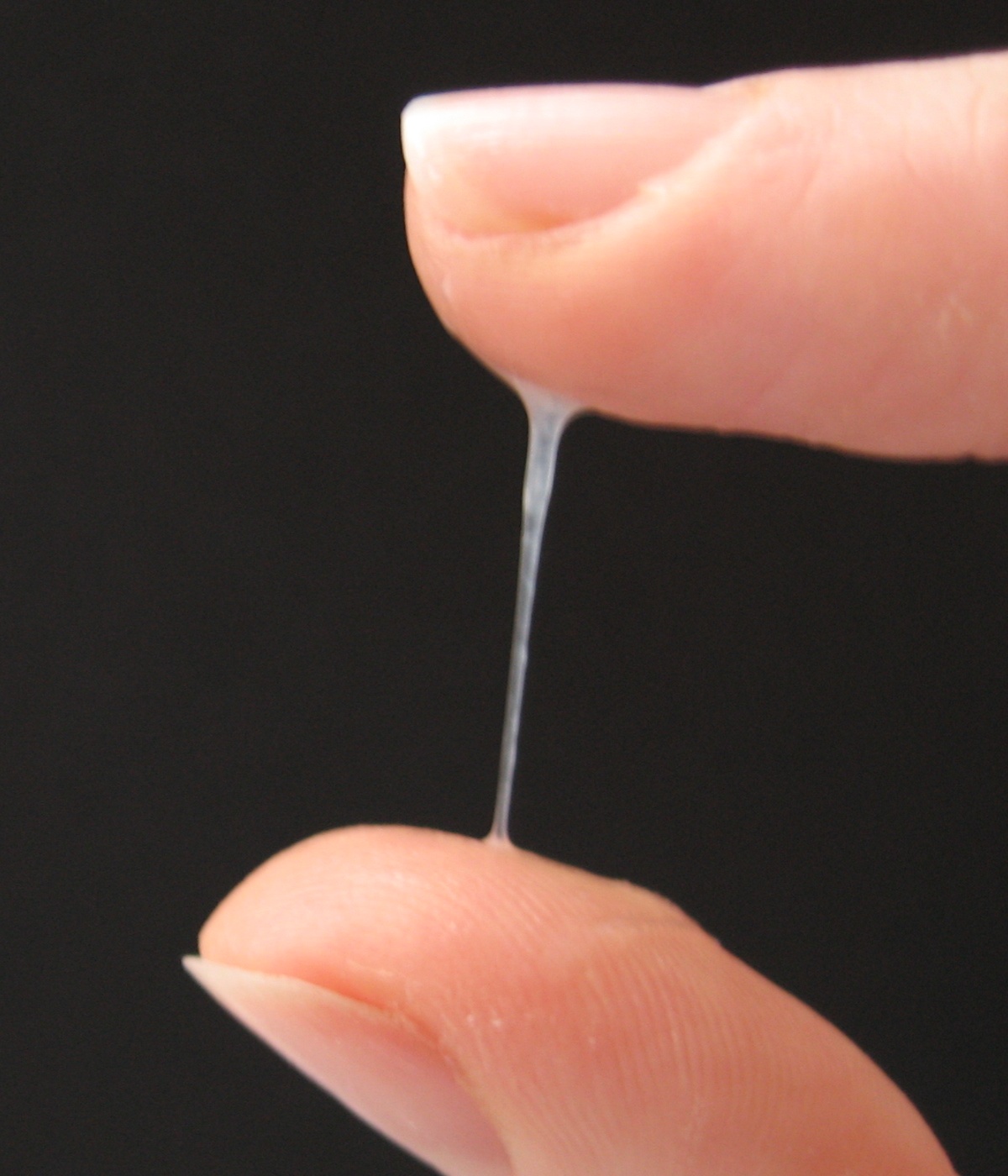
In the days leading up to ovulation, the cervix responds to estrogen by producing mucus capable of sustaining sperm survival. This mucus leaves the vagina as the woman is in an upright position. The mucus is observed through the sensation at the vulva and by looking at any cervical secretions. Daily charting of these observations will reveal either an unchanging pattern indicating infertility or a changing pattern of sensation and discharge indicating fertility. Both of these patterns follow the hormonal patterns which control sperm survival and conception.
History
The first recorded observations of the relationship between cervical mucus and survival of spermatozoa come from the mid-19th century. The topic was not systematically studied, however, for almost another century. In 1948, Erik Odeblad was studying mycoplasms in the female genital tract. During the course of his studies, he noticed that cervical mucus changed in a predictable pattern through the course of a woman's cycle. He continued his study of the cervix.
John Billings (1918–2007) was involved with the development of the Billings ovulation method.
References
References
- (2010). "Population and Society: An Introduction to Demography". Cambridge University Press.
- (2009). "Fertility awareness-based methods: another option for family planning.". Journal of the American Board of Family Medicine.
- (2007). "Contraceptive Technology". Ardent Media.
- "Ovarian hyperstimulation syndrome (OHSS)".
- Hospital, The Royal Women's. "Ovulation and conception".
- Kippley, John. (1996). "The Art of Natural Family Planning". The Couple to Couple League.
- [http://www.woomb.org/bom/trials/chinaLaunching.html China Successfully Launching Billings Method] {{webarchive. link. (December 30, 2006 : Dr. Shao-Zhen Qian)
- Teaching the Billings Ovulation Method, Dr E. L. Billings AM, MB BS, DCH (London), 2001.
- [https://www.auntminnieeurope.com/clinical-news/mri/article/15644883/europe-celebrates-the-forgotten-pioneer-of-mri-dr-erik-odeblad ]
- (1994). "The Discovery of Different Types of Cervical Mucus". Bulletin of the Ovulation Method Research and Reference Centre of Australia.
- (2002). "THE QUEST – leading to the discovery of the Billings Ovulation Method". Bulletin of Ovulation Method Research and Reference Centre of Australia.
This article was imported from Wikipedia and is available under the Creative Commons Attribution-ShareAlike 4.0 License. Content has been adapted to SurfDoc format. Original contributors can be found on the article history page.
Ask Mako anything about Billings ovulation method — get instant answers, deeper analysis, and related topics.
Research with MakoFree with your Surf account
Create a free account to save articles, ask Mako questions, and organize your research.
Sign up freeThis content may have been generated or modified by AI. CloudSurf Software LLC is not responsible for the accuracy, completeness, or reliability of AI-generated content. Always verify important information from primary sources.
Report