From Surf Wiki (app.surf) — the open knowledge base
Bignan
Commune in Brittany, France
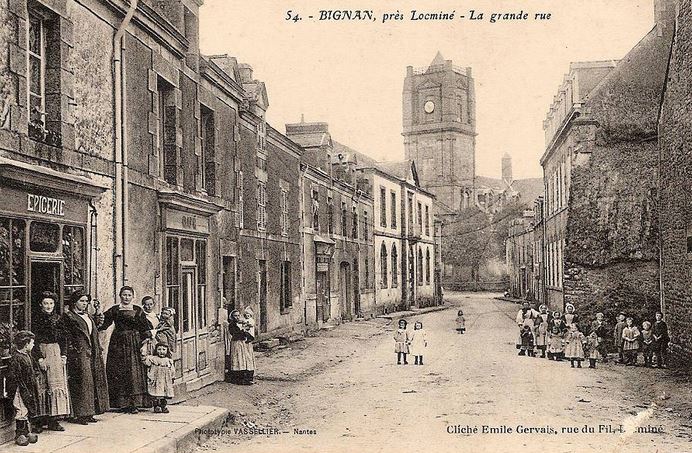
Commune in Brittany, France
| Field | Value |
|---|---|
| name | Bignan |
| native name | Begnen |
| commune status | Commune |
| image | Allée couverte de Kergonfalz 4104.JPG |
| caption | The Allée couverte de Kergonfalz |
| image coat of arms | Blason ville fr Bignan (Morbihan).svg |
| coordinates | |
| INSEE | 56017 |
| postal code | 56500 |
| arrondissement | Pontivy |
| canton | Moréac |
| mayor | Chantal Bihoes |
| term | 2020–2026 |
| intercommunality | Centre Morbihan Communauté |
| elevation min m | 53 |
| elevation max m | 181 |
| area km2 | 45.84 |
| population | |
| population date | |
| population footnotes |
|image coat of arms = Blason ville fr Bignan (Morbihan).svg
Bignan (; ) is a commune in the Morbihan department in Brittany in northwestern France.
Location
The town is based on the Landes de Lanvaux. Bignan is located between the townships of Locminé and Saint-Jean-Brévelay. Bignan is only half an hour from the main cities of Morbihan: Vannes, Lorient and Pontivy.
History
In 1252, Guillaume de Bignan founded the nearby abbaye de prières.
The earliest mention of Bingnen is in 1421, Buignen in 1428, and Bignen in 1461. Bignen was formerly part of the deanery of Porhoët, of the fief of the lords of Rohan.
The town church was constructed between 1787 and 1801 with construction interrupted by the French Revolution.
Bignan was a very active center of chouannerie from 1794 by the action of Pierre Guillemot, called "the king of Bignan", lieutenant of Georges Cadoudal.
After the revolution Castle Kerguéhennec, sometimes nicknamed the " Versailles breton", served as a warehouse for the Chouans to remove crops to the law of requisition of grain applied by the Republican administration.
In 1906, traces of an Iron Age settlements and in particular of the Acheulean period were found near the town.
At the start of the 2016 academic year, 49 students were enrolled in the Catholic bilingual stream (22% of children in the commune enrolled in primary school)
Name
The meaning of the towns toponym is obscure. Several hypotheses exist:
- A Beg (either Beg-Hent - Beg-nein : end of the road or Naizin) but the nasalisation of Breton seems to oppose it.
- A similar origin ("little Bethany ")
- A Breton origin via the term Bedun meaning birch which is called beg beu today, there is actually a locality, the Bézo, which could confirm (bezo = birches)
- An idea of height based on the Celtic radicals benn (Benian) and penn = height (approximation with pign: pignein (to rise). The village is indeed located on a height.
In Breton the city is named Begnen. The municipality signed the charter Ya d'ar brezhoneg on 20 November 2009.
Population
| graph-pos = right |1968 | 2067 |1975 | 2227 |1982 | 2446 |1990 | 2567 |1999 | 2546 |2007 | 2607 |2012 | 2757 |2017 | 2791
Inhabitants of Bignan are called Bignanais. In 2017, the municipality had 2,791 inhabitants, an increase of 7% compared to 2007.
Landmarks
Catholic Church
The Saint-Pierre-et-Saint-Paul church is a Catholic church located in Bignan. It is dedicated to the apostles Peter and Paul.
The building was built at the end of the 18th century on the site of a ruined Romanesque church. On the initiative of the rector of the time, Pierre Nourry, and following his plans, the construction of a new church was begun in 1787.
The first stone was laid on 19 August 1787, but construction was interrupted during the French Revolution and the exile of Abbot Nourry, refractory, work resumed in 1801. Pierre Nourry is buried there at his death in 18043. New bells are melted for the church and received in 1807. The bell tower is built between 1824 and 1857. The church - with the sacristy, the furniture that is integrated and the placier - is registered as a historic monument by order of 23 February 2016.
Cross of Tenuel
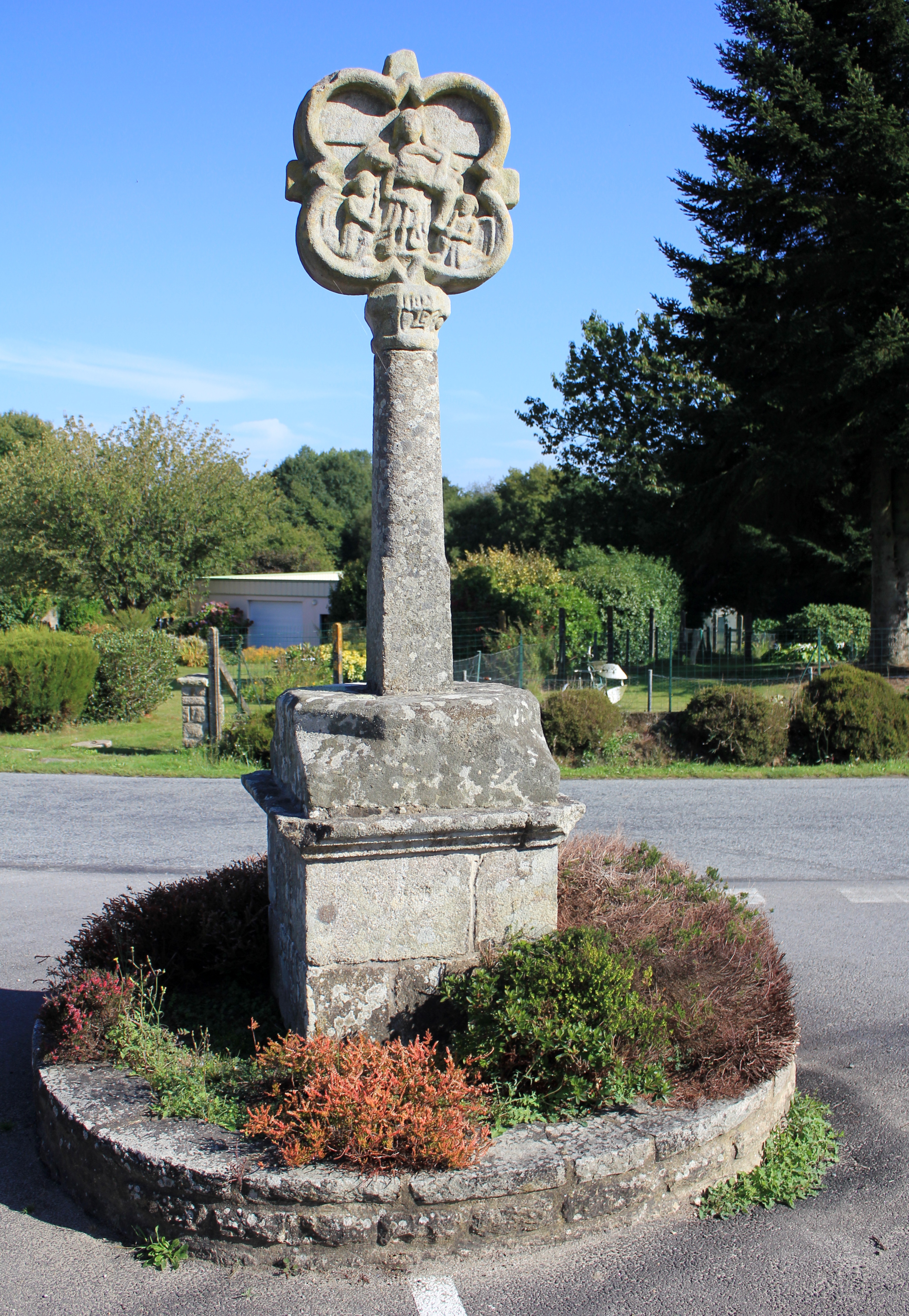
The Cross of Tenuel is located at a place called "Treuliec" in Bignan in Morbihan in the center of the town of Bignan (French department of Morbihan). The cross is of seventeenth century origin, rebuilt in 1897 and the cross has a medallion with four leaves representing the crucifixion on the front and a pietà verso. The plinth is carved. The cross is the subject of an inscription as a historical monument since 5 April 1935.
Village Cross

The cross has been registered as a historical monument since 29 March 1935. The basement is an altar which is accessed by two steps. It is surmounted by a patted cross.
Fontaine Saint-Éloi
The fountain has been listed as a historic monument since 18 October 1944. The niche is surmounted by a shell. Access to the pool is via two steps.
Château de Kerguéhennec
.JPG)
Allée couverte de Kergonfalz
The Allée couverte de Kergonfalz is a stone structure near the town. The building is located at the crossroads of the Moustoir-Ac road and the road to the hamlet of Kergonfalz. It is located approximately 470 m as the crow flies to the north of the latter and 200 m southwest of the hamlet of Kergal1. About 50 m to the west, on the other side of the Moustoir-Ac road, stands the Kergonfalz dolmen.
The covered alley dates from the Neolithic, around 3000 to 2700 BC. The structure is classified as historical monuments by order of 10 January 1970.
Chapelle Sainte-Noyale
fontaine Sainte-Nolwenn
Breton language
In 2008, 17.36% of primary-school children attended bilingual schools.
References
References
- (7 July 2020). "Maires du Morbihan". Préfecture du Morbihan.
- Rev. Sabine Baring-Gould (M.A.). "S. NOYALA, V.M. (DATE UNCERTAIN.)." In: The Lives of the Saints. Volume the Seventh: July - Part I. London: John C. Nimmo, 1898. pp. 137-140.
- [http://celticsaints.org/2010/0706e.html St. Noyala of Brittany, Virgin Martyr].
- Kerdel's Margarite Admission - 30 September 1428 (parchment)
- Patrick Huchet, Georges Cadoudal and the Chouans, p. 156.
- In 1788-1795: Quevenois at the time of the French Revolution, p. 57 of the Historic Committee of Quebec
- Memoirs of the Society of History and Archeology of Brittany, 1911, Volumes 21 to 23, p. 210 of the Society of History and Archeology of Brittany.
- [[Roger Grand]]., The Chouannerie of 1815: The Hundred Days in the West, p. 210.
- Revue morbihannaise - Volume 15 - 1911 - p. 48 of Max Nicol, Father Jerome Buléon and Paul Aveneau de la Granciére
- [http://www.brezhoneg.bzh/98-kelenn.htm Kelenn].
- link. (2018-09-30 .)
- to Beignon and Bignac Gallo and Charentais countries which would give it a Gallo-Roman origin.
- [https://www.insee.fr/fr/statistiques/4515315?geo=COM-56017#ancre-POP_T1 Population en historique depuis 1968], INSEE
- [http://www.mairie-bignan.fr/decouverte/patrimoine/eglise Egleise de Bignan] {{Webarchive. link. (5 August 2018 .)
- [http://www.infobretagne.com/bignan.htm Bignan, sur Infobretagne].
- {{Base Mérimée. PA56000077. Eglise Saint-Pierre Saint-Paul
- {{Base Mérimée. PA00091042. Croix de Treuliec
- {{Base Mérimée. PA00091043. Croix du bourg
- {{Base Mérimée. PA00091045. Fontaine Saint-Eloi
- {{Base Mérimée. PA00091041. Château de Kerguéhennec et ses dépendances
- [http://megalithes-breton.fr/56/accueil_56.php?nom=al/kergonflaz.html Allée couverte de Kergonflaz, commune de Bignan].
- [http://www.t4t35.fr/Megalithes/AfficheSite.aspx?NumSite=7109 France - Allée couverte de Kergonfalz [ALKER7]].
- {{Base Mérimée. PA00091040. Allée couverte de Kergonfalz
- [http://www.megalithic.co.uk/article.php?sid=9106 « Kergonfalz allée couverte ].
- {{in lang
This article was imported from Wikipedia and is available under the Creative Commons Attribution-ShareAlike 4.0 License. Content has been adapted to SurfDoc format. Original contributors can be found on the article history page.
Ask Mako anything about Bignan — get instant answers, deeper analysis, and related topics.
Research with MakoFree with your Surf account
Create a free account to save articles, ask Mako questions, and organize your research.
Sign up freeThis content may have been generated or modified by AI. CloudSurf Software LLC is not responsible for the accuracy, completeness, or reliability of AI-generated content. Always verify important information from primary sources.
Report