From Surf Wiki (app.surf) — the open knowledge base
Bicycle parking rack
Device used to park bicycles, not to be confused with a kick stand

Device used to park bicycles, not to be confused with a kick stand
bicycle racks, or bike stands, for the parking of bicycles
A bicycle parking rack, usually shortened to bike rack and also called a bicycle stand, is a device to which bicycles can be securely attached for parking purposes. It may be freestanding, or securely attached to the ground or a stationary object, such as a building. Indoor racks are commonly used for private bicycle parking, while outdoor racks are often used in commercial areas. General styles of racks include the Inverted U, Serpentine, Bollard, Grid, and Decorative. The most effective and secure bike racks are those that can secure both wheels and the frame of the bicycle, using a bicycle lock.
Bike racks can be constructed from a number of materials, including stainless steel, steel, recycled plastic, and thermoplastic. Durability, weather resistance, appearance and functionality are important factors when choosing this material.

The visibility of the bike rack, adequate spacing from automobile parking and pedestrian traffic, weather coverage, and proximity to destinations are all important factors determining usefulness of a bicycle rack, helping to increase its usage and assure cyclists that their bikes are securely parked.
History
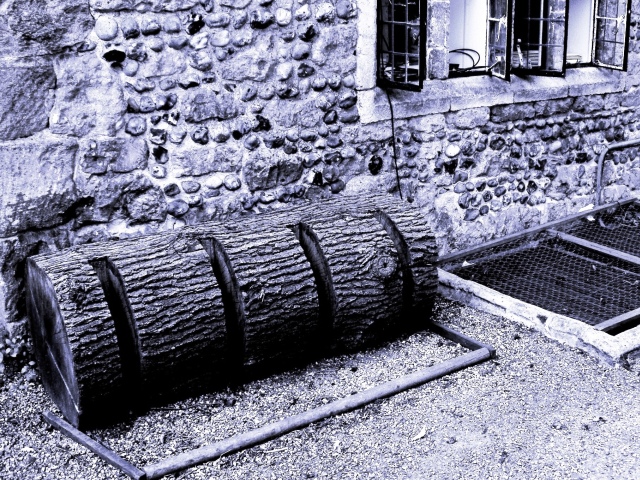
Early models tend to offer a means of securing one wheel: these can be a grooved piece of concrete in the ground, a forked piece of metal into which a wheel of the bicycle is pushed, or a horizontal "ladder" providing positions for the front wheel of many bicycles. These are not very effective, since a thief need only detach the wheel in question from the bicycle to free the rest of the bicycle. They also do not offer much support, and a row of bicycles in this type of stand are susceptible to all being toppled in a domino effect. These types of stand are known as "wheel benders" among cyclists.

A modern version is known as the "Sheffield rack" or "Sheffield stand" after the city of Sheffield in England where these were pioneered. These consist of a thick metal bar or tube bent into the shape of a square arch. The top part is about level with the top bar of the bicycle frame, and thus supports the bicycle and allows the frame to be secured. The origin of the racks was when the frugal citizens of Sheffield had to decide what to do with some old gas piping. Local cyclists suggested the cycle rack idea and two simple bends later, and a little concrete in the ground, the rack was born. At the time this was a revolution in a world of 'single-point holders' that bent wheels and offered little lockability for frames. A version of this design feature a second, lower horizontal bar to support smaller bikes (this version is also known as "A stand"), and are coated to reduce their surface hardness and to not scratch the bike's paintwork.

Since 1984 the City of Toronto has installed post and ring bicycle racks consisting of a steel bollard or post topped by a cast aluminium ring. In August 2006, it became publicly known that these stands could be defeated by prying the ring off with a two-by-four, limiting its effectiveness in high-crime areas.
In Amsterdam two-tiered bicycle stands are ubiquitous. Bikes can be parked in a smaller area as the handlebars (usually wider than the back of the bicycle) of every other one is at a different height (either high or low). These racks are made of steel and have a large bar to which the frame may be easily locked. Most Dutch bicycles have a rear wheel lock, so that wheel need not be locked.
Classes
Bike parking needs vary from environment to environment.
;Class I: :Some locations require Class I standards (commonly referred to as long-term bike parking). Class I parking regulations are implemented when bicycles will be parked for hours at a time. Examples of these environments are office buildings, elementary schools, libraries, etc. When implementing Class I bike racks, installers should also incorporate some form of weather protection for the racks and bikes. (See also Bicycle parking station.) ;Class II: :More commonly seen in public areas are Class II bike racks. These bike racks are needed when cyclists will be leaving their bikes unattended for less than two hours. Weather protection is not as important for this class, however proximity to main attractions and public visibility should be considered to encourage usage and enhance security. Class II bike racks can be implemented near restaurants, parks, picnic areas, or other similar places.

Design
Styles
Many different styles of bike rack are available to match any environment. Specific details such as bolt size, tubing diameter, tubing style (square or round), height, length, and many other things vary with manufacturer, but typically, there are six general styles of commercial bike rack.
| Name | Variant names | Description | Images | |||||||||
|---|---|---|---|---|---|---|---|---|---|---|---|---|
| U-rack | Staple, Sheffield rack | url = http://www.bikeparking.com | title = Palmer Group | date = 4 September 2009 | url-status = live | archive-url = https://web.archive.org/web/20100327192339/http://www.bikeparking.com/ | archive-date = 27 March 2010 }} | [[File:U Rack.png | thumb | none | alt=A tube of black-painted metal bent into a tall U shape and bolted at both ends to a concrete slab, in front of a brick pathway and iron railings | U-rack bolted to the ground. Unknown location.]] |
| Wave | Serpentine | The wave is an extension of the U-Rack. Waves accommodate more bicycles than the single U-rack, but only support a bicycle frame at one point (as opposed to two points with a U-rack), resulting in a greater chance of the bicycle falling over when parked in the rack. | [[File:WTM3 NYU FC 0019.jpg | thumb | none | alt=Ground-level view of a black-painted metal square tube bent into a curved M shape and bolted to concrete by a road. In the background are two cars parked in front of a long building. | Wave rack in [[New York City]]]] | |||||
| Bollard style | Post and ring | Bollards are short vertical posts most commonly used as traffic or parking barriers. Bollard style bike racks add one or two arms to which bikes may be secured. Post-and-ring racks are a North American variant on the bollard type. | [[File:Seattle - stylized bike rack.jpg | thumb | none | alt=A ring with a stylized bicycle inside, with riveted to a post (running through the ring), all of galvanized metal. It is set in a concrete slab in front of a brick wall. | Bollard-style rack in [[Seattle | Seattle, Washington, United States]]]] | ||||
| Grid style | Ladder | The grid consists of vertical bars that connect larger upper and lower metal tubing that accept bikes on one or both sides of the rack. Grid style racks can be left freestanding or anchored to the ground with permanent or temporary anchors. This rack does not allow both the wheel and frame of the bike to be locked, allowing for potential theft of the bicycle. | [[File:Grüne Apotheke Fahrradständer KA 2012.JPG | thumb | none | Free-standing ladder rack in front of an apothecary in [[Baden-Württemberg]], Germany]] | ||||||
| Innovative | Innovative designs incorporate both utility and style. Many bike rack engineers have made small alterations to basic bike racks to improve functionality and appearance. | [[File:Davis Bike Rack.jpg | thumb | none | alt=An array of sixteen or so parking spots for bicycles. Each is a square metal bar angled at 45 degrees from the ground with a parallel loop of thinner round tubing at the top. They are set in a row with the bars pointing in alternating directions. A pink ladies' bicycle with a shipping basket is parked in one. Another row of them is mostly out of frame to the left with a mountain bike parked in it. In the background is a car park with trees. | An innovative type of bicycle rack in [[Davis, California]]]] | ||||||
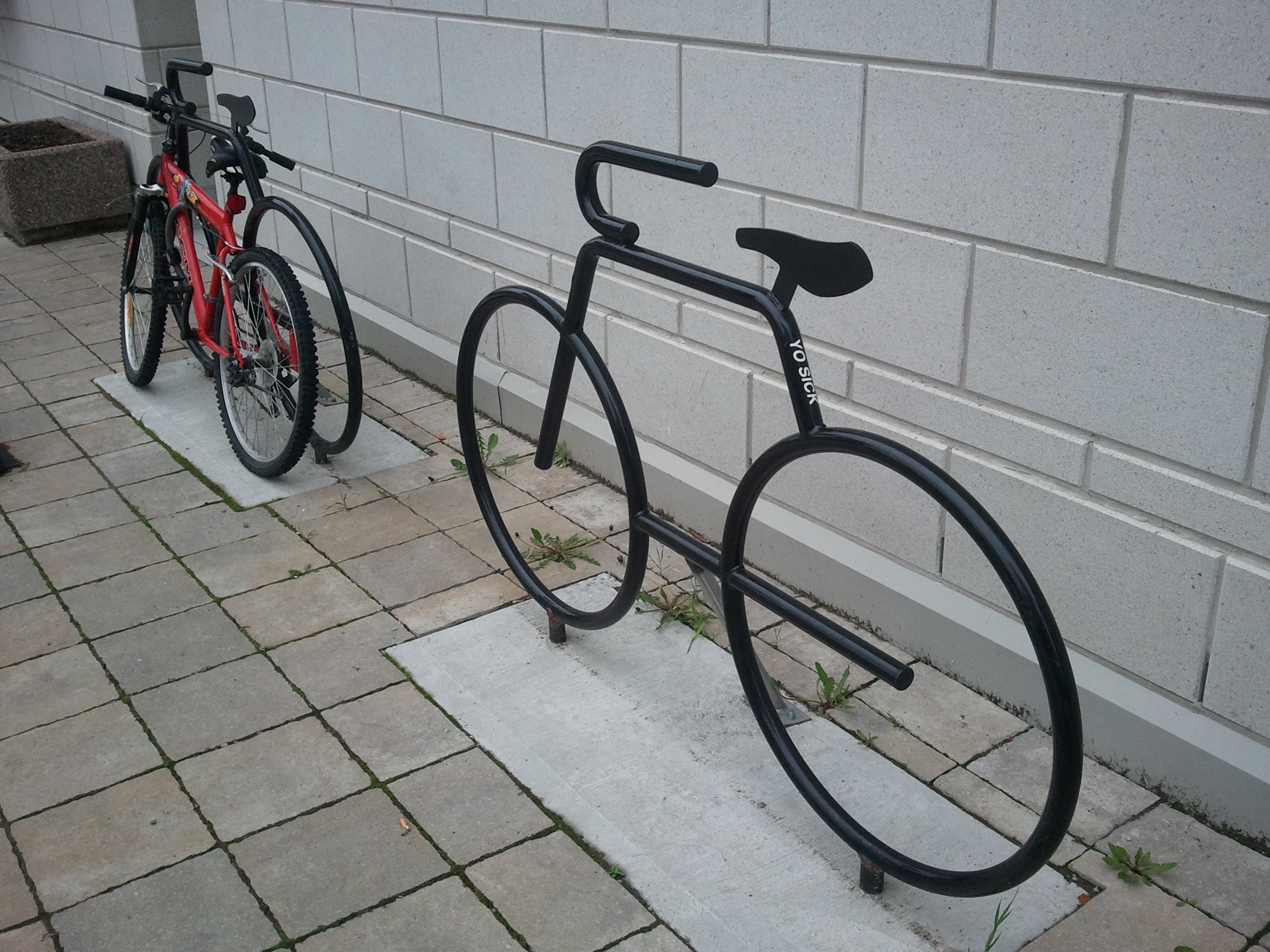
| Decorative | In response to the often unique nature of commercial areas, some environments require a more decorative bike rack. For example, a public aquarium or zoo may prefer a shark shaped bike rack over a traditional style bike rack. | [[File:Yellow bikerack Adams jeh.jpg | thumb | none | alt=A bike rack shaped like a stylized bicycle with a rider with hair streaming in the wind. It is painted yellow and set in tarmac at the edge of a road between two large concrete plant pots. A folded bicycle is parked there and an abandoned chain hangs from it. Behind, two women walk past on the sidewalk in front of black iron railings. | Decorative bike rack in [[downtown Brooklyn]], New York City]] | ||||||
| Double deck | Two-tier bike racks can be used to increase bicycle storage capacity in a fixed space. In order to easily maneuver a bicycle onto the top tier, some double deck bike racks incorporate hydraulic pistons to lift the bike into the rack after the user has locked it. | [[File:Bicycle rack, Waterloo stn.jpg | thumb | none | Double-decker bike rack at [[London Waterloo railway station | London Waterloo station]], England]] |
Mounts


Bike racks can be mounted to a surface in a number of different ways.
- In-ground: The base of the bike rack is planted into the ground, and secured by a perpendicular anchor pin for stability. These stable mounts are most secure from theft or vandalism.
- Surface: Flanges extending outwards from the base of the bike rack are secured into existing concrete with lag bolts. For added support, surface mounts can also include triangular brackets, also referred to as gusset plates, to reinforce the connection between the flange and tubing. Surface mounts with this extra support are called gusset mounts. Surface and gusset mounts are used to secure a bike rack into an existing piece of concrete.
- Rail mounts: Some bike rack units can be connected with rails. This type allows using single bike racks, while limiting the number of mounts be implemented. Rail mounts are mostly used to connect multiple 'U' Racks so each rack need not be mounted, saving labor costs and limiting the number of holes in the surface.
- Wall mounts: Certain bike racks are designed to be mounted to the wall using bolts to connect flanges of the rack onto existing walls. These conserve floor space and are most useful for long-term storage.
- Removable mounts: Some models of bike stands and bike bollards can be installed with mounting systems that allow them to become temporarily removable. Removable mountings are used in areas where removing the bike stand or bike bollard could permit temporary access to emergency, delivery and maintenance vehicles.
Finishes

Commercial bike racks can be constructed with a variety of different materials. Some of the most important factors to consider when choosing a finishing material are the weather conditions the bike rack will need to endure, the overall style and look of the atmosphere, the volume of bikes the rack will be holding, and environmental issues.
- Galvanized: Galvanized bike racks are the best value finish. They are inexpensive, and provide a thin layer of zinc for corrosion protection. The appearance is a dull gray color, with little to no shine.
- Powder-coat: This finish is usually available in a wide range of colors. It is achieved by a dry-powder coat that provides a durable outer layer that has a high gloss appearance and excellent weather resistance.
- Thermoplastic-coated: This polyethylene matte finish is usually available in a wide range of colors as well. The powder coating, applied for corrosion protection, can easily match existing surroundings, and creates a finish without runs or drips.
- Recycled plastic: Recycled plastic bike racks are composed of recycled materials, up to 96% recycled. It does not splinter or crack, is more fire-safe than wood, and does not emit harmful chemicals into the environment.
- Stainless steel: Stainless steel is the most durable material for a bike rack. It has maximum corrosion protection, is antimicrobial, and has a glossy appearance that is easy to clean and maintain.
- eSteel: The eSteel process produces a durable and uniform finish. The process is environmentally friendly, and is compliant with regulations of the US OSHA and EPA agencies.
Area needed

Bicycle parking takes up much less space than parking for cars. A typical bicycle is about 1.8 meters long, 1 meter high and 40-60 cm wide. Based on an ordinary bicycle, the Stavanger municipality guide suggests the following area requirements for parking racks:
- Area-efficient A racks: 17.5 m2 for 10 bicycles (0.5 meter width per bicycle)
- 2-story rack: 7 m2 for 10 bikes (0.4 meter width per bike) The guide indicates that a depth of 3.5 meters is needed (of which 2 m is for the bicycle and rack, and 1.5 m for access). If cargo bikes or bikes with trailers are to be able to be parked, the area must be increased.
If there is very little floor space, a bicycle rack can be used where the bike is hung uphill behind the front wheels, but such racks are more cumbersome to use.
Installation

Where a bike rack is installed is just as important as how safe and useful it is. The better the location, the more use the bike rack will encourage. Bike racks should be installed in an area that is highly visible to the public. By avoiding isolated areas and hidden spaces, cyclists will feel safe enough to lock their bikes there. Crowded locations will also deter bike thieves from stealing bicycles. Also, by placing bike racks in a highly visible area, the location will most likely be near common places of interest, making it more convenient for people to ride their bike to their destinations.
However, while a bike rack should be implemented in a visible area, it is important that the bike rack have adequate spacing away from pedestrians and other traffic. Bike riders will need ample space to maneuver their bike around and into the rack, without hitting other parked bikes, cars, or people. It is also important to place bike racks far enough away from doorways, sidewalks, or paths where it may obstruct traffic flow.
Another important factor to consider is weather protection. If bike racks are being used for long-term parking, the bike rack should be placed under some form of weather protection. This will not only help protect the bike rack from corrosion, but also encourage bike riders to store their bikes there for extended periods of time.
Although the primary use for a bicycle stand is for parking, it is useful at times to use it for maintenance and adjustments. While it is difficult to spin a rear wheel while making derailleur adjustments, if a stand were high enough to support the rear of the bike by the saddle nose, then this problem could be solved. Generally speaking, stands are not high enough for this and quite often have bracings and other obstructions in their construction that would prevent such use.
Along with bike racks, often other cycle infrastructure is added to a cycle parking project. This can include bike pumps and repair stations to allow on-the-go maintenance of bicycles, and wash stations for cleaning. Some modern, large scale projects use technology such as bicycle detection systems to show users whether there is space available for their cycle, and e-bike charging stations to allow electric bike users to plug in while away from home.
References
References
- "Bike Federation of Wisconsin, Bicycle Parking Services".
- (June 2009). "Stand and Deliver, Cycle parking in London". Greater London Authority.
- "Transportation Alternative, On-Street Bicycle Parking: Bike Racks".
- "Bike Security Racks Co., Inc.".
- "How to Buy a Bike Rack {{!}} Buying Guide". Belson Outdoors.
- Pedestrian and Bicycle Information Center. "Bicycle Parking." ''Bicyclinginfo.org.'' U.S. Department of Transportation Federal Highway Administration. Web. 4 September 2009. <http://www.bicyclinginfo.org {{webarchive. link. (30 August 2009 >.)
- "Glossary of cycle campaigning: Sheffield rack/stand". Cambridge Cycling Campaign.
- "Toronto: Bicycle parking – Choosing a rack".
- "Toronto: Bicycle parking – Recommended racks".
- "Online TDM Encyclopedia – Bicycle Parking".
- "Various types of bicycle racks (German: Die verschiedenen Arten)".
- (4 September 2009). "Palmer Group".
- "Products Finishing Online – Main Page".
- "Stainless Steel Overview: Features & Benefits". Speciality Steel Industry of North America.
- (2020-01-26). "What size shed do I need for my bikes? {{!}} The Best Bike Lock".
- (2019-08-27). "Sykkelparkeringsveileder - Prinsipper og veiledning for god sykkelparkering {{!}} Stavanger kommune". www.stavanger.kommune.no.
- "Commercial Bike Racks & Public Park Bike Stands".
- "Additional cycling infrastructure". Turvec Cycle Parking Solutions.
This article was imported from Wikipedia and is available under the Creative Commons Attribution-ShareAlike 4.0 License. Content has been adapted to SurfDoc format. Original contributors can be found on the article history page.
Ask Mako anything about Bicycle parking rack — get instant answers, deeper analysis, and related topics.
Research with MakoFree with your Surf account
Create a free account to save articles, ask Mako questions, and organize your research.
Sign up freeThis content may have been generated or modified by AI. CloudSurf Software LLC is not responsible for the accuracy, completeness, or reliability of AI-generated content. Always verify important information from primary sources.
Report