From Surf Wiki (app.surf) — the open knowledge base
Biconical antenna
Type of antenna
Type of antenna
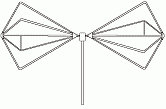
In radio systems, a biconical antenna is a broad-bandwidth antenna made of two roughly conical conductive objects, nearly touching at their points.
Biconical antennas are broadband dipole antennas, typically exhibiting a bandwidth of three octaves or more. A common subtype is the bowtie antenna, essentially a flattened version of the biconical design which is often used for short-range UHF television reception. These are also sometimes referred to as butterfly antennas.
Sir Oliver Lodge is the inventor of the biconical antenna.

Properties
The biconical antenna has a broad bandwidth because it is an example of a traveling wave structure; the analysis for a theoretical infinite antenna resembles that of a transmission line. For an infinite antenna, the characteristic impedance at the point of connection is a function of the cone angle only and is independent of the frequency.
Practical antennas have finite length and a definite resonant frequency. A simple conical monopole antenna is a wire approximation of the solid biconical antenna and has increased bandwidth (over a simple monopole).
Applications
.jpg)
Biconical (or "bicon") antennas are often used in electromagnetic interference (EMI) testing either for immunity testing, or emissions testing.

Advantages and drawbacks
While the bicon is very broadband, it exhibits poor transmitting efficiency at frequencies at the low end of its range, resulting in low field strengths when compared to the input power. Log periodic dipole arrays, Yagi–Uda antennas, and reverberation chambers have shown to achieve much higher field strengths for the power input than a simple biconical antenna in an anechoic chamber.
However, when the goal is to fully characterize a modulated or impulse signal, rather than merely measuring peak and average spectrum energy content, a reverberation chamber is a poor choice for a test environment.
References
References
- Zhang, Zhuohui. (2007). "Analysis and Design of a Broadband Antenna for Software Defined Radio".
- "Bow tie antenna".
- Schantz, Hans G.. (2015-06-01). "The Art and Science of Ultrawideband Antennas, Second Edition". Artech House.
- (2022-10-05). ["Oliver joseph lodge"](https://patents.google.com/patent/US609154A/en}} {{Webarchive).
This article was imported from Wikipedia and is available under the Creative Commons Attribution-ShareAlike 4.0 License. Content has been adapted to SurfDoc format. Original contributors can be found on the article history page.
Ask Mako anything about Biconical antenna — get instant answers, deeper analysis, and related topics.
Research with MakoFree with your Surf account
Create a free account to save articles, ask Mako questions, and organize your research.
Sign up freeThis content may have been generated or modified by AI. CloudSurf Software LLC is not responsible for the accuracy, completeness, or reliability of AI-generated content. Always verify important information from primary sources.
Report