From Surf Wiki (app.surf) — the open knowledge base
Bi-pin lamp base
Type of lamp/lightbulb fitting/connector
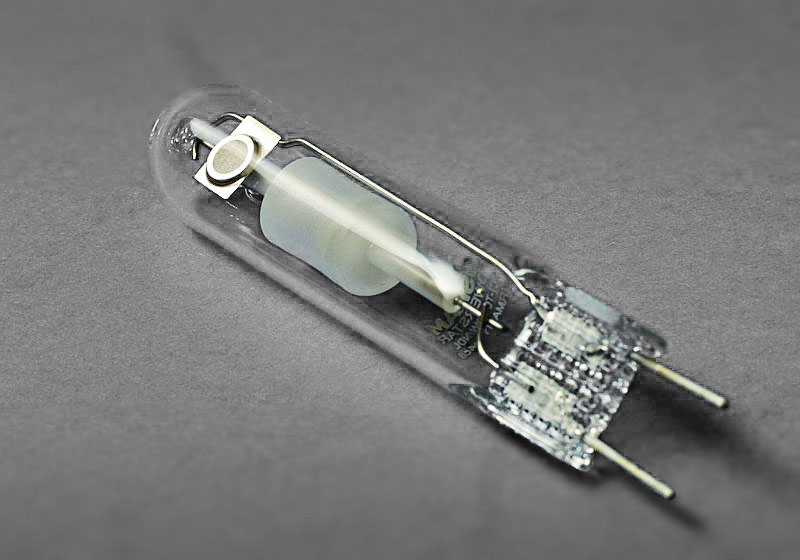
Type of lamp/lightbulb fitting/connector
A bipin or bi-pin (sometimes referred to as two-pin, bipin cap or bipin socket) is a type of lamp fitting. They are included in the IEC standard "IEC 60061 Lamp caps and holders together with gauges for the control of interchangeability and safety". They are used on many small incandescent light bulbs (especially halogen lamps), and for starters on some types of fluorescent lights.
Some sockets have pins placed closer together, preventing the low-power bulbs they use from being replaced by bulbs that are too high power, which may generate excessive heat and possibly cause a fire. These are sometimes called "mini-bipin". Where the terminals of the lamp are bent back onto the sides of the base of the bulb, this forms a wedge base, often used in small bulbs for automotive lighting.
The bi-pin base was invented by Reginald Fessenden for the 1893 World's Fair in Chicago. After Westinghouse won the contract to wire and illuminate the first electrified fair with AC instead of arch-rival Thomas Edison's DC, Edison and his General Electric company refused to allow his patented Edison screw-base bulbs to be used. Westinghouse overcame this by developing the bi-pin base for use at the fair. An incandescent electric lamp with a bi-pin base was patented by the Westinghouse (G. Westinghouse, Jr.) in 1895.
Types
| Illustration | Designation | IEC60061-1 sheet | Pin | Usage | Pitch | Diameter | ||
|---|---|---|---|---|---|---|---|---|
| [[File:G4 bi-pin connector.jpg | 100px | G4 bi-pin connector]] | G4 | 7004-72-3 | 4.0 mm | 0.65–0.75 mm | Small halogen quartz capsules of 5/10/20 watt and 6/12 volt AC and DC. | |
| GU4 | 7004-108-2 | 4.0 mm | 0.95–1.05 mm | MR11 and MR8 | ||||
| GY4 | 7004-72A-1 | 4.0 mm | 0.65–0.75 mm | |||||
| GZ4 | 7004-67-3 | 4.0 mm | 0.95–1.05 mm | MR11 and MR8 | ||||
| G5 | 7004-52-7 | 5 mm | T4 and T5 fluorescent tubes | |||||
| [[File:GU5.3 bi-pin connector.jpg | 100px | G5.3 bi-pin connector]] | G5.3 | 7004-73-2 | 5.33 mm | 1.47–1.65 mm | ||
| G5.3-4.8 | 7004-126-1 | |||||||
| [[File:MR16 LED lamp with GU5.3 socket.png | 100px | MR16 [[LED lamp]] with GU5.3 base]] | GU5.3 | 7004-109-2 | 5.33 mm | 1.45-1.6 mm | ||
| GX5.3 | 7004-73A-2 | 5.33 mm | 1.45–1.6 mm | Round pins. MR16 and other small halogens of 20/35/50 watt and 12/24 volt. | ||||
| [[File:OSRAM ENH 93506 120V-250W GY-5,3 halogen lamp base.jpg | 100px | GY5.3 base]] | GY5.3 | 7004-73B-2 | 5.33 mm | Flat pins | ||
| [[File:Sylvania FHB 35 225V 1000W - G6.35 socket-9673.jpg | 100x100px | G6.35 bi-pin connector]] | G6.35 | 7004-59-6 | 6.35 mm | 0.95–1.05 mm | ||
| GX6.35 | 7004-59-6 | 6.35 mm | 0.95–1.05 mm | |||||
| GY6.35 | 7004-59-6 | 6.35 mm | 1.2–1.3 mm | Halogen various wattage (e.g. 50W/100W), various voltage (e.g. 12/24V). Common for task lighting, landscape lighting. | ||||
| GZ6.35 | 7004-59A-3 | 6.35 mm | 0.95–1.05 mm | projector bulb | ||||
| G8 | 8.0 mm | 1.0 mm | Halogen 35–100W 120-240V | |||||
| GY8.6 | 8.0 mm | 1.25 mm | Halogen up to 100W, 120V | |||||
| [[File:G9 bi-pin connector.jpg | 100px | G9 bi-pin connector]] | G9 | 7004-129-3 | 9.0 mm | Halogen 120V (US) / 230V (EU), also used for LED lamps. | ||
| G9.5 | 7004-70-2 | 9.5 mm | 3.10–3.25 mm | Common for theatre use, several variants | ||||
| [[File:GU10.JPG | 100px | GU10 bi-pin connector]] | GU10 | 7004-121-2 | 10 mm | 5 mm | Twist-lock 120/230-volt MR16 halogen lighting of 35/50 watt, since the mid-2000s. Also used for compact fluorescents and LED lamps. | |
| GZ10 | 7004-120-1 | 10 mm | Twist-lock 120/230-volt MR16 halogen lighting of 35/50 watt, differs from GU10 by use of a dichroic reflector. GZ10 fixtures can use GU10 bulbs, but not vice versa. | |||||
| G12 | 7004-63-2 | 12.0 mm | 2.35 mm | Used in theatre and single-end metal halide lamps. | ||||
| G13 | 7004-51-10 | 0.50 in (12.7 mm) | 0.093 in (2.35 mm) | Common T8, T10 and T12 fluorescent tubes. | ||||
| GX16d | "Mogul End Prong", common for theatre PAR lamps. | |||||||
| [[File:General_electric_G23_light_bulb_(cropped).JPG | 100px]] | G23 | 7004-69-1 | 23 mm | 2 mm | |||
| [[File:Compact fluorescent light bulb with GU24 connector.png | 100px]] | GU24 | 7004-78-5 | 24 mm | Twist-lock for self-ballasted compact fluorescents, since the 2000s. | |||
| [[File:G38 Bulb with CD.png | 100px | 2000-W halogen lamp with G38 base]] | G38 | 7004-76-1 | 38 mm | 11.1 mm | Mostly used for high-power theatre lamps. | |
| [[File:GX53_LED_Leuchtmittel_11W_1000lm_4.jpg | 100px | 11-W 1000-lm [[LED lamp]] with GX53 base]] | GX53 | 7004-142-2 | 53 mm | Twist-lock for puck-shaped under-cabinet compact fluorescents and LED lamps, since the 2000s. | ||
| GX70 | 70 mm | Twist-lock for puck-shaped compact fluorescents or LED lamps. |
The suffix after the G indicates the pin spread; the G dates to the use of Glass for the original bulbs. GU usually also indicates that the lamp provides a mechanism for physical support by the luminaire: in some cases, each pin has a short section of larger diameter at the end (sometimes described as a "peg" rather than a "pin"); the socket allows the bulb to lock into place by twisting it; in others, the base of the lamp has a groove which can be held by a spring or clip.
A lowercase "q" at the end of the designation indicates that it is a quad-pin base, with two bi-pin pairs. These are used with compact fluorescent tubes that plug into a light fixture that has a permanent ballast.
There are also double-ended halogen and fluorescent tubes with one pin at each end, and high-output fluorescents with recessed or shrouded contacts, which are not covered here.
File:Lampg4.jpg|Halogen lamps with GU4 (left) and G4 (right) bases File:Lamp6-35.jpg|Halogen lamp with G6.35 base File:Halogenmetalldampflampe.jpg| Metal halide lamp with G8.5 base File:Lampg9.jpg|Halogen lamp with G9 looped-pin base File:Lampgu10.jpg|Halogen lamp with GU10 twist-lock base
References
References
- *{{US patent. 543280, incandescent electric lamp
- Simon Brammer. (28 March 2014). "Converting to LED lights: everything you need to know". The Guardian.
- (2012-03-09). "index". Osram.com.
This article was imported from Wikipedia and is available under the Creative Commons Attribution-ShareAlike 4.0 License. Content has been adapted to SurfDoc format. Original contributors can be found on the article history page.
Ask Mako anything about Bi-pin lamp base — get instant answers, deeper analysis, and related topics.
Research with MakoFree with your Surf account
Create a free account to save articles, ask Mako questions, and organize your research.
Sign up freeThis content may have been generated or modified by AI. CloudSurf Software LLC is not responsible for the accuracy, completeness, or reliability of AI-generated content. Always verify important information from primary sources.
Report