From Surf Wiki (app.surf) — the open knowledge base
Bhutan national football team
Men's national association football team representing Bhutan
Men's national association football team representing Bhutan
| Field | Value |
|---|---|
| Name | Bhutan |
| Badge | Flag of Bhutan.svg |
| Badge_size | 125px |
| Nickname | དྲག་པོའི་བུ་ཚུ |
| (Dragon Boys) | |
| Association | Bhutan Football Federation (BFF) |
| Confederation | AFC (Asia) |
| Sub-confederation | SAFF (South Asia) |
| Coach | Atsushi Nakamura |
| Captain | Chencho Gyeltshen |
| Most caps | Chencho Gyeltshen (46) |
| Top scorer | Chencho Gyeltshen (13) |
| Home Stadium | Changlimithang Stadium |
| FIFA Trigramme | BHU |
| FIFA Rank | |
| FIFA max | 159 |
| FIFA max date | June 2015 |
| FIFA min | 209 |
| FIFA min date | November 2014 – March 2015 |
| Elo Rank | |
| Elo max | 184 |
| Elo max date | April 1982 |
| Elo min | 234 |
| Elo min date | 2015 |
| pattern_la1 | _BHU2427h |
| pattern_b1 | _BHU2427h |
| pattern_ra1 | _BHU2427h |
| pattern_sh1 | _yellowsides |
| pattern_so1 | _3_stripes_yellow |
| leftarm1 | EA642C |
| body1 | EA642C |
| rightarm1 | EA642C |
| shorts1 | DE5E21 |
| socks1 | DE5E21 |
| pattern_la2 | _BHU2427a |
| pattern_b2 | _BHU2427a |
| pattern_ra2 | _BHU2427a |
| pattern_sh2 | _BHU2427a |
| pattern_la3 | _orangeborder |
| pattern_b3 | _orangecollar |
| pattern_ra3 | _orangeborder |
| pattern_sh3 | _orangesides |
| pattern_so3 | _3_orange stripes |
| leftarm3 | FFFFFF |
| body3 | FFFFFF |
| rightarm3 | FFFFFF |
| shorts3 | FFFFFF |
| socks3 | FFFFFF |
| First game | Unofficial: |
| 3–1 | |
| (Kathmandu, Nepal; 1 April 1982) | |
| Official: | |
| 0–3 | |
| (Kuwait City, Kuwait; 2 February 2000) | |
| Largest win | 6–0 |
| (Thimphu, Bhutan; 23 April 2003) | |
| Largest loss | 20–0 |
| (Kuwait City, Kuwait; 14 February 2000) | |
| Regional name | SAFF Championship |
| Regional cup apps | 8 |
| Regional cup first | 2003 |
| Regional cup best | Semi-finals (2008) |
| 2ndRegional name | AFC Challenge Cup |
| 2ndRegional cup apps | 1 |
| 2ndRegional cup first | 2006 |
| 2ndRegional cup best | Group stage (2006) |
the men's team
(Dragon Boys) | Sub-confederation = SAFF (South Asia) 3–1 (Kathmandu, Nepal; 1 April 1982) Official: 0–3 (Kuwait City, Kuwait; 2 February 2000) (Thimphu, Bhutan; 23 April 2003) (Kuwait City, Kuwait; 14 February 2000)
The Bhutan national football team () represents Bhutan in men's international football. The team is controlled by the governing body for football in Bhutan, the Bhutan Football Federation, which is a member of the Asian Football Federation and the regional body the South Asian Football Federation (SAFF). The national football team of Bhutan plays its home games at the national stadium, Changlimithang.
The side has consistently been ranked as one of the worst national teams in the world on both the official FIFA rankings and the Elo rating system. As of the end of November 2017, they have only won six competitive fixtures and have a goal difference of −279. The team have never qualified for the finals of a major tournament and, beyond friendlies and qualifying matches, their only participation in an official competition has been in the regional South Asian Games and the South Asian Football Federation Cup.
History
Beginning (1950s–1980s)
There is uncertainty around how the game was ultimately brought to Bhutan. During the colonial period in Bhutan, although it had signed treaties with the government of India which ceded control of its defence and foreign relations to the British, continued to function as an independent state and was never under the direct rule of the British government in India. Whereas Indians were introduced to football by the British government, the lack of a permanent British presence in Bhutan meant that foreign sports were not played there. The arrival of football in Bhutan was very closely linked with the opening of schools in Haa and Paro in the 1950s, as foreign teachers, mainly from India but some from Europe, were recruited. The Bhutan Football Federation note that in the beginning there was little in the way of formal facilities or equipment and the game was played on stone-covered pitches with a ball made from a bundle of clothes. The game continued to grow as more Bhutanese went abroad, mainly to India, to study and helped increase the popularity of the sport upon their return, though the game was still considered to be just that and was not really developed during this period.
The main centers for football during the 1960s were Phuentsholing and Samtse, close to the border with India, where hastily arranged teams would travel back and forth over the border to play neighboring tea gardens. In 1968, a team nominally representing Bhutan, but essentially consisting of foreign players traveled to Calcutta to compete in the Indian Independence Cup. Over time football gradually increased in popularity until it was seen as an essential part of the school curriculum, with numerous school tournaments established within Thimphu. Teams used to travel from all over the country to take part, some coming from as far away as Khaling. However, regardless of the popularity of the game amongst the Bhutanese, the notion of a Bhutan "national team" consisting almost entirely of foreigners persisted for some time, and this team would regularly travel abroad to take part in international competitions such as the ANFA Cup, with a team consisting of around 60% Indian players. These Indian players were brought to Bhutan and given jobs within the Civil Service, although essentially their role was to play football.
In the late 1970s and early 1980, as well as playing several matches in Bhutan, the representative team, known as Druk 11, also played a number of games outside the country in Nepal and India, against representative teams such as the Food Corporation of India. At that time, eight out of the eleven members of the team were from India. Such a situation could not last, however, and in time these players either retired or returned to their home country creating a vacuum of talent which would seriously affect the national team in the years to come.
Given that the first international competition had been taking place since 1872, Bhutan's official entry into the international arena was comparatively late, playing their first match only in 1982, a 3–1 loss to Nepal in the 1982 ANFA Cup. However, other sources also indicate that a team representing Bhutan travelled to Nepal eight years earlier and won a tournament known as the Shripanch Mahendra Gold Cup, though it is not clear the extent to which this was a true international tournament or whether they were competing against club teams. They also played a representative team from China's Kunming Army Unit in the competition, also losing 3–1. Unfortunately, the scorers for Bhutan are not recorded, so it is unknown who scored Bhutan's first international goal. Bhutan's involvement in the ANFA Cup came some seven years before the inauguration of their own league competition. Again however, sources are contradictory with some indicating that a tournament that at least shared the name "A-League" was established in Thimphu sometime around the beginning of the 1980s.
Despite the at best fledgling nature of their domestic competition at that time, Bhutan continued to put out a side, this time in the South Asian Games. They entered the first games in 1984, but lost all three of their games, 2–0 to Bangladesh, 5–0 to hosts and eventual winners Nepal and 1–0 to the Maldives to finish last out of the four competing teams. It is unclear whether a play-off for third place was held between Bhutan and the Maldives. If it was, then the result is not known. Either way, the bronze medal was awarded to the Maldives.
Undeterred, Bhutan sent a team to the following year's competition in Bangladesh. Results went the same way as the prior year's tournament. Bhutan were drawn in group B of the competition along with India and Nepal. They lost their first match narrowly, 1–0 to Nepal and were beaten 3–0 by eventual champions India to ensure that they finished bottom of the group and did not progress.
The national team did not play any fixtures for the next two years as the South Asian Games moved to become a biennial competition, though they again sent a team to the third edition of the games in Kolkata, India. Drawn in group B again, this time with Nepal and Bangladesh, history repeated itself, as Bhutan lost first to Bangladesh 3–0, with Badal Das, Khurshid Alam Babul and Ahmed Ali scoring for Bangladesh, and then 6–2 to Nepal. Whilst their two goals ended a five-year, six-game scoring drought, they were thoroughly outclassed as Ganesh Thapa scored five times for Nepal.
Stagnation (1990s–2000s)
Despite establishing the first recorded football league in Bhutan in 1986, and while the Bhutan Football Federation was admitted as member of the AFC in 1994, the national team did not compete in any matches following their defeat to Nepal in the South Asian Games until 1999, missing four editions of the Games, returning only in 1999.
Their absence from the international arena had not seen an improvement in the standard of their football, even though there had been a national championship established in the country for the previous four seasons. Their first game against hosts Nepal ended in a resounding 7–0 defeat. The team found themselves 3–0 down within the first twenty minutes as Hari Khadka scored in the first and fifth minutes, with Naresh Joshi extending the lead after eighteen. Bhutan were able to keep Nepal at bay for the rest of the half, but conceded two more either side of the hour mark courtesy of Deepak Amatya and Rajan Rayamajhi before a brace from Basanta Thapa sealed an emphatic victory for Nepal. They performed better defensively in their next match, but still lost 3–0 to India, Vijayam Imivalappil scoring all three goals for India. Out of the competition, Bhutan faced a dead-rubber against Pakistan, who were also eliminate prior to the fixture following losses to India and Nepal. With nothing to play for, they produced their best performance of the tournament. Dinesh Chhetri opened the scoring for Bhutan in the twenty-first minute, the first time they had led a game in their history, only to see a potential victory disappear following two-second-half goals for Pakistan from Haroon Yousaf.
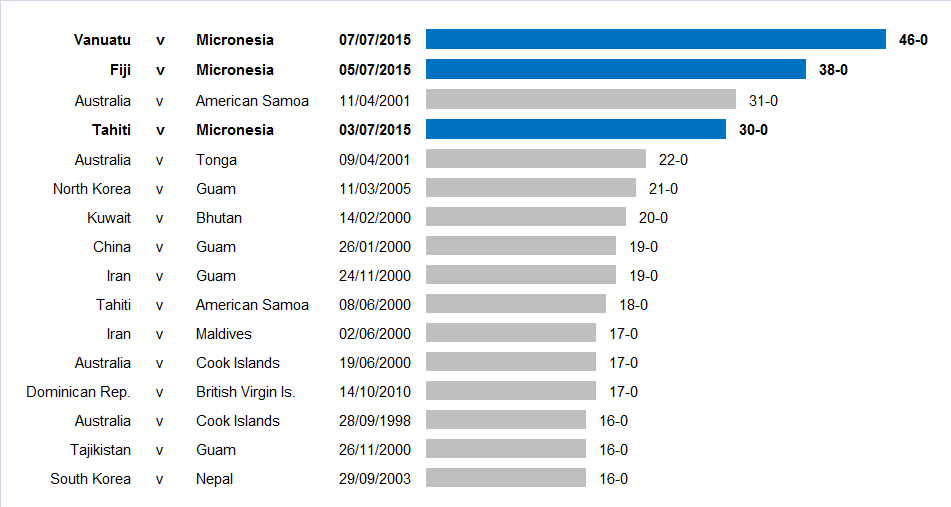
At the turn of the century, having spent the best part of the last two decades competing only against teams within South Asia, Bhutan made their first foray into international football at a continental level, competing in the qualification rounds for the 2000 AFC Asian Cup. This tournament was to be one of the lowest points in the history of the admittedly hastily assembled national team. An opening 3–0 loss to Nepal was perhaps not surprising, with Bhutan never having gained any form of positive result against their Himalayan neighbours, and at this point in time having scored against them only once in the ANFA Cup back in 1982. Four days later they faced Kuwait and were beaten 20–0. Seven of the ten Kuwaiti outfield players got their names on the scoresheet that day, including Bashar Abdullah who scored eight and Jassem Al-Houwaidi who scored five. Bhutan were seriously hampered in this game by their years in the footballing wilderness, but did not help themselves in the match conceding four penalties in total for what were described as "rugby-like challenges" and having two players sent off. This defeat was a world record international defeat, though this most undesirable of records was only held for fourteen months when Australia beat Tonga 22–0. As of 2016 this remains their worst ever result. Further heavy defeats were to follow, an 8–0 loss to Turkmenistan was followed by an 11–2 defeat to Yemen. Following this qualifying tournament, having been established in 1983, the Bhutan Football Federation was admitted as the 204th member of FIFA.
The Other Final (2002)
Main article: The Other Final
Their defeats in 2000 in AFC Cup qualifying had left Bhutan ranked as the world's second worst national team with thirteen points in the official FIFA rankings, sandwiched between American Samoa above and Montserrat below. At this time, following the Netherlands failure to qualify for the 2002 FIFA World Cup, two Dutch ad-agency partners, Johan Kramer and Matthijs de Jongh, not having their home team to cheer on pondered who the worst team in the world might be. With Bhutan and Montserrat so close to each other at the bottom of the FIFA rankings, they set out to arrange a match between the two nations. Montserrat, their only pitch having been destroyed by one of the island nation's seven active volcanoes, agreed to the match and travelled to Bhutan for the game, held at Changlimithang a few hours before the actual World Cup Final, a match authorised by FIFA. The game started strongly for Montserrat and Bhutan struggled to contain them during early exchanges. However, initial nerves were settled after five minutes when Wangay Dorji headed a goal to give Bhutan the lead. This gave them the momentum to press on, but their finishing was lax and they were unable to convert the chances they created. Montserrat were able to keep Bhutan at bay for the rest of the half and the game remained at 1–0 until well past the hour mark when English referee Steve Bennett awarded Bhutan a freekick. Dorji stepped up and scored his second of the game. The momentum remained with Bhutan and veteran striker Dinesh Chhetri scored a third before Dorji took full advantage of a tiring Montserratian team to complete his hat-trick and seal a 4–0 victory, Bhutan's first victory on the international stage against any opposition, indeed their first-ever result of any kind and the first time they had ever kept a clean sheet.
Slow regression (2003–present)
However, despite this memorable victory, Bhutan was unable to carry this form forward into competitive matches. Although the Bhutan Football Federation now received substantial payments as a member of FIFA, there was still very little money in the game for players, even those who played for the national team. Players who were unemployed outside football had to exist on a stipend from the Federation of only Nu 3–5,500 per month and there were no internationally certified coaches in the country at all, only amateurs and school teachers. It is no surprise then that Bhutan was defeated in all three games in the 2003 South Asian Football Federation Gold Cup, losing 6–0 to the Maldives, 2–0 to Nepal and 3–0 to hosts Bangladesh, returning home bottom of their group without scoring a single goal. They took advantage though in their next set of matches as they hosted Group F of the preliminary qualifying round for the 2004 AFC Asian Cup. Drawn with Guam and Mongolia, two teams ranked much closer to them than the majority of their previous opposition, they began their campaign with a 6–0 victory over Guam (a result that as of 2016 is still their record victory) and followed it up with a 0–0 draw against Mongolia to top their group and progress to the qualifying round proper. The victory over Guam was their biggest ever margin of victory to date and the two games undefeated in this group represents Bhutan's best run of form to date as of 2014. In the next stage though they were drawn against much stronger opposition in the shape of Saudi Arabia, Indonesia and Yemen. Faced with this increase in quality, Bhutan were outclassed in all six of their qualifying games, losing all of them and again failing to score a single goal in the process.
Their losing run continued into the 2005 South Asian Football Federation Gold Cup, where yet again they were to return home winless, losing 3–0 to Bangladesh and India respectively and 3–1 to Nepal, Bikash Pradhan scoring their only goal of the tournament, a consolation goal with Nepal already 3–0 up in what was a dead rubber for both sides.
From 2006 to 2009 saw something of an improvement in results for Bhutan. Entering the inaugural AFC Challenge Cup, they suffered narrow defeats to Nepal, 2–0 and Sri Lanka 1–0, before holding Brunei to a 0–0 draw. Although they failed to score and did not progress to the main competition, the draw against Brunei was their first positive result of any kind for nearly three years following a similar 0–0 draw with Mongolia and ended an eleven match losing streak. They did not play any international matches for the next two years, appearing again on the continental stage in the 2008 AFC Challenge Cup. Their performance was similar to the previous Challenge Cup, opening with a 3–1 loss to Tajikistan, Passang Tshering scoring for Bhutan after sixty-nine minutes, only for the Tajiks to seal the victory from the penalty spot in the dying minutes through Numonjon Hakimov. Bhutan achieved a better result in the next game, drawing 1–1 with Brunei. Nawang Dendhup gave Bhutan the initial advantage, a lead which they held until the seventy-sixth minute when Khayrun Bin Salleh equalized. Although a 3–0 loss to the Philippines in their final group game confirmed that again Bhutan would not be progressing to the competition proper. However, the two goals they scored and the draw achieved, meant that they finished in third place in the group above Brunei.
Bhutan built on the positive results they had gained from the previous two tournaments when they took part in the 2008 SAFF Championship. A late Nima Sangay goal was sufficient to give them a share of the points in their opening game against Bangladesh. They could not repeat the performance against the hosts Sri Lanka in their next game, losing 2–0, but recovered in their final game to record a 3–1 victory over Afghanistan, Yeshey Gyeltshen scoring twice and his namesake Yeshey Dorji getting the third before H.A. Habib scored a consolation for the Afghans. Sri Lanka beat Bangladesh in the other final group game to ensure that Bhutan finished as runners-up in the group and qualified for the knock-out rounds of a tournament for the first time in their history. They met India in the semi-finals and took the lead through Kinley Dorji after eighteen minutes. It was a lead they would hold for less than fifteen minutes though as Sunil Chhetri equalized before halftime. With no further goals in the second half, the game went to extra time only for Bhutan to see the possibility of victory snatched from them at the very last moment as Gouramangi Singh scored in added time at the end of extra time to claim the narrowest of victories for India. Nonetheless, the semi-final appearance is Bhutan's best performance in any tournament as of 2016.
Unfortunately, they were again not able to build on these positive performances. Their loss to India was the start of the longest losing streak in their history, which was ultimately to last for nineteen games. The 2010 AFC Challenge Cup qualifying competition began with a narrow 1–0 loss to the Philippines, but quickly worsened as Bhutan lost 7–0 to Turkmenistan and 5–0 to the Maldives to return home yet again without a point or scoring.
A Passang Tshering goal was of little consolation as a 2–1 friendly loss to Nepal failed to end the streak, before a similarly poor 2009 SAFF Championship saw them lose 4–1 to Bangladesh, 6–0 to Sri Lanka and 7–0 to Pakistan, a Nawang Dendhup penalty against Bangladesh being their only reward in all three games.[[File:SAFF Championship 2013 (11).JPG|thumb|right|Bhutan lining up against [[Maldives national football team|Maldives]] at the [[2013 SAFF Championship]]|273x273px]] Bhutan withdrew from the international stage for the next two years, re-emerging to play two back to back friendly matches against Nepal in preparation for the 2012 AFC Challenge Cup. Both of these games resulted in narrow losses, 1–0 and 2–1. Their 2012 AFC Challenge Cup qualification was essentially over before it started. Rather than being drawn in a group for initial qualification, the process was changed so that the lowest-ranked eight teams entering the competition played-off over two legs on a home-and-away basis. Bhutan perhaps suffered from the fact that neither leg was played in Bhutan, with both matches taking place at the Tau Devi Lal Stadium, Gurgaon, India, but nonetheless, a hat-trick from Sidiq Walizada in the first leg to give Afghanistan a 3–0 lead, made the second leg, which Afghanistan won 2–0, essentially irrelevant. A disappointing year was compounded with three successive defeats in the 2011 SAFF Championship, Bhutan losing 3–0 to Sri Lanka, 5–0 to India and finally 8–1 to Afghanistan, Chencho Gyeltshen's consolation being the only positive from the year's competition.
The team played only one match in 2012, a 5–0 lost friendly to Thailand, prior to the 2013 SAFF Championship. This tournament produced an almost identical result to the previous SAFF championship; Bhutan opened the competition losing 3–0 to Afghanistan, then 8–2 to the Maldives despite being 2–1 up at one point and level going into halftime, before rounding off another miserable year with a 5–2 loss to Sri Lanka. One of the main reasons suggested for Bhutan's significant drop in form was the amount of money available to players, even those who played for the national team. Yeshey Dorji, one of the country's leading players, announced his retirement following the 2013 SAFF Championships, citing an inability to generate a sufficient living from football as the main reason. In 2014, the Bhutan Football Federation withdrew the Nu 4,000 monthly payment to players in the national team, and whilst money is spent at grassroots, more needs to be spent on the national team as former national head coach Kazunori Ohara noted, once players get to the end of school age they often drop out of football completely.
2018 FIFA World Cup qualification
In 2015, Bhutan made their first ever attempt to qualify for the FIFA World Cup entering the qualifiers for the 2018 edition. In preparation for their qualifying campaign, and in an attempt to improve the overall standard of football in the country and attract more players, the Bhutan Football Federation offered a monthly salary of Ng 10,000 to all players in the main national squad who are not currently on federation scholarships.
In their first ever qualifying match, they faced Sri Lanka in the two-legged preliminary round. In the first leg in Colombo, Bhutan produced a shock result, beating their hosts 1–0, with Tshering Dorji scoring the winner in the eighty-fourth minute. This result even drew praise from now-disgraced FIFA president Sepp Blatter who described the result as "a wonderful, historic moment" on Twitter, though Sri Lanka coach Nikola Kavazovic, whilst conceding Bhutan were the better team remained confident that his team would ultimately be victorious. The result was met very positively in Bhutan, with the team featuring heavily in the news. Anticipation ahead of the second leg at Changlimithang ran high, a half-day holiday was declared by the government for students and public sector employees and the gates to the ground were opened four hours prior to kick off. The game started positively for Bhutan as Chencho Gyeltshen, the country's only professional footballer, scored in the sixth minute. However, Sri Lanka equalised before half time through Subash Madushan. A disallowed goal for each side increased the tension as the game progressed but in injury time at the end of the second half Gyeltshen scored his second goal of the match to seal a 3–1 aggregate victory, ensuring they advanced to round 2 in the AFC qualifying section whilst Sri Lanka were eliminated. In qualifying for the second phase of the competition, Bhutan were guaranteed at least a place in the play-off round for the 2019 AFC Asian Cup.
For the next stage, Bhutan were drawn in Group C, along with China, Qatar, Hong Kong, and the Maldives, all sides ranked higher than Sri Lanka in the FIFA rankings. Against these much stronger teams, their results were not as successful. In their first game, they lost 7–0 against Hong Kong in the Mong Kok Stadium, and then 6–0 less than a week later against China at Changlimithang, the first time despite their lowly ranking that Bhutan had been beaten at home in an official international match. Results got worse still in the following match as they lost 15–0 to Qatar, their heaviest defeat since their then world record 20–0 loss to Kuwait in 2000. The next two matches saw an improvement in their fortunes. Though both were lost, the scorelines were much more narrow. Firstly a 4–3 home defeat to the Maldives, in which Bhutan showed a spirited display to come back from 4–0 down in the final five minutes. At half time in the match, following a disagreement with team manager Hishey Tshering, coach Norio Tsukitate was sacked, his rigid methodology having created significant friction between himself and the overall team management. Secondly a 1–0 home loss to Hong Kong, the winning goal coming in the penultimate minute of the match for the visitors. This was a result that pleased the Bhutan Football Federation so much that they awarded all of the players involved in the match a Nu 25,000 bonus to reflect their "brilliant performance". However the improvement in their performances was not to last and a visit to China resulted in a 12–0 loss, and a home match against Qatar another loss, this time 3–0.
Following their World Cup qualifying attempt, Bhutan entered the eleventh SAFF Championship, held in India between 23 December 2015 and 3 January 2016. Originally scheduled to take place in July 2015, the monsoon season and schedule congestion led to the tournament being postponed to late December. Their performance was identical to their efforts in the last four tournaments as the team lost all three group games beginning with a 3–1 defeat to the Maldives, Tshering Dorji scoring for Bhutan after 20 minutes, and followed by two 3–0 losses to Afghanistan and Bangladesh to be eliminated from the competition.
Prior to their last qualifying match, the national team visited Thailand where they played two back to back charity friendly matches against reigning Thai League T1 champions Buriram United. Although they were playing against a club side rather than a fellow national team, Bhutan were soundly beaten in both matches; firstly 6–0 and then 9–0 in a rematch the following day, with Buriram's new signing Weslley scoring five times across the two matches.
A final 4–2 defeat against the Maldives in Malé confirmed Bhutan's last place finish in their group with a −47 goal difference and extending their losing run in official competition to twelve games.
2019 AFC Asian Cup qualification
Bar the initial victories over Sri Lanka, one of the few positives to be taken from their inaugural World Cup qualifying campaign was that their presence in the second round guaranteed their qualification for the qualifying playoff round of the 2019 AFC Asian Cup. Two rounds of play-off matches were played to determine the final eight qualifiers for the third round. The draw was made on 7 April 2016, at the AFC House in Kuala Lumpur, Malaysia. The first round of matches were played between 2 and 7 June 2016 and the second round of matches between 6 September and 11 October 2016. As the lowest ranked of all the teams taking part in the play-off round, Bhutan entered in round two, where they were drawn against Bangladesh. The first match was played on 6 September, with the second leg played on 11 October 2016. Bhutan drew the first leg 0–0, breaking a twelve match losing streak in official matches and a fifteen match losing streak in total. Bhutan ended up winning the second match 3–1, giving them a 3–1 advantage on aggregate and enabling them to advance to round three of the Asian Cup qualification. Bhutan were drawn on 23 January 2017 with Maldives, Palestine and Oman; the draw was moved from 18 January. The Bhutanese were eliminated from contention after four straight losses, especially a 10–0 away loss to Palestine.
2022 FIFA World Cup qualification
Bhutan were eliminated when they lost 5–1 on aggregate to Guam. They won the first match at home 1–0 but lost the return leg 5–0.
Team image
Colours
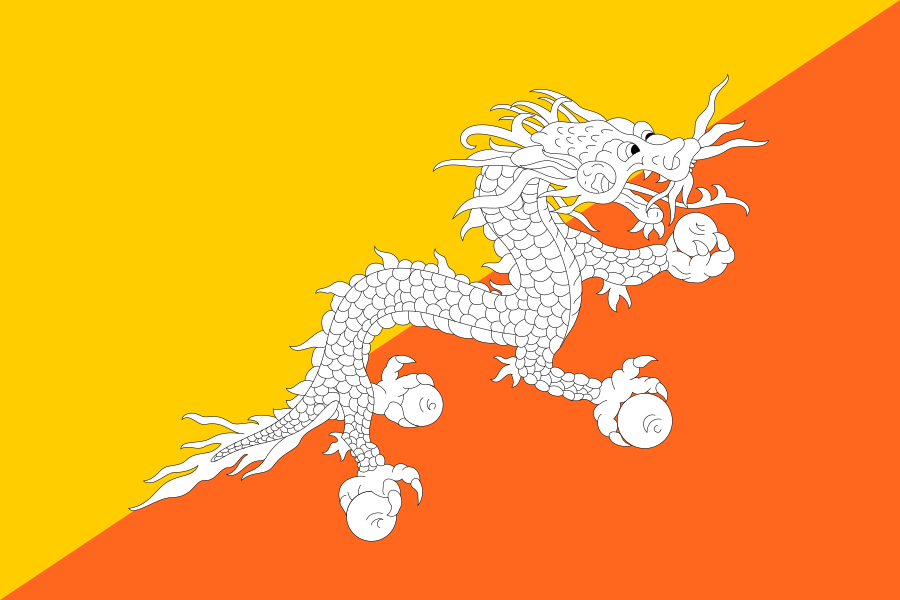
Bhutan's current home colours are orange shirts with yellow trim and a yellow dragon motif, orange shorts and orange socks. Their away colours is predominantly white with orange trim on the shirt and shorts and an orange dragon motif. Both their home and away colours are so closely aligned to the national colours and pattern of the Flag of Bhutan that they essentially mirror it. The current manufacturer of the national colours is Nivia.
There are three main themes contained within Bhutan's home colours, all of which have wider symbolism within the nation as outlined in the Constitution of Bhutan. Firstly, the use of orange signifies Mahayana Buddhist spiritual tradition, particularly the Drukpa Kagyu and Nyingma schools. Secondly, the use of yellow in the trim and also as the colour of the dragon motif signifies civil tradition and temporal authority as embodied in the Druk Gyalpo, the Dragon King of Bhutan, whose royal garb traditionally includes a yellow kabney (scarf). though the dragon depicted in the team's colours does not hold the jewels representing wealth that are found on the national flag, though the similar snarling mouth of the dragon symbolizes the Bhutanese deities' commitment to the defense of Bhutan.
The orange theme and that of the dragon motif noted above are carried over into the away colours. Additionally, the predominant white theme mirrors the colour of the dragon on the national flag which signifies the purity of inner thoughts and deeds that unite all the ethnically and linguistically diverse peoples of Bhutan.
Kit history
Home
| pattern_la =_buth14h | pattern_b =_buth14h | pattern_ra =_buth14h | pattern_sh =_stripes_cut_white | leftarm = FCD218 | body = FCD218 | rightarm = FCD218 | shorts = FCD218 | socks = FCD218 | title = 2014 | pattern_la = | pattern_b = _bhutanWCQ18h-01 | pattern_ra = | pattern_sh = | leftarm = FF4E12 | body = FF4E12 | rightarm = FF4E12 | shorts = FF4E12 | socks = FF4E12 | title = 2015–2022 | pattern_la = _BHU2427h | pattern_b = _BHU2427h | pattern_ra = _BHU2427h | pattern_sh = _BHU2427h | leftarm = EA642C | body = DE5E21 | rightarm = EA642C | shorts = F0DE3C | socks = DE5E21 | title = 2023 |
|---|
Away
| pattern_la = _buth14a | pattern_b = _buth14a | pattern_ra = _buth14a | pattern_sh = | leftarm = FFFFFF | body = FFFFFF | rightarm = FFFFFF | shorts = FFFFFF | socks = FFFFFF | title = 2014 | pattern_la = | pattern_b = _bhutanWCQ18a-01 | pattern_ra = | pattern_sh = _bhutanWCQ18a-01 | leftarm = FFFFFF | body = FFFFFF | rightarm = FFFFFF | shorts = FFFFFF | socks = FFFFFF | title = 2015–2022 | pattern_la = _BHU2427a | pattern_b = _BHU2427a | pattern_ra = _BHU2427a | pattern_sh = _BHU2427a | leftarm = DEDEDE | body = C2C2C2 | rightarm = DEDEDE | shorts = 005E7C | socks = C2C2C2 | title = 2023 |
|---|
Goalkeeper Kit
| pattern_la = | pattern_b =_BHUGK2427h | pattern_ra = | pattern_sh = | leftarm = C2004A | body = 7C7C88 | rightarm = 7C7C8h,lyy8 | shorts = 7C7C88 | title = Home 2023 | pattern_la = | pattern_b = _BHUGK2427a | pattern_ra = | pattern_sh = | leftarm = 9AC2DE | body = 96C23C | rightarm = 96C23C | shorts = 96C23C | socks = 9AC2DE | title = Away 2023 |
|---|
Logo
The logo of the national team is identical to that used for its governing body, the Bhutan Football Federation. It consists of a football surrounded by two concentric circles, one yellow, one orange, representing the Dragon King of Bhutan and the Buddhist tradition in the country, overlaid on a Himalayan blue poppy (Meconopsis horridula), the national flower of Bhutan. Below this is a wish-fulfilling jewel, similar to that located at the top of the official Emblem of Bhutan.
Home stadium
Main article: Changlimithang Stadium

Changlimithang Stadium is a multi-purpose stadium in Thimphu, Bhutan, which serves as the National Stadium. The stadium can holds a capacity of 15,000. It is predominantly used for football matches and is the home of both the Bhutan national football team and a number of Thimphu-based football clubs who play in both the A-Division and the National League. In addition to football, the stadium also regularly plays host to major archery tournaments, the national sport of Bhutan. The stadium was initially constructed in 1974 for the coronation of the fourth Druk Gyalpo, Jigme Singye Wangchuck, but was completely refurbished in 2007 in advance of the coronation of the fifth Druk Gyalpo, Jigme Khesar Namgyel Wangchuck. Floodlighting was added to the football pitch in 2009 and an artificial pitch was laid in 2012 to coincide with the start of the first season of the National League. Unusually for a national stadium, and as a result of the conversion of the playing surface to artificial turf, the football field at Changlimithang is available for public hire and is extremely popular with people in Thimphu.
Results and fixtures
Main article: Bhutan national football team results
The following is a list of match results in the last 12 months, as well as any future matches that have been scheduled.
2025
- Hamza
- Sohel
- Nazirrudin
- Chetrim
- Tshering
- Shour
- Ayoub
- Fakhro
- Chakroun
- Safwan
- Farran
- V. P. Singh
- Ali
- Williams
- Yumnam
- Yadwad
- Jamtsho
- Al-Zubaidi
- Al-Gahwashi
- Qasem
- Al-Golan
- Wangchuk
2026
Technical staff
| Staff |
|---|
| Technical director |
| Head coach |
| Assistant coach |
| Goalkeeping coach |
| Fitness coach |
| Video analyst |
| Team manager |
Coaching history
| Coach | Dates | P | W | D | L | Win % | KOR | KOR | NED | NED | BHU | JPN | JPN | JPN | BHU | JPN | BHU | GER | BHU | ENG | BHU | KOR Kim Tae-in | JPN Atsushi Nakamura |
|---|
Coached in an interim capacity.
Players
The following players were named in the squad for the 2027 AFC Asian Cup qualification – third round match against Yemen on 25th March 2025.
Caps and goals updated as of 8 September 2024
Recent call-ups
The following players have also been called up to the Bangladesh squad within the last twelve months. INJ Withdrew due to injury
PRE Preliminary squad / standby
RET Retired from the national team
SUS Serving suspension
WD Player withdrew from the squad due to non-injury issue.
Player records
| 2011–present |
|---|
| 5 |
| 14 |
|
| 2002–2008 |
|---|
| 5 |
| 31 |
|
| 2011–2019 |
|---|
| 5 |
| 36 |
|
| 2003–2015 |
|---|
| 5 |
| 4 |
| 14 |
|
| 2002–2003 |
|---|
| 6 |
| 2 |
| 27 |
|
| 2003–2011 |
|---|
| } |
Competitive record
FIFA World Cup
| FIFA World Cup | Qualification | Year | Pld | W | D* | L | F | A | Pld | W | D* | L | F | A | Total | 0 | 0/3 | 0 | 0 | 0 | 0 | 14 | 4 | 0 | 10 | 11 | 62 |
|---|---|---|---|---|---|---|---|---|---|---|---|---|---|---|---|---|---|---|---|---|---|---|---|---|---|---|---|
| Uruguay 1930 to France 1998 | Not a FIFA member | Not a FIFA member | |||||||||||||||||||||||||
| South Korea Japan 2002 to Brazil 2014 | Did not enter | Did not enter | |||||||||||||||||||||||||
| Russia 2018 | Did not qualify | 10 | 2 | 0 | 8 | 8 | 53 | ||||||||||||||||||||
| Qatar 2022 | 2 | 1 | 0 | 1 | 1 | 5 | |||||||||||||||||||||
| Canada Mexico United States 2026 | 2 | 1 | 0 | 1 | 2 | 4 | |||||||||||||||||||||
| Morocco Portugal Spain 2030 | To be determined | To be determined | |||||||||||||||||||||||||
| Saudi Arabia 2034 |
AFC Asian Cup
| AFC Asian Cup | AFC Asian Cup qualification | Year | Pld | W | D* | L | GF | GA | Pld | W | D* | L | GF | GA | Total | 0 | 0 | 0 | 0 | 0 | 0 | 38 | 6 | 3 | 29 | 25 | 178 | ||||||||||||
|---|---|---|---|---|---|---|---|---|---|---|---|---|---|---|---|---|---|---|---|---|---|---|---|---|---|---|---|---|---|---|---|---|---|---|---|---|---|---|---|
| Hong Kong 1956 to UAE 1996 | Did not enter | Did not enter | |||||||||||||||||||||||||||||||||||||
| Lebanon 2000 | Did not qualify | 4 | 0 | 0 | 4 | 2 | 42 | ||||||||||||||||||||||||||||||||
| China 2004 | 8 | 1 | 1 | 6 | 6 | 26 | |||||||||||||||||||||||||||||||||
| Indonesia Malaysia Thailand Vietnam 2007 | |||||||||||||||||||||||||||||||||||||||
| to Australia 2015 | Did not enter | Did not enter | |||||||||||||||||||||||||||||||||||||
| United Arab Emirates 2019* | Did not qualify | 18 | 3 | 1 | 14 | 13 | 93 | ||||||||||||||||||||||||||||||||
| Qatar 2023 | 2 | 1 | 0 | 1 | 1 | 5 | |||||||||||||||||||||||||||||||||
| Saudi Arabia 2027 | 6 | 1 | 1 | 4 | 3 | 12 |
*****: 2019 qualification campaign also included qualifying matches from the Asian section of the 2018 FIFA World Cup qualification. In 2014, a proposal to merge the preliminary qualification rounds of the FIFA World Cup with those of the AFC Asian Cup was ratified by the AFC Competitions Committee. The new qualification structure took place in three stages, with the first two merging with the 2018 FIFA World Cup qualification.
AFC Challenge Cup
| AFC Challenge Cup | AFC Challenge Cup qualification record | Year | Result | Pld | W | D* | L | GF | GA | Pld | W | D* | L | GF | GA | Total | Group stage | 3 | 0 | 1 | 2 | 0 | 3 | 8 | 0 | 1 | 7 | 1 | 24 | |||||||||||||
|---|---|---|---|---|---|---|---|---|---|---|---|---|---|---|---|---|---|---|---|---|---|---|---|---|---|---|---|---|---|---|---|---|---|---|---|---|---|---|---|---|---|---|
| Bangladesh 2006 | Group stage | 3 | 0 | 1 | 2 | 0 | 3 | No qualification stage | ||||||||||||||||||||||||||||||||||
| India 2008 | Did not qualify | 3 | 0 | 1 | 2 | 1 | 6 | |||||||||||||||||||||||||||||||||||
| Sri Lanka 2010 | Did not qualify | 3 | 0 | 0 | 3 | 0 | 13 | |||||||||||||||||||||||||||||||||||
| Nepal 2012 | Did not qualify | 2 | 0 | 0 | 2 | 0 | 5 | |||||||||||||||||||||||||||||||||||
| Maldives 2014 | Did not enter | Did not enter |
SAFF Championship
| SAFF Championship | Year | Result | Pld | W | D* | L | GF | GA | Total | Semi-finals | 28 | 1 | 1 | 26 | 13 | 102 | |||||||
|---|---|---|---|---|---|---|---|---|---|---|---|---|---|---|---|---|---|---|---|---|---|---|---|
| PAK 1993 | Did not enter | ||||||||||||||||||||||
| SRI 1995 | |||||||||||||||||||||||
| NEP 1997 | |||||||||||||||||||||||
| IND 1999 | |||||||||||||||||||||||
| Bangladesh 2003 | Group stage | 3 | 0 | 0 | 3 | 0 | 11 | ||||||||||||||||
| Pakistan 2005 | Group stage | 3 | 0 | 0 | 3 | 1 | 9 | ||||||||||||||||
| Maldives Sri Lanka 2008 | Semi-finals | 4 | 1 | 1 | 2 | 5 | 6 | ||||||||||||||||
| Bangladesh 2009 | Group stage | 3 | 0 | 0 | 3 | 0 | 17 | ||||||||||||||||
| India 2011 | Group stage | 3 | 0 | 0 | 3 | 0 | 16 | ||||||||||||||||
| Nepal 2013 | Group stage | 3 | 0 | 0 | 3 | 4 | 16 | ||||||||||||||||
| India 2015 | Group stage | 3 | 0 | 0 | 3 | 1 | 9 | ||||||||||||||||
| Bangladesh 2018 | Group stage | 3 | 0 | 0 | 3 | 0 | 9 | ||||||||||||||||
| Maldives 2021 | Did not participate | ||||||||||||||||||||||
| India 2023 | Group stage | 3 | 0 | 0 | 3 | 2 | 9 | ||||||||||||||||
| Sri Lanka 2026 | Qualified |
:*Denotes draws includes knockout matches decided on penalty kicks. Red border indicates that the tournament was hosted on home soil. Gold, silver, bronze backgrounds indicates 1st, 2nd and 3rd finishes respectively. Bold text indicates best finish in tournament.
Head-to-head record
:Last match updated: on 18 November 2025.
| Opponent | Played | Won | Drawn | Lost | For | Against | Diff | Win % | Loss % | Official Total | 111 | 10 | 7 | 94 | 58 | 406 | −348 | 9.00% | 84.68% |
|---|---|---|---|---|---|---|---|---|---|---|---|---|---|---|---|---|---|---|---|
| 6 | 1 | 0 | 5 | 4 | 20 | −16 | 17% | 83% | |||||||||||
| 19 | 2 | 2 | 15 | 8 | 43 | −35 | 10,52% | 78,94% | |||||||||||
| 3 | 0 | 2 | 1 | 2 | 3 | −1 | 0% | 33,33% | |||||||||||
| 1 | 0 | 0 | 1 | 0 | 2 | −2 | 0% | 100% | |||||||||||
| 1 | 0 | 0 | 1 | 0 | 6 | −6 | 0% | 100% | |||||||||||
| 2 | 0 | 0 | 2 | 0 | 18 | −18 | 0% | 100% | |||||||||||
| 3 | 2 | 0 | 1 | 7 | 5 | +2 | 66% | 33% | |||||||||||
| 4 | 1 | 0 | 3 | 2 | 12 | −10 | 25% | 75% | |||||||||||
| 6 | 0 | 0 | 6 | 1 | 19 | −18 | 0% | 100% | |||||||||||
| 2 | 0 | 0 | 2 | 0 | 4 | −4 | 0% | 100% | |||||||||||
| 1 | 0 | 0 | 1 | 0 | 20 | −20 | 0% | 100% | |||||||||||
| 1 | 0 | 0 | 1 | 1 | 2 | −1 | 0% | 100% | |||||||||||
| 3 | 0 | 0 | 3 | 1 | 10 | −9 | 0% | 100% | |||||||||||
| 1 | 1 | 0 | 0 | 1 | 0 | +1 | 100% | 0% | |||||||||||
| 1 | 0 | 0 | 1 | 0 | 7 | −7 | 0% | 100% | |||||||||||
| 10 | 0 | 0 | 10 | 8 | 42 | −34 | 0% | 100% | |||||||||||
| 1 | 0 | 1 | 0 | 0 | 0 | 0 | 0% | 0% | |||||||||||
| 1 | 1 | 0 | 0 | 4 | 0 | +4 | 100% | 0% | |||||||||||
| 15 | 0 | 1 | 14 | 7 | 46 | −39 | 0% | 93,33% | |||||||||||
| 2 | 0 | 0 | 2 | 2 | 18 | −16 | 0% | 100% | |||||||||||
| 3 | 0 | 0 | 3 | 1 | 12 | −11 | 0% | 100% | |||||||||||
| 2 | 0 | 0 | 2 | 0 | 12 | −12 | 0% | 100% | |||||||||||
| 2 | 0 | 0 | 2 | 0 | 4 | −4 | 0% | 100% | |||||||||||
| 2 | 0 | 0 | 2 | 0 | 18 | −18 | 0% | 100% | |||||||||||
| 2 | 0 | 0 | 2 | 0 | 10 | −10 | 0% | 100% | |||||||||||
| 8 | 2 | 0 | 6 | 5 | 20 | −15 | 25% | 75% | |||||||||||
| 1 | 0 | 0 | 1 | 1 | 3 | −2 | 0% | 100% | |||||||||||
| 1 | 0 | 0 | 1 | 0 | 5 | −5 | 0% | 100% | |||||||||||
| 2 | 0 | 0 | 2 | 0 | 15 | −15 | 0% | 100% | |||||||||||
| 5 | 0 | 1 | 4 | 3 | 30 | −27 | 0% | 80% |
Unofficial matches
| Opponent | Played | Won | Drawn | Lost | For | Against | Diff | Win % | Loss % | Unofficial Total* | 13 | 1 | 3 | 9 | 7 | 44 | −37 | 0% | 70% |
|---|---|---|---|---|---|---|---|---|---|---|---|---|---|---|---|---|---|---|---|
| 2 | 0 | 0 | 2 | 0 | 6 | −21 | 0% | 100% | |||||||||||
| THA Buriram United | 2 | 0 | 0 | 2 | 0 | 15 | −15 | 0% | 100% | ||||||||||
| CHN Guangzhou Football Team | 1 | 0 | 0 | 1 | 1 | 6 | −5 | 0% | 100% | ||||||||||
| HKG Hong Kong Gurkhas | 1 | 0 | 1 | 0 | ? | ? | ? | 0% | 0% | ||||||||||
| IND India B | 1 | 0 | 0 | 1 | 0 | 3 | −3 | 0% | 100% | ||||||||||
| CHN Kunming Army Team | 1 | 0 | 0 | 1 | 1 | 3 | −2 | 0% | 100% | ||||||||||
| NEP Nepal Red | 1 | 0 | 0 | 1 | 0 | 1 | −1 | 0% | 100% | ||||||||||
| NEP Nepal Youth | 1 | 0 | 1 | 0 | ? | ? | ? | 0% | 0% | ||||||||||
| KOR Soongsil University | 1 | 0 | 0 | 1 | 0 | 6 | −6 | 0% | 100% | ||||||||||
| 2 | 1 | 1 | 0 | 5 | 4 | +1 | 0% | 0% |
NB: Unofficial matches includes ANFA Cup matches against teams other than the official Nepal national team, four friendly matches against Tibet and Bangladesh and two charity matches against Buriram United.
*****: Includes unofficial matches in the 1986 ANFA Cup against Hong Kong Gurkhas and Nepal Youth which sources indicate were drawn but for which no score is available. The results are included here statistically as 0–0 for the purpose of completeness.
Rankings
FIFA

Prior to the victories over Sri Lanka, their highest FIFA ranking achieved was 187th, which they last reached in December 2008 following their semi-final performance in the 2008 SAFF Championship. From that high point, they slipped down the rankings to last place in December 2012 to join San Marino and the Turks and Caicos Islands in 207th. They fell to 208th place following the admission to FIFA of South Sudan in July 2014, and dropped to 209th as the only team without ranking points following San Marino's draw with Estonia. However, Bhutan rose to 163rd on the FIFA rankings after two victories over Sri Lanka in World Cup qualifying, achieving their highest ranking ever in April 2015. They then rose to 156th in June 2015. However, following their performance in the second round of world cup qualifying in which they have failed to win a game, they slipped back to 193rd as of February, but have since risen to 185th as of November 2017.
Elo ratings

The team is also ranked extremely low on the all time Elo ratings at 227th out of 234 as of December 2017. There is one FIFA affiliated team ranked below them, American Samoa. Their initial comparatively high position in the 1980s was more to do with the number of nations competing globally at the time than their specific performances. Since they have started competing with a degree of regularity on the continental scene, Bhutan have always hovered at or near the bottom of the ratings. Their high point in the 21st century was 218th as a result of their performance at the 2008 SAFF Championship.
Honours
Friendly
- The Other Final (1): 2002
Awards
- SAFF Championship Fair Play Award (2): 2005, 2018
References
Notes
Citations
References
- "A look at football in Bhutan". RA Online / Kuensel.
- McKay, Alex. (2005). "Subaltern Sports: Politics and Sport in South Asia". Wimbledon Publishing Company.
- McKay, Alex. (2005). "Subaltern Sports: Politics and Sport in South Asia". Wimbledon Publishing Company.
- (25 April 2015). "The 'Black Horse' of Bhutanese football". [[Kuensel]].
- [[Paul Mitchell (broadcaster). "The first international football match". [[bbc.co.uk]].
- "World Football Elo Ratings: Bhutan". World Football Elo Ratings and Advanced Satellite Consulting.
- Achariya, Gopilal. (16 December 2002). "The sports scene in Bhutan: what is wrong?". [[Kuensel]].
- (13 January 2011). "ANFA Invitational Tournament (Nepal)". [[Rec.Sport.Soccer Statistics Foundation]].
- (6 November 2009). "1st South Asian Federation Games 1984". [[Rec.Sport.Soccer Statistics Foundation]].
- Garin, Erik. (3 October 2002). "2nd South Asian Federation Games 1985 (Dhaka, Bangladesh)". [[Rec.Sport.Soccer Statistics Foundation]].
- (16 December 2010). "3rd South Asian Federation Games 1987 (Calcutta, India)". [[Rec.Sport.Soccer Statistics Foundation]].
- (28 May 2014). "Bhutan – List of Champions". [[Rec.Sport.Soccer Statistics Foundation]].
- "A Look at Football in Bhutan". RA Online / Kuensel.
- Gautam, Biplav. (21 April 2002). "8th South Asian Federation Games 1999 (Kathmandu, Nepal)". [[Rec.Sport.Soccer Statistics Foundation]].
- (3 May 2003). "Editorial: Football, maturing". Kuensel Online.
- (4 March 2011). "Asian Nations Cup 2000". [[Rec.Sport.Soccer Statistics Foundation]].
- (16 February 2000). "Japan star claims fastest hat-trick". [[BBC]].
- (2005). "Football The Ultimate Guide: Updated 2010 Edition". [[Dorling Kindersley]].
- "Bhutan Club Directory". [[Bhutan Football Federation]].
- (January 2002). "FIFA/Coca-Cola World Ranking". [[FIFA]].
- Nesselson, Lisa. (26 August 2003). "Review: 'The Other Final'". [[Penske Business Media]].
- Wangdi, Kencho. (17 June 2002). "Bhutan prepares to meet Montserrat". Kuensel Online.
- Wangdi, Kencho. (27 June 2002). "Anxious wait for the "other final" over". Kuensel Online.
- Wangdi, Kencho. (28 June 2002). "World Cup 2002: The other final – Bhutan met Montserrat". RA Online / Kuensel.
- Wangdi, Kencho. (5 July 2002). "Football in Bhutan: what next?". Kuensel Online.
- (2 October 2005). "South Asian Gold Cup 2003 (Dhaka, Bangladesh)". [[Rec.Sport.Soccer Statistics Foundation]].
- (2 October 2005). "Asian Nations Cup 2004". [[Rec.Sport.Soccer Statistics Foundation]].
- (6 March 2008). "South Asian Gold Cup 2005 (Karachi, Pakistan)". [[Rec.Sport.Soccer Statistics Foundation]].
- Hai Naveed, Malik Riaz. (3 April 2009). "AFC Challenge Cup 2006 (Bangladesh)". [[Rec.Sport.Soccer Statistics Foundation]].
- King, Ian. (3 April 2009). "AFC Challenge Cup 2008". [[Rec.Sport.Soccer Statistics Foundation]].
- Hai Naveed, Malik Riaz. (11 December 2009). "South Asian Gold Cup 2008 (Colombo and Malé)". [[Rec.Sport.Soccer Statistics Foundation]].
- King, Ian. (12 December 2013). "AFC Challenge Cup 2010". [[Rec.Sport.Soccer Statistics Foundation]].
- (2 May 2013). "South Asian Gold Cup 2009 (Dhaka)". [[Rec.Sport.Soccer Statistics Foundation]].
- "AFC Challenge Cup 2012 (Qualifiers) Competition Regulations". [[Asian Football Confederation]].
- "Bhutan vs Afghanistan – 2012 AFC Challenge Cup qualification". [[Asian Football Confederation]].
- "Afghanistan vs Bhutan – 2012 AFC Challenge Cup qualification". [[Asian Football Confederation]].
- Di Maggio, Roberto. (12 December 2013). "AFC Challenge Cup 2012". [[Rec.Sport.Soccer Statistics Foundation]].
- Courtney, Barrie. (19 September 2013). "South Asian Gold Cup 2011 (New Delhi)". [[Rec.Sport.Soccer Statistics Foundation]].
- (14 November 2012). "Thailand vs Bhutan – Lineup".
- Stokkermans, Karel. (19 September 2013). "South Asian Championship 2013 (Kathmandu)". [[Rec.Sport.Soccer Statistics Foundation]].
- Penjore, Ugyen. (11 October 2013). "It doesn't pay to play for the national squad". Kuensel Online.
- Tshedup, Younten. (31 January 2015). "18-man national squad selected". Kuensel Online.
- (13 March 2015). ""World's worst" Bhutan enjoys dream World Cup debut". Arab News.
- . (12 March 2015). ["World's worst team Bhutan kick off 2018 World Cup qualifying with victory"](https://www.theguardian.com/football/2015/mar/12/bhutan-win-world-cup-qualifier-2018). *[[Guardian Media Group]]*.
- (16 March 2015). ""World's worst team" Bhutan aim to make history against Sri Lanka". [[Guardian Media Group]].
- (19 March 2015). "Bhutan, Bhutan – football chanted like a prayer as World Cup success grips nation". [[Guardian Media Group]].
- . (17 March 2015). ["Match Report: Bhutan v Sri Lanka – AFC first round"](https://www.fifa.com/worldcup/matches/round=275167/match=300311254/report.html). *[[FIFA]]*.
- (13 April 2015). "World Cup draw looms large in Asia". FIFA.com.
- . (11 June 2015). ["Hong Kong v Bhutan – AFC second round: Group C"](https://www.fifa.com/worldcup/matches/round=275171/match=300317431/index.html#nosticky). *[[FIFA]]*.
- . (16 June 2015). ["Bhutan v China – AFC second round: Group C"](https://www.fifa.com/worldcup/matches/round=275171/match=300317410/index.html). *[[FIFA]]*.
- . (3 September 2015). ["Qatar v Bhutan – AFC second round: Group C"](https://www.fifa.com/worldcup/matches/round=275171/match=300317432/index.html). *[[FIFA]]*.
- . (8 October 2015). ["Bhutan v Maldives – AFC second round: Group C"](https://www.fifa.com/worldcup/matches/round=275171/match=300317421/index.html). *[[FIFA]]*.
- (9 February 2016). "Football still dominates sporting realm". [[Kuensel]].
- . (13 October 2015). ["Bhutan v Hong Kong – AFC second round: Group C"](https://www.fifa.com/worldcup/matches/round=275171/match=300317407/index.html). *[[FIFA]]*.
- "Bhutanese coach to lead the national team in China". [[Kuensel]].
- . (17 November 2015). ["China v Bhutan – AFC second round: Group C"](https://www.fifa.com/worldcup/matches/round=275171/match=300317411/index.html). *[[FIFA]]*.
- . (17 November 2015). ["Bhutan v Qatar – AFC second round: Group C"](https://www.fifa.com/worldcup/matches/round=275171/match=300317413/index.html). *[[FIFA]]*.
- . (24 December 2016). ["Maldives 3–1 Bhutan"](http://www.saffsuzukicup.com/news/match-report-maldives-3-1-bhutan). *[[South Asian Football Federation]]*.
- . (26 December 2016). ["Bhutan 0–3 Afghanistan"](http://www.saffsuzukicup.com/news/report-bhutan-0-3-afghanistan). *[[South Asian Football Federation]]*.
- . (26 December 2016). ["Bhutan 0–3 Bangladesh"](http://www.saffsuzukicup.com/news/match-report-bhutan-0-3-bangladesh). *[[South Asian Football Federation]]*.
- . (24 March 2016). ["Weslley Scores as Buriram Beat Bhutan 6–0 in Friendly"](http://footballchannel.asia/2016/03/24/post10158/). *Kanzen Ltd*.
- . (24 March 2016). ["Weslley Scored a Hat-Trick, Buriram Wins 9–0 Against Bhutan"](http://footballchannel.asia/2016/03/24/post10158/). *Kanzen Ltd*.
- . (29 March 2016). ["Maldives v Bhutan – AFC second round: Group C"](https://www.fifa.com/worldcup/matches/round=275171/match=300317420/index.html). *[[FIFA]]*.
- (28 November 2014). "AFC Competitions Committee Meeting". [[Asian Football Confederation]].
- "AFC Calendar of Competitions 2016 – 2018". AFC.
- (17 March 2016). "AFC confirms raft of crucial draw dates". AFC.
- "Stage set for UAE 2019 Qualifiers Play-off draw {{!}} AFC".
- "Bangladesh v Bhutan – 2019 AFC Asian Cup qualification – Play-off Round". [[Asian Football Confederation]].
- "Bhutan advance to AFC Asian Cup 2019 Final Qualifying Round".
- (23 January 2017). "Draw for final round of AFC Asian Cup UAE 2019 qualifiers concluded". AFC.
- (20 October 2016). "Кубок Азии-2019: сборная Таджикистана узнает своих соперников по отбору 18 января". Tajikistan Football Federation.
- (10 October 2017). "AFC ASIAN CUP 2019 QUALIFIERS – GROUP D: PALESTINE 10–0 BHUTAN". AFC.
- "Asian Qualifiers: Bhutan 1-0 Guam {{!}} Football News {{!}} FIFA World Cup 2022".
- (11 June 2019). "2nd Leg: Guam 5-0 Bhutan".
- (18 July 2008). "The Constitution of the Kingdom of Bhutan". constitution.bt.
- (1991). "Nepal and Bhutan: Country Studies". Federal Research Division, [[United States Library of Congress]].
- "First Schedule – The National Flag and the National Emblem of Bhutan". Constitution of the Kingdom of Bhutan.
- . ["National Flower"](http://www.tourism.gov.bt/about-bhutan/national-flower). *Tourism Council of Bhutan*.
- (9 June 2008). "K2: Changlimithang ground". Kuensel Online.
- Dorji, Kinley. (2006). "Thimphu: A face-lift for Changlimithang". RA Online / Kuensel.
- "Floodlighting at Changlimithang". Druk Green.
- Phuntsho, Tashi. (13 December 2013). "To open artificial turf". Kuensel Online.
- Norbu, Passang. (12 April 2013). "New enthusiasm for an old sport". Kuensel Online.
- (16 January 2025). "𝙋𝙧𝙚𝙨𝙚𝙣𝙩𝙞𝙣𝙜 𝙩𝙝𝙚 𝘿𝙧𝙖𝙜𝙤𝙣 𝘽𝙤𝙮𝙨 𝙬𝙝𝙤 𝙬𝙞𝙡𝙡 𝙥𝙧𝙤𝙪𝙙𝙡𝙮 𝙧𝙚𝙥𝙧𝙚𝙨𝙚𝙣𝙩 𝘽𝙝𝙪𝙩𝙖𝙣 𝙞𝙣 𝙩𝙝𝙚 𝙪𝙥𝙘𝙤𝙢𝙞𝙣𝙜 𝘼𝙁𝘾 𝘼𝙨𝙞𝙖𝙣 𝘾𝙪𝙥 𝙌𝙪𝙖𝙡𝙞𝙛𝙞𝙘𝙖𝙩𝙞𝙤𝙣 𝙏𝙝𝙞𝙧𝙙 𝙍𝙤𝙪𝙣𝙙!". Bhutan Football Federation.
- "Bhutan".
- (16 April 2014). "ExCo approves expanded AFC Asian Cup finals". AFC.
- (17 July 2014). "Bhutan – Ranking". [[FIFA]].
- (27 November 2014). "Latest FIFA Rankings November 2014 – San Marino's Delight". Worst in the World.
- . (3 April 2015). ["FIFA Ranking: April 2015 final preview"](http://www.football-rankings.info/2015/04/fifa-ranking-april-2015-final-preview.html).
- . (29 May 2015). ["FIFA Ranking: June 2015 final preview"](http://www.football-rankings.info/2015/05/fifa-ranking-june-2015-final-preview.html).
- . (29 May 2015). ["FIFA Ranking: February 2016 probable ranking"](http://www.football-rankings.info/2016/01/fifa-ranking-february-2016-probable_8.html).
- . (7 April 2016). ["Bhutan – Men's Ranking"](https://www.fifa.com/fifa-world-ranking/associations/association=bhu/men/). *[[FIFA]]*.
- (2 June 2014). "World Football Elo Ratings". World Football Elo Ratings web site and Advanced Satellite Consulting.
This article was imported from Wikipedia and is available under the Creative Commons Attribution-ShareAlike 4.0 License. Content has been adapted to SurfDoc format. Original contributors can be found on the article history page.
Ask Mako anything about Bhutan national football team — get instant answers, deeper analysis, and related topics.
Research with MakoFree with your Surf account
Create a free account to save articles, ask Mako questions, and organize your research.
Sign up freeThis content may have been generated or modified by AI. CloudSurf Software LLC is not responsible for the accuracy, completeness, or reliability of AI-generated content. Always verify important information from primary sources.
Report