From Surf Wiki (app.surf) — the open knowledge base
Bharatanatyam
Major form of Indian classical dance
.jpg)
Major form of Indian classical dance
| Field | Value |
|---|---|
| name | Bharatanatyam |
| image | Murugashankari Leo.jpg |
| genre | Indian classical dance |
| origin | Tamil Nadu, India |
Bharatanatyam is an Indian classical dance form that comes from Tamil Nadu, India. It is a classical dance form recognized by the Sangeet Natak Akademi, and expresses South Indian religious themes and spiritual ideas, particularly of Shaivism and in general of Hinduism.
A description of precursors of Bharatanatyam from the Natya Shastra date from around 500 BCE–500 CE and those in the ancient Tamil epic Silappatikaram date to around 171 CE. Temple sculptures of the 6th to 9th century CE suggest dance was a refined performance art by the mid-1st millennium CE. Sadiraattam, which was renamed Bharatanatyam in 1932, is the oldest classical dance tradition in India.
Bharatanatyam contains different types of bani. Bani, or "tradition", is a term used to describe the dance technique and style specific to a guru or school, often named for the village of the guru. Bharatanatyam style is noted for its fixed upper torso, bent legs, and flexed knees (Aramandi) combined with footwork, and a vocabulary of sign language based on gestures of hands, eyes, and face muscles. The dance is accompanied by music and a singer, and typically the dancer's guru is present as the nattuvanar or director-conductor of the performance and art. The performance repertoire of Bharatanatyam, like other classical dances, includes nrita (pure dance), nritya (Conveys a meaning to the audience through hand gestures) and natya (Consists of the elements of drama). A program of bharatanatyam usually lasts two hours without interruption and includes a specific list of procedures, all performed by one dancer, who does not leave the stage or change costume. The accompanying orchestra—composed of drums, drone, and singer—occupies the back of the stage, led by the guru, or the teacher, of the dancer.
Sadiraattam remained exclusive to Tamil Hindu temples through the 19th century. It was banned by the colonial British government in 1910, Modern stage productions of Bharatanatyam have become popular throughout India and include performances that are purely dance-based on non-religious ideas and fusion themes. The Thanjavur Quartet developed the basic structure of modern Bharatanatyam by formalizing it.
Etymology
The word Bharatam is seen as a backronym, with bha standing for bhavam (feelings, emotions), ra for ragam (melody, framework for musical notes), and tam for talam (rhythm). The term Natyam is a Sanskrit word for "dance". The compound word Bharatanatyam therefore is understood to connote a dance that harmoniously expresses bhavam, ragam and talam. Other interpretations suggest that the name literally translates as "the dance of Bharata", from Bharata, who is reputed to be the author of the Natya Shastra, a Sanskrit text of performance arts.
In 1932, E Krishna Iyer and Rukmini Devi Arundale proposed renaming Sadiraattam (), also known as Parathaiyar Aattam or Thevarattam, as Bharatanatyam to give the dance form a measure of respect, at a meeting of the Madras Music Academy. They also were instrumental in modifying mainly the Pandanallur style of dance.
History

The theoretical foundations of dance Bharatanatyam are found first in Natya Shastra and later in a Tamil text called Kootha nool taken from Tholkappiyam (250 BCE).
The Natya Shastra, attributed to the ancient scholar Bharata, and its first complete compilation is dated to between 500 BCE and 200 CE, but estimates vary between 500 BCE and 500 CE. Richmond et al. estimate the Natasutras to have been composed around 600 BCE. The most studied version of the Natya Shastra text consists of about 6000 verses structured into 36 chapters. The text, states Natalia Lidova, describes the theory of Tāṇḍava dance (Shiva), the theory of rasa, of bhāva, expression, gestures, acting techniques, basic steps, standing postures—all of which are part of Indian classical dances. Dance and performance arts, states this text, are a form of expression of spiritual ideas, virtues and the essence of scriptures.
Historical references to dance are found in the Tamil epics Silappatikaram (c. 2nd century CE) and Manimegalai (c. 6th century). The ancient text Silappatikaram, includes a story of a dancing girl named Madhavi; it describes the dance training regimen called Arangatrau Kathai of Madhavi in verses 113 through 159. The carvings in Kanchipuram's Shiva temple that have been dated to 6th to 9th century CE suggest dance was a well-developed performance art by about the mid 1st millennium CE.
A famous example of illustrative sculpture is in the southern gateway of the Chidambaram temple (≈12th century) dedicated to the Hindu god Shiva, where 108 poses, described as karanas in the Natya Shastra, are carved in stone.
Bharatanatyam shares the dance poses of many ancient Shiva sculptures in Hindu temples. The image, 5 ft tall, has 18 arms in a form that expresses the dance positions arranged in a geometric pattern. The arms of Shiva express mudras (symbolic hand gestures), that are used in Bharatanatyam. The early 12th century ancient Sanskrit text Manasollasa discusses about the dancing movements like Natya, Tandava, Lasya, Laghu, Visama and Vikata, This discussion is similar to the content found in Natya Shastra.
Devadasis, anti-dance movement, colonial ban, and the decline
Some colonial Indologists and modern authors have argued that Bharatanatyam is a descendant of an ancient :o Devadasi () culture, suggesting a historical origin back to between 300 BCE and 300 CE. According to James Lochtefeld, classical dance remained exclusive to Hindu temples through the 19th century, only in the 20th century appearing on stage outside the temples. Further, the Thanjavur Maratha kingdom patronized classical dance.

With the arrival of the East India Company in the 18th century, and British colonial rule in the 19th, classical Indian dance forms were ridiculed and discouraged, and these performance arts declined. Christian missionaries and British officials presented "nautch girls" of north India (Kathak) and "devadasis" of south India (Bharatanatyam) as evidence of "harlots, debased erotic culture, slavery to idols and priests" tradition, and Christian missionaries demanded that this must be stopped, launching the "anti-dance movement" in 1892. The anti-dance camp accused the dance form as a front for prostitution, while revivalists questioned the constructed colonial histories.
In 1910, the Madras Presidency of the British Empire banned temple dancing, and with it the classical dance tradition in Hindu temples.
The banning of temple dancing stemmed from the 1892 anti-dance movement and new, liberal colonial perspectives. What the English imagined nineteenth-century modernity to be did not include what they regarded Bharatanatyam to be, which they regarded as indecent. Coming from a deep orientalist perspective, the morality of people who performed Bharatanatyam was called into question. Accusations of prostitution were thrown around. Some women from traditionally performing communities were used as a way to showcase obscenity. New reforms disregarded local issues like production of the arts for the sake of liberalism and felt able to impose disruptive reforms that reshaped lives at all levels and subjected people to new standards. Colonial reforms were largely unsympathetic to local traditions, and dismissive of the industry surrounding producing art. The adoption of Anglo-Indian laws that imposed certain restrictions and regulations on certain expressions of sexuality, and more so regulations on bodies and sex in general, which in turn affected traditional dance practices. Temple dancing became caught in a web of multiple political agendas, hoping to bend this burgeoning morality issue to suit their cause. Colonial denunciations of the practice of temple dancing were caught up in liberal ideals of bringing modernity to India, where modernity was tied to Anglo-Protestant moral ideas about how bodies are viewed and how sexuality was presented.
Post-colonial revival
The 1910 ban triggered protests against the stereotyping and dehumanization of temple dancers. Iyer was arrested and sentenced to prison on charges of nationalism, who while serving out his prison term persuaded his fellow political prisoners to support Bharatanatyam.
While the British colonial government enforced laws to suppress Hindu temple dances, some from the West, such as the American dancer Esther Sherman moved to India in 1930, learned Indian classical dances, changed her name to Ragini Devi, and joined the movement to revive Bharatanatyam and other ancient dance arts.
The Indian independence movement in the early 20th century, already in progress, became a period of cultural foment and initiated an effort by its people to reclaim their culture and rediscover history. In this period of cultural and political turmoil, Bharatanatyam was revived as a mainstream dance outside of Hindu temples by artists such as Rukmini Devi Arundale, Balasaraswati and Yamini Krishnamurti They championed and performed the Pandanallur style and Thanjavur styles of Bharatanatyam.
Nationalist movements that brought revitalizing devadasis up as an issue to focus on viewed it as a way to critique the imposition of colonial morality on India. However, the revival movement was not without Western influence. Nationalist movements that also focused on devadasis revival were influenced by Western ideas of democratization of arts. Part of the revival movement was making the opportunity to dance open to more people. Nationalist movements that focused on revival were also influenced by Western ideology through their propagation that part of the revival movement is a reassertion of traditional values, as well as a moment to remind people of the country's cultural heritage and reestablish a sense of identity. Fighting for freedom from the British and fighting for civil liberties included debates about morality, and how gender impacts morality. The revival movement moralized devadasis by democratizing the art, while also decorating it with the female performing class. Figures like Rukmini Devi Arundale, who are credited with revitalizing Bharatanatyam, also shifted the practice to appeal to middle to upper-class women. Rukmini Devi Arundale is credited with helping develop the Kalakshetra style of Bharatanatyam. There was an emphasis on building a modern India through Indian nationalism, which tied in with protecting traditional artistic traditions. The decommercialization and sanitation of Bharatanatyam for the sake of protecting the spirit of the art is part of Bharatanatyam's revival. Bharatanatyam's successful revival meant that it was regarded as a classical dance tradition specific to India, as opposed to a cultural dance that had been changed by colonial censorship. It was becoming a modern nation to have a traditional dance that was practiced recreationally and was nationally recognized. With the standardization of Bharatanatyam, there came books based on historic texts, like Natya Shastra, which described the different movements. Evidence of a successful revival movement of Bharatanatyam through Indian Nationalist movements was the introduction of state-sponsored dance festivals in 1955 in an independent India. These festivals were put on to display art with religious, social, and cultural connotations that have some regional diversity on a common national platform.
In the late 20th century, Tamil Hindu migrants reintroduced the traditions of temple dancing in British Tamil temples.
Elements

Bharatanatyam is traditionally a team performance art that consists of a solo dancer, accompanied by musicians and one or more singers. It is described as classical art because the theory of musical notes, vocal performance, and the dance movement reflect ideas of the Sanskrit treatise Natya Shastra and other Sanskrit and Tamil texts, such as the Abhinaya Darpana.
The solo artist (ekaharya) in Bharatanatyam is dressed in a colorful sari, adorned with jewelry and presents a dance and it is synchronized with Indian classical music. The hand and facial gestures are a coded sign language able to recite legends and spiritual ideas from the Mahabharata, the Ramayana, the Puranas and historic drama texts. The dancer deploys turns or specific body movements to mark punctuations in the story or the entry of a different character in the play or legend being acted out through dance. Abhinaya is the art of expression in Indian aesthetics; footwork, body language, postures, musical notes, the tones of the vocalist, aesthetics and costumes integrate to express and communicate the underlying text.
In modern adaptations, Bharatanatyam dance troupes may involve many dancers who play specific characters in a story, creatively choreographed to ease the interpretation and expand the experience by the audience.
The repertoire of Bharatanatyam, like all major classical Indian dance forms, follows the three categories of performance in the Natya Shastra. These are Nritta (Nirutham), Nritya (Niruthiyam) and Natya (Natyam).
Bharata Natyam is an art which consecrates the body (...) the dancer, who dissolves her identity in rhythm and music, makes her body an instrument, at least for the duration of the dance, for the experience and expression of the spirit. The traditional order of Bharata Natyam recital viz. alarippu, jatiswaram, kauthuvam, varnam, padams, ashtapadi,tillana and the shloka is the correct sequence in the practice of this art, which is an artistic Yoga, for revealing the spiritual through the corporeal.
- The Nritta performance is an abstract, fast, and rhythmic aspect of the dance.
- The Nritya is a slower and more expressive aspect of the dance that attempts to communicate feelings, and storyline, particularly with spiritual themes in Hindu dance traditions. In a nritya, the dance-acting expands to include silent expression of words through gestures and body motion set to musical notes. The actor articulates a legend or a spiritual message. This part of a Bharatanatyam repertoire is more than sensory enjoyment, it aims to engage the emotions and mind of the viewer.
- The Natyam is a play, typically a team performance, but can be acted out by a solo performer where the dancer uses certain standardized body movements to indicate a new character in the underlying story. A Natya incorporates the elements of a Nritya.
Arangetram

A Bharatanatyam arangetram is a solo debut performance that signifies the completion of initial formal training of a young dancer, female or male in Indian classical dance. The term Arangetram translates to "ascending the stage". This performance is typically done ten to twelve years after a dancer begins learning Bharatanatyam. Still, more importantly, it is done when the guru believes the student is ready for a solo performance. This solo debut is synonymous with a "coming-of-age" celebration. The arangetram is a culmination of multiple years of hard work by the student and the guru, and it is an opportunity for the dancer to showcase their dedication and skills developed over the years. Throughout this debut, the dancer performs a series of dances. The dancer must build up their concentration and stamina to perform solo dances for approximately three hours. Each dance performed symbolizes various aspects of Hindu religion.
Sequence of dances

A traditional Bharatanatyam arangetram dance performance follows a seven to eight-part order of presentation. This set is called Margam.
Pushpanjali
The Arangetram performance typically begins with a dance called the Pushpanjali, which translates to "offering of flowers". In this dance, the performer offers flowers and salutations to the Hindu deities, the guru, and the audience as a mark of respect. The beginning of the dance symbolizes supplication, from which the dancer then commences the rest of the performance.
Alarippu
The presentation can also begin with a rhythmic invocation (vandana) called the Alarippu. It is a pure dance, which combines a thank you and benediction for blessings from the gods and goddesses, the guru and the gathered performance team. It also serves as a preliminary warm-up dance, without melody, to enable the dancer to loosen their body, and journey away from distractions and towards single-minded focus.
Jatiswaram
The next stage of the performance adds melody to the movement of Alarippu, and this is called Jatiswaram. The dance remains a prelim technical performance (nritta), pure in form and without any expressed words. The drums set the beat, of any Carnatic music raga (melody). They perform a sequence (Korvai) to the rhythm of the beat, presenting to the audience the unity of music, rhythm and movements.
Shabdam
The performance sequence then adds Shabdam (expressed words). This is the first item of Margam where expressions are introduced. The solo dancer, the vocalist(s), and the musical team, in this stage of the production, present short compositions, with words and meaning, in a spectrum of moods.
Varnam[[File:Rajasree warrier IMG 7539.JPG|thumb|180px|The Varnam part of Bharatanatyam emphasizes expressive dance.]]
The performance thereafter evolves into the Varnam stage. This marks the arrival into the sanctum sanctorum core of the performance. as the musicians envelop them with musical notes and tones that set the appropriate mood.
Padam
The Padam is next. This is the stage of reverence, of simplicity, of abhinaya (expression) of the solemn spiritual message or devotional religious prayer (bhakti). The music is lighter, the chant intimate, the dance emotional. The choreography attempts to express rasa (emotional taste) and a mood, while the recital may include items such as a keertanam (expressing devotion), a javali (expressing divine love) or something else.
Tillana
The performance sequence ends with a Tillana, the climax. It closes out the nritya portion, the movements exit the temple of expressive dance, returning to the nritta style, where a series of pure movement and music are rhythmically performed. Therewith the performance ends. "The Guru (teacher) is the Brahma, the Guru is the Vishnu, the Guru is the Maheshvara (Shiva). The Guru is the pathway to Supreme Brahman (supreme soul), to you the auspicious, I reverentially bow." Original: गुरुर्ब्रह्मा गुरुर्विष्णुर्गुरुर्देवो महेश्वरः । गुरुरेव परं ब्रह्म तस्मै श्रीगुरवे नमः ।।}}
Shlokam or Mangalam
The seventh and final item in the sequence can be either a Shlokam or a Mangalam. The dancer calls for blessings on the people all around.
The overall sequence of Bharatanatyam, states Balasaraswati, thus moves from "mere meter; then melody and meter; continuing with music, meaning and meter; its expansion in the centerpiece of the varnam; thereafter, music and meaning without meter; (...) a non-metrical song at the end. We see a most wonderful completeness and symmetry in this art".
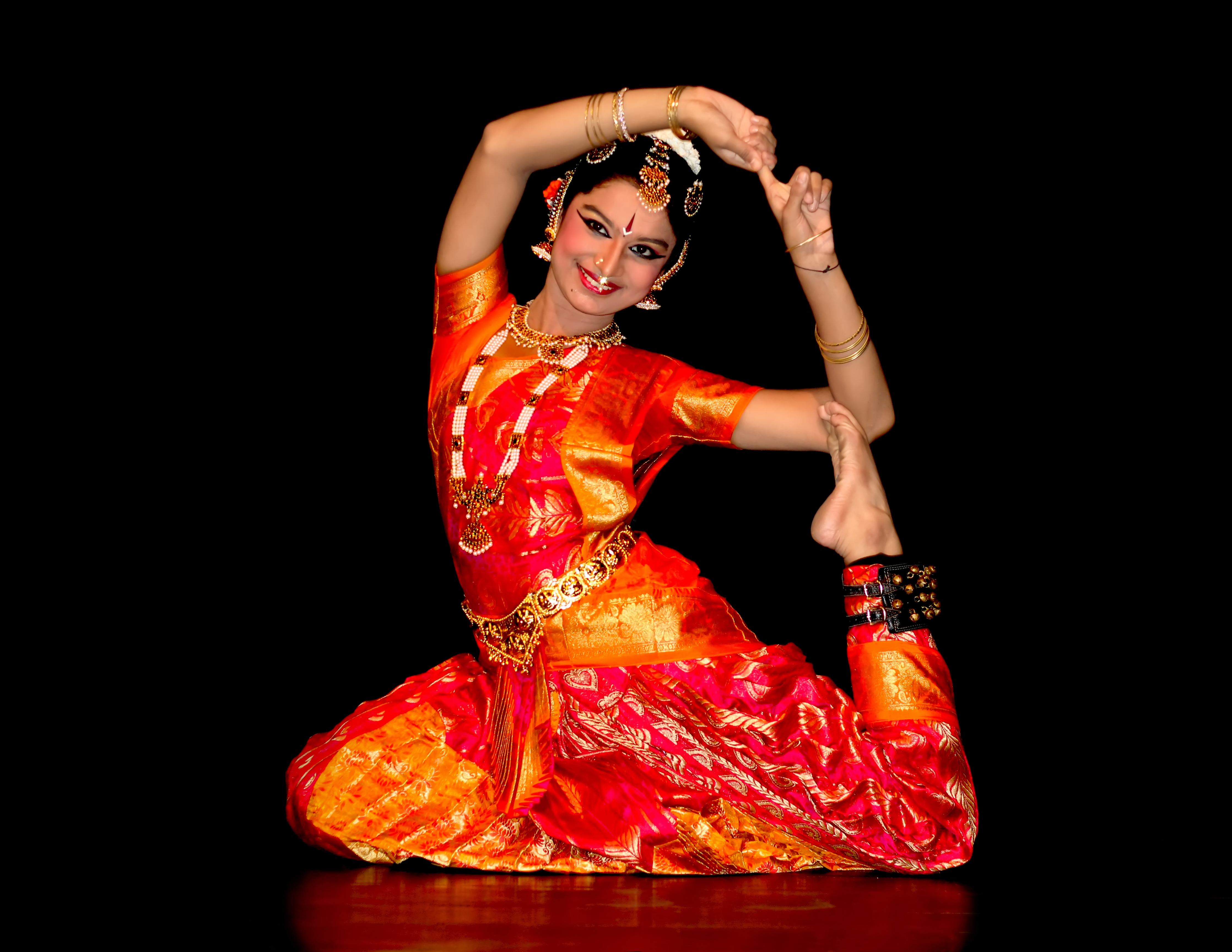
Costume and attire
The costume of a female Bharatanatyam dancer resembles a Tamil Hindu bridal dress. It typically consists of a sari in bright colors with golden or silver zari embroidery on the borders. The costume can be stitched from the sari, with individual pieces for a bottom (either a skirt or salwar-shaped pants), a pleated piece which falls in front and opens like a hand fan when the dancer flexes her knees or performs footwork, a hip piece that covers the seat of the pant/skirt, and a torso piece that looks like an aanchal (i.e. the draped part of a regular sari). Some dancers also opt for an unstitched sari that is draped specially, with the single piece of cloth starting around the legs like a dhoti, then upwards along the front torso, over the left shoulder, and then down the back with its end held at the waist by a jeweled belt. The costume of a male Bharatanatyam dancer is usually either a sari or a white cotton cloth draped around the legs and bottom half of the body like a dhoti. During performances, the upper body of the male dancer remains bare. Male dancers typically do not wear stitched costumes.
Both female and male dancers wear elaborate jewelry on their ears, nose, neck, and wrists. Female dancers wear additional jewelry on their heads that emphasizes their hairline and parting. They also wear a smaller piece of jewelry on each side of their parting. These represent the sun and the moon.
Long hair on both male and female dancers is either secured by a bun or a braid. Female dancers with short hair often use braid extensions or bun hair pieces to simulate long hair. Female dancers also wear imitation flowers made of either cloth or paper around their braids or buns. These are known as (or gajra).
Both male and female dancers wear makeup, including foundation, blush, lipstick, and thick eyeliner or kohl, which helps the audience see and understand their facial expressions.
All dancers wear leather anklets on each foot, which are called salangai or ghungroos. These are made of small bells attached to a broad leather strap with belts that secure them at the back of the ankle. The bells are arranged in uniform rows and can be heard when the dancer moves their feet. The salangai helps emphasize the rhythm of the music as well as the dancer's footwork.
Lastly, all dancers outline their hands and feet with red kumkum powder or alta, a tradition that helps the audience easily see their hand and foot gestures. [[File:Nyra Alta for bhratnatyam.png|thumb|Nyra Alta Pen originialy by Shanthi Tailors]]
For classes, training, practice, or rehearsals, dancers traditionally wear a special dance sari. These saris are always cotton and have a shorter breadth than normal saris, falling at the knees rather than the ankles. These are paired with cotton pyjamas and blouses. The sari is worn with pleats at the front and tied tightly around the torso and hips. However, in recent times, dancers also opt for salwar kameez or athletic wear (like T-shirts and leggings) when not performing.
The accompanying music to Bharatanatyam is in the Carnatic style of South India, as is the recitation and chanting. The vocalist is called nattuvanar, typically also the conductor of the entire performance, who may be the guru of the dancer and may also be playing cymbals or one of the musical instruments. The recited verses and text in Bharatanatyam are in Tamil, and Sanskrit.
The instruments used include the mridangam (double-sided drum), nadaswaram (long type of oboe made from black wood), nattuvangam (cymbals), the flute, violin and veena.
Symbolism
Bharatanatyam, like all classical dances of India, uses symbolism in its abhinaya (acting) and its goals. The roots of abhinaya appear in the Natya Shastra text, which defines drama in verse 6.10 as something that aesthetically arouses joy in the spectator, through the medium of the actor's art of communication, that helps connect and transport the individual into a sensual inner state of being. A performance art, asserts Natya Shastra, connects the artists and the audience through abhinaya (literally, "carrying to the spectators"), that is applying body-speech-mind and scene, wherein the actors communicate to the audience, through song and music. Drama in this ancient Sanskrit text, thus is an art that engages every aspect of life to glorify and give a state of joyful consciousness.
The communication through symbols is in the form of expressive gestures and pantomime set to music. The gestures and facial expressions convey the ras (sentiment, emotional taste) and bhava (mood) of the underlying story. In the Hindu texts on dance, the dancer successfully expresses the spiritual ideas by paying attention to four aspects of a performance: Angika (gestures and body language), Vachika (song, recitation, music and rhythm), Aharya (stage setting, costume, makeup, jewelry), and Sattvika (artist's mental disposition and emotional connection with the story and audience, wherein the artist's inner and outer state resonates). Abhinaya draws out the bhava (mood, psychological states).
The gestures used in Bharatanatyam are called Hasta (or mudras). These symbols are of three types: asamyuta hastas (single hand gestures), samyuta hastas (two hand gestures), and nrtta hastas (dance hand gestures). Like words in a glossary, these gestures are presented in the nritta as a list or embellishment to a prelim performance. In nritya stage of Bharatanatyam, these symbols set in a certain sequence become sentences with meaning, with emotions expressed through facial expressions and other aspects of abhinaya. The basic standing position is called as Aramandi.
Bharatanatyam contains at least 20 asanas found in modern yoga, including Dhanurasana (the bow, a back-arch); Chakrasana (the wheel, a standing back-arch); Vrikshasana (the tree, a standing pose); and Natarajasana, the pose of dancing Shiva. 108 karanas of classical temple dance are represented in temple statuary; they depict the devadasi temple dancers who made use of yoga asanas in their dancing. Bharatanatyam is also considered a form of Bhakti Yoga. However, Natarajasana is not found in any medieval hatha yoga text; it was among the many asanas introduced into modern yoga by Krishnamacharya in the early 20th century.
Image Gallery
File:KSK2026-22034-2-Bharatanatyam HS(B) 2-Manas C Krishnna.jpg|Bharatanatyam Performance at School Kalolsavam 2026, Thrissur
In cinema
- Senthamarai (Tamil, 1962)
- Thillana Mohanambal (Tamil, 1968)
- Paattum Bharathamum (Tamil, 1975)
- Sagara Sangamam (Telugu, 1983)
- Mayuri (Telugu, 1985)
- Manichitrathazhu (Malayalam, 1993)
- Sringaram (Tamil, 2007)
- Kamaladalam (Malayalam, 1992)
- Kochu Kochu Santhoshangal (Malayalam)
Notes
References
Bibliography
- Uttara Asha Coorlawala, ed. Re-presenting Indian Dance. Dance Research Journal. Congress on Research in Dance 36/2. Winter 2004. ISSN 0149-7677
- Douglas M. Knight, Jr. Balasaraswati: Her Art and Life. Wesleyan University Press. Middletown, CT, 2010.
- Sunil Kothari, Bharata Natyam, Marg Publications, Mumbai: 1997.
- Narayanan Chittoor Namboodiripad, "Revealing the Art of Natyasastra."
- Srividya Natarajan Another Stage in the Life of the Nation: Sadir, Bharatanatyam, Feminist Theory. Unpublished Ph.D. Thesis, Dept of English, University of Hyderabad, 1997.
- Sukanya Rahman. Dancing in the Family. Rupa and Co. New Delhi: 2004.
- Vijaya Rao, (1987), Abbild des Göttlichen. Bharata Natyam. Der klassische Indische Tanz. Freiburg (Germany)
- , Table of Contents
References
- (2016-04-29). "Dance Discourses: Keywords in Dance Research". Routledge.
- (2019-10-01). "Lonely Planet India". Lonely Planet.
- [https://www.britannica.com/art/bharata-natyam Bharata-natyam] ''Encyclopædia Britannica''. 2007
- Richard Schechner. (2010). "Between Theater and Anthropology". University of Pennsylvania Press.
- T Balasaraswati (1976), Bharata Natyam, ''NCPA Quarterly Journal'', Volume 4, Issue 4, pages 1-8
- Khokar, Mohan. (1984). "Traditions of Indian Classical Dance". Clarion Books.
- James G. Lochtefeld. (2002). "The Illustrated Encyclopedia of Hinduism: A-M". The Rosen Publishing Group.
- Richard Schechner. (2010). "Between Theater and Anthropology". University of Pennsylvania Press.
- (2003). "South Asian Folklore: An Encyclopedia". Routledge.
- Kavitha Jayakrishnan (2011), [https://uwspace.uwaterloo.ca/handle/10012/6356 Dancing Architecture: the parallel evolution of Bharatanātyam and South Indian Architecture], MA Thesis, Awarded by University of Waterloo, Canada, page 25
- Janet O'Shea. (2007). "At Home in the World: Bharata Natyam on the Global Stage". Wesleyan University Press.
- Mahotsav, Amrit. "'Tanjore Quartet' and the birth of modern-day Bharatanatyam".
- James G. Lochtefeld. (2002). "The Illustrated Encyclopedia of Hinduism: A-M". The Rosen Publishing Group.
- Anjani Arunkumar. (1989). "Compositions for Bharatanāṭyam: A Soulful Worship the Divine". Bharatiya Vidya Bhavan.
- Brenda P McCutchen. (2006). "Teaching Dance as Art in". Human Kinetics.
- "Bharatanatyam, n. meanings, etymology and more {{!}} Oxford English Dictionary".
- Amanda J. Weidman. (2006). "Singing the Classical, Voicing the Modern". Duke University Press.
- James G. Lochtefeld. (2002). "The Illustrated Encyclopedia of Hinduism: A-M". The Rosen Publishing Group.
- "The Celebrated Sadir Dancer Tanjore Gnyana (1857-1922): A Life in Words and Pictures".
- (2011). "A Dictionary of Theatre Anthropology: The Secret Art of the Performer". Routledge.
- (2004). "World Musics in Context: A Comprehensive Survey of the World's Major Musical Cultures". Oxford University Press.
- Guy L. Beck. (2012). "Sonic Liturgy: Ritual and Music in Hindu Tradition". University of South Carolina Press.
- Coormaraswamy and Duggirala. (1917). "The Mirror of Gesture". Harvard University Press.
- Kilger, George. (1993). "Bharata Natyam in Cultural Perspective". Manohar American Institute of Indian Studies.
- (1982). "India: Cultural Patterns and Processes". Westview Press.
- (2006). "Encyclopedia of Hinduism". Infobase Publishing.
- Vidya Dehejia. (2013). "Art of the Imperial Cholas". Columbia University Press.
- Alice Boner (1990), Principles of Composition in Hindu Sculpture: Cave Temple Period, Motilal Banarsidass, {{ISBN. 978-81-208-0705-1, pages 89–95, 115–124, 174–184
- Fred Kleiner (2009), Gardner's Art through the Ages: Non-Western Perspectives, Wadsworth Publishing, {{ISBN. 978-0-495-57367-8, page 21
- Kavitha Jayakrishnan (2011), [https://uwspace.uwaterloo.ca/handle/10012/6356 Dancing Architecture: the parallel evolution of Bharatanātyam and South Indian Architecture], MA Thesis, Awarded by University of Waterloo, Canada, pages 21-27, 46
- "Mannasolasa".
- Nijenhuis, Emmie Te. (1992). "Saṅgītaśiromaṇi: A Medieval Handbook of Indian Music". BRILL.
- "Bharatanatyam - classical Dance".
- Davesh Soneji. (2011). "Unfinished Gestures: Devadasis, Memory, and Modernity in South India". University of Chicago Press.
- (2017). "Royal tribute to Thanjavur rulers". The New Indian Express.
- Leslie C. Orr. (2000). "Donors, Devotees, and Daughters of God: Temple Women in Medieval Tamilnadu". Oxford University Press.
- Mary Ellen Snodgrass. (2016). "The Encyclopedia of World Folk Dance". Rowman & Littlefield.
- Nalini Ghuman. (2014). "Resonances of the Raj: India in the English Musical Imagination, 1897-1947". Oxford University Press.
- Margaret E. Walker. (2016). "India's Kathak Dance in Historical Perspective". Routledge.
- Amrit Srinivasan. (1983). "The Hindu Temple-dancer: Prostitute or Nun?". The Cambridge Journal of Anthropology.
- Leslie C. Orr. (2000). "Donors, Devotees, and Daughters of God: Temple Women in Medieval Tamilnadu". Oxford University Press.
- (2012). "Dance Matters: Performing India on Local and Global Stages". Routledge.
- Avanthi Meduri. (2004). "Bharatanatyam as a Global Dance: Some Issues in Research, Teaching, and Practice". Dance Research Journal.
- Thobani, Sitara. (2017). "Indian classical dance and the making of Postcolonial National Identities: Dancing on Empire's stage". Routledge.
- Kannan, Rajalakshmi Nadadur. (2019). "Colonial Material Collections and Representations of Devadasi Bodies in the Public Sphere in the Early 20th-Century South India". Anthropos.
- Ganesh, Swarnamalya. (2015). "RENAMING "SADIR" AS BHARATANATYAM: What's in a Name?". India International Centre Quarterly.
- Meduri, Avanthi. (1988). "Bharatha Natyam-What Are You?". University of Hawaii Press.
- Janet O'Shea. (2007). "At Home in the World: Bharata Natyam on the Global Stage". Wesleyan University Press.
- Janet O'Shea. (2007). "At Home in the World: Bharata Natyam on the Global Stage". Wesleyan University Press.
- Margaret E. Walker. (2016). "India's Kathak Dance in Historical Perspective". Routledge.
- Ester Gallo. (2016). "Migration and Religion in Europe: Comparative Perspectives on South Asian Experiences". Routledge.
- Janet O'Shea. (2007). "At Home in the World: Bharata Natyam on the Global Stage". Wesleyan University Press.
- Paromitra Kar. (2013). "Geographies of Dance: Body, Movement, and Corporeal Negotiations". Lexington.
- Shah, Purnima. (2002). "State Patronage in India: Appropriation of the "Regional" and "National"". Dance Chronicle.
- Bharat Muni. "Natya Shastra".
- Ann David (2007), Religious Dogma or Political Agenda? Bharatanatyam and its Reemergence in British Tamil Temples, ''Journal for the Anthropological Study of Human Movement'', Volume 14, Number 4, Fall 2007, University of Illinois Press, [http://jashm.press.illinois.edu/14.4/index.html Archive]
- Meduri, Avanthi. (1988). "Bharatha Natyam-What Are You?". University of Hawaii Press.
- Meduri, Avanthi. (1988). "Bharatha Natyam-What Are You?". University of Hawaii Press.
- Katrak, Ketu H.. (2004). "Cultural Translation of Bharata Natyam into Contemporary Indian Dance. Second-generation South Asian Americans and cultural politics in diasporic locations". South Asian Popular Culture.
- Meduri, Avanthi. (1988). "Bharatha Natyam-What Are You?". University of Hawaii Press.
- T Balasaraswati (1976), Bharata Natyam, ''NCPA Quarterly Journal'', Volume 4, Issue 4, page 3
- Meduri, Avanthi. (1988). "Bharatha Natyam-What Are You?". University of Hawaii Press.
- Janet Descutner. (2010). "Asian Dance". Infobase.
- Ellen Koskoff. (2008). "The Concise Garland Encyclopedia of World Music: The Middle East, South Asia, East Asia, Southeast Asia". Routledge.
- "Shivam Natyalaya - Bharatnatyam School".
- Chatterjee, Jagyaseni. (2016-12-08). "Much ado about a debut". The Hindu.
- (2009-05-13). "Arangetram".
- (2003). "Taken by Surprise: A Dance Improvisation Reader". Wesleyan University Press.
- "Pushpanjali – Nadanam".
- Brenda P McCutchen. (2006). "Teaching Dance as Art in". Human Kinetics.
- Kapila Vatsyayan. (1997). "The Square and the Circle of the Indian Arts". Abhinav Publications.
- Sinha, Aakriti. (2006). "Let's Know Dances of India". Star Publications.
- (April 2022). "An analysis of Bharatanatyam". Journal of Veda Samskrita Academy.
- (2015). "Performing Arts and Therapeutic Implications". Routledge.
- T Balasaraswati (1976), Bharata Natyam, ''NCPA Quarterly Journal'', Volume 4, Issue 4, pages 3-5
- (2003). "Taken by Surprise: A Dance Improvisation Reader". Wesleyan University Press.
- [http://ccrtindia.gov.in/bharatnatyam.php Bharatnatyam Dance], Centre for Cultural Resources and Training, Government of India
- T Balasaraswati (1976), Bharata Natyam, ''NCPA Quarterly Journal'', Volume 4, Issue 4, pages 3, 5-6
- (24 November 2018). "A Short Introduction to Bharatanatyam". [[Sadler's Wells]].
- T Balasaraswati (1976), Bharata Natyam, ''NCPA Quarterly Journal'', Volume 4, Issue 4, page 4
- Anjani Arunkumar. (1989). "Compositions for Bharatanāṭyam: A Soulful Worship of the Divine". Bharatiya Vidya Bhavan.
- (1986). "Floriculture in India". Allied Publishers.
- (2002). "Cultural tourism in India: museums, monuments & arts". Indraprastha Museum of Art and Archaeology.
- (2016). "Scripting Dance in Contemporary India". Lexington Books.
- Desifaves. (2025-04-08). "Dance Practice Attire: Comfort Rooted in Tradition".
- Siyuan Liu. (2016). "Routledge Handbook of Asian Theatre". Routledge.
- Aakriti Sinha. (2010). "Let's Know Dances of India". lakshmidanceacademy.
- TM Krishna. (2013). "A Southern Music". HarperCollins Publishers.
- (2015). "The Dravidian Languages". Routledge.
- P. K. Ravindranath. (1980). "Bhavaṁ, ragaṁ, talam, natyaṁ: a hand-book of Indian dance". Savita Damodaran Arengetra Samiti.
- (2015). "Performing Arts and Therapeutic Implications". Routledge.
- (2015). "Performing Arts and Therapeutic Implications". Routledge.
- (2001). "BHARATANATYAM AND YOGA".
- (28 August 2007). "The Divine Dance". [[Yoga Journal]].
- Goldberg, Elliott. (2016). "The Path of Modern Yoga: the history of an embodied spiritual practice". Inner Traditions.
This article was imported from Wikipedia and is available under the Creative Commons Attribution-ShareAlike 4.0 License. Content has been adapted to SurfDoc format. Original contributors can be found on the article history page.
Ask Mako anything about Bharatanatyam — get instant answers, deeper analysis, and related topics.
Research with MakoFree with your Surf account
Create a free account to save articles, ask Mako questions, and organize your research.
Sign up freeThis content may have been generated or modified by AI. CloudSurf Software LLC is not responsible for the accuracy, completeness, or reliability of AI-generated content. Always verify important information from primary sources.
Report