From Surf Wiki (app.surf) — the open knowledge base
BH11960

Bartonella henselae hypothetical protein 11960 (BH11960) is encoded by the BH11960 gene. This hypothetical protein is conserved in all Bartonella species whose genomes have been sequenced to date, and are highlighted in the picture below.
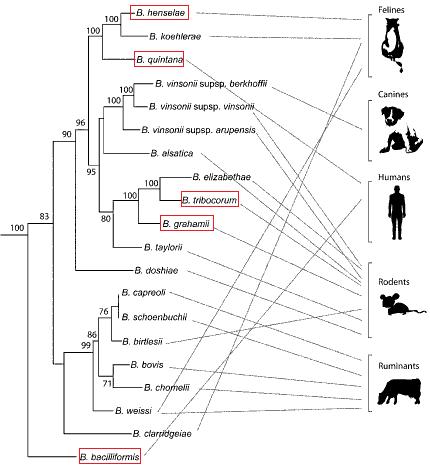
Bartonella henselae is a gram-negative bacterial pathogen of humans and animals. Like other members of the alphaproteobacteria subdivision, B. henselae is capable of establishing an intracellular lifestyle within eukaryotic cells (3). Infection of immunocompetent humans with B. henselae results in “cat scratch disease,” a regional lymphadenopathy that is typically associated with wounds of feline origin (12, 22). In most cases, the lymph node lesions are self-limiting and antibiotic therapy is not indicated (32). However, in 5 to 14% of infected individuals, atypical manifestations can occur, including prolonged fever, malaise, fatigue, myalgia, arthralgia, weight loss, splenomegaly, and Parinaud's oculoglandular syndrome (32). In contrast, infection of immunosuppressed humans can result in a variety of severe and life-threatening disease syndromes, such as bacillary angiomatosis, peliosis hepatis, endocarditis, and bacteremia (22). Even in cases of severe disease, antibiotic therapy is often effective, but relapses can occur (32).
Properties
Function
The function of the BH11960 protein is not known, but its function is thought to be involved in signal transduction that regulates aerotolerance in conjunction with the other genes within its cluster. Evidence for such function is:
- Presence of a PRKEL signal peptide domain at the N-terminus of the protein on all orthologs
- Presence of MoxR-AAA family protein in the four-gene cluster, which is predicted to serve as a chaperone
- Hypothesis: The signal peptide PRKEL allows for the cleavage of the N-terminal aerotolerance regulator, which is released into the cytoplasm and folded by the interacting chaperone. This cleaved and modified protein serves as a sensor for oxygen concentration changes and may go on to interact with other parts of the cell to induce a response mechanism.
Protein sequence
The importance of this protein lies in the beginning of the sequence, and is represented in the conceptual translation below. This region contains the aerotolerance motif, the transmembrane hydrophobic segment highlighted in yellow, and a high-conservation region represented in all studied orthologs. Furthermore, a signal peptide protein is present in this region that allows transport of a protein.

Based on sequence analysis performed by PSortB program, this protein is located in the cytoplasmic membrane of this Gram-negative bacterium and contains a double transmembrane domain.
Gene neighborhood
The four-gene cluster of BH11940, BH11950, BH11960, and BH11970 all produce proteins of unknown function transcribed on the sense strand and encoded by the same promoter. The promoter is ubiquitously conserved in the other* Bartonella* species and contains a TATA box. BH11960 is the largest of the four proteins.

Bartonella henselae: BH11960. KEGG Database.
Homologs
| Genus/species | Gene name | Accession number | Sequence length | Sequence similarity |
|---|---|---|---|---|
| Bartonella henselae | Hypothetical protein | BX897699.1 | 2805nt/934aa | 100 |
| Bartonella quintana | Hypothetical protein | BX897700.1 | 2805nt/934aa | 91 |
| Bartonella grahamii | Transcription regulator | CP001562.1 | 2799nt/932aa | 87 |
| Bartonella tribocorum | Alanyl-tRNA synthetase | AM260525.1 | 2799nt/932aa | 87 |
| Methylobacterium nodulans | Hypothetical protein | YP_002500318.1 | 2820nt/939aa | 53 |
| Nitrobacter hamburgensis | Double transmembrane region like | YP_578448.1 | 2817nt/938aa | 53 |
| Hyphomicrobium denitrificans | Conserved hypothetical protein | ZP_05374729.1 | 2973nt/990aa | 53 |
| Rhodopseudomonas palustris | Double transmembrane region like | YP_568432.1 | 2826nt/941aa | 54 |
| Hoeflea phototrophica | Double transmembrane region like | YP_002289983.1 | 1832nt/943aa | 55 |
| Oceanicola batsensis | Hypothetical protein OB2597_11306 | ZP_00998791.1 | 2771nt/923aa | 48 |
References
References
- (August 2006). "Cloning, Characterization, and Expression of Bartonella henselae p26". Clinical and Vaccine Immunology.
- "Kegg T00180: Bh11960".
This article was imported from Wikipedia and is available under the Creative Commons Attribution-ShareAlike 4.0 License. Content has been adapted to SurfDoc format. Original contributors can be found on the article history page.
Ask Mako anything about BH11960 — get instant answers, deeper analysis, and related topics.
Research with MakoFree with your Surf account
Create a free account to save articles, ask Mako questions, and organize your research.
Sign up freeThis content may have been generated or modified by AI. CloudSurf Software LLC is not responsible for the accuracy, completeness, or reliability of AI-generated content. Always verify important information from primary sources.
Report