From Surf Wiki (app.surf) — the open knowledge base
Beta2-adrenergic agonist
Compounds that bind to and activate adrenergic beta-2 receptors
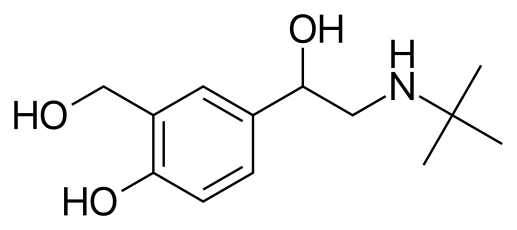
Compounds that bind to and activate adrenergic beta-2 receptors
Beta2-adrenergic agonists, also known as adrenergic β2 receptor agonists, are a class of drugs that act on the β2 adrenergic receptor. Like other β adrenergic agonists, they cause smooth muscle relaxation. β2 adrenergic agonists' effects on smooth muscle cause dilation of bronchial passages, vasodilation in muscle and liver, relaxation of uterine muscle. They are primarily used to treat asthma and other pulmonary disorders. Bronchodilators are considered an important treatment regime for chronic obstructive pulmonary disease (COPD) and are usually used in combination with short acting medications and long acting medications in a combined inhaler.
Mechanism of action
Activation of β adrenergic receptors leads to relaxation of smooth muscle in the lung, and dilation and opening of the airways.
β adrenergic receptors are coupled to a stimulatory G protein of adenylyl cyclase. This enzyme produces the second messenger cyclic adenosine monophosphate (cAMP). In the lung, cAMP decreases calcium concentrations within cells and activates protein kinase A. Both of these changes inactivate myosin light-chain kinase and activate myosin light-chain phosphatase. In addition, β2 agonists open large conductance calcium-activated potassium channels and thereby tend to hyperpolarize airway smooth muscle cells. The combination of decreased intracellular calcium, increased membrane potassium conductance, and decreased myosin light chain kinase activity leads to smooth muscle relaxation and bronchodilation.
Adverse effects
Findings indicate that β2 stimulants, especially in parenteral administration such as inhalation or injection, can induce adverse effects:
- Tachycardia secondary to peripheral vasodilation and cardiac stimulation (such tachycardia may be accompanied by palpitations).
- Tremor, excessive sweating, anxiety, insomnia, and agitation
- More severe effects include paradoxical bronchospasm, hypokalemia, and in rare cases a myocardial infarction.
Overuse of β2 agonists and asthma treatment without proper inhaled corticosteroid use has been associated with an increased risk of asthma exacerbations and asthma-related hospitalizations. The excipients, in particular sulfite, could contribute to the adverse effects.
Delivery
All β2 agonists are available in inhaler form, as either metered-dose inhalers which dispense an aerosolized drug and contains propellants, dry powder inhalers which dispense a powder to be inhaled, or soft mist inhalers which dispense a mist without use of propellants.
Salbutamol (INN) or albuterol (USAN) and some other β2 agonists, such as formoterol, also are sold in a solution form for nebulization, which is more commonly used than inhalers in emergency rooms. Nebulizers continuously deliver aerosolized drug and salbutamol delivered through nebulizer was found to be more effective than IV administration.
Salbutamol and terbutaline are also both available in oral forms. In addition, several of these medications are available in intravenous forms, including both salbutamol and terbutaline. It can be used in this form in severe cases of asthma, but it is more commonly used to suppress premature labor because it also relaxes uterine muscle, thereby inhibiting contractions.
Risks
On 18 November 2005, the U.S. Food and Drug Administration (FDA) alerted healthcare professionals and patients that several long-acting bronchodilator medicines have been associated with possible increased risk of worsening wheezing in some people, and requested that manufacturers update warnings in their existing product labeling.
A 2006 meta-analysis found that "regularly inhaled β agonists (orciprenaline/metaproterenol [Alupent], formoterol [Foradil], fluticasone+salmeterol [Serevent, Advair], and salbutamol/albuterol [Proventil, Ventolin, Volmax, and others]) increased the risk of respiratory death more than two-fold, compared with a placebo," while used to treat chronic obstructive pulmonary disease.
On 11 December 2008, a panel of experts convened by the FDA voted to ban drugs Serevent and Foradil from use in the treatment of asthma. When these two drugs are used without steroids, they increase the risks of more severe attacks. They said that two other, much more popular, asthma drugs containing long-acting β agonists—Advair and Symbicort—should continue to be used.
Types
They can be divided into short-acting, long-acting, and ultra-long-acting beta adrenoreceptor agonists:
Generic name—Trade name
Short-acting β2 agonists (SABAs)
- bitolterol—Tornalate
- fenoterol—Berotec
- isoprenaline (INN) or isoproterenol (USAN)—Isuprel
- levosalbutamol (INN) or levalbuterol (USAN)—Xopenex
- orciprenaline (INN) or metaproterenol (USAN)—Alupent
- pirbuterol—Maxair
- procaterol
- ritodrine—Yutopar
- salbutamol (INN) or albuterol (USAN)—Ventolin
- terbutaline—Bricanyl
Long-acting β2 agonists (LABAs)
- arformoterol—Brovana (some consider it to be an ultra-LABA)
- bambuterol—Bambec, Oxeol
- clenbuterol—Dilaterol, Spiropent
- formoterol—Foradil, Oxis, Perforomist
- salmeterol—Serevent
Ultra-long-acting β2 agonists
- abediterol
- carmoterol
- indacaterol—Arcapta Neohaler (U.S.), Onbrez Breezhaler (EU, RU)
- olodaterol—Striverdi Respimat
- vilanterol
- with umeclidinium bromide—Anoro Ellipta
- with fluticasone furoate—Breo Ellipta (U.S.), Relvar Ellipta (EU, RU)
- with fluticasone furoate and umeclidinium bromide—Trelegy Ellipta
Unknown duration of action
- isoxsuprine
- mabuterol
- zilpaterol—Zilmax
Research
New drugs in this class with more selective activity or that act simultaneously as muscarinic receptor antagonists are under development as of 2023.
Society and culture
β2 agonists are used by athletes and bodybuilders as anabolic performance-enhancing drugs and their use has been banned by the World Anti-Doping Agency except for certain drugs that people with asthma may use; they are also used illegally to try to promote the growth of livestock. A 2011 meta-analysis found no evidence that inhaled β₂-agonists improve performance in healthy athletes and found that the evidence was too weak to assess whether systemic administration of β₂-agonists improved performance in healthy people.
References
References
- (2022). "StatPearls". StatPearls Publishing.
- (2023-12-06). "Inhaled corticosteroids with combination inhaled long-acting beta2-agonists and long-acting muscarinic antagonists for chronic obstructive pulmonary disease". The Cochrane Database of Systematic Reviews.
- (2005-11-01). "Beta2-agonist and anticholinergic drugs in the treatment of lung disease". Proceedings of the American Thoracic Society.
- (2020). "StatPearls". StatPearls Publishing.
- (2016). "β2 Agonists". Handbook of Experimental Pharmacology.
- (July 1986). "Adverse reactions to beta 2-agonist bronchodilators". Medical Toxicology.
- (January 1996). "Advances in Organ Biology". Elsevier.
- (January 2022). "Global Initiative for Asthma Strategy 2021: executive summary and rationale for key changes". The European Respiratory Journal.
- (May 2020). "Inhalation therapy devices for the treatment of obstructive lung diseases: the history of inhalers towards the ideal inhaler". European Journal of Internal Medicine.
- {{cite encyclopedia. (2014). Elsevier
- (2010). "Paediatric Cardiology". Churchill Livingstone.
- (2010). "Terbutaline versus salbutamol for suppression of preterm labor: a randomized clinical trial". Annals of Saudi Medicine.
- (11 December 2008). "F.D.A. Panel Votes to Ban Asthma Drugs".
- (2007). "ultra-long-acting beta2-adrenoceptor agonists: an emerging therapeutic option for asthma and COPD?". Drugs.
- (October 2014). "Abediterol (LAS100977), a novel long-acting β2-agonist: efficacy, safety and tolerability in persistent asthma". Respiratory Medicine.
- (July 2005). "Ultra long-acting beta 2-agonists in development for asthma and chronic obstructive pulmonary disease". Expert Opinion on Investigational Drugs.
- (May 2011). "β(2) -adrenoceptor agonists: current and future direction". British Journal of Pharmacology.
- (November 2023). "Advances in adrenergic receptors for the treatment of chronic obstructive pulmonary disease: 2023 update". Expert Opinion on Pharmacotherapy.
- (November 2013). "Clenbuterol". Drug Enforcement Administration.
- (January 2011). "β₂-Agonists and physical performance: a systematic review and meta-analysis of randomized controlled trials". Sports Medicine.
This article was imported from Wikipedia and is available under the Creative Commons Attribution-ShareAlike 4.0 License. Content has been adapted to SurfDoc format. Original contributors can be found on the article history page.
Ask Mako anything about Beta2-adrenergic agonist — get instant answers, deeper analysis, and related topics.
Research with MakoFree with your Surf account
Create a free account to save articles, ask Mako questions, and organize your research.
Sign up freeThis content may have been generated or modified by AI. CloudSurf Software LLC is not responsible for the accuracy, completeness, or reliability of AI-generated content. Always verify important information from primary sources.
Report