From Surf Wiki (app.surf) — the open knowledge base
Beta-ketoacyl-ACP synthase
Enzyme

Enzyme
| Field | Value |
|---|---|
| Name | 3-oxoacyl-ACP synthase, mitochondrial |
| HGNCid | 26063 |
| Symbol | OXSM |
| EntrezGene | 54995 |
| OMIM | 610324 |
| RefSeq | NM_017897 |
| UniProt | Q9NWU1 |
| ECnumber | 2.3.1.41 |
| Chromosome | 3 |
| Arm | p |
| Band | 24.2 |
In molecular biology, Beta-ketoacyl-ACP synthase , is an enzyme involved in fatty acid synthesis. It typically uses malonyl-CoA as a carbon source to elongate ACP-bound acyl species, resulting in the formation of ACP-bound β-ketoacyl species such as acetoacetyl-ACP.
Beta-ketoacyl-ACP synthase is a highly conserved enzyme that is found in almost all life on earth as a domain in fatty acid synthase (FAS). FAS exists in two types, aptly named type I and II. In animals, fungi, and lower eukaryotes, Beta-ketoacyl-ACP synthases make up one of the catalytic domains of larger multifunctional proteins (Type I), whereas in most prokaryotes as well as in plastids and mitochondria, Beta-ketoacyl-ACP synthases are separate protein chains that usually form dimers (Type II).{{Cite journal Beta-ketoacyl-ACP synthase III, perhaps the most well known of this family of enzymes, catalyzes a Claisen condensation between acetyl CoA and malonyl ACP. The image below reveals how CoA fits in the active site as a substrate of synthase III.

Beta-ketoacyl-ACP synthases I and II only catalyze acyl-ACP reactions with malonyl ACP. Synthases I and II are capable of producing long-chain acyl-ACPs. Both are efficient up to acyl-ACPs with a 14 carbon chain, at which point synthase II is the more efficient choice for further carbon additions. Type I FAS catalyzes all the reactions necessary to create palmitic acid, which is a necessary function in animals for metabolic processes, one of which includes the formation of sphingosines.{{Cite journal
Beta-ketoacyl-ACP synthase is found as a component of a number of enzymatic systems, including fatty acid synthetase (FAS); the multi-functional 6-methysalicylic acid synthase (MSAS) from Penicillium patulum, which is involved in the biosynthesis of a polyketide antibiotic; polyketide antibiotic synthase enzyme systems; Emericella nidulans multifunctional protein Wa, which is involved in the biosynthesis of conidial green pigment; Rhizobium nodulation protein nodE, which probably acts as a beta-ketoacyl synthase in the synthesis of the nodulation Nod factor fatty acyl chain; and yeast mitochondrial protein CEM1.
Structure
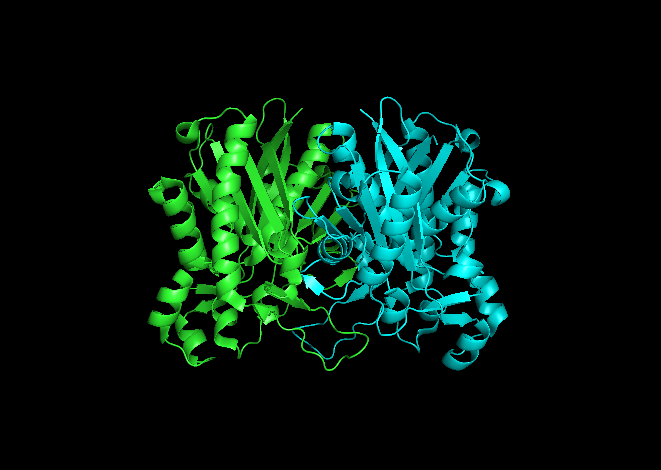
Beta-ketoacyl synthase contains two protein domains. The active site is located between the N- and C-terminal domains. The N-terminal domain contains most of the structures involved in dimer formation and also the active site cysteine. Residues from both domains contribute to substrate binding and catalysis
In animals and in prokaryotes, beta-ketoacyl-ACP synthase is a domain on type I FAS, which is a large enzyme complex that has multiple domains to catalyze multiple different reactions. Analogously, beta-ketoacyl-ACP synthase in plants is found in type II FAS; note that synthases in plants have been documented to have a range of substrate specificities. The presence of similar ketoacyl synthases present in all living organisms point to a common ancestor.{{Cite journal | doi-access = free
Mechanism
Beta-ketoacyl-synthase’s mechanism is a topic of debate among chemists. Many agree that Cys171 of the active site attacks acetyl ACP's carbonyl, and, like most enzymes, stabilizes the intermediate with other residues in the active site. ACP is subsequently eliminated, and it deprotonates His311 in the process. A thioester is then regenerated with the cysteine in the active site. Decarboxylation of a malonyl CoA that is also in the active site initially creates an enolate, which is stabilized by His311 and His345. The enolate tautomerizes to a carbanion that attacks the thioester of the acetyl-enzyme complex.{{Cite journal

Biological function
The main function of beta-ketoacyl-ACP synthase is to produce fatty acids of various lengths for use by the organism. These uses include energy storage and creation of cell membranes. Fatty acids can also be used to synthesize prostaglandins, phospholipids, and vitamins, among many other things. Further, palmitic acid, which is created by the beta-ketoacyl-synthases on type I FAS, is used in a number of biological capacities. It is a precursor of both stearic and palmitoleic acids. Palmitoleic can subsequently be used to create a number of other fatty acids.{{Cite web | access-date = 2016-02-29
Clinical significance
The different types of beta-ketoacyl-ACP synthases in type II FAS are called FabB, FabF, and FabH synthases. FabH catalyzes the quintessential ketoacyl synthase reaction with malonyl ACP and acetyl CoA. FabB and FabF catalyze other related reactions. Given that their function is necessary for proper biological function surrounding lipoprotein, phospholipid, and lipopolysaccharide synthesis, they have become a target in antibacterial drug development. In order to adapt to their environment, bacteria alter the phospholipid composition of their membranes. Inhibiting this pathway may thus be a leverage point in disrupting bacterial proliferation.{{Cite journal | article-number=14797 | doi-access = free
These types of drugs are highly relevant. For example, Y. pestis was the main agent in the Justinian Plague, Black Death, and the modern plague. Even within the last five years, China, Peru, and Madagascar all experienced an outbreak of infection by Y. pestis. If it is not treated within 24 hours, it normally results in death. Furthermore, there is worry that it can now be used as a possible biological warfare weapon.
Unfortunately, many drugs that target prokaryotic beta-ketoacyl-synthases carry many side effects. Given the similarities between prokaryotic ketoacyl synthases and mitochondrial ones, these types of drugs tend to unintentionally also act upon mitochondrial synthases, leading to many biological consequences for humans.
Industrial applications
Recent efforts in bioengineering include engineering of FAS proteins, which includes beta-ketoacyl-ACP synthase domains, in order to favor the synthesis of branched carbon chains as a renewable energy source. Branched carbon chains contain more energy and can be used in colder temperatures because of their lower freezing point. Using E. coli as the organism of choice, engineers have replaced the endogenous FabH domain on FAS, which favors unbranched chains, with FabH versions that favor branching due to their high substrate specificity for branched acyl-ACPs.{{Cite journal
References
References
- (Sep 1990). "The multifunctional 6-methylsalicylic acid synthase gene of Penicillium patulum. Its gene structure relative to that of other polyketide synthases". European Journal of Biochemistry.
- (Mar 1998). "Crystal structure of beta-ketoacyl-acyl carrier protein synthase II from E.coli reveals the molecular architecture of condensing enzymes". The EMBO Journal.
This article was imported from Wikipedia and is available under the Creative Commons Attribution-ShareAlike 4.0 License. Content has been adapted to SurfDoc format. Original contributors can be found on the article history page.
Ask Mako anything about Beta-ketoacyl-ACP synthase — get instant answers, deeper analysis, and related topics.
Research with MakoFree with your Surf account
Create a free account to save articles, ask Mako questions, and organize your research.
Sign up freeThis content may have been generated or modified by AI. CloudSurf Software LLC is not responsible for the accuracy, completeness, or reliability of AI-generated content. Always verify important information from primary sources.
Report