From Surf Wiki (app.surf) — the open knowledge base
Bessel beam
Non-diffractive wave

Non-diffractive wave


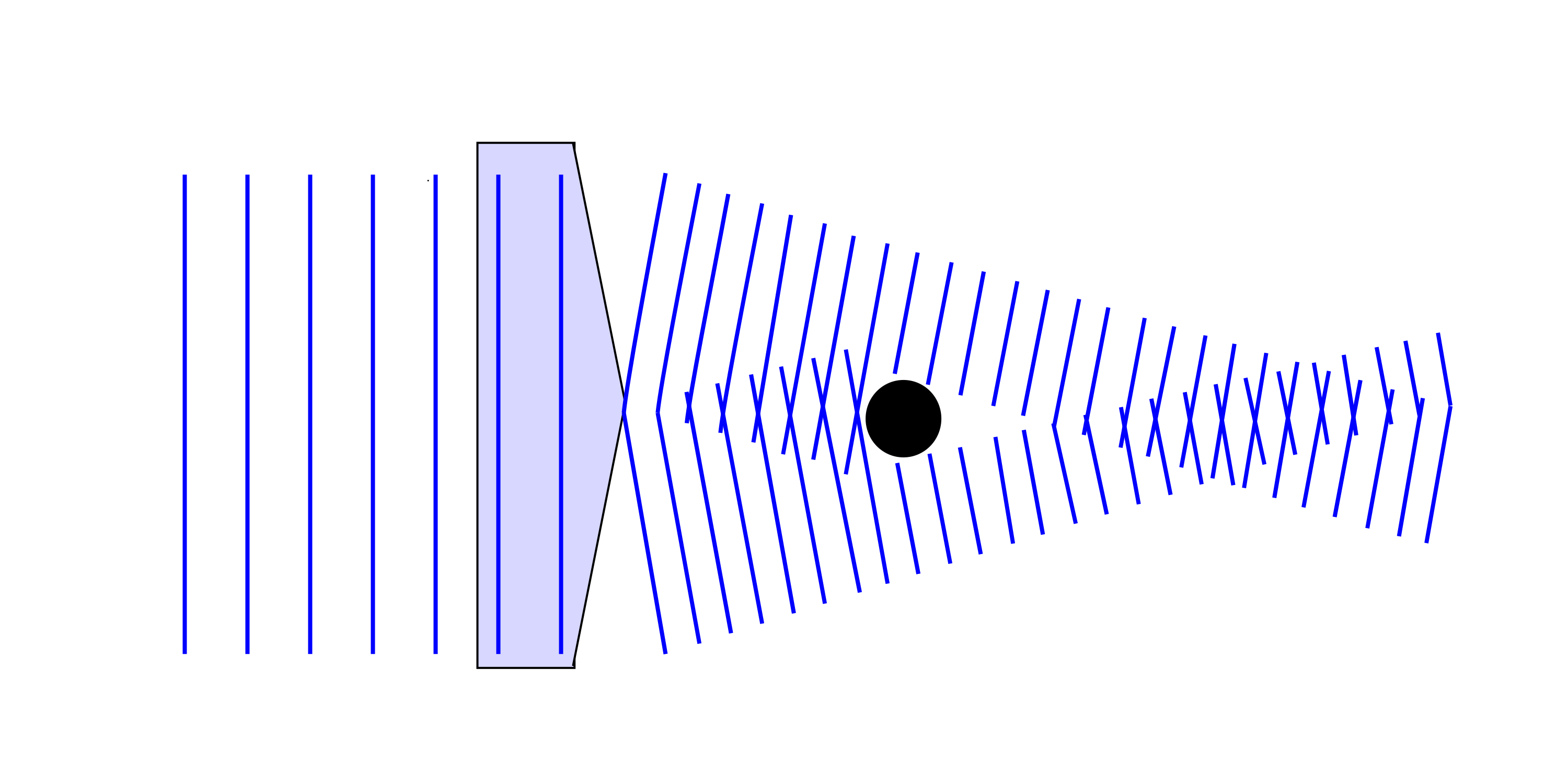
A Bessel beam is a wave whose amplitude is described by a Bessel function of the first kind.{{cite journal
As with a plane wave, a true Bessel beam cannot be created, as it is unbounded and would require an infinite amount of energy. Reasonably good approximations can be made, however, and these are important in many optical applications because they exhibit little or no diffraction over a limited distance. Approximations to Bessel beams are made in practice either by focusing a Gaussian beam with an axicon lens to generate a Bessel–Gauss beam, by using axisymmetric diffraction gratings, |display-authors=etal |display-authors=etal
Properties
The properties of Bessel beams |doi-access=free |doi-access=free |hdl-access=free
The mathematical function which describes a Bessel beam is a solution of Bessel's differential equation, which itself arises from separable solutions to Laplace's equation and the Helmholtz equation in cylindrical coordinates. The fundamental zero-order Bessel beam has an amplitude maximum at the origin, while a high-order Bessel beam (HOBB) has an axial phase singularity along the beam axis; the amplitude is zero there. HOBBs can be of vortex (helicoidal) or non-vortex types.
X-waves are special superpositions of Bessel beams which travel at constant velocity, and can exceed the speed of light. |display-authors=etal
Mathieu beams and parabolic (Weber) beams
Acceleration
In 2012 it was theoretically proven |display-authors=etal
Attenuation-compensation
Beams may encounter losses as they travel through materials which will cause attenuation of the beam intensity. A property common to non-diffracting (or propagation-invariant) beams, such as the Airy beam and Bessel beam, is the ability to control the longitudinal intensity envelope of the beam without significantly altering the other characteristics of the beam. This can be used to create Bessel beams which grow in intensity as they travel and can be used to counteract losses, therefore maintaining a beam of constant intensity as it propagates.
Applications
Imaging and microscopy
In light-sheet fluorescence microscopy, non-diffracting (or propagation-invariant) beams have been utilised to produce very long and uniform light-sheets which do not change size significantly across their length. The self-healing property of Bessel beams has also shown to give improved image quality at depth as the beam shape is less distorted after travelling through scattering tissue than a Gaussian beam. Bessel beam based light-sheet microscopy was first demonstrated in 2010 but many variations have followed since. In 2018, it was shown that the use of attenuation-compensation could be applied to Bessel beam based light-sheet microscopy and could enable imaging at greater depths within biological specimens.
Acoustofluidics
Bessel beams are a good candidate for the selectively trapping, because of the concentric circles of pressure maximum and minimum in the transverse planes.
References
References
- (1992). "Constant-axial-intensity nondiffracting beam". Optics Letters.
- D. Baresch, J.L. Thomas, and R. Marchiano, Physical review letters, 2016, 116(2), 024301.
- Zamboni-Rached, Michel. (2004-08-23). "Stationary optical wave fields with arbitrary longitudinal shape by superposing equal frequency Bessel beams: Frozen Waves". Optics Express.
- (2009-08-31). "Tunable Bessel light modes: engineering the axial propagation". Optics Express.
- (2010). "Microscopy with self-reconstructing beams". Nature Photonics.
- (2018-04-01). "Light-sheet microscopy with attenuation-compensated propagation-invariant beams". Science Advances.
This article was imported from Wikipedia and is available under the Creative Commons Attribution-ShareAlike 4.0 License. Content has been adapted to SurfDoc format. Original contributors can be found on the article history page.
Ask Mako anything about Bessel beam — get instant answers, deeper analysis, and related topics.
Research with MakoFree with your Surf account
Create a free account to save articles, ask Mako questions, and organize your research.
Sign up freeThis content may have been generated or modified by AI. CloudSurf Software LLC is not responsible for the accuracy, completeness, or reliability of AI-generated content. Always verify important information from primary sources.
Report