From Surf Wiki (app.surf) — the open knowledge base
Berberis koreana
Species of shrub

Species of shrub
Berberis koreana, the Korean barberry, is deciduous shrub that can grow up to 1.5 m in height. The species is endemic to Korea. It is planted as an ornamental shrub in North America, South America and Europe.
Distribution
Berberis koreana is endemic to Korea. The species is reportedly naturalized in a few locations in the US State of Vermont.
Habitat and ecology
Berberis koreana is a deciduous shrub that is hardy to winter temperatures around -35 °C. The species can also tolerate a range of soil types; it can be in a well-drained or moist soil. B. koreana can be placed in full sun or part shade but does not prefer to be in full shade.
Morphology

Individuals of this species are deciduous shrubs with berries that are purple to red. The leaf margins are dentate and have inflorescences in racemes on reddish branchlets. The leaves are up to 6 cm long and 3 cm broad, simple, spirally arranged, and are either elliptical or oval shape and are dark to medium-green. They show pinnate venation with smooth edges.
Flowers and fruit
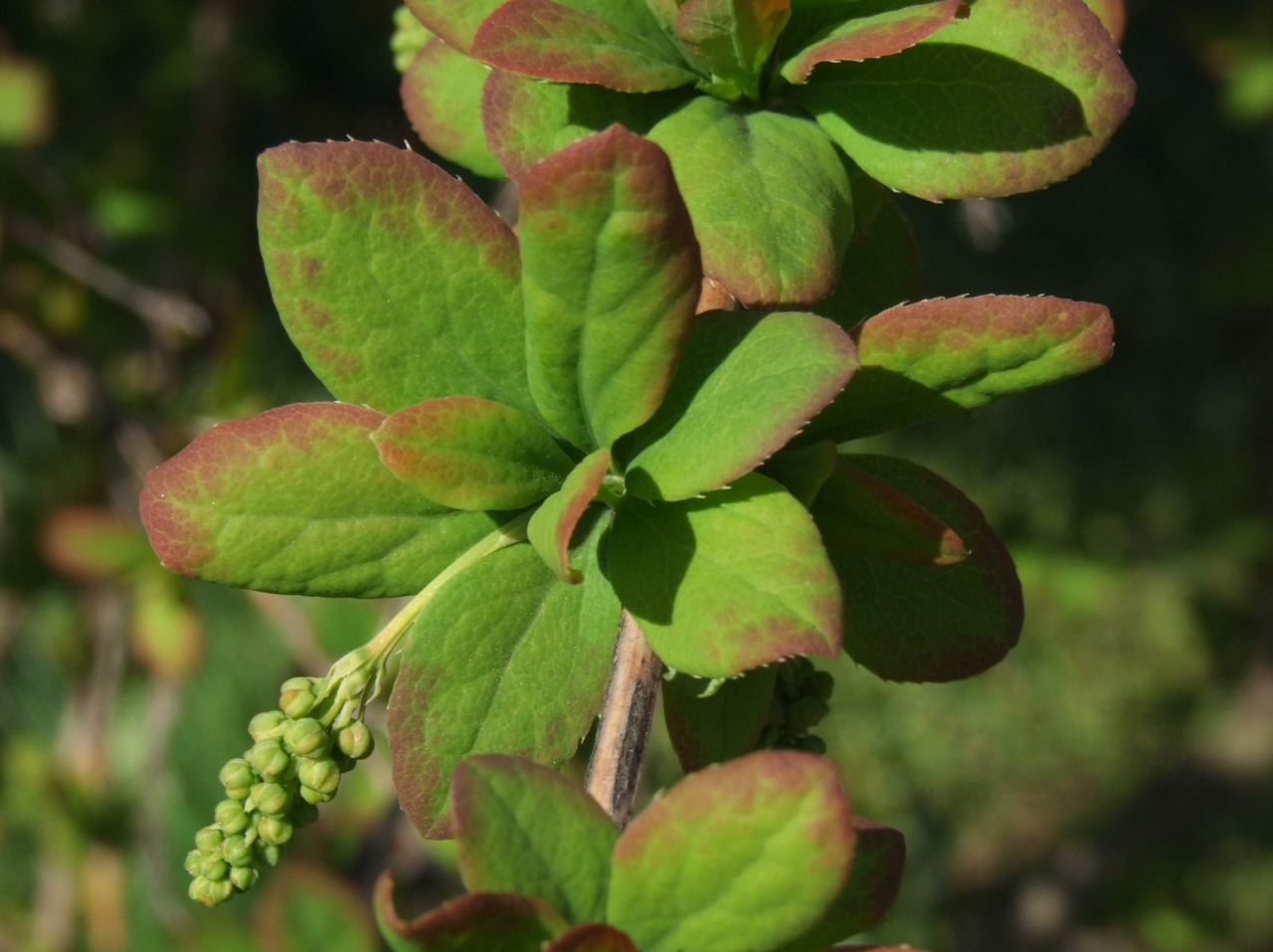
The flowers of Berberis koreana are approximately 5 mm in length, appear in clusters, and are yellow when they bloom in the spring. B. koreana has globose to egg-shaped, red to purple berries 8 mm diameter in the fall and winter months. The flower has six yellow sepals, six stamens and six petals that can be yellow to dark orange-red. B. koreana has 1-10 seeds that are tan to red-brown or black.
Uses
Ornamental use
The cultivar 'Red Tears' is a vigorous shrub to 2 m tall, with purple-tinged leaves, and fruit in racemes up to 10 cm long.
Food
Berberis berries are edible but sour and are mostly used in jams and jellies. However, eating high quantities of B. koreana berries can result in adverse side effects (see Intoxication section).
Medicinal purposes
There are no established medical uses for barberry. However, roots of other Berberis species were used by American Indians and settlers to help with upset stomachs, hemorrhages, tuberculosis, and eye trouble. It has also been said, but not proved, that Berberis koreana can be used as an antibacterial agent.
Intoxication

Several species of Berberis contain alkaloids such as berberine, canadine, columbamine, corypalmine, jatrorrhizine, and palmatine. These alkaloids are all very similar in chemical structure, but they vary in the effects they have on humans. Protoberberine relaxes smooth muscle and causes a decrease in overall blood pressure. Berberine, at high dosages, has been known to cause seizures and inhibit enzymes. Berberis can have adverse side effects such as severe digestive tract irritation that includes nausea, vomiting, and diarrhea. The side effects are not life-threatening and can be treated.
References
References
- Kim, H.. (2017). "''Berberis koreana''".
- Huxley, Anthony. (1992). "Royal Horticultural Society Dictionary of Gardening". Macmillan Press.
- [http://bonap.net/MapGallery/County/Berberis%20koreana.png Biota of North America Program]
- Evans, Erv. "Shrubs: Berberis koreana". North Carolina State University College of Agriculture & Life Sciences.
- "Berberis koreana - Palibin.". Plants for a Future.
- Bratman, Steven. (2007). "Collins Alternative Health Guide". Harper Collins.
- (Mar 15, 2010). "Bioactivity-guided isolation of cytotoxic triterpenoids from the trunk of Berberis koreana". Bioorg Med Chem Lett.
- Kim, Ki Hyun. (30 November 2009). "Biphenyls from". Journal of Natural Products.
- (2001). "Toxic Plants of North America". Iowa State University Press.
This article was imported from Wikipedia and is available under the Creative Commons Attribution-ShareAlike 4.0 License. Content has been adapted to SurfDoc format. Original contributors can be found on the article history page.
Ask Mako anything about Berberis koreana — get instant answers, deeper analysis, and related topics.
Research with MakoFree with your Surf account
Create a free account to save articles, ask Mako questions, and organize your research.
Sign up freeThis content may have been generated or modified by AI. CloudSurf Software LLC is not responsible for the accuracy, completeness, or reliability of AI-generated content. Always verify important information from primary sources.
Report