From Surf Wiki (app.surf) — the open knowledge base
Benzyl group
Chemical group (–CH2–C6H5)

Chemical group (–CH2–C6H5)
In organic chemistry, benzyl is the substituent or molecular fragment possessing the structure . Benzyl features a benzene ring () attached to a methylene group ().
Nomenclature
In IUPAC nomenclature, the prefix benzyl refers to a substituent, for example benzyl chloride or benzyl benzoate. Benzyl is not to be confused with phenyl with the formula . The term benzylic is used to describe the position of the first carbon bonded to a benzene or other aromatic ring. For example, is referred to as a "benzylic" carbocation. The benzyl free radical has the formula . The benzyl cation or phenylcarbenium ion is the carbocation with formula ; the benzyl anion or phenylmethanide ion is the carbanion with the formula . None of these species can be formed in significant amounts in the solution phase under normal conditions, but they are useful referents for discussion of reaction mechanisms and may exist as reactive intermediates.
Abbreviations
Benzyl is most commonly abbreviated Bn. For example, benzyl alcohol can be represented as BnOH. Less common abbreviations are Bzl and Bz, the latter of which is ambiguous as it is also the standard abbreviation for the benzoyl group . Likewise, benzyl should not be confused with the phenyl group , abbreviated Ph.
Reactivity of benzylic centers
The enhanced reactivity of benzylic positions is attributed to the low bond dissociation energy for benzylic C−H bonds. Specifically, the bond is about 10–15% weaker than other kinds of C−H bonds. The neighboring aromatic ring stabilizes benzyl radicals. The data tabulated below compare benzylic C−H bond to related C−H bond strengths.
| Bond | Bond | Bond-dissociation energy | Comment | (kcal/mol) | (kJ/mol) |
|---|---|---|---|---|---|
| benzylic C−H bond | 90 | 377 | akin to allylic C−H bonds | ||
| such bonds show enhanced reactivity | |||||
| methyl C−H bond | 105 | 439 | one of the strongest aliphatic C−H bonds | ||
| ethyl C−H bond | 101 | 423 | slightly weaker than | ||
| phenyl C−H bond | 113 | 473 | comparable to vinyl radical, rare | ||
| allylic C–H bond | 89 | 372 | similar to benzylic C-H | ||
| fluorenyl C–H bond | 80 | more activated vs diphenylmethyle (pKa = 22.6) | |||
| diphenylmethyl C–H bond | 82 | "doubly benzylic" (pKa = 32.2) | |||
| trityl C–H bond | 81 | 339 | "triply benzylic" |
The weakness of the C−H bond reflects the stability of the benzylic radical. For related reasons, benzylic substituents exhibit enhanced reactivity, as in oxidation, free radical halogenation, or hydrogenolysis. As a practical example, in the presence of suitable catalysts, p-xylene oxidizes exclusively at the benzylic positions to give terephthalic acid: :CH3C6H4CH3 + 3 O2 - HO2CC6H4CO2H + 2 H2O Millions of tonnes of terephthalic acid are produced annually by this method.
Functionalization at the benzylic position
In a few cases, these benzylic transformations occur under conditions suitable for lab synthesis. The Wohl-Ziegler reaction will brominate a benzylic C–H bond: (). Any non-tertiary benzylic alkyl group will be oxidized to a carboxyl group by aqueous potassium permanganate () or concentrated nitric acid (): (). Finally, the complex of chromium trioxide and 3,5-dimethylpyrazole () will selectively oxidize a benzylic methylene group to a carbonyl: (). 2-iodoxybenzoic acid in DMSO performs similarly.
As a protecting group
Benzyl groups are occasionally employed as protecting groups in organic synthesis. Their installation and especially their removal require relatively harsh conditions, so benzyl is not typically preferred for protection.
Alcohol protection
Benzyl is commonly used in organic synthesis as a robust protecting group for alcohols and carboxylic acids.
- Treatment of alcohol with a strong base such as powdered potassium hydroxide or sodium hydride and benzyl halide (BnCl or BnBr)
- :[[File:BnProtectedalcohol.png|none|455x455px]]
- Monobenzylation of diols can be achieved using Ag2O in dimethylformamide (DMF) at ambient to elevated temperatures
- Primary alcohols can be selectively benzylated in presence of phenol functional groups using Cu(acac)2
Deprotection methods
Benzyl ethers can be removed under reductive conditions, oxidative conditions, and the use of Lewis acids.
-
Removed using hydrogenolysis
-
:[[File:BnEtherExample.png|none|626x626px]]
-
Single electron process with Na/NH3 or Li/NH3
-
Benzyl protecting groups can be removed using a wide range of oxidizing agents including:
- CrO3/acetic acid at ambient temperature
- Ozone
- N-Bromosuccinimide (NBS)
- N-Iodosuccinimide (NIS)
-
Trimethylsilyl iodide (Me3SiI) in dichloromethane at ambient temperature (selectivity can be achieved under specific conditions)
The ''p''-methoxybenzyl protecting group
p-Methoxybenzyl (PMB) is used as a protecting group for alcohols in organic synthesis (4-Methoxybenzylthiol is used to protect thiols).

- Strong base such as powdered potassium hydroxide or sodium hydride and p-methoxybenzyl halide (chloride or bromide)
- 4-methoxybenzyl-2,2,2-trichloroacetimidate can be used to install the PMB group in presence of:
- Scandium (III) triflate (Sc(OTf)3) in toluene at 0 °C
- Trifluoromethanesulfonic acid (TfOH) in dichloromethane at 0 °C
- :[[File:PMBAlcohol.png|none|676x676px]]
Deprotection methods
- 2,3-Dichloro-5,6-dicyano-p-benzoquinone (DDQ)
- :[[File:PMBDeprotection.png|none|674x674px]]
- Conditions for deprotection of benzyl group are applicable for cleavage of the PMB protecting group
Amine protection
The benzyl group is occasionally used as a protecting group for amines in organic synthesis. Other methods exist.
- Aqueous potassium carbonate and benzyl halide (BnCl, BnBr) in methanol
- :[[File:Bn_protection_with_bnbr.png|none|609x609px]]
- Benzaldehyde, 6 M HCl and NaBH3CN in methanol
- :[[File:Bn_protection_with_benzaldehyde.png|none|532x532px]]
Deprotection methods
- Hydrogenation in the presence of the palladium catalyst
References
References
- (2008). "Advanced Organic Chemistry, Part A: Structure and Mechanisms". Springer.
- (2017). "The Essential Role of Bond Energetics in C–H Activation/Functionalization". Chemical Reviews.
- (1992). "Homolytic bond dissociation energies of the benzylic carbon-hydrogen bonds in radical anions and radical cations derived from fluorenes, triphenylmethanes, and related compounds". Journal of the American Chemical Society.
- Sheehan, Richard J.. "Terephthalic Acid, Dimethyl Terephthalate, and Isophthalic Acid".
- C., Vollhardt, K. Peter. (2018-01-29). "Organic chemistry : structure and function".
- Chandler), Norman, R. O. C. (Richard Oswald. (1993). "Principles of organic synthesis.". Blackie Academic & Professional.
- Johnston, Jeffrey N.. (2001). "Chromium(VI) Oxide–3,5-Dimethylpyrazole". American Cancer Society.
- (2001-04-01). "Selective Oxidation at Carbon Adjacent to Aromatic Systems with IBX". Journal of the American Chemical Society.
- (2006). "Greene's Protective Groups in Organic Synthesis". Wiley Online Library.
- (1987-01-01). "Synthesis of (±)-prepinnaterpene, a bromoditerpene from the red alga Yamada". Tetrahedron Letters.
- (1985-10-01). "Intramolecular 1,3-diyl trapping reactions. A formal total synthesis of (±)-coriolin". The Journal of Organic Chemistry.
- (2003-11-10). "Benzylation of alcohols by using bis[acetylacetonato]copper as catalyst". Tetrahedron Letters.
- (2003-03-01). "Total Synthesis of (+)-Spongistatin 1. An Effective Second-Generation Construction of an Advanced EF Wittig Salt, Fragment Union, and Final Elaboration". Organic Letters.
- (1988-01-01). "Synthesis of optically pure 1-(3-furyl)-1,2-dihydroxyethane derivatives". Tetrahedron Letters.
- (1984-01-01). "Oligonucleotide synthesis. Part 21. Synthesis of ribooligonucleotides using the 4-methoxybenzyl group as a new protecting group for the 2′-hydroxyl group". The Journal of Organic Chemistry.
- (2007-11-01). "Total Synthesis of (−)-Pseudolaric Acid B". Journal of the American Chemical Society.
- (1999-01-04). "Asymmetric Total Synthesis of Taxol\R". Chemistry – A European Journal.
- (2003-11-01). "Total Synthesis and Structural Confirmation of Malayamycin A: A Novel Bicyclic ''C''-Nucleoside from Streptomyces malaysiensis". Organic Letters.
- (1993-12-01). "Total synthesis of strychnan and aspidospermatan alkaloids. 3. The total synthesis of (±)-strychnine". The Journal of Organic Chemistry.
- (1990-01-01). "Asymmetric deprotonation of prochiral ketones using chiral lithium amide bases". Tetrahedron.
- (2004-01-01). "Regiospecific, Enantiospecific Total Synthesis of the 12-Alkoxy-Substituted Indole Alkaloids, (+)-12-Methoxy-Na-methylvellosimine, (+)-12-Methoxyaffinisine, and (−)-Fuchsiaefoline". Organic Letters.
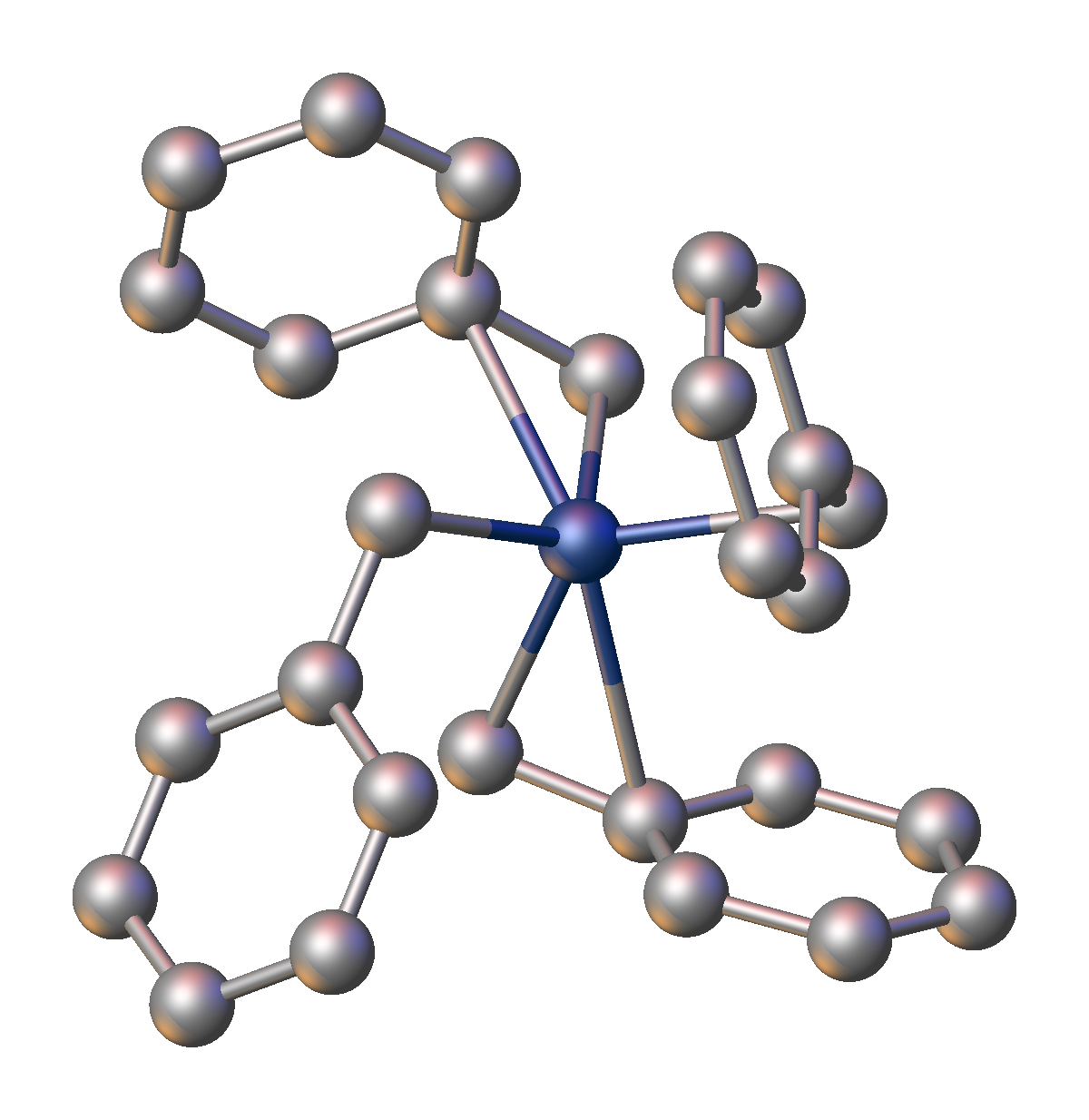
- (2012). "Highly Variable Zr–CH2–Ph Bond Angles in Tetrabenzylzirconium: Analysis of Benzyl Ligand Coordination Modes". Organometallics.
This article was imported from Wikipedia and is available under the Creative Commons Attribution-ShareAlike 4.0 License. Content has been adapted to SurfDoc format. Original contributors can be found on the article history page.
Ask Mako anything about Benzyl group — get instant answers, deeper analysis, and related topics.
Research with MakoFree with your Surf account
Create a free account to save articles, ask Mako questions, and organize your research.
Sign up freeThis content may have been generated or modified by AI. CloudSurf Software LLC is not responsible for the accuracy, completeness, or reliability of AI-generated content. Always verify important information from primary sources.
Report