From Surf Wiki (app.surf) — the open knowledge base
Bentley Speed Six
| Field | Value |
|---|---|
| name | Bentley 6½ Litre & Speed Six |
| image | Sir Michael Kadoorie's 1930 Bentley Speed Six Mulliner Drop Head Coupe1.jpg |
| caption | Speed Six Mulliner drophead coupé 1930 |
| manufacturer | Bentley Motors Limited |
| production | 1926–1930 |
| 544 produced | |
| assembly | United Kingdom: Cricklewood |
| class | rolling chassis |
| body_style | as arranged with coachbuilder by customer |
| layout | FR layout |
| successor | Bentley 8 Litre |
| engine | 6.5 L I6 |
| designer | Walter Owen Bentley |
| wheelbase | 132 in |
| 138 in | |
| 140.5 in | |
| 144 in | |
| 145.5 in | |
| 150 in | |
| 151.5 in | |
| 152.5 in |
544 produced 138 in 140.5 in 144 in 145.5 in 150 in 151.5 in 152.5 in
The Bentley 6½ Litre and the high-performance Bentley Speed Six were rolling chassis produced by Bentley from 1926 to 1930. The Speed Six, introduced in 1928, became the most successful racing Bentley.
Two Bentley Speed Sixes chassis became known as the Blue Train Bentleys after their owner Woolf Barnato in March 1930 "raced" the French Blue Train which departed Cannes at 17:45 and, after a stop in Paris, was scheduled to arrive in Calais at 15:24 when Barnato already was in his club in London.
Background
By 1924 Bentley had been in business for five years. He decided to build a larger chassis than the 3 Litre, with a smoother, more powerful, engine. The new chassis would be more suitable for the large and heavy limousine bodies that many of his customers were then putting on his sports car chassis. The resulting car would be more refined and better suited for comfortable general motoring.
Prototype race
Bentley built a development mule with a 4¼-litre straight-six engine derived from the 3 Litre's four-cylinder engine. To disguise the car's origin, it had a large, wedge-shaped radiator and was registered as a "Sun". The chassis was given a large very lightweight Weymann-type tourer body built by Freestone and Webb.
W. O. Bentley combined one of his road tests of the "Sun" with a trip to see the 1924 French Grand Prix in Lyon. On his return trip to the ferry at Dieppe, W. O. encountered another disguised car at a three-way junction. W. O. and the Rolls-Royce test driver recognized each other and began racing each other along the routes nationales. This street race continued until the Rolls-Royce driver's hat blew off and he had to stop to retrieve it. The Sun's tyres were heavily worn when W.O. got to the ferry at Dieppe.
6½ Litre

Realizing from the impromptu race that the Sun had no performance advantage over Rolls-Royce's latest development, W. O. increased the bore of his six-cylinder engine from 80 mm to 100 mm. With a 140 mm stroke, the engine had a displacement of 6.6 L (6597 cc) Like the four-cylinder engine, Bentley's six included an overhead camshaft, 4 valves per cylinder, and a single-piece engine block and cylinder head cast in iron, which eliminated the need for a head gasket. In base form, with a single Smiths 5-jet carburettor, twin ignition magnetos, and a compression ratio of 4.4:1, the Bentley 6½ Litre delivered 147 hp at 3500 RPM.
Although based on the 3 Litre's engine, the 6½ engine incorporated many improvements. The 3 Litre's cone-type clutch was replaced by a dry-plate design that incorporated a clutch brake for fast gear changes, and the car had power-assisted four-wheel brakes with finned drums. The front brakes had 4 leading shoes per drum. By operating a patented compensating device, the driver could adjust all four brakes to correct for wear while the car was moving, which was particularly advantageous during races.
A variety of wheelbases were provided ranging from 132 to; the most popular was 150 inches.
Speed Six

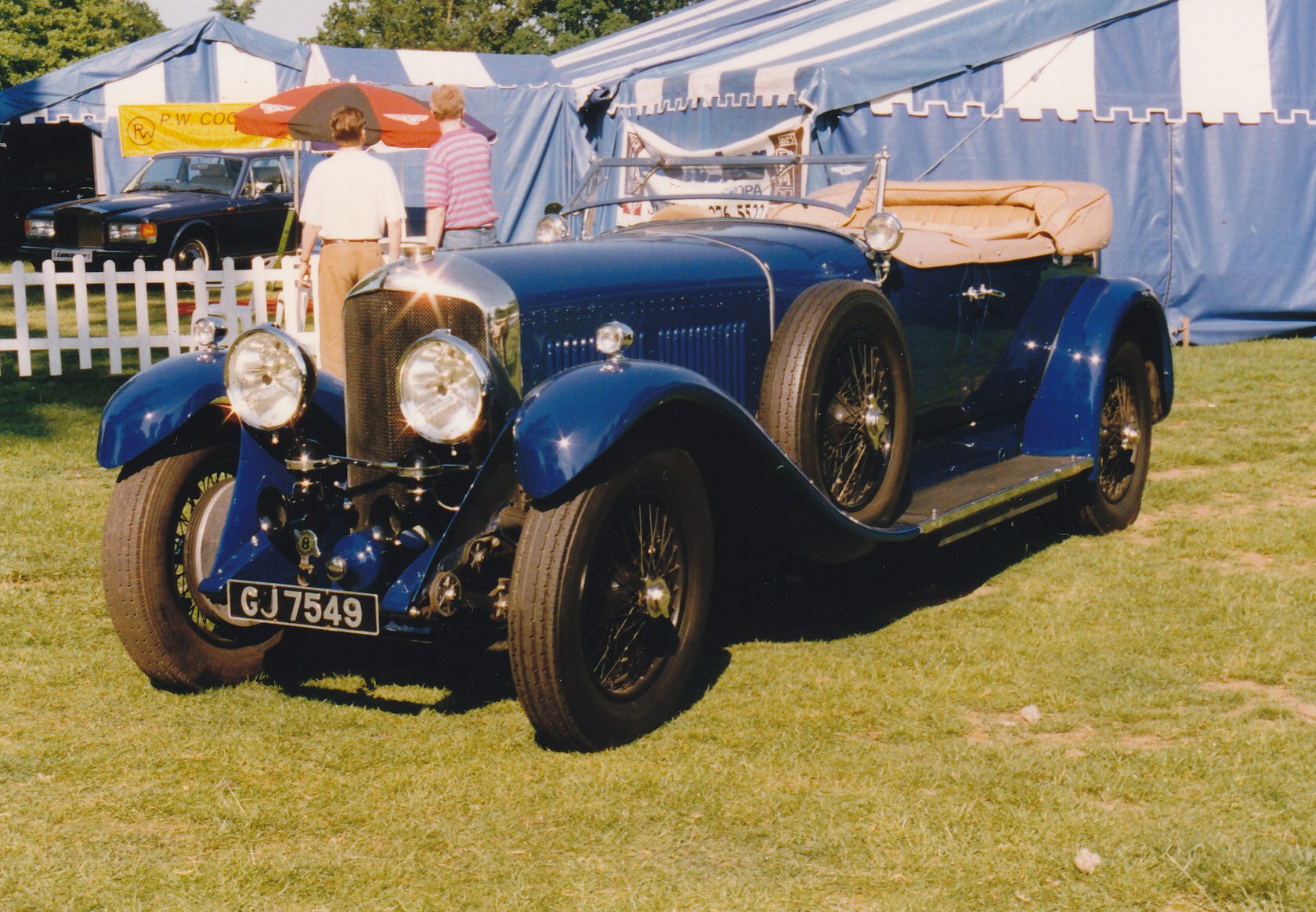
The Bentley Speed Six chassis was introduced in 1928 as a more sporting version of the Bentley 6½ Litre. With a single-port block, two SU carburettors, a high-performance camshaft, and a compression ratio of 5.3:1, the Speed Six's engine produced 180 hp at 3500 rpm. The Speed Six chassis was available to customers with wheelbases of 138 in, 140.5 in, and 152.5 in. The 138 inch wheelbase was the most popular.
The Criminal Investigation Department of the Western Australia Police operated two saloon-bodied examples as patrol cars.
In March 1930, Barnato raced against the Blue Train in a Speed Six with H. J. Mulliner saloon coachwork, reaching his club in London before the train was due in the station at Calais. It had generally been believed that the car in the race was a Gurney Nutting Sportsman Coupé, but that car was delivered to Barnato in May 1930, more than a month after the race.
Factory racing cars
The racing version of the Speed Six had a wheelbase of 11 ft and an engine with a compression ratio of 6.1:1 that produced 200 hp at 3500 rpm. Successful in racing, these cars won the 24 Hours of Le Mans in 1929 and 1930 with Bentley Boys drivers "Tim" Birkin, Glen Kidston, and Woolf Barnato, the chairman of Bentley Motors.
Production
- 6½ Litre: 362
- Speed Six: 182
Gallery
File:Blue Train Bentley 6½-litre saloon.jpg|Woolf Barnato's Speed Six H. J. Mulliner saloon, in which he raced against the Blue Train File:1930 Bentley Speed Six Nutting Coupe (3828597253).jpg|1930 Gurney Nutting Sportsman Coupé, often believed to be the car that raced the Blue Train; in fact delivered to Barnato weeks after the race. Photo from 2009 Concours. File:1930 Bentley Speed Six Nutting Coupe (3828596647).jpg|Side view File:1928 Bentley 6½ Litre Tourer KD2111, VandenPlas lhs.jpg|Bentley 6½ Litre Tourer File:1929 Bentley "Speed Six" IMG 9625 - Flickr - nemor2.jpg|Bentley Speed Six drophead coupé File:Bentley Speed Six.JPG|Bentley Speed Six prepared for racing File:Bentley 6,5-Litre Tourer.jpg|Bentley 6½-Litre Tourer File:Bentley 6,5-Litre Speed Six Tourer 1930.jpg|Bentley 6½-Litre Speed Six Tourer 1930 File:1930 Bentley Speed Six - Old Number 2 int 4668554133.jpg|Bentley Speed Six interior
Notes
References
;Online
References
- ''[[#VBO. History By Chassis – List of all W. O. Bentleys with original chassis nos. 6 1/2 Litre (Page 1)]]''
- {{harvnb. Feast. 2004. 5l0PBEg9Ta0C. The DNA of Bentley
- {{harvnb. Feast. 2004. 5l0PBEg9Ta0C. The DNA of Bentley
- {{harvnb. Feast. 2004. 5l0PBEg9Ta0C. The DNA of Bentley
- [[#CarExBlueTrain. "Special Edition: Bentley Arnage Blue Train"]], ''[http://www.thecarexperience.com/ The Car Experience]''
- {{harvnb. Robson. 2001. rWYbYVnybTsC. The Illustrated Directory of Classic Cars
- {{harvnb. Robson. 2001. rWYbYVnybTsC. The Illustrated Directory of Classic Cars
- {{harvnb. Robson. 2001. rWYbYVnybTsC. The Illustrated Directory of Classic Cars
This article was imported from Wikipedia and is available under the Creative Commons Attribution-ShareAlike 4.0 License. Content has been adapted to SurfDoc format. Original contributors can be found on the article history page.
Ask Mako anything about Bentley Speed Six — get instant answers, deeper analysis, and related topics.
Research with MakoFree with your Surf account
Create a free account to save articles, ask Mako questions, and organize your research.
Sign up freeThis content may have been generated or modified by AI. CloudSurf Software LLC is not responsible for the accuracy, completeness, or reliability of AI-generated content. Always verify important information from primary sources.
Report