From Surf Wiki (app.surf) — the open knowledge base
Bentley 3 Litre
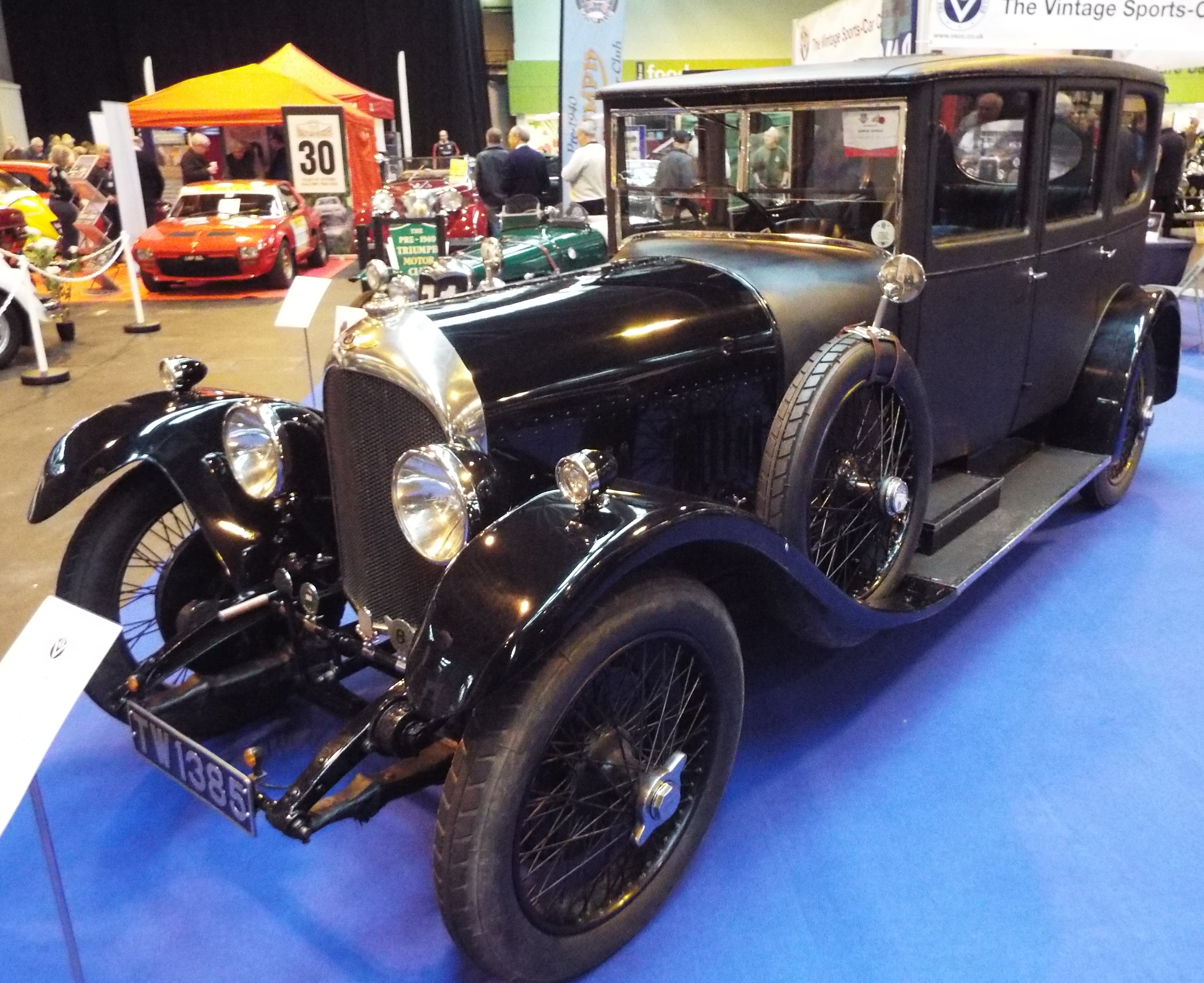
| Field | Value |
|---|---|
| name | Bentley 3 Litre |
| image | 1924 Bentley 3-litre Sports Tourer by Park Ward.jpg |
| caption | 1924 Blue label tourer by Park Ward |
| manufacturer | Bentley Motors Limited |
| production | 1921–1929 |
| 1,622 produced | |
| assembly | United Kingdom: Cricklewood |
| class | Sports car |
| body_style | as arranged with coachbuilder by customer |
| successor | 4½ Litre |
| engine | 3.0 L OHC 4-valve I4 |
| designer | Walter Owen Bentley |
| wheelbase | 108 in |
| 117.5 in | |
| 130 in |
1,622 produced 117.5 in 130 in The Bentley 3 Litre was a car chassis manufactured by Bentley. The company's first, it was developed from 1919 and made available to customers' coachbuilders from 1921 to 1929. The Bentley was very much larger than the 1368 cc Bugattis that dominated racing at the time, but double the size of engine and strength compensated for the extra weight. The 4000 lb (1800 kg) car won the 24 Hours of Le Mans in 1924, with drivers John Duff and Frank Clement, and again in 1927, this time in Super Sports form, with drivers S. C. H. "Sammy" Davis and Dudley Benjafield. Its weight, size, and speed prompted Ettore Bugatti to call it "the fastest lorry in the world", which was regarded as a compliment. Built in 3 main variants, Blue label, Red Label Speed models all carrying a 5-year warranty, and the coveted and rare Green Label 100 mph cars, which only carried a 12-month warranty reflecting the high state of tune.
Coachwork
The 3 Litre was delivered as a running chassis to the coachbuilder of the buyer's choice. Bentley referred many customers to their near neighbour Vanden Plas for bodies. Dealers might order a short cost-saving run of identical bodies to their own distinctive design. Most bodies took the simplest and cheapest form, tourers, but as it was all bespoke or "custom" coachwork, there was plenty of variation. Customers included Prince George, Duke of Kent, Gertrude Lawrence, and Beatrice Lillie.
Engineering

The 3.0 L (2996 cc) straight-4 engine was designed by ex-Royal Flying Corps engineer Clive Gallop and was very technically advanced for its time. It was one of the first production car engines with 4 valves per cylinder, dry-sump lubrication and an overhead camshaft. The four valve SOHC Hemi design, with a bevel-geared shaft drive for the camshaft, was based on the pre-World War I 1914 Mercedes Daimler M93654 racing engine. Just before the outbreak of the war Mercedes had placed one of the winning Grand Prix cars in their London showroom in Long Acre. At the suggestion of W.O. Bentley, then being commissioned in the Royal Naval Air Service, the vehicle was confiscated in 1915 by the British army, dismantled at Rolls-Royce and subjected to scrutiny. A notable difference to both the Mercedes and the aero engines was the cast-iron monobloc design, and the fully Aluminium enclosed camshaft, which greatly contributed to its durability. But having the valve-head and block in one-piece made for a complicated and labour-intensive casting and machining. This was a feature shared during that time by the Bugattis which the car was later to compete with. The engine was also among the first with two spark plugs per cylinder, pent-roof combustion chambers, and twin carburettors. It was extremely undersquare, optimized for low-end torque, with a bore of 80 mm and a stroke of 149 mm.
Un-tuned power output was around 70 hp, allowing the 3 Litre to reach 80 mph. The Speed Model could reach 90 mph; the Super Sports could exceed 100 mph.
A four-speed gearbox was fitted.
The chassis from a Humber was designed by Frederick Tasker Burgess (1879–1929), previously chief designer at Humber, who had worked with W.O. during the war producing the aero engines BR1 and BR2.
Bentley did not deliver complete vehicles, but—as was customary—provided only a rolling chassis.
Only the rear wheels had brakes until 1924, when four-wheel brakes were introduced.
Variants

There were three main variants of the 3-litre and they became known by the colours commonly used on the radiator badge. There was a definite rule controlling badge colours but astonishingly it has since been established that given "special circumstances" the factory would indeed supply a "wrong" colour.
Blue label
This was the standard model with 117.5 in wheelbase from 1921 to 1929 or long 130.0 in wheelbase from 1923 to 1929.
Red label
This used a 5.3:1 high compression engine in the 117.5 in wheelbase chassis and was made from 1924 to 1929.
Green label
Made between 1924 and 1929 this was the high performance model with 6.3:1 compression ratio and short 108 in wheelbase chassis. 100 mi/h performance was guaranteed.
Production
.jpg)
The 3 Litre chassis was shown at the 1919 London Motor Show, but the engine had not yet been finished. It took two years to get the engine right, with the first customer delivery in September 1921. Production lasted through 1929, by which time the car had been surpassed by Bentley's own 4½ Litre car.
- Experimental: 3
- 3 Litre: 1088
- Speed Model: 513
- Super Sports: 18
;Car later rebuilt and supercharged In the winter of 1926/7 the factory's service department created the first supercharged Bentley when chassis number 220 FR5189 had a Roots type blower fitted to its 3-litre engine. This pre-dated the Birkin supercharged Bentleys by two years. Like the later 4½ litre supercharged cars its blower was crankshaft-driven and mounted in front of the radiator between the dumb irons. Unlike them its carburettor was mounted on the left side of the engine block. A rather circuitous intake tract carries the fuel-air mixture forward from there to the blower. On 4½ litre cars the carburettor is mounted on the blower, as commonly done on other supercharged British cars with front-mounted blowers.
| [[File:First supercharged Bentley,frontal.jpg | thumb | left | First supercharged Bentley, FR5189]] | [[File:First supercharged Bentley,engine.jpg | thumb | left | FR5189's Engine]] | [[File:First supercharged Bentley, FR 5189.jpg | thumb | left | FR5189 at Lime Rock Park]] |
|---|
Survivors

The oldest surviving production Bentley is 3 Litre chassis number 3. The first Bentley sold, it was delivered to its original owner in 1921. Bodied by UK coachbuilder R. Harrison & Son, chassis number 3 has engine number 4 and UK registration AX 3827. In 2011 it sold at auction for $962,500 including buyer's premium.
An original, unrestored 1927 3 Litre Speed Model (Red Label), chassis #1209 DE, is a part of the permanent collection at the Simeone Foundation Automotive Museum in Philadelphia, PA, USA. The car retains all of its original components and is the only Bentley to compete in pre-war road racing competition in the USA.
A 1924 3 Litre has been on display at the Shepparton Motor Museum in Shepparton, Victoria, Australia, since July 2019.
References
References
- Baldwin, N.. (1994). "A-Z of Cars of the 1920s". Bay View Books.
- link. "History By Chassis – List of all W. O. Bentleys with original chassis nos. 3 Litre (Page 1)". VintageBentleys.Org. VintageBentleys.org
- (Fall 2011). "The Eight-Litre: Bentley's Last is Bentley's Best". [[Classic Car Club of America]].
- Adolphus, David Traver. (2011). "DMG M 93654". Hemming Motor News Magazine.
- (18 April 2016). "1914 Mercedes 115HP Grand Prix - Supercars.net". Supercars.net.
- Snellmann, Leif. (2000). "Not just one of the Boys". AUTOSPORT MEDIA UK.
- "Mercedes-Benz Motorsport-Story: Teil 2 : Die Daimler-Motoren-Gesellschaft und der Rennsport - Classic".
- Stein, Ralph. (1979). "The Greatest Cars".
- {{webarchive. link. (16 June 2011 BentleyHistory S. 31)
- "Die Bentley-Geschichte". rrec.ch.
- "Bentley Heritage". uniquecarsandparts.com.au.
- Georgano, N.. (2000). "Beaulieu Encyclopedia of the Automobile". HMSO.
- "Gooding & Company Consigns the World's Oldest Bentley and A Superior Motorcycle Owned by Steve McQueen and Von Dutch".
- "1921 Bentley 3 Litre".
- [http://www.autoblog.com/2011/10/09/the-story-behind-the-1921-bentley-3-litre-the-worlds-oldest-pr/ The story behind the 1921 Bentley 3-Litre, the world's oldest production Bentley]
- "1927 Bentley 3 Litre Speed Model". Simeone Foundation Automotive Museum.
This article was imported from Wikipedia and is available under the Creative Commons Attribution-ShareAlike 4.0 License. Content has been adapted to SurfDoc format. Original contributors can be found on the article history page.
Ask Mako anything about Bentley 3 Litre — get instant answers, deeper analysis, and related topics.
Research with MakoFree with your Surf account
Create a free account to save articles, ask Mako questions, and organize your research.
Sign up freeThis content may have been generated or modified by AI. CloudSurf Software LLC is not responsible for the accuracy, completeness, or reliability of AI-generated content. Always verify important information from primary sources.
Report