From Surf Wiki (app.surf) — the open knowledge base
Belfast North (UK Parliament constituency)
Parliamentary constituency in the United Kingdom, 1885–1918 and since 1922
Parliamentary constituency in the United Kingdom, 1885–1918 and since 1922
| Field | Value |
|---|---|
| name | Belfast North |
| parliament | uk |
| map1 | BelfastNorth2024 |
| map_entity | Northern Ireland |
| map_size | 200px |
| year | 1922 |
| type | Borough |
| borough | Belfast |
| previous | |
| seats | 1 |
| electorate | 67,422 (March 2011) |
| population | 102,531 (2011 census) |
| mp | John Finucane |
| party | Sinn Féin |
| region | Northern Ireland |
| county | |
| year2 | 1885 |
| abolished2 | 1918 |
| type2 | Borough |
| next2 | |
| elects_howmany2 | 1 |
| previous2 | Belfast |
Belfast North is a parliamentary constituency in the United Kingdom House of Commons. The MP is John Finucane (Sinn Féin).
History
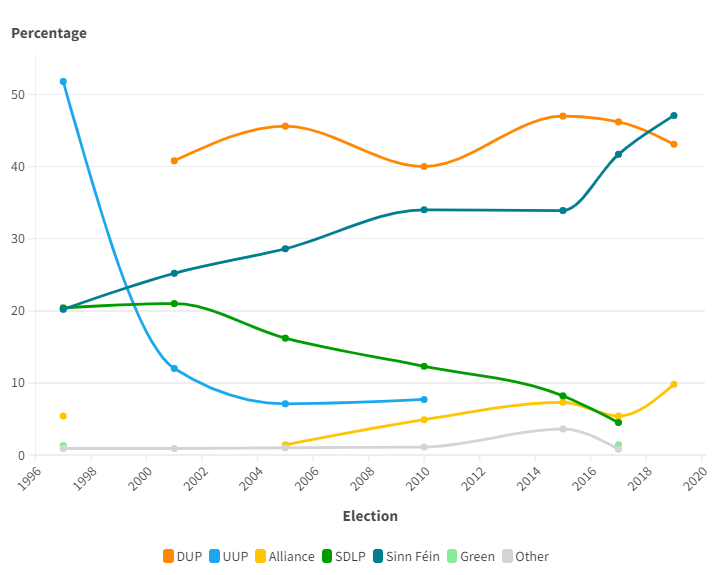
Belfast North historically had a narrow unionist majority, which gradually decreased over time. The nationalist vote is considerable, and those from a Catholic background (47%) now slightly outnumber those from a Protestant background (46%), according to the 2011 census. It has generated particular interest for a number of highly unusual election results, as well as for several candidates and MPs prominently disagreeing with their parties.
Of the five main political parties in Northern Ireland, four (the Ulster Unionist Party, the Democratic Unionist Party, the Social Democratic and Labour Party, and Sinn Féin) all have relatively strong support bases and routinely poll similar results. Other parties such as the Alliance, Progressive Unionist Party, Unionist Party of Northern Ireland, Conservatives and the Workers' Party have at times polled significantly, as have independent candidates, with the result that many elections have been won on comparatively low shares of the vote. The elections to the various assemblies have often seen the seats for the constituency heavily split – in 1998 no party won more than one Assembly seat.
The area saw a steady out movement of Protestants during the Troubles, to some degree replaced by a growing Catholic population, although the overall population of the area fell sharply. However, all the inner-city communities in the constituency are now haemorrhaging electors, and the overall ethnic composition of the constituency now seems stable. The constituency suffered the highest level of violence in Northern Ireland during the Troubles and covers many areas synonymous with the conflict – the New Lodge, Ardoyne, Rathcoole, Ballysillan and Woodvale. The overall tenor of the constituency is working-class, with a high proportion of residents in public housing, and concentrations of low-income single people in the middle Antrim Road and Cliftonville areas. There are some upscale residential areas around Belfast Castle and on the slopes of Cavehill. Sectarian divisions are stark, with a number of Peace lines cutting through the constituency and occasional outbursts of sectarian street violence, and was the focus for post-ceasefire incidents such as the Holy Cross dispute.
The seat was consistently held by the Ulster Unionist Party from its creation until the 1970s. In 1972 the first notable dissent occurred when the sitting MP, Stratton Mills, dissented from the UUP's decision to withdraw from the Conservative whip at Westminster over the suspension of the Stormont Parliament. Mills remained as a Conservative MP, but the following year he joined the Alliance, giving them their only Westminster representation before 2010.
In the February 1974 general election the seat was won by John Carson of the Ulster Unionist Party with backing by the Vanguard Progressive Unionist Party and the Democratic Unionist Party on a united slate in opposition to the Sunningdale Agreement. Carson's victory came despite a majority of votes being cast for pro-Sunningdale candidates, albeit split between the Pro-Assembly Unionists, the Social Democratic and Labour Party and the Northern Ireland Labour Party. Carson held his seat in the October 1974 election but was deselected by the local Ulster Unionists over his support for the minority Labour government.
At the 1979 general election, John McQuade of the Democratic Unionist Party won the seat with a mere 27.6% of the vote – the third lowest total for a successful candidate in a UK general election in the twentieth century. This came about due to the strong showing of several other parties, dividing the vote strongly. McQuade also had the distinction of being the oldest person to be initially elected to Westminster in the 20th century. He did not stand at the next general election.
At the 1983 general election, Cecil Walker regained the seat for the UUP, beating Scotsman George Seawright of the DUP. In the 1987 general election the UUP and DUP agreed a pact in opposition to the Anglo-Irish Agreement. Seawright had been expelled from the DUP and stood in the election, reviving the Protestant Unionist Party label, but was unsuccessful.
Walker continued to hold the seat until 2001 but gained a reputation for inactivity. In the 2001 general election the DUP contested the seat for the first time since 1983, with their candidate Nigel Dodds campaigning heavily on both their opposition to the Good Friday Agreement and Walker's record. Walker also suffered from a disastrous television interview during the campaign. In the election Walker's vote collapsed to a mere 12%, coming fourth whilst Dodds won the seat. The UUP vote fell even further in both the 2003 Assembly election and the 2005 general election.
Nigel Dodds became the DUP's deputy leader and Commons leader in 2008, but the 2010 general election saw Sinn Féin increase their vote share and reduce the DUP majority. Sinn Féin targeted the seat in the 2015 general election, campaigning on returning the constituency's first Irish nationalist MP and the growing Catholic population surpassing Protestants. However, the DUP and the UUP agreed an electoral pact in which the UUP would withdraw their candidate to help re-elect an unionist. This allowed for Dodds to hold the seat comfortably with an increased majority, although a 4.3% swing to Sinn Féin in the 2017 general election confirmed the seat's marginal status.
Prior to the 2019 general election, the SDLP and UUP withdrew their candidates. In a highly divisive contest marred by threats from loyalist paramilitaries, John Finucane of Sinn Féin won with a majority of 1,943 votes. This meant that the 2019 election was the first time that Sinn Féin won multiple seats in Belfast and the first time Belfast North had elected a nationalist instead of a unionist. Dodds was replaced as Commons leader by Jeffrey Donaldson.
Boundaries
Under the Redistribution of Seats Act 1885, the parliamentary borough of Belfast was expanded. The 2-seat borough constituency of Belfast in the House of Commons of the United Kingdom was divided into four divisions: East, South, West, and North.
The city boundaries were expanded under the Belfast Corporation Act 1896. Under the Redistribution of Seats (Ireland) Act 1918, the parliamentary borough was extended to include the whole city and the number of divisions increased from 4 to 9. The Duncairn and Shankill divisions largely replaced the North division. These boundaries were in effect at the 1918 general election.
The Government of Ireland Act 1920 established the Parliament of Northern Ireland, which came into operation in 1921. The representation of Northern Ireland in the Parliament of the United Kingdom was reduced from 30 MPs to 13 MPs, taking effect at the 1922 United Kingdom general election. These changes saw a 4-seat Belfast North constituency in the House of Commons of Northern Ireland and Belfast West re-established as a one-seat constituency at Westminster. The seat is centred on the north section of Belfast, though at times the area around the Docks on the north side of the Lagan Estuary has been part of variously Belfast East and Belfast West.
| 2024– | In Antrim and Newtownabbey, the part of the Abbey ward to the south of the northern boundary of the 2008 Belfast North constituency, and the wards of Ballyhenry, Carnmoney Hill, Collinbridge, Glebe, Glengormley, Hightown, O'Neill, Rathcoole, Valley, Whitehouse ward; |
|---|
Members of parliament
| Election | Member | Party |
|---|---|---|
| 1885 | Sir William Ewart | |
| 1889 by-election | Edward Harland | |
| 1896 by-election | James Horner Haslett | |
| 1905 by-election | Sir Daniel Dixon | |
| 1907 by-election | George Clark | |
| Jan. 1910 | Robert Thompson | |
| 1918 | constituency abolished | |
| 1922 | constituency recreated | |
| Thomas McConnell | ||
| 1929 | Thomas Somerset | |
| 1945 | William Neill | |
| 1950 | H. Montgomery Hyde | |
| 1959 | Stratton Mills | |
| 1972 | ||
| 1973 | ||
| Feb 1974 | John Carson | |
| 1979 | John McQuade | |
| 1983 | Cecil Walker | |
| 2001 | Nigel Dodds | |
| 2019 | John Finucane |
File:Edward James Harland Belfast.jpg|Edward James Harland MP, Lord Mayor of Belfast File:James Horner Haslett Belfast.jpg|James Horner Haslett MP, Mayor of Belfast File:Sir Daniel Dixon.jpg|Sir Daniel Dixon MP, Lord Mayor of Belfast
Elections
Elections in the 2020s
|reg. electors =74,240
Elections in the 2010s
| Party excl. candidate | Vote | % |
|---|---|---|
| Sinn Féin | 23,158 | |
| Democratic Unionist Party | 19,419 | |
| Alliance | 5,009 | |
| Social Democratic and Labour Party | 255 | |
| Ulster Unionist Party | 161 | |
| People Before Profit | 57 | |
| Aontú | 16 | |
| Conservatives | 5 | |
| Majority | 3,739 | 7.8 |
| Turnout | 48,140 | 67.4 |
| Electorate | 71,372 |
|reg. electors = 72,225 This seat saw the only increase in vote share for Sinn Féin at the 2019 general election. |reg. electors = 68,249 |reg. electors = 68,553 |reg. electors = 65,504
Elections in the 2000s
|reg. electors = 52,535 |reg. electors = 60,941
Elections in the 1990s
|reg. electors = 64,645 1997 changes are compared to the 1992 notional results shown below. |reg. electors = 55,068
Elections in the 1980s
|reg. electors = 59,124 |reg. electors = 59,791 |reg. electors = 61,087
Elections in the 1970s
|reg. electors = 65,073 |reg. electors = 71,779 |reg. electors = 72,178 |reg. electors = 75,740
Elections in the 1960s
|reg. electors = 71,434 |reg. electors = 72,400
Elections in the 1950s
|reg. electors = 74,494 |reg. electors = 76,990 |reg. electors = 76,243 |reg. electors = 75,563
Elections in the 1940s
|reg. electors = 73,231
Elections in the 1930s
|reg. electors = 64,259 |reg. electors = 62,017
Elections in the 1920s
|reg. electors = 61,438 |reg. electors = 46,902 |reg. electors = 46,844 |reg. electors =
Elections in the 1910s
|reg. electors = |reg. electors = 11,829
Elections in the 1900s
|reg. electors = 12,065 |reg. electors = 11,385 |reg. electors = 10,762 |reg. electors = 10,117
Elections in the 1890s
|reg. electors = 9,201 |reg. electors = |reg. electors = 8,610
Elections in the 1880s
|reg. electors = 6,469 |reg. electors = 6,831 |reg. electors = 6,831
References
References
- "Usual Resident Population". Northern Ireland Statistics and Research Agency.
- "John Finucane".
- Moriarty, Gerry. (13 December 2019). "Belfast North: John Finucane beats Nigel Dodds in 'showdown' battle". The Irish Times.
- McGrath, Dominic. (4 November 2019). "It'll be a head-to-head between the DUP and SF as the SDLP stands aside in Belfast North".
- (5 November 2019). "Northern Ireland paramilitaries accused of using threats to help DUP in election". [[The Times]].
- "Redistribution of Seats (Ireland) Act 1918 (7 & 8 Geo. 5. c. 65), Second Schedule, Part I".
- (1917). "Representation of the People Bill 1917: redistribution of seats: report". Boundary Commission (Ireland).
- "Redistribution of Seats Act 1885 (48 & 49 Vict. c. 23), s. 8 and Sixth Schedule, Part 3".
- "Government of Ireland Act 1920: Fifth Schedule". [[The National Archives (United Kingdom).
- "Representation of the People Act 1948 (11 & 12 Geo. 6, Ch. 65)". The National Archives.
- "The Parliamentary Constituencies (Northern Ireland) Order 1970 (No. 1678)". The National Archives.
- (22 December 1982). "The Parliamentary Constituencies (Northern Ireland) Order 1982 (No. 1838)". The National Archives.
- {{Cite legislation UK. (1995). (23 November 1995)
- {{Cite legislation UK. (2008). (11 June 2008)
- {{Cite legislation UK. (2023). (15 November 2023)
- "General election for the constituency of Belfast North on 4 July 2024".
- "Belfast North: Seat Details".
- (2024-06-07). "Statement of Persons Nominated and Notice of Poll".
- "Notional results for a UK general election on 12 December 2019". [[UK Parliament]].
- "Belfast North Parliamentary constituency". BBC News.
- (19 December 2019). "General Election 2019: results and analysis". House of Commons Library.
- (11 May 2017). "Election of a Member of Parliament for the BELFAST NORTH Constituency – Statement of Persons Nominated and Notice of Poll". Electoral Office of Northern Ireland.
- "UK Parliamentary Election Result 2017 – Belfast North".
- "Election Data 2015". [[Electoral Calculus]].
- "The Electoral Office of Northern Ireland – EONI".
- "Member of Parliament for Belfast North". YourNextMP.
- "Election Data 2010". [[Electoral Calculus]].
- [http://news.bbc.co.uk/1/shared/election2010/results/constituency/702.stm Election 2010: Belfast North] {{Webarchive. link. (23 August 2017 , [[BBC News]])
- "Election Data 2005". [[Electoral Calculus]].
- "Election Data 2001". [[Electoral Calculus]].
- "Election Data 1997". [[Electoral Calculus]].
- "BBC – Error 404 : Not Found". BBC.
- "Election Data 1992". [[Electoral Calculus]].
- "Election Data 1987". [[Electoral Calculus]].
- [http://www.election.demon.co.uk/by1983.html Results of Byelections in the 1983–87 Parliament] {{Webarchive. link. (5 April 2018 in the [http://www.election.demon.co.uk/election.html United Kingdom Election Results website] {{Webarchive). link. (7 May 2009 maintained by David Boothroyd)
- "Election Data 1983". [[Electoral Calculus]].
- (1969). "British parliamentary election results 1918–1949". Political Reference Publications.
- (1978). "Parliamentary Election Results in Ireland, 1801–1922". Royal Irish Academy.
This article was imported from Wikipedia and is available under the Creative Commons Attribution-ShareAlike 4.0 License. Content has been adapted to SurfDoc format. Original contributors can be found on the article history page.
Ask Mako anything about Belfast North (UK Parliament constituency) — get instant answers, deeper analysis, and related topics.
Research with MakoFree with your Surf account
Create a free account to save articles, ask Mako questions, and organize your research.
Sign up freeThis content may have been generated or modified by AI. CloudSurf Software LLC is not responsible for the accuracy, completeness, or reliability of AI-generated content. Always verify important information from primary sources.
Report