From Surf Wiki (app.surf) — the open knowledge base
Beijing Capital International Airport
Airport serving Beijing, China

Airport serving Beijing, China
| Field | Value | |
|---|---|---|
| name | Beijing Capital International Airport | |
| nativename | 北京首都国际机场 | |
| image | BeijingCAH.svg | |
| image-width | 250 | |
| image2 | Aerial view of Beijing Capital International Airport (cropped).jpg | |
| image2-width | 280 | |
| caption2 | Aerial view of the airport in December 2022 | |
| IATA | PEK | |
| ICAO | ZBAA | |
| WMO | 54511 | |
| type | Public | |
| owner-oper | Beijing Capital International Airport Company Limited | |
| city-served | Jing-Jin-Ji Beijing | |
| location | Shunyi, Beijing, China | |
| opened | ||
| hub | {{ubl | class=nowrap |
| focus_city | {{ubl | class=nowrap |
| elevation-f | 116 | |
| coordinates | ||
| website | ||
| pushpin_map | China Beijing#China | |
| pushpin_map_caption | Location in Beijing##Location in China | |
| pushpin_label | PEK/ZBAA | |
| r1-number | 18L/36R | |
| r1-length-m | 3,810 | |
| r1-surface | Asphalt | |
| r2-number | 18R/36L | |
| r2-length-m | 3,445 | |
| r2-surface | Asphalt | |
| r3-number | 01/19 | |
| r3-length-m | 3,810 | |
| r3-surface | Concrete | |
| metric-rwy | yes | |
| stat-year | 2024 | |
| stat1-header | Passengers | |
| stat1-data | 67,367,428 | |
| stat2-header | Aircraft movements | |
| stat2-data | 433,572 | |
| stat3-header | Cargo (metric tons) | |
| stat3-data | 1,443,286 | |
| footnotes | Statistics from Airports Council International, China's busiest airports by passenger traffic by CAAC |
| image-width = 250 | image2-width = 280 | owner-oper = Beijing Capital International Airport Company Limited | city-served = Jing-Jin-Ji Beijing | Air China | Hainan Airlines | SF Airlines}} | Sichuan Airlines | Shenzhen Airlines | Shandong Airlines}} | elevation-f = 116
| r1-number = 18L/36R | r1-length-m = 3,810 | r1-surface = Asphalt | r2-number = 18R/36L | r2-length-m = 3,445 | r2-surface = Asphalt | r3-number = 01/19 | r3-length-m = 3,810 | r3-surface = Concrete | metric-rwy = yes | stat-year = 2024 | stat1-header = Passengers | stat1-data = 67,367,428 | stat2-header = Aircraft movements | stat2-data = 433,572 | stat3-header = Cargo (metric tons) | stat3-data = 1,443,286
Beijing Capital International Airport is the busier of the two international airports serving Beijing, the capital city of China (the other one being Beijing Daxing International Airport). The airport is located 32 km northeast of downtown Beijing, in an exclave of Chaoyang and the surroundings of that exclave in suburban Shunyi. The airport is owned and operated by the Beijing Capital International Airport Company Limited, a state-controlled company. The airport's IATA Airport code, PEK, is based on the city's former romanized name, Peking. The facility covers an area of 3,657 acre of airport property.
History
Beijing Airport was opened on 1 March 1958. The airport then consisted of one small terminal building, which still stands to this day, apparently for the use of VIPs and charter flights, along with a single 2,500 m runway on its eastern side, which was extended to 3,200 m in 1966 and 3,800 m in 1982 respectively. Another 3200 m runway on the west was completed in October 1978. On 1 January 1980, a newer, larger Terminal 1 – green in color – opened, with docks for 10 to 12 aircraft. The terminal was larger than the one built in the 1950s but, by the mid-1990s, its size had become inadequate.
The first international flight to China and Beijing Capital International Airport was of Pakistan International Airlines from Islamabad.

In late 1999, to mark the 50th anniversary of the founding of the PRC, the airport underwent a new round of expansion. Terminal 2 opened on 1 November of that year and Terminal 1 was temporarily closed for renovation. 20 September 2004 saw the opening of the renovated Terminal 1 which, at that time, only handled China Southern Airlines' domestic and international flights from Beijing. Other airlines' domestic and international flights still operated in Terminal 2.
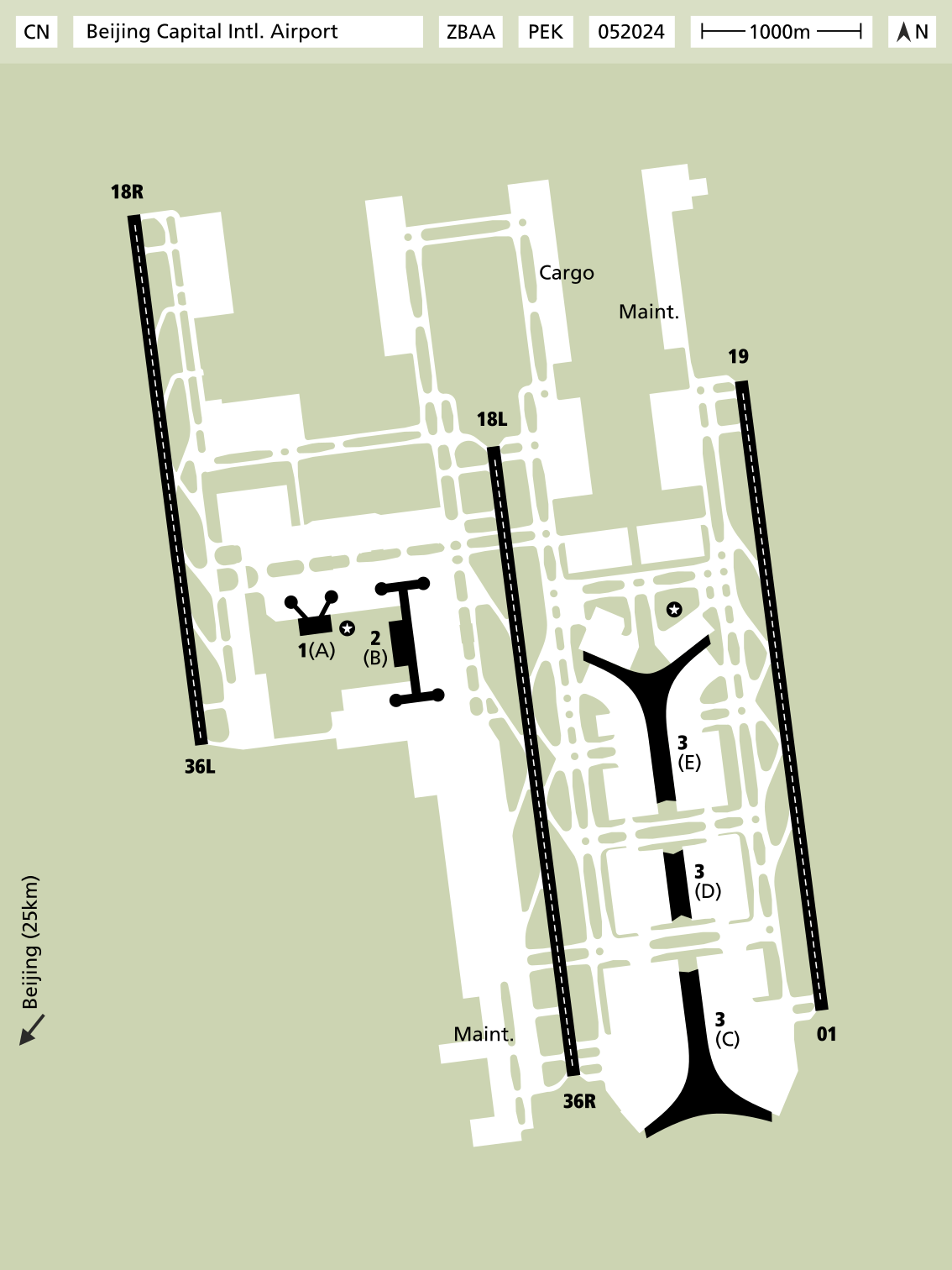
More expansion began in 2007. A third runway opened on 29 October 2007, to relieve congestion on the other two runways. Terminal 3 (T3) was completed in February 2008, in time for the 2008 Beijing Summer Olympics. The significant expansion included a rail link to the city center.
At its opening, the new Terminal 3 was the largest man-made structure in the world in terms of area covered, and a major landmark in the developing Chinese capital. The expansion was largely funded by a 30 billion yen loan from Japan and a 500-million-euro (US$625 million) loan from the European Investment Bank (EIB). The loan was the largest ever granted by the EIB in Asia, and the agreement was signed during the eighth China-EU Summit held in September 2005.
Following the 2008 Summer Olympics and the addition of adding the new terminal building, Beijing Capital overtook Tokyo Haneda as the busiest airport in Asia based on scheduled seat capacity.
Due to limited capacity of Beijing Capital International Airport, plans were announced for the construction of a new airport at Daxing. The project was given final approval on 13 January 2013. Construction began in late 2014 and was completed in 2019. The new Daxing Airport became the Beijing home of China Eastern Airlines, China Southern Airlines, and China United Airlines, while Air China and Hainan Airlines remained at Capital.
Terminals
.jpg)
Shuttle buses connect the airport's three terminals. Terminal 2 serves Hainan Airlines and SkyTeam with the exception of China Airlines, Oneworld member SriLankan Airlines, and also other domestic and international flights. Terminal 3, the newest terminal, serves Air China, Star Alliance, Oneworld members with the exception of SriLankan Airlines, plus SkyTeam member China Airlines, and some other domestic and international flights that do not operate from Terminals 2.
Terminal 2
Terminal 2 opened on 1 November 1999, with a floor area of 336000 m2. This terminal was used to replace Terminal 1 while the latter was undergoing renovation, cramping all airlines despite being far bigger than Terminal 1. It can handle twenty aircraft at docks connecting directly to the terminal building. Prior to the opening of Terminal 3, all international flights (and the majority of domestic flights) operated from this terminal. This terminal now houses Hainan Airlines (all international, Hong Kong, Macau, and Taiwan flights), SkyTeam with the exception of China Airlines, which uses Terminal 3, Oneworld member SriLankan Airlines, Air Koryo, and other domestic and international flights other than those operated by Shanghai Airlines, Star Alliance members and Oneworld members. A gate capable of handling the A380 (gate 21) was also built at the terminal. Star Alliance member Air China also uses Terminal 2 for some of its domestic flights.
Terminals 1 and 2 are linked by a public walkway that takes about 10–15 minutes to traverse.
|File:Beijing Capital International Airport Terminal 2 20120915.JPG|BCIA Terminal 2 |File:Beijing Capital International Airport T2 Departure hall 20120814.JPG|Terminal 2 departure hall |File:Interior of Beijing Capital International Airport T2 20220609.jpg|Terminal 2 waiting hall |SkyTeam Lounge in Beijing (25391270759).jpg|SkyTeam lounge at Terminal 2 |Airbus A330-343X, China Eastern Airlines AN1839733.jpg|Takeoff view of T2 in 2010, from a China Eastern Airlines flight
Westwing Satellite Terminal (formerly Terminal 1)

Terminal 1, with 60000 m2 of space, opened on 1 January 1980, and replaced the smaller existing terminal, which had been in operation since 1958. Terminal 1 was closed for renovation from 1 November 1999 to 20 September 2004, during which all airlines operated from Terminal 2. Featuring 16 gates, it was the operational base for the domestic routes of China Southern Airlines and a few other airlines such as XiamenAir and Chongqing Airlines, and was originally planned to handle domestic traffic excluding those to Hong Kong and Macau.
With the opening of Terminal 3, the terminal was closed for light refurbishment, and its airlines were moved to Terminal 2 on 20 May 2008. Terminal 1 reopened for a second time on 27 June 2008, and became the operational base for all domestic flights operated by the HNA Group including those of Hainan Airlines, Grand China Air and Tianjin Airlines, while all HNA Group's international, Hong Kong, Macau, and Taiwan flights remain in Terminal 2.
On 3 May 2020, Terminal 1 temporary closed for reproposing, after Hainan Airlines moved its all domestic routes to Terminal 2. The Terminal 1 was reopened on 1 August 2023 as Westwing Satellite Terminal as part of Terminal 2.
|File:Beijing Capital International Airport Terminal 1 20120915.JPG|BCIA Terminal 1 |File:Beijing Capital International Airport T1 Departure hall 201209151459.JPG|Terminal 1 departure hall |File:Beijing Capital International Airport T1 Waiting hall 20120915.JPG|Terminal 1 waiting hall |File:Beijing Capital International Airport T1 Arrival hall 20161124.jpg|Terminal 1 arrival hall |File:Beijing Capital International Airport T1 Corridor 10291002.jpg|Terminal 1 corridor
Terminal 3
Construction of Terminal 3 started on 28 March 2004, and the terminal opened in two stages. Trial operations commenced on 29 February 2008, when seven airlines including El Al, Qantas, Qatar Airways, Shandong Airlines and Sichuan Airlines moved into the terminal. Twenty other airlines followed when the terminal became fully operational on 26 March 2008. Currently, it mainly houses Air China, Star Alliance, Oneworld with the exception of SriLankan Airlines, which uses Terminal 2, SkyTeam member China Airlines, and other domestic and international flights that are not operated from Terminal 2. Star Alliance members LOT Polish Airlines, Scandinavian Airlines, Lufthansa, Austrian Airlines, United Airlines, Air Canada, Turkish Airlines, Thai Airways International, Singapore Airlines, All Nippon Airways, Asiana Airlines and Air China use Terminal 3-E as part of the Move Under One Roof program to co-locate alliance members.
Terminal 3 was designed by a consortium of Netherlands Airport Consultants (NACO), Foster + Partners, Arup and the Beijing Institute of Architectural Design (BIAD). Lighting was designed by UK lighting architects Speirs and Major Associates. The budget for the expansion is US$3.5 billion. Much larger in size and scale than the other two terminals, Terminal 3 was the largest airport terminal-building complex in the world to be built in a single phase, with 986000 m2 in total floor area at its opening.
At the time of its opening, Terminal 3 was the largest airport passenger terminal building in the world. Its title as the world's largest passenger terminal was surrendered on 14 October 2008 to Dubai International Airport's Terminal 3, which has 1713000 m2 of floor space.
On 20 July 2013, a man in a wheelchair detonated small homemade explosives in Terminal 3 of the Beijing International Airport. The bomber, reported to be Ji Zhongxing, was injured and taken to a hospital for his injuries. No other people were hurt.
|Airport, Terminal JP6209567.jpg|Terminal 3 exterior |Beijing Capital International Airport on 18 February 2018 - SkySat (2).jpg|Terminal 3E aerial view |VM Beijing Airport - hallways 4350.jpg|Terminal 3 transport hub interior |File:Beijing capital airport 8.jpg|Terminal 3 waiting hall |Beijing Capital International Airport Terminal 3 water feature by Don Ramey Logan.jpg|Waiting hall water feature in Terminal 3E |File:Empty international arrivals area of ZBAA T3 (20200825175054).jpg|International arrivals area}}
System, security and luggage
.jpg)
Terminal 3 has a 300000 m2 transportation hub with a 7,000-car garage. The transportation center has designated traffic lanes for airport buses, taxis, and private vehicles. Travelers bound for T3 can exit their vehicles and enter T3 within five minutes. There is also a station for the Capital Airport Express of the Beijing Subway.
Terminal 3 has 243 elevators, escalators or moving walkways.
One of Terminal 3's highlights is the US$240 million luggage-transfer systems. The luggage system is equipped with yellow carts, each of which has a code that matches the bar code on every piece of luggage loaded and allows easy and accurate tracking. More than 200 cameras are used to monitor activities in the luggage area.
The luggage system can handle 19,200 pieces of luggage per hour. After luggage is checked in at any of the 292 counters in Terminal 3C, it can be transferred at a speed of ten meters per second. Hence, a suitcase can travel from T3C to T3E in five minutes. Arriving passengers should be able to begin retrieving their luggage within 4.5 minutes after airplanes are unloaded.
Besides X-ray scanners, additional equipment is used to conduct baggage screening. Passengers will be able to check-in their luggage at the airport from several hours to even a day before their flights. The airport will store the luggage in its luggage system and then load it on the correct aircraft.

Appearance
The highest building at the airport, a 98.3 m monitoring tower, stands at the southern end of T3. The roof of T3 is red, the Chinese color for good luck. The terminal's ceilings use white strips for decoration and to indicate directions. Under the white strips, the basic color of the ceiling is orange with light to dark tones indicating where a passenger is inside the building. The roof is light orange in the center. The color deepens as the roof extends to the sides in T3E and goes the other way round in T3C.
The roof of T3 has dozens of triangular windows to let in the daylight. Light angles can be adjusted to ensure adequate interior lighting. Many traditional Chinese elements will be employed in the terminal's interior decoration, including a "Menhai", a big copper vat used to store water for fighting fires in the Forbidden City, and the carvings imitating the famous Nine-Dragon Wall.
An indoor garden in the T3E waiting area is built in the style of imperial gardens such as the Summer Palace. In T3C, a tunnel landscape of an underground garden has been finished with plants on each side so that passengers can appreciate them inside the mini-train.
Facilities
.jpg)
The T3 food-service area is called a "global kitchen", where 72 stores provide food ranging from formal dishes to fast food, from Chinese to Western, and from bakery goods to ice cream. Airport officials have promised that people who buy products at the airport will find the same prices in central Beijing. In addition to food and beverage areas, there is a 16200 m2 domestic retail area, a 12600 m2 duty-free-store area and a nearly 7200 m2 convenience-service area, which includes banks, business centers, Internet services and more. At 45200 m2, the commercial area is twice the size of Beijing's Lufthansa Shopping Center.
The terminal provides 72 aerobridges or jetways and is further complemented with remote parking bays that bring the total number of gates to 150. Terminal 3 comes with an additional runway. It increases BCIA's total capacity by 72 million passengers per year to approximately 90 million.
Airbus A380
The terminal has gates and a nearby runway that can handle the Airbus A380. This capability was proven when Singapore Airlines briefly offered A380 flights to Beijing in August 2008 during the Summer Olympics. Emirates started its scheduled daily operation to Dubai on 1 August 2010. Singapore Airlines has been using an A380 since June 2014 and increased to two A380s in 2015. China Southern Airlines operated two flights to Guangzhou Baiyun Airport, Chongqing Jiangbei Airport, and Amsterdam Schiphol Airport starting from 2011, 2013, and 2015 before retiring them in 2023. Lufthansa has been using these facilities since October 2010 to handle up to five A380 flights per week.
Airlines and destinations
Passenger
| Air Algérie | Algiers | Air Astana | Almaty | Air Canada | Vancouver | Air China | Aksu, Almaty, Astana, Athens, Auckland, Abu Dhabi, Bangkok–Suvarnabhumi, Baotou, Barcelona, Bayannur, Beihai, Brussels (begins 24 March 2026), Budapest, Busan, Cairo, Changchun, Changsha, Changzhi, Changzhou, Chengdu–Shuangliu, Chengdu–Tianfu, Chiang Mai, Chita, Chongqing, Copenhagen, Dali, Dalian, Dandong, Daqing, Dazhou, Dhaka, Dubai–International, Dunhuang, Frankfurt, Fukuoka, Fuyang, Fuyuan, Fuzhou, Ganzhou, Geneva, Guangyuan, Guangzhou, Guilin, Guiyang, Haikou, Hailar, Hami, Hangzhou, Hanoi, Harbin, Havana, Hefei, Hengyang, Hiroshima, Ho Chi Minh City, Hohhot, Hong Kong, Hotan, Huangshan, Huizhou, Irkutsk, Islamabad, Istanbul, Jakarta–Soekarno-Hatta, Jeju, Jiamusi, Jiansanjiang, Jieyang, Jingdezhen, Jinggangshan, Jiuzhaigou, Johannesburg–O.R. Tambo, Karachi, Karamay, Kashgar, Korla, Kuala Lumpur–International, Kunming, Lanzhou, Lhasa, Lianyungang, Lijiang, Linfen, Lishui, Liupanshui, Liuzhou, London–Gatwick, London–Heathrow, Los Angeles, Lüliang, Madrid, Manila, Melbourne, Mianyang, Milan–Malpensa, Minsk, Moscow–Sheremetyevo, Mudanjiang, Munich, Nagoya–Centrair, Naha, Nanchang, Nanjing, Nanning, Nantong, New York–JFK, Ningbo, Nyingchi, Ordos, Osaka–Kansai, Paris–Charles de Gaulle, Phnom Penh, Phuket, Qingdao, Qiqihar, Quzhou, Riyadh, Rome–Fiumicino, San Francisco, Sanya, São Paulo–Guarulhos, Sapporo–Chitose, Sendai, Seoul–Gimpo, Seoul–Incheon, Shanghai–Hongqiao, Shanghai–Pudong, Shangrao, Shaoyang, Shenyang, Shenzhen, Shiyan, Singapore, Songyuan, Stockholm–Arlanda, Suifenhe, Sydney, Taipei–Taoyuan, Taiyuan, Taizhou, Tashkent, Tokyo–Haneda, Tokyo–Narita, Tonghua, Tongliao, Toronto–Pearson, Tumxuk, Ulaanbaatar, Ulanhot, Ürümqi, Vancouver, Vienna, Vladivostok, Warsaw–Chopin, Washington–Dulles, Weihai, Wenzhou, Wuhan, Xiamen, Xi'an, Xichang, Xilinhot, Xining, Yan'an, Yancheng, Yangon, Yangzhou, Yanji, Yantai, Yibin, Yichang, Yinchuan, Yining, Yiwu, Yuncheng, Zhangjiajie, Zhanjiang, Zhengzhou, Zhuhai, Zunyi–Maotai | Air China Inner Mongolia | Xiamen | Air France | Paris–Charles de Gaulle | Air Koryo | Pyongyang | Air Macau | Macau | All Nippon Airways | Osaka–Kansai, Tokyo–Haneda | Asiana Airlines | Seoul–Gimpo, Seoul–Incheon | Azerbaijan Airlines | Baku | Cathay Pacific | Hong Kong | China Airlines | Taipei–Taoyuan | China Eastern Airlines | Shanghai–Hongqiao, Shanghai–Pudong | Dalian Airlines | Dalian, Xiamen, Xi'an | Egyptair | Cairo | Emirates | Dubai–International | Ethiopian Airlines | Addis Ababa | EVA Air | Taipei–Taoyuan | Fuzhou Airlines | Fuzhou | Grand China Air | Anqing, Hailar, Harbin, Jiujiang, Manzhouli, Yinchuan | Hainan Airlines | Altay, Bangkok–Suvarnabhumi, Belgrade, Berlin, Boston, Brussels, Changsha, Chengdu–Shuangliu, Chongqing, Dalian, Dongying, Dublin, Edinburgh, Fuzhou, Guangzhou, Guiyang, Haikou, Hangzhou, Harbin, Holingol, Irkutsk, Jiamusi, Jixi, Kashgar, Lanzhou, Longnan, Moscow–Sheremetyevo, Nanchang, Nanning, Osaka–Kansai, Oslo, Phuket, Prague, Qianjiang, Qionghai, Saint Petersburg, Sanya, Seattle/Tacoma, Shanghai–Hongqiao, Shanghai–Pudong, Shenzhen, Taipei–Taoyuan, Tel Aviv, Tijuana, Tokyo–Haneda, Tokyo–Narita, Toronto–Pearson, Ürümqi, Vladivostok, Wenzhou, Wuhai, Wuhan, Xiamen, Xi'an, Yichang, Yueyang, Yulin (Guangxi), Yulin (Shaanxi), Zhangye | Hong Kong Airlines | Hong Kong | Iraqi Airways | Baghdad, Basra | Japan Airlines | Tokyo–Haneda | Jeju Air | Jeju | KLM | Amsterdam | Korean Air | Busan, Jeju, Seoul–Gimpo, Seoul–Incheon | Kunming Airlines | Kunming | Loong Air | Hangzhou | Lucky Air | Kunming | Lufthansa | Munich | Mahan Air | Tehran–Imam Khomeini | Maldivian | Malé | MIAT Mongolian Airlines | Ulaanbaatar | Pakistan International Airlines | Islamabad | Philippine Airlines | Manila | Shandong Airlines | Fuzhou, Qingdao, Xiamen, Yantai, Zhuhai | Shenzhen Airlines | Chengdu–Tianfu, Guangzhou, Nanning, Nantong, Quanzhou, Shenzhen, Wuxi, Xiangyang, Yichun (Jiangxi) | Sichuan Airlines | Cairo, Chengdu–Shuangliu, Chengdu–Tianfu, Chongqing, Kashgar, Zhongwei | Singapore Airlines | Singapore | Spring Airlines Japan | Tokyo–Narita | SriLankan Airlines | Colombo–Bandaranaike | Thai Airways International | Bangkok–Suvarnabhumi | Tibet Airlines| Chengdu–Shuangliu, Lhasa, Qamdo | Turkish Airlines | Istanbul | Turkmenistan Airlines | Ashgabat | United Airlines | Los Angeles, San Francisco | Uzbekistan Airways | Tashkent | Vietnam Airlines | Hanoi, Ho Chi Minh City, Nha Trang

Cargo
| AirBridgeCargo | Moscow–Sheremetyevo | Air China Cargo | Amsterdam, Anchorage, Atlanta, Chicago–O'Hare, Frankfurt, Glasgow–Prestwick, Los Angeles, Munich, Nanjing, New York–JFK, Paris–Charles de Gaulle, Seoul–Incheon, Shanghai–Pudong, Taipei–Taoyuan, Tokyo–Narita | Air Koryo Cargo | Pyongyang | Asiana Cargo | Seoul–Incheon | Cargolux | Luxembourg | China Airlines Cargo | Taipei–Taoyuan | China Cargo Airlines | Shanghai–Pudong | China Postal Airlines | Guangzhou, Hangzhou, Nanjing, Seoul-Incheon, Shanghai–Pudong, Shenzhen | DHL Aviation operated by Air Hong Kong | Hong Kong | Etihad Cargo | Abu Dhabi, Almaty | EVA Air Cargo | Taipei–Taoyuan | FedEx Express | Osaka–Kansai, Paris–Charles de Gaulle, Seoul–Incheon, Shanghai–Pudong | Garuda Cargo | Jakarta–Soekarno-Hatta | Korean Air Cargo | Seoul–Incheon | Lufthansa Cargo | Frankfurt | SF Airlines | Guangzhou, Hangzhou, Macau, Shanghai–Pudong, Shenzhen, Wuxi | Singapore Airlines Cargo | Singapore | Suparna Airlines Cargo | Hangzhou, Shanghai–Pudong, Shenzhen
Ground transportation
Intraterminal transportation
Terminal 3 consists of three sub-concourses. Both domestic and international travellers check in at concourse T3C. Gates for domestic flights are in T3C, and gates for domestic flights operated by Air China are also located in concourse T3D. All international, Hong Kong, and Macau, and Taiwan flights are handled in concourse T3E.
.jpg)
In conjunction with the construction of the new terminal, Bombardier Transportation installed a 2 km automated people mover which connects T3C and T3E via T3D in a 2–5-minute one-way trip. The line uses Innovia APM 100 vehicles running at 6-minute intervals at a maximum speed of 55 km/h.
New Innovia APM 300 vehicles were being delivered to Beijing Capital International Airport Terminal 3 People Mover in July 2021.
Interterminal transportation
.jpg)
The airport provides a free interterminal shuttle bus between Terminals 1/2 and 3. They operate every 10 minutes from 6 am to 11 pm, and every 30 minutes from 11 pm until 6 am. Terminals 1 and 2 are connected by a lengthy corridor.
.jpg)
Rail
Main article: Capital Airport Express
Beijing Capital International Airport is served by the Capital Airport Express, a dedicated rail link operated as part of the Beijing Subway system. The 30.0 km line runs from Terminal 3 to Terminal 2 and then to the city with stops at Sanyuanqiao and Dongzhimen before ending at Beixinqiao. The line opened on 19 July 2008, in time for the 2008 Summer Olympics, while a one-stop extension to Beixinqiao station was opened on 31 December 2021. A one-way trip takes approximately 16–20 minutes.
Bus
.jpg)
Main article: Beijing Capital Airport Bus
There are 18 bus routes to and from points throughout the city including Xidan, Beijing railway station, Beijing South railway station, Beijing West railway station, Zhongguancun, Fangzhuang and Shangdi. The airport buses run to each of the three terminals and cost up to ¥30 per ride depending on the route. The airport buses accept only paper tickets that are sold at each terminal and certain bus stops in the city. The airport also offers intercity bus services to and from neighboring cities including Tianjin, Qinhuangdao, Baoding, Langfang and Tangshan.
Car
The airport is accessible by four expresses tollways, two of which run directly from northeastern Beijing to the airport. The other two connect to the airport from nearby highways.
- The Airport Expressway is a 20 km toll road that runs from the northeastern 3rd Ring Road at Sanyuanqiao directly to Terminals 1 and 2. It was built in the 1990s and has served as the primary road connection to the city.
- The 2nd Airport Expressway, opened in 2008, is a 15.6 km toll road that runs east from Yaojiayuan Lu at the eastern 5th Ring Road and then north to Terminal 3.
- The Northern Airport Line, opened in 2006, is an 11.3 km toll road that runs east from the Jingcheng Expressway to Terminals 1 and 2.
- The Southern Airport Line, opened in 2008, is a toll road that runs parallel and to the south of the Northern Airport Line from the Jingcheng Expressway to the eastern Sixth Ring Road at the Litian Bridge. This highway crosses the Airport Expressway and 2nd Airport Expressway, and enables drivers on the former to reach Terminal 3 and the latter to head to Terminals 1 and 2.
Accolades
| Traffic | Rank | Year | ||
|---|---|---|---|---|
| List of airports by passenger traffic | ||||
| List of airports by traffic movements | ||||
| List of airports by cargo traffic |
- 2009 – first on the ranking of the World's Best Airport by Condé Nast Traveler magazine, based on its satisfaction survey.
- 2011 – third Best Airport Worldwide of the Airport Service Quality Awards by Airports Council International.
- 2011–2022 – ACI Director General's Roll of Excellence by Airports Council International
- 2020, 2021 – best airport in the Asia-Pacific serving over 40 million passengers per year by Airports Council International
- 2021 – best hygiene measures in the Asia-Pacific by Airports Council International
- 2021 – Voice of the Customer by Airports Council International
Statistics
| Year | Passenger volume | Change from previous year | Aircraft operations | Cargo | ||||||||||||||||||||||||
|---|---|---|---|---|---|---|---|---|---|---|---|---|---|---|---|---|---|---|---|---|---|---|---|---|---|---|---|---|
| (tons) | url=http://www.caac.gov.cn/I1/K3/200903/P020090316404943831137.xls | script-title=zh:2008年全国机场吞吐量排名 | access-date=29 March 2011 | date=12 March 2009 | publisher=Civil Aviation Administration of China | url-status=dead | archive-url=https://web.archive.org/web/20110524111655/http://www.caac.gov.cn/I1/K3/200903/P020090316404943831137.xls | archive-date=24 May 2011 }} | 2008 | 2009 | 2010 | 2011 | 2012 | 2013 | 2014 | 2015 | 2016 | 2017 | 2018 | 2019 | 2020 | 2021 | 2022 | 2023 | 2024{{Cite web | date=2 April 2025 | title=2024年度营运数据 | url=https://en.bcia.com.cn/userfiles/files/article/images/2025/02/nianduyingyunshuju_2024.zip |
| 53,611,747 | 399,209 | 1,416,211.3 | ||||||||||||||||||||||||||
| 55,938,136 | 4.3% | 429,646 | 1,367,710.3 | |||||||||||||||||||||||||
| 65,375,095 | 16.9% | 487,918 | 1,475,656.8 | |||||||||||||||||||||||||
| 73,948,114 | 13.1% | 517,585 | 1,551,471.6 | |||||||||||||||||||||||||
| 78,674,513 | 6.4% | 533,166 | 1,640,231.8 | |||||||||||||||||||||||||
| 81,929,359 | 4.1% | 557,167 | 1,787,027 | |||||||||||||||||||||||||
| 83,712,355 | 2.2% | 567,759 | 1,843,681 | |||||||||||||||||||||||||
| 86,128,313 | 2.9% | 581,952 | 1,848,251 | |||||||||||||||||||||||||
| 89,900,000 | 4.4% | 594,785 | 1,843,543 | |||||||||||||||||||||||||
| 94,393,000 | 5.6% | 606,086 | 1,831,167 | |||||||||||||||||||||||||
| 95,786,296 | 1.5% | 597,259 | 2,029,583 | |||||||||||||||||||||||||
| 100,983,290 | 5.4% | 614,022 | 2,074,005 | |||||||||||||||||||||||||
| 100,013,642 | 1.0% | 594,000 | 1,955,286 | |||||||||||||||||||||||||
| 34,513,827 | 65.5% | 291,498 | 1,210,441 | |||||||||||||||||||||||||
| 32,639,013 | 5.4% | 297,176 | 1,401,313 | |||||||||||||||||||||||||
| 12,703,342 | 61.1% | 157,630 | 988,675 | |||||||||||||||||||||||||
| 52,879,156 | 316.3% | 379,710 | 1,115,908 | |||||||||||||||||||||||||
| archive-url=https://web.archive.org/web/20250402183928/https://en.bcia.com.cn/userfiles/files/article/images/2025/02/nianduyingyunshuju_2024.zip | format=XLS }} | 67,367,428 | 27.4% | 433,572 | 1,443,286 |
Climate
Other facilities
Beijing Capital Airlines has its headquarters in the Capital Airlines Building () at the airport.
Accidents and incidents at or near PEK
On December 5, 1968, the airport was the site of two fatal accidents in less than 24 hours;
- A Civil Aviation Administration of China (CAAC) Ilyushin Il-14 on approach plunged towards the ground for undetermined reasons (possibly wind shear), broke apart and caught fire, and killed 13 out of the 14 occupants on board.
- Another CAAC Ilyushin Il-14 crashed 1.2 km (0.8mls) from PEK during a nighttime approach in poor visibility because of an incorrect altimeter setting and the absence of the flight instructor in the cockpit during the approach. Both occupants died. On August 27, 2019, an Air China Airbus A330 caught fire while parked at the gate during boarding. All 161 passengers and crew evacuated safely, but the aircraft was substantially damaged and written off.
Sister airports
- O'Hare International Airport
- Helsinki Airport
- Hong Kong International Airport
- Los Angeles International Airport
- Manchester Airport
- Munich Airport
- Suvarnabhumi Airport
- Sydney Airport
- Stockholm Arlanda Airport
- Zayed International Airport
References
References
- "Boeing: Airport Compatibility - Airport Planning and Engineering Services".
- (13 March 2019). "Preliminary world airport traffic rankings".
- link. (5 March 2019). Civil Aviation Administration of China
- [http://www.hytrip.net/n23609c971.aspx Map from Maptown.cn]. ([https://web.archive.org/web/20130116040631/http://www.hytrip.net/n23609c971.aspx Archive])
- (13 September 2022). "Beijing Capital Int'l Airport Facts and Figures".
- Beijing Almanac Editing Committee (北京市地方志编纂委员会). Beijing Press . (2000)
- link
- "Beijing Airport's third runway opens on Monday".
- "europa-eu-un.org".
- (5 September 2008). "AAPA members' international traffic falls in July; Beijing now busiest airport in the region". anna.aero.
- WANG XIAODONG. (14 January 2013). "New capital airport cleared for takeoff". China Daily.
- "Dynamic Information".
- "Beijing Airport, Beijing Capital International Airport - PEK, ZBAA".
- "China Southern, Xiamen Airlines and Chongqing Airlines move to Terminal 2".
- "HNA Group domestic routes move to Terminal 1".
- (2023-07-31). "关于北京首都国际机场二号航站楼启用西区卫星厅的通知". [[海南航空]].
- [http://en.bcia.com.cn/ad/notify071211_en.shtml Company Introduction – About Us – BCIA] {{webarchive. link. (5 July 2008)
- It features a main passenger terminal (Terminal 3C) and two satellite concourses (Terminal 3D and Terminal 3E), all of the five floors above ground and two underground, with the letters "A and B" omitted to avoid confusion with the existing Terminals 1 and 2. Only two concourses were initially opened, namely, Terminal 3C dedicated for domestic flights and Terminal 3E for international flights. Terminal 3D officially opened on 18 April 2013. The newly opened concourse is temporarily used solely by Air China for some of its domestic flights."Beijing Airport opens new section for passengers"http://www.chinadaily.com.cn/beijing/2013-04/17/content_16415445.htm {{Webarchive. link. (17 July 2013)
- (20 July 2013). "China's Beijing airport hit in blast protest". [[BBC News]].
- Zhang, Dayu. (20 July 2013). "Man sets off black powder in Beijing airport". [[CNN]].
- (16 April 2016). "Airport – Beijing Tsinghua Group Study – 2016".
- [http://en.bcia.com.cn/ecoinverstor/faq_1.shtml Beijing Airport Operational Capacity] {{webarchive. link. (25 February 2010)
- (31 October 2024). "Air Canada to resume daily flights to Beijing, increase service to Shanghai". AeroRoutes.
- (23 June 2025). "Air China Files Central Asia Network Expansion From July 2025". AeroRoutes.
- "New flight from Beijing to Abu Dhabi".
- "包头东河国际机场丨冬春新航季 朔风启程,踏雪寻古".
- "巴彦淖尔机场{{!}}新航季来啦!航班时刻表与机场大巴时刻,记得收藏保存并转发!".
- (1 December 2025). "Air China komt volgende zomer met twee bestemmingen naar Brussel".
- "Air China Resumes Cairo Service in 2H25". Aeroroutes.
- "Air China Adds Beijing – Dhaka Service from July 2024".
- "新增航线解锁!敦煌=哈密=库尔勒航线航班首航成功!".
- "赣州黄金机场 {{!}} 新航季,再启程".
- "Air China Resumes Hanoi Service From late-Jan 2024".
- (April 12, 2024). "Air China will start direct Beijing-Havana flights in May". Prensa Latina.
- "冬春航季 {{!}} 入"湘"随俗,吃"湘"喝辣".
- "呼和浩特机场2024年冬航季航班时刻表已发布!".
- "Hong Kong (SAR) China HKG".
- "安徽机场2024/25冬春季航班时刻表".
- (4 March 2025). "Air China Adds Beijing – Irkutsk Service in NS25". Aeroroutes.
- (19 December 2023). "Air China Adds Beijing - Istanbul Service from late-Dec 2023". AeroRoutes.
- "出行必看!佳木斯机场2023年冬春航季航班时刻来了".
- "【关注】3月31日起,九黄机场将执行夏秋航季航班计划".
- "民航局202324年冬春航季换季颁发、注销国内航线经营许可信息通告".
- (2025-07-09). "定了!丽水机场7月18日首航 浙江第八座机场即将起飞". Zhejiang Online.
- "【启航新季】2025年夏秋航季航班计划出炉".
- "【新航季】 柳州机场最新航班时刻表请收藏!方便出行".
- "Air China 2Q25 Beijing – London Gatwick Service Changes – 09DEC24".
- "衢州机场2023年冬航季航班计划!新增临汾、西双版纳!".
- "Chinese Carriers Continue Saudi Arabia Network Add with Air China Riyadh From May 2024".
- (September 28, 2023). "Air China NW23 US Operation Changes - 27SEP23". AeroRoutes.
- (18 March 2024). "Air China Resumes Sao Paulo Service from April 2024". AeroRoutes.
- "绥芬河东宁机场航班时刻及机场巴士运行时刻".
- (16 June 2025). "Air China Adds Beijing – Tashkent Service From July 2025". AeroRoutes.
- "通辽机场航班换季 开启便捷出行新篇章".
- "Air China Resumes Toronto Service in 2Q25 After 33-year Hiatus". Aeroroutes.
- (19 February 2025). "Air China Adds Beijing – Vladivostok Service in NS25". AeroRoutes.
- (10 November 2023). "Air China resumes Washington Dulles service from late-Nov 2023". Aeroroutes.
- "关于国航内蒙古公司与国航共用航班的公告".
- "China Eastern Adds Air France Paris – Beijing Codeshare in NS25".
- "Seoul, Korea Republic Of SEL".
- "Flight Route Schedule Information".
- "Seoul, Korea Republic Of SEL".
- (14 January 2025). "Azerbaijan Airlines Expands Beijing Service in late-1Q25". AeroRoutes.
- "Hong Kong (SAR) China HKG".
- "Taipei, Chinese Taipei TPE".
- "China Eastern / Etihad Expands Codeshare Network From Sep 2025".
- "关于大连航与国航共用航班的公告".
- "Taipei, Chinese Taipei TPE".
- "福州机场冬春航季航线表!".
- "【航班换季{{!}}安庆机场2025年夏航季航班计划发布".
- "民航局2024年夏秋航季新增37条航线".
- (November 9, 2023). "Hainan Airlines Resumes US Service from late-Nov 2023". AeroRoutes.
- (10 May 2024). "Hainan Airlines Extends Beijing - Dublin to Year-Round in NW24". AeroRoutes.
- "Hainan Airlines NW25 Preliminary Europe Service Changes – 27APR25".
- "Hainan Airlines Resumes Beijing – Irkutsk Service From late-Dec 2023".
- (August 2025). "鸡西机场秋冬季航班时刻表".
- "四川阆中古城机场通航-新华网".
- "HAINAN AIRLINES RESUMES MEXICO SERVICE FROM JULY 2024".
- "【头条】南宁机场2023年冬春航季航班换季预告来啦!".
- "Hainan Airlines Resumes Beijing – Oslo Service in late-1Q25".
- (3 April 2024). "Hainan Airlines to Resume Direct Flights Between Prague and Beijing".
- "换季有我•出行无忧 {{!}} 黔江机场2023年冬航季航班时刻表新鲜出炉!".
- (11 December 2024). "Hainan Airlines 1Q25 Beijing – St. Petersburg Service Changes". AeroRoutes.
- (20 March 2024). "Hainan Airlines Resumes Beijing - Seattle Service in April 2024". AeroRoutes.
- (18 August 2025). "פרסום ראשון: החיבור לבייג'ינג מתחדש - Hainan Airlines מחזירה את הקו הישיר לתל אביב". PassportNews.
- "HAINAN AIRLINES RESUMES BEIJING – TOKYO HANEDA SERVICE FROM SEP 2024".
- (4 November 2024). "Hainan Airlines Resumes Beijing – Toronto Service From mid-Nov 2024". AeroRoutes.
- "Hainan Airlines Adds Beijing – Vladivostok From Oct 2024".
- "开启冬春新航季 {{!}} 快来码住这份航线一览表~".
- "航班换季 {{!}} 玉林机场夏秋航季,焕新起航".
- "3月31日起,张掖机场执行夏航季航班计划".
- "Hong Kong (SAR) China HKG".
- "Iraqi Airways Plans Beijing May 2024 Launch".
- "Busan, Korea Republic Of PUS".
- "Korean Air Resumes Busan – Beijing Capital Service in Sep 2024".
- "Jeju, Korea Republic Of CJU".
- "Seoul, Korea Republic Of SEL".
- "Seoul, Korea Republic Of SEL".
- (7 August 2023). "Pakistan International Airlines resumes flights to Beijing". The International News.
- Liu, Jim. (4 December 2024). "Philippine Airlines Intends to Resume Beijing Service in NS25". AeroRoutes.
- "深航 2024 冬春航季,开启全新旅程".
- "Singapore, Singapore SIN".
- "Spring Japan Begins JAL Codeshare and Expands China Service From August 2024".
- (30 April 2025). "SriLankan Airlines Moves Beijing Service Resumption to 4Q25".
- "Bangkok, Thailand BKK".
- "西藏航空2024年夏航季航线计划新鲜出炉!".
- "西藏航空2025冬春航季焕新启航,持续织密高高原航线网络".
- (4 July 2024). "Turkmenistan Airlines NW24 East Asia Preliminary Operations – 04JUL24". AeroRoutes.
- "United NS25 Intercontinental Network Changes – 22DEC24".
- (August 23, 2023). "San Francisco Airport: United Airlines resumes, expands routes to Asia".
- "Hanoi, Viet Nam HAN".
- (3 June 2025). "PIK welcomes Air China Cargo's new freighter service". Air Cargo Week.
- (24 January 2022). "StackPath".
- "Etihad Crystal Cargo Schedule".
- (13 June 2022). "FedEx Express expands Asia-Europe connections".
- Bombardier Transportation. (10 December 2007). "Bombardier Completes Automated People Mover System in Beijing, China". MarketWire.
- (14 April 2008). "Retrieved 7 April 2013.".
- "PBTS举行首都国际机场首列APM 300R新车发运仪式". 都市轨道交通网.
- (1 January 2022). "新线开通 最新版线路图及首末班车时刻表".
- [http://chinatour.net/beijing/transportation/capital-airport/airport-express/ "Beijing Capital International Airport" ChinaTour.Net] {{Webarchive. link. (2 April 2015 Accessed 4 December 2014)
- "Conde Nast names Beijing as best airport of 2009".
- [http://www.cnngo.com/seoul/visit/worlds-best-airports-773549 "World's best airports announced – Asia dominates"] {{Webarchive. link. (9 April 2012 ''CNN Go''. 15 February 2012. Retrieved 12 April 2012)
- (2021-04-07). "ASQ Awards and Recognition - ACI World".
- (2022-03-04). "Past ASQ Awards Winners - ACI World".
- link. (12 March 2009). Civil Aviation Administration of China
- link. (5 February 2010). Civil Aviation Administration of China
- link. (15 March 2011). Civil Aviation Administration of China
- link. (21 March 2012). Civil Aviation Administration of China
- link. (24 March 2013). Civil Aviation Administration of China
- link. (3 April 2015). Civil Aviation Administration of China
- "Presentation of 2019 Air Transport Statistical Results".
- (22 April 2021). "ACI World data reveals COVID-19's impact on world's busiest airports - ACI World".
- (25 July 2022). "Final data released: Top 20 busiest airports confirmed - ACI World".
- (10 January 2024). "北京首都国际机场股份有限公司 12 月份营运数据快报".
- "METAR北京(机场)历史天气".
- link. Beijing Capital Airlines. zh-Hans. 北京首都国际机场货运北路3号首都航空大厦
- "[http://www.capitalairlines.com.cn/frontend/youjidizhi.doc youjidizhi.doc] {{dead link. (July 2017). (February 2017)
- "unknown".
- "640".
- "R-5958".
- "CDA and the Beijing Capital International Airport Company establish "Sister Airport" Agreement". Ohare.com.
- "Helsinki Airport and Beijing Capital International Airport establish a sister airport relationship".
- (28 October 2010). "Media Center – Press Release – Hong Kong and Beijing Airports Become "Sister Airports" – Hong Kong International Airport". Hongkongairport.com.
- (7 December 2011). "Beijing Capital Airport Signs Sister Airports Agreement with Los Angeles". Wcarn.com.
- (21 August 2011). "Manchester Airport Links Up With Beijing | Property & Business". Manchester Confidential.
- (21 October 2011). "Munich Adds Beijing to List of Sister Airports – News". PATA.
- (1 March 2011). "Suvarnabhumi Airport". Suvarnabhumi Airport.
- (4 June 2010). "Beijing and Sydney Establish Sister Airport Relationship". International Airport Review.
- Tore, Ozgur. (28 December 2017). "Abu Dhabi and Beijing airports become sister".
This article was imported from Wikipedia and is available under the Creative Commons Attribution-ShareAlike 4.0 License. Content has been adapted to SurfDoc format. Original contributors can be found on the article history page.
Ask Mako anything about Beijing Capital International Airport — get instant answers, deeper analysis, and related topics.
Research with MakoFree with your Surf account
Create a free account to save articles, ask Mako questions, and organize your research.
Sign up freeThis content may have been generated or modified by AI. CloudSurf Software LLC is not responsible for the accuracy, completeness, or reliability of AI-generated content. Always verify important information from primary sources.
Report