From Surf Wiki (app.surf) — the open knowledge base
Beer glassware
Drinking and serving glass for beer

Drinking and serving glass for beer
Beer glassware comprise vessels, today usually made of glass, designed or commonly used for serving and drinking beer. Styles of beer glasses vary in accord with national or regional traditions; legal or customary requirements regarding serving measures and fill lines; such practicalities as breakage avoidance in washing, stacking or storage; commercial promotion by breweries; artistic or cultural expression in folk art or as novelty items or usage in drinking games; or to complement, to enhance, or to otherwise affect a particular type of beer's temperature, appearance and aroma, as in the case of its head. Drinking vessels intended for beer are made from a variety of materials other than glass, including pottery, pewter, and wood.
In many countries, beer glasses are served placed on a paperboard beer mat, usually printed with brand advertising, in commercial settings.
International styles
Pilsner glass


A pilsner glass is used for many types of light beers, including pale lager or pilsner. Pilsner glasses are generally smaller than a pint glass, usually in 200 ml, 250 ml, 300 ml, 330 ml or 400 ml sizes. In Europe, 500 ml glasses are also common. They are tall, slender and tapered. The slender glass reveals the colour, and carbonation of the beer, and the broad top helps maintain a beer head.
Weizen glasses are sometimes mistakenly called pilsner glasses because they are somewhat similar in appearance, but true pilsner glasses have an even taper without any amount of curvature.
Pint glass
The definition of a pint differs by country, thus a pint glass will reflect the regular measure of beer in that country. In the UK, law stipulates that a serving of beer be fixed at the imperial pint (568 ml or 1.20095 US pints). Half-pint glasses of 10 impoz and one-third pint glasses of 189ml are generally smaller versions of pint glasses. Quarter-pint glasses of 5 impoz also exist, and are popular in Australia (now 140 ml from metrication), where they are known as a "pony". These may simply be smaller pint glasses, or may be a special pony glass. In the US, a pint is 16 usoz, but the glasses may vary somewhat, and glasses of 500 ml are also called pints in American parlance.
The common shapes of pint glasses are:
- Conical glasses are shaped, as the name suggests, as an inverted truncated cone around 6 in tall and tapering by about 1 in in diameter over its height.
- The nonic, a variation on the conical design, where the glass bulges out a couple of inches from the top; this is partly to improve the grip, partly to prevent the glasses from sticking together when stacked, and partly to give strength and stop the rim from becoming chipped or "nicked". The term "nonic" derives from "no nick".
- Jug glasses, or "dimple mugs", are shaped more like a large mug with a handle. They are moulded with a grid pattern of thickened glass on the outside, somewhat resembling the segmentation of a WWII-era hand grenade. The dimples prevent the glass slipping out of the fingers in a washing-up bowl, and the design of the glass emphasises strength, also to withstand frequent manual washing. These design features became less important when manual washing was superseded by machine washing from the 1960s onwards. Dimpled glasses are now rarer than the other types and are regarded as more traditional. This sort of glass is also known as a "Handle" due to the handle on the glass. They are popular with the older generation and people with restricted movement in their hands which can make holding a usual pint glass difficult. They have recently started to make a comeback, especially in northern Britain.
Image:British dimpled glass pint jug with ale.jpg|British dimpled glass pint mug Image:Real Ale 2004-05-09 cropped.jpg|"Conical" pint glass Image:Pint Glass (Pub).svg|"Nonic" pint glass File:Guinness Glass 2010.jpg|Current Guinness glass
Connoisseur's glassware
Beer connoisseurs sometimes invest in special, non-traditional glassware to enhance their appreciation. An example was the range marketed by Michael "Beer Hunter" Jackson.
Snifters

Typically used for serving brandy and cognac, a snifter is ideal for capturing the volatiles of aromatic beers such as Double/Imperial IPAs, Belgian ales, barley wines and wheat wines. The shape helps trap the volatiles, while allowing swirling to agitate them and produce an intense aroma.
Taster glasses
Tasting glasses, also known as testers, are small, versatile glasses designed for sampling a variety of beers in small amounts. These glasses are a staple at beer festivals, tasting events, and breweries, allowing drinkers to explore different styles without committing to a full glass. Glasses holding of a pint or less may be used to:
- Try a beer in a pub or café before purchasing a full measure
- Split a bottle of rare or strong beer between friends
- Sample multiple beers without becoming inebriated. For instance a brewpub might provide a sampler of three different brews in pint measures, or a beer festival might provide small capacity glasses for patrons.
Plastic
Plastic beer vessels are usually shaped in imitation of whichever glasses are usual in the locality. They are mainly used as a substitute for glass vessels where breakages would be particularly problematic or likely, for instance at outdoor events.
German, Austrian, and Swiss styles
{{lang|de|Weizen}} glasses

A weizen glass is used to serve wheat beer. Originating in Germany, the glass is narrow at the bottom and slightly wider at the top; the width both releasing aroma, and providing room for the often thick, fluffy heads produced by wheat beer. It tends to be taller than a pint glass, and generally holds 500 ml with room for foam or "head". In some countries, such as Belgium, the glass may be 250 ml or 330 ml.
Wheat beers tend to foam a lot, especially if poured quickly. In pubs, if the bottle is handed to the patron for self pouring, it is customary for the glass to be taken to the patron wet or with a bit of water in the bottom to be swirled around to wet the entire glass to keep the beer from foaming excessively.
Beer stein
Beer stein or simply "stein" ( ) has been for over a century an English expression for a traditional German beer mug made out of stoneware, whether simple and serviceably sturdy, or elaborately ornamental with either a traditionally cultural theme, or so embellished as to be sold as a souvenir or a collectible. The former may be made out of stoneware, but rarely the inferior earthenware or wood, while the latter is usually of glazed pottery, but often porcelain or pewter, or even silver or crystal. It may have either an uncovered mouth or a hinged pewter lid with a thumb-lever. The capacity of a German "stein" indicated by its fill line on its side ranged from "0.4l" (4 deci-litre), through "0.5l" (half a litre) or a full litre (or comparable historic sizes). Like decorative tankards, steins are often decorated in a culturally nostalgic, often German or Bavarian, theme. Some believe the lid that excludes flies from the beer today was originally intended for those so diseased in the age of the Black Plague.
''Maßkrug''

Main article: Maß
The Maß () is a 1 l quantity of beer, most commonly used in Bavaria and Austria. It is served in a Maßkrug (pl. Maßkrüge), which is sometimes simply referred to as a Maß. As a feminine noun, it is die Maß, though commonly confused with the grammatically neuter noun das Maß, meaning "measure". The unit of volume is typically used only for measuring beer sold for immediate on-site consumption. Because the Maß is a unit of measure, it can come in the form of a glass or stoneware mug.
The endurance sport of Maßkrugstemmen involves holding a filled, 2.4 kg Maß at arm's length. The world record is 45minutes and 2seconds.
{{lang|de|Stangen}}

The high, narrow and cylindrical Stange (German for "stick" or "rod", plural Stangen) is traditionally used for Kölsch. A Becher, traditionally used for Altbier, is similar, though slightly shorter and fatter. The Stange usually holds between 100 and, though larger ones are now sometimes used to reduce serving work. Stangen are carried by slotting them into holes in a special tray called a Kranz ("wreath").
''Willibecher''
.jpg)
The Willibecher or Willybecher ("Willi glass") is common in Germany. Its invention in 1954 is commonly attributed to an employee of Ruhrglas GmbH named Willy Steinmeier. It is characterized by its shape: conical to the top portion where it curves inward to converge back to the top of a smaller diameter opening. The Willibecher is produced in sizes of 200 ,.
Beer boot
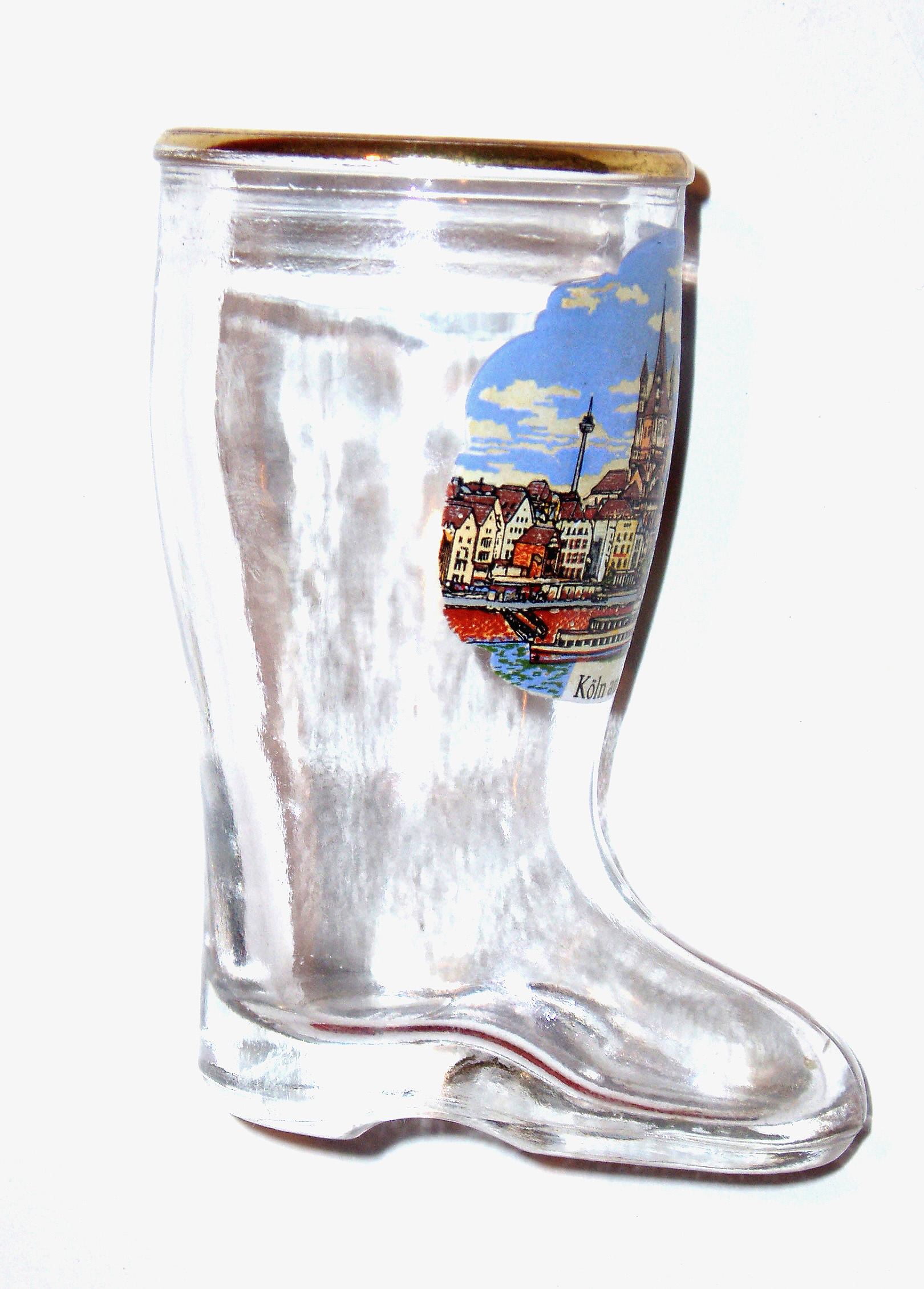
Main article: Beer boot
Boot- and shoe-shaped drinking vessels have been found at archaeological sites dating back to the bronze-age Urnfield cultures. Modern beer boots () have over a century of history and culture behind them. It is commonly believed that a general somewhere promised his troops to drink beer from his boot if they were successful in battle. When the troops prevailed, the general had a glassmaker fashion a boot from glass to fulfill his promise without tasting his own feet and to avoid spoiling the beer in his leather boot. Since then, soldiers have enjoyed toasting to their victories with a beer boot. At gatherings in Germany, Austria and Switzerland, beer boots are often passed among the guests for a festive drinking challenge. Since the movie Beerfest premiered in 2006, beer boots have become increasingly popular in the United States.
It is an old joke to hand the boot to a young novice drinker with the toe pointing away from his person, which will result in beer pouring over the drinker's face uncontrollably when air enters the toe; seasoned drinkers always point the toe towards their body until the glass is sufficiently drained.
''Pilstulpe''
.jpg)
The Pilstulpe ("Pilsner Tulip") or Biertulpe ("Beer tulip") is the traditional glass used for German pilsner beers. Sizes are typically around 300 ml, but can be as large as 500 ml. When used in restaurant settings, a small piece of absorbent paper is placed around the base to absorb any drips from spilling or condensation.
Gallery
File:Beerstein.jpg|Elaborate earthenware beer steins File:Humpen.jpg|Common half-litre Humpen or beer mug File:Warsteiner glass.jpg|Warsteiner glass File:Masskrug neutral.jpg|A Maßkrug
Belgian and Dutch styles
Stronger or bottled beers are frequently served in specially made, elaborately branded glassware. In addition to the profusion of glasses provided by brewers, some Belgian beer cafés serve beer in their own "house" glassware, which avoids having to keep a large number of different glass types in stock.
Flute glass
A vessel similar to a champagne flute is often the preferred serving vessel for Belgian lambics and fruit beers. The narrow shape helps maintain carbonation, while providing a strong aromatic front. Flute glasses display the lively carbonation, sparkling color, and soft lacing of this distinct style.
Goblet or Chalice
Chalices and goblets are large, stemmed, bowl-shaped glasses considered suitable for serving heavy Belgian ales, German bocks, and other big sipping beers. The distinction between goblet and chalice is typically in the glass thickness. Goblets tend to be thick, while the chalice is thin walled. Some chalices are even etched on the bottom to nucleate a stream of bubbles for maintaining a nice head. File:Beerglass orval.jpg|Orval beer's "chalice" glass File:Beerglass trappiste rochefort.jpg|Rochefort beer's "goblet" glass
Tulip glass
A tulip glass has a shape similar to a brandy snifter. The body is bulbous, like a snifter, but the top flares out to form a lip which helps head retention. It is recommended for serving Scottish ales, American double/imperial IPAs, barley wines, Belgian ales and other aromatic beers. Some pint glasses that taper outwards towards the top are also called tulip glasses, despite having noticeably less curvature.
Gallery
File:Cuvee_Rene_Gueuze.jpg|Geuze lambic beer in a flute glass Image:Duvel and glass sunday.jpg|The Belgian ale Duvel in its tulip glass File:Kwak.jpg|Kwak beer with its unusual glass and stand File:Bier gordon.jpg|A thistle-shaped glass complements Belgian Scotch ales
British and Irish styles
Tankard
A tankard is a form of drinkware consisting of a large, roughly cylindrical, drinking cup with a single handle. Tankards are usually made of silver, pewter, or glass, but can be made of other materials, for example wood, ceramic or leather. A tankard may have a hinged lid, and tankards featuring glass bottoms are also fairly common. Tankards are shaped and used similarly to beer steins. Metal tankards were popular in 18th and early 19th century Britain and Ireland, but were largely superseded by glass vessels. They are now seen as collector's items, or may be engraved and presented as a gift. Wooden and leather tankards were popular before the 17th century, but being made of organic materials have rarely survived intact to the present day. File:MaryRose-wooden tankard1.JPG|Reconstructed 16 CE wooden tankard Image:Pewter Tankard.jpg|Pewter tankard File:IV BM 00535.jpg|Glass tankard
Yard of ale

A yard of ale or yard glass is a very tall glass used for drinking around 2.5 imppt of beer, depending upon the diameter. The glass is approximately 1 yd long, shaped with a bulb at the bottom, and a widening shaft which constitutes most of the height.
The glass most likely originated in 17th-century England where the glass was known also as a "Long Glass", a "Cambridge Yard (Glass)" and an "Ell Glass". It is associated by legend with stagecoach drivers, though was mainly used for drinking feats and special toasts. (Compare with the Pauwel Kwak glass).
Drinking a yard glass full of beer is a traditional pub game. The fastest drinking of a yard of ale in the Guinness Book of Records is 5 seconds.
Capacity
| Volume | France | Belgium | Netherlands | Germany | Austria | Switzerland | Czechia | Italy | Spain |
|---|---|---|---|---|---|---|---|---|---|
| 125 ml | Galopin, Bock | Benjamin | Pfiff | Birrino | Zurito (Basque) | ||||
| 200 ml | Flûte, Hollandais | Fluitje, Buisje, Pijpje | Stange (Cologne, but only for Kölsch) | Galopin (French), Herrgöttli (German) | Birra Piccola | Caña | |||
| 250 ml | Demi, Bock | Boerke, Chope, Pintje | Vaasje, Emmertje, Rendsje, | Botellín | |||||
| 300 ml | Seidl, Seitel, Seiterl | Jonker | Seidl, Seitel, Seiterl | Becher, Stange, Rugeli | |||||
| 330 ml | Gourde, Klepke | Canette | Třetinka | Tercio, Mediana | |||||
| 400 ml | Birra Media | ||||||||
| 500 ml | Distingué, Baron, Mini-chevalier, Chope, Pinte, Sérieux | Demi, Bierpot | Pul, Halve Leo | Seidel, Seidla, Halbe (Southern Germany), Humpen | Krügel, Krügerl, Halbe | Chope (French), Grosses (German) | Půllitr, Holba | Pinta | |
| 1000 ml | Chevalier, Parfait, Double Pinte, Formidable | Corbeau, Lunette, Litron | Maß | Maß | Masse/Litron (French), Mass (German) | Tuplák | Birra Grande | ||
| 2000 ml | Stiefel, Liesl |
| UK | Ireland | Australia |
|---|---|---|
| 5 fl oz | ||
| 10 fl oz | Middy, Half, Ten | Middy, Half, Ten |
| 15 fl oz | ||
| 20 fl oz | Pint | Pint |
| 40 fl oz | Quart | Quart |
Australian measures
Main article: Beer in Australia#Beer glasses
Prior to metrication in Australia, one could buy beer in glasses of size 4, 5, 6, 7, 10, 15 or 20 imperial fluid ounces. Each sized glass had a different name in each Australian state. These were replaced by glasses of size 115, 140, 170, 200, 285, 425 and 570 ml. Progressively, the differences are decreasing. In the 21st century, most pubs no longer have a glass smaller than 200 ml (7 imp fl oz); typically available are 200ml, 285ml and 425ml, and increasingly many pubs also have pints 570 ml available.
References
References
- Shepard, Robin. (2001). "Wisconsin's Best Breweries and Brewpubs: Searching for the Perfect Pint". University of Wisconsin Press.
- Swierczynski, Duane. (2004). "The Big Book o' Beer: Everything You Ever Wanted to Know About the Greatest Beverage on Earth". Quirk Books.
- Garrett Oliver. (9 September 2011). "The Oxford Companion to Beer". Oxford University Press.
- Ford, Richard. (24 August 2009). "Last orders for traditional pint glass as search begins for alternatives". [[The Times]].
- Gray, Chris. (10 March 2001). "Collapse of Glass Firms Calls Time on Dimpled Jugs". The Independent.
- (30 April 2014). "The return of the dimpled pint glass". [[BBC News]].
- (2009). "''World's Best Beers: One Thousand Craft Brews from Cask to Glass'', page 27". Sterling Publishing Company, Inc..
- (August 2007). "The Beer Journal". Lulu Enterprises Incorporated.
- Gary Kirsner. (1999). "A Brief History of Beer Steins".
- "Maß". [[Duden]].
- Bernstein, Joshua M.. (September 21, 2013). "10 brew-tiful ways to rock Oktoberfest". [[New York Post]].
- (11 March 2019). "Weltrekord im Dauer-Maßkrugstemmen". [[Bayerischer Rundfunk]].
- "Willybecher". Gastro Lexikon.
- (1 April 2015). "Zahlreiche Gäste bei der Eröffnung der Ausstellung 'Der Willybecher' in der Heimatstube im Neuen Schloss". Der Kißlegger.
- Thrillist. (29 September 2014). "A Brief History of German Beer Boots, and Where You Can Find Them". The Huffington Post.
- "Tankard at British History Online".
- (1998). "The Dictionary of Beer and Brewing". Taylor & Francis.
- "Yard-of-ale glass (drinking glass) – Britannica Online Encyclopedia". britannica.com.
- "The Yard of Ale : Our History". theyardofale.com.
- (1998). "The Guinness book of records 1999". Guinness.
This article was imported from Wikipedia and is available under the Creative Commons Attribution-ShareAlike 4.0 License. Content has been adapted to SurfDoc format. Original contributors can be found on the article history page.
Ask Mako anything about Beer glassware — get instant answers, deeper analysis, and related topics.
Research with MakoFree with your Surf account
Create a free account to save articles, ask Mako questions, and organize your research.
Sign up freeThis content may have been generated or modified by AI. CloudSurf Software LLC is not responsible for the accuracy, completeness, or reliability of AI-generated content. Always verify important information from primary sources.
Report