From Surf Wiki (app.surf) — the open knowledge base
Bee pollen
Ball of pollen gathered by worker honeybees

Ball of pollen gathered by worker honeybees


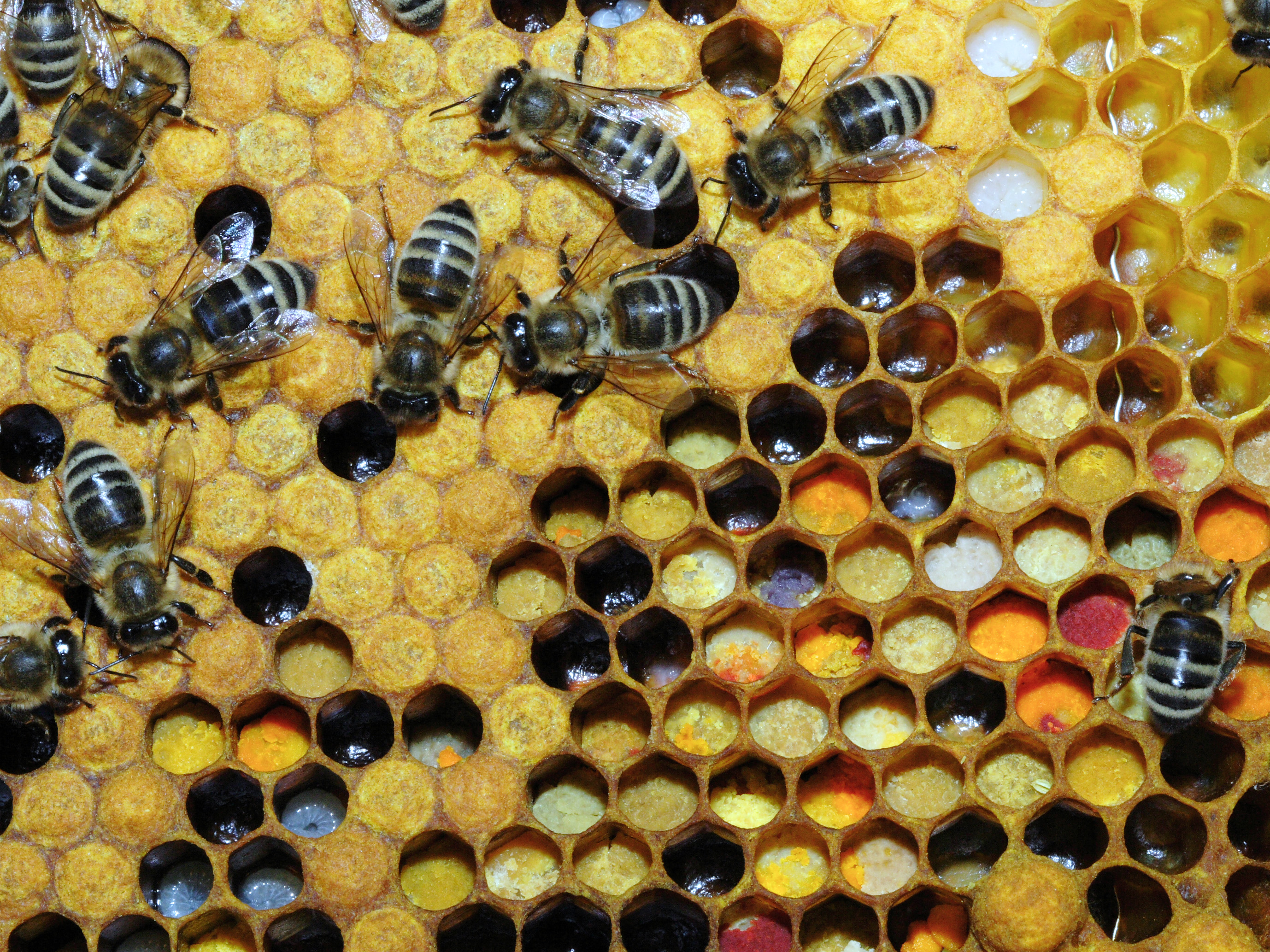

Bee pollen, also known as bee bread and ambrosia, is a ball or pellet of field-gathered flower pollen packed by worker honeybees, and used as the primary food source for the hive. It consists of simple sugars, protein, minerals and vitamins, fatty acids, and a small percentage of other components. Bee pollen is stored in brood cells, mixed with saliva, and sealed with a drop of honey. Bee pollen is harvested as food for humans and marketed as having various, but yet unproven, health benefits.
Details

In honeybees (Apis species) pollen is stored in the chambers of the hives. It differs from field-gathered pollen as honeybee secretions induce a fermentation process, where biochemical transformations break down the walls of flower pollen grains and render the nutrients more readily available.
Forager bees that gather pollen do not eat it themselves, since they stop producing the proteolytic enzymes necessary to digest it when they transition to foraging. The foragers unload the pollen they gather directly into open cells located at the interface between the brood and stored honey, creating a typical band of what is called bee bread – the substance which is the main food source for honeybee larvae and workers.
Foraging bees bring pollen back to the hive, where they pass it off to other worker bees, who pack the pollen into cells with their heads. During collection and possibly packing, the pollen is mixed with nectar and bee salivary secretions, signaling the start of the lactic fermentation process. Bee pollen is the primary source of protein for the hive.
Bees other than Apis typically form pollen into balls; these are primarily ground-nesting bees or twig-nesting bees, most of which are solitary, such as leafcutter bees. With the leafcutter bee, as in most such bees, when the pollen ball is complete, the female lays an egg on top of the pollen ball, and seals the brood cell. The egg hatches and the larva consumes the pollen directly; the pollen is not stored separately from the brood. This method of pollen usage can also be seen in the wood-nesting bee species Xylocopa sulcatipes and Xylocopa sonorina.
Composition
Like honey and propolis, other well-known honeybee products that are gathered rather than secreted (i.e., in contrast to royal jelly and beeswax), the exact chemical composition depends on the plants from which the worker bees gather the pollen, and can vary from hour to hour, day to day, week to week, colony to colony, even in the same apiary, with no two samples of bee pollen being exactly identical. Accordingly, chemical and nutritional analyses of bee pollen apply only to the specific samples being tested and cannot be extrapolated to samples gathered in other places or other times.
Although there is no specific chemical composition, the average composition is said to be 40–60% simple sugars (fructose and glucose), 20–60% proteins, 3% minerals and vitamins, 1–32% fatty acids, and 5% diverse other components. Bee bread is a niche for yeasts and bacteria, including lactic acid bacteria, Bifidobacterium, Bacillus spp., and others. A study of bee pollen samples showed that they may contain 188 kinds of fungi and 29 kinds of bacteria. Despite this microbial diversity, stored pollen is a preservation environment similar to honey, and contains consistently low microbial biomass.
Use as a health supplement
Bee pollen has been touted by herbalists as a treatment for a variety of medical conditions. Bee bread is rich in micronutrients, minerals, and phenolic compounds.
Potential risks of consuming bee pollen include contamination by fungal mycotoxins, pesticides, or toxic metals. Bee pollen is safe for short term use, but for those with pollen allergies, allergic reactions may occur (shortness of breath, hives, swelling, and anaphylaxis). Bee pollen is not safe for pregnant women and should not be used during breastfeeding. The Food and Drug Administration has warned against the use of some bee pollen products because they are adulterated with unapproved drugs including sibutramine and phenolphthalein.
Alternative diets for honeybees
There are several artificial pollen diets available for honeybees that incorporate a variety of ingredients like soy, corn gluten, yeast, egg, or milk protein, but they often fail to provide the essential macronutrients (such as lipids and proteins), micronutrients (vitamins and minerals), and antioxidants needed by honeybees to thrive.
References
References
- ''Oxford Canadian Dictionary''
- Gilliam, Martha. (1979). "Microbiology of pollen and bee bread: the yeasts.". Apidologie.
- (2016-10-01). "Biological and therapeutic properties of bee pollen: a review". [[Journal of the Science of Food and Agriculture]].
- (2005). "Bee products properties, processing and marketing". Agromisa Foundation.
- Bogdanov, Stefan. (2017). "The Pollen Book". Bee Product Science.
- (1998). "The Beekeeper's Handbook". Cornell University Press.
- "Examination of "pollen Balls" in the nests of the Alfalfa Leafcutting Bee, ''Megachile rotundata''". Agricultural Research Service.
- Thorp, Robbin W.. (5 March 2013). "Vernal pool flowers and their specialist bee pollinators". California Vernal Pools.
- Gerling, Dan; Hurd, Paul David; Hefetz, Abraham (1983). Comparative behavioral biology of two Middle East species of carpenter bees (''Xylocopa'' Latreille)(Hymenoptera: Apoidea). Smithsonian Contributions to Zoology. Smithsonian Institution Press.
- (2020). "Botanical Origin and Nutritional Values of Bee Bread of Stingless Bee (''Heterotrigona itama'') from Malaysia". Journal of Food Quality.
- Staff writer. (September 2011). "What Is Bee Bread?".
- (2020-08-25). "Probiotic properties of bacteria isolated from bee bread of stingless bee ''Heterotrigona itama''". Journal of Apicultural Research.
- Gilliam, Martha. (1979). "Microbiology of Pollen and Bee Bread: The Genus ''Bacillus''". Apidologie.
- Gilliam, Martha. (1979). "Microbiology of Pollen and Bee Bread: The Yeasts". Apidologie.
- Black, Jacquelyn G.. (2004). "Microbiology". John Wiley and Sons.
- (5 November 2014). "Hive-stored pollen of honey bees: many lines of evidence are consistent with pollen preservation, not nutrient conversion". Molecular Ecology.
- (2021-10-12). "Stingless Bee-Collected Pollen (Bee Bread): Chemical and Microbiology Properties and Health Benefits". Molecules.
- "Bee Pollen Benefits and Side Effects". [[WebMD]].
- (October 24, 2012). "Public Notification: "Zi Xiu Tang Bee Pollen Capsules" Contains Hidden Drug Ingredient". [[Food and Drug Administration]].
- (April 7, 2014). "FDA warns consumers not to use Zi Xiu Tang Bee Pollen capsules". [[Food and Drug Administration]].
- Jiang, Georgia. (2021). "Microalgae is the Bee's Knees". [[Agricultural Research Service.
This article was imported from Wikipedia and is available under the Creative Commons Attribution-ShareAlike 4.0 License. Content has been adapted to SurfDoc format. Original contributors can be found on the article history page.
Ask Mako anything about Bee pollen — get instant answers, deeper analysis, and related topics.
Research with MakoFree with your Surf account
Create a free account to save articles, ask Mako questions, and organize your research.
Sign up freeThis content may have been generated or modified by AI. CloudSurf Software LLC is not responsible for the accuracy, completeness, or reliability of AI-generated content. Always verify important information from primary sources.
Report