From Surf Wiki (app.surf) — the open knowledge base
Beaufort Castle, Lebanon
Crusader fortress in Nabatieh Governorate, Lebanon

Crusader fortress in Nabatieh Governorate, Lebanon
| Field | Value | ||
|---|---|---|---|
| name | Beaufort Castle | ||
| native_name | قلعة الشقيف | ||
| location | Nabatieh Governorate, Lebanon | ||
| coordinates | |||
| image | [[File:The ruins of Beaufort Castle in 2022..jpg | 300px | ]] |
| caption | The remains of the ancient castle | ||
| map_type | Lebanon | ||
| type | Castle | ||
| built | 12th century | ||
| builder | Crusaders |
Beaufort or Belfort Castle, known locally as Qal'at al-Shaqif () or Shaqif Arnun (), is a Crusader fortress in Nabatieh Governorate, Southern Lebanon, about 1 km to the south-south-east of the village of Arnoun. There was a fortification on the site before it was captured by Fulk, King of Jerusalem, in 1139 and construction of the Crusader castle probably began soon after. Saladin captured Beaufort in 1190, but 60 years later Crusaders re-took it. In 1268 Sultan Baibars finally captured the castle for the Islamic forces.
Beaufort provides one of the few cases in which a medieval castle proved of military value and utility in modern warfare as well, as shown by its late 20th-century history, especially during the 1982 Lebanon War.
Name
The castle was named bel fort or by the Crusaders who occupied the castle in the 12th century. Its Arabic name ar means 'Castle of the High Rock', with syc being a borrowing from Aramaic.
History
Medieval era
The outcrop Beaufort occupied overlooks the Litani River. The river flows past the east side of the castle, which stands atop a 300 m cliff which declines steeply to the river. Little is known of the site prior to its capture by Crusader forces in 1139, as no contemporary documents mention the site before then. However, historians assume that the castle's commanding hilltop site made it a strategic position that was fortified before its capture by the Crusaders. Fulk, King of Jerusalem, captured the fortification of Qal'at al-Shaqif in 1139 and gave the site to the lords of Sidon. Medieval historian Hugh Kennedy speculates that construction of the Crusader castle began soon after Fulk gave the site to the lords of Sidon.
Saladin defeated the Crusaders at the Battle of Hattin in 1187. In the aftermath, many castles and cities fell to Saladin's forces so that only a handful of cities remained under the Crusaders' control. Beaufort was one of the last castles to resist Saladin. In April 1189, Saladin was preparing to besiege the castle and Arab sources describe the event in detail. At the time Beaufort was under the control of Reynald of Sidon who had survived the Battle of Hattin. While Saladin was camped at nearby Marjayoun, preparing for the siege, Reynald met him and claimed to have Muslim sympathies. He said that while he would like to hand over control of Beaufort, his family were in the Christian city of Tyre and he could not surrender until they were safely out of the city. In the hope of a taking the castle without any bloodshed, Reynald was given three months to extract his family from Tyre; instead he used this time to repair the castle and stock up on supplies.
After three months Reynald met Saladin again, protesting he needed more time. Saladin insisted he hand over the castle immediately, so Reynald ordered the garrison to surrender. When they refused Reynald was taken prisoner and the siege began. In April 1190 an agreement was reached where the castle's garrison would hand over control to Saladin in return for Reynald's release. The castle came under Crusader control in 1240 as part of a treaty negotiated by Theobald I of Navarre. It was sold to the Knights Templar by Reginald's grandson, Julian of Sidon, in 1260. In 1268, the Mamluke Sultan Baibars captured the castle, and there was relative calm through the 14th, 15th, and 16th centuries.
Modern era
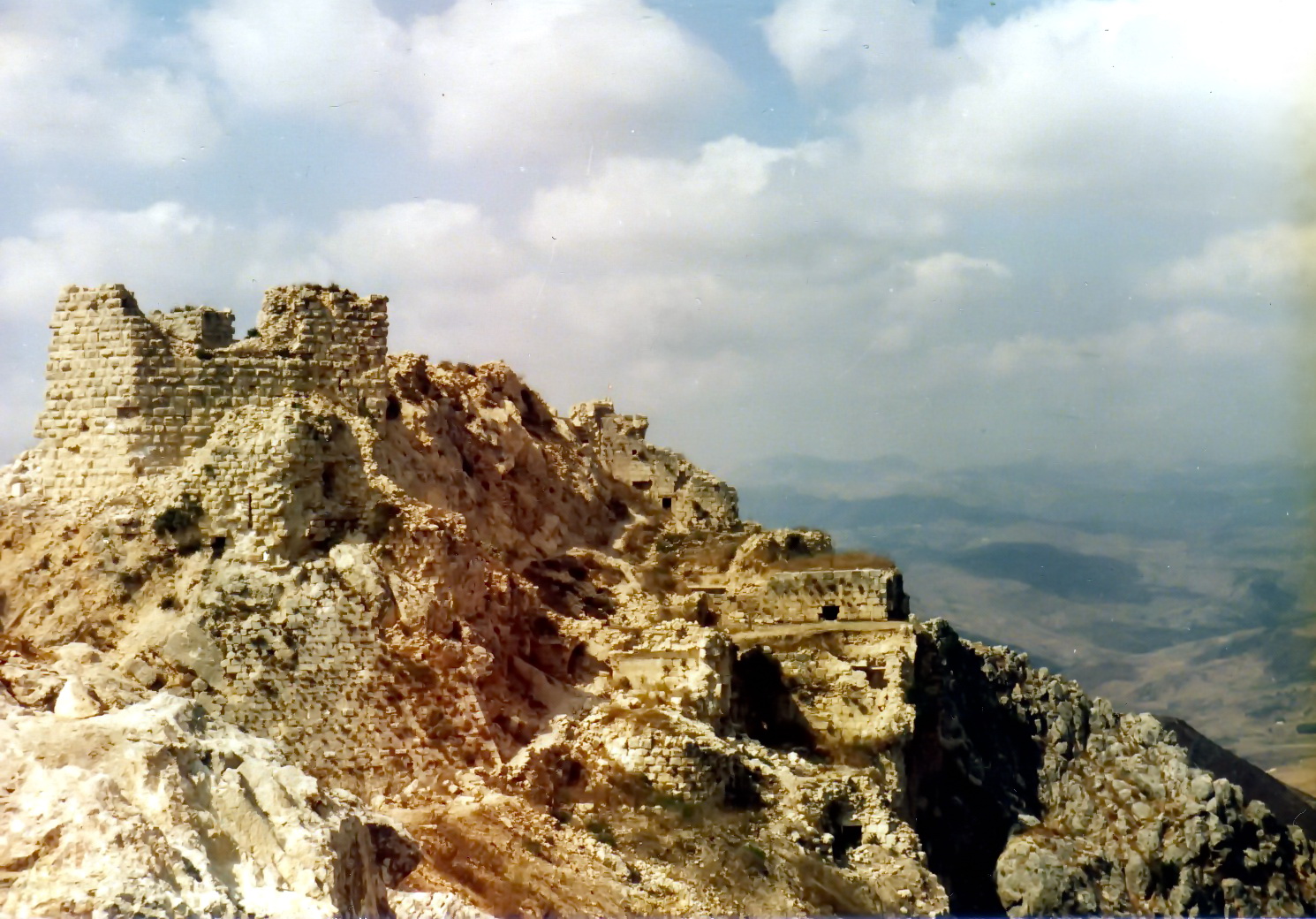


After the Ottoman conquest of Syria in 1516, the Ottomans attempted to revive the area by granting military benefices (timar) to Ottoman cavalry soldiers around Shaqif Arnun castle. The Shiite Sa'b family held the castles on the Ottomans behalf as early as 1571. In the early 17th century Fakhr-al-Din II took the castle as a part of his network of fortifications. Fakhr-al-Din II was defeated by the Ottomans, who destroyed the upper portions of the castle. Thereafter it was reinvested by the Sa'bs. The area was ruled by Shiite feudal families until 1769. In 1782 the Governor of Acre, Jazzar Pasha, besieged the castle, captured it and destroyed many of its remaining fortifications. The Galilee earthquake of 1837 caused further damage to the structure and from then on the ruins were used as a quarry and a shelter for sheep.
T. E. Lawrence visited the castle in 1909 during his walk across modern-day Lebanon and Syria, conducting research for his thesis. He was particularly struck by the view of the coast and along the Litani River.
In 1921 the French Mandate was established and French historians and archaeologists investigated the region's history and structures. The medieval historian began studying Crusader castles in 1927 and his work influenced subsequent generations of historians of the Crusades. In 1936, nine years after he first visited Beaufort, Deschamps and architect Pierre Coupel organised 65 soldiers to clear Beaufort's inner enclosure and the keep. Kennedy highlights Deschamps' La Défense du Royaume de Jerusalem (1939) as a particularly important source in the study of Beaufort as "his descriptions and plans record a building which has probably been mutilated beyond recognition by recent military activity". The French Mandate ended in 1943 when Lebanon became independent.
The castle's strategic location, which affords a view of much of southern Lebanon and northern Israel, has caused it to be a focus for recent conflicts. The Palestine Liberation Organization (PLO) held the castle from 1976 onwards, during the Lebanese Civil War and consequentially it was attacked dozens of times by Israeli forces in the space of five years. In 2000 the Israeli army left Beaufort, altogether demolishing the base. The IDF occupation of Beaufort provides the basis of the Israeli film Beaufort, although the film itself was shot on the Golan Heights. After the Israeli withdrawal, attempts by local tourism services to restore the fort began, albeit with very slow progress and lack of funding.
During the 2024 Israeli invasion of Lebanon, UNESCO gave enhanced protection to 34 cultural sites in Lebanon including Beaufort Castle to safeguard it from damage.
Construction
Several of the great Crusader castles were built on spurs, using natural defenses and fortifying the one access point. The setting of Beaufort plays a role in the defense of the site, but the terrain is only impassable on the north side. The Kurds extended the castle to include a slightly lower shelf of rock immediately to the east of the castle, thereby removing one of the routes of attack. Divided into two wards, one occupying the lower ground to the east, the castle is roughly triangular in shape and measures about 150 by. A keep or great tower was built against the west wall of the upper ward; the tower has a square plan and measures about 12 by. While it was common for keeps in Europe to be entered through the first floor, in Syria the convention was for a ground floor entrance as can be seen at Beaufort.
References
Notes
Bibliography
References
- Nicolle (2004), p. 57
- Kennedy (1994), p. 41
- Kennedy (1994), p. 43
- Grussenmeyer & Yasmine (2003), p. 2
- Tyerman (2006), p. 403
- Kennedy (1994), pp. 43–44
- Hostilities lasted until August that year when Saladin was forced to lift the siege to defend [[Siege of Acre (1189–1191). Acre]].Tyerman (2006), p. 405
- Tyerman (2006), p. 767
- Winter, Stefan. (2010). "The Shiites of Lebanon under Ottoman Rule, 1516-1788". Cambridge University Press.
- The late 19th century saw the start of study of Beaufort Castle, with surveys by [[Victor Guérin]] in 1880 and [[Claude Reignier Conder]] and [[Herbert Kitchener, 1st Earl Kitchener. Herbert Kitchener]] in 1881 as part of the [[Survey of Western Palestine]].Boas (2006), p. 27
- Sattin (2014), p. 41
- Kennedy (1994), pp. 5–7
- Kennedy (1994), p. 7
- "Cultural property under enhanced protection Lebanon".
- "Lebanon: 34 cultural properties placed under enhanced protection".
- Smail (1978), pp. 218, 221
- Boas (2006), pp. 27–28
- Smail (1956), p. 227
This article was imported from Wikipedia and is available under the Creative Commons Attribution-ShareAlike 4.0 License. Content has been adapted to SurfDoc format. Original contributors can be found on the article history page.
Ask Mako anything about Beaufort Castle, Lebanon — get instant answers, deeper analysis, and related topics.
Research with MakoFree with your Surf account
Create a free account to save articles, ask Mako questions, and organize your research.
Sign up freeThis content may have been generated or modified by AI. CloudSurf Software LLC is not responsible for the accuracy, completeness, or reliability of AI-generated content. Always verify important information from primary sources.
Report