From Surf Wiki (app.surf) — the open knowledge base
BeagleBoard
Single board computer

Single board computer
| Field | Value | |
|---|---|---|
| name | [[Image:beagle-hd-logo.png | 200px]] |
| image | Beagle Board big.jpg | |
| caption | BeagleBoard rev.B | |
| manuf1 | Circuitco LLC on behalf of BeagleBoard.org | |
| designfirm | Texas Instruments | |
| introduced | BeagleBoard | |
| BeagleBoard rev.C | ||
| BeagleBoard-xM | ||
| BeagleBone | ||
| BeagleBone Black | ||
| BeagleBoard-X15 | ||
| cost | US$95 to $149 | |
| type | Single-board computer | |
| processor | ARM Cortex-A8 | |
| frequency | 600 MHz to 1 GHz | |
| memory | 128 MB to 512 MB | |
| connection | USB On-The-Go | |
| ports | USB On-The-Go/DVI-D/PC audio/SDHC/JTAG/HDMI | |
| power | 2 W | |
| weight | ~37 g | |
| dimensions | 7.62 cm × 7.62 cm × 1.6 cm |
| invent-date = | invent-name = | class-name =
BeagleBoard rev.C
BeagleBoard-xM
BeagleBone
BeagleBone Black
BeagleBoard-X15
The BeagleBoard is a low-power open-source single-board computer produced by Texas Instruments in association with Digi-Key and Newark element14. The BeagleBoard was also designed with open source software development in mind, and as a way of demonstrating the Texas Instrument's OMAP3530 system-on-a-chip. The board was developed by a small team of engineers as an educational board that could be used in colleges around the world to teach open source hardware and software capabilities. It is also sold to the public under the Creative Commons share-alike license. The board was designed using Cadence OrCAD for schematics and Cadence Allegro for PCB manufacturing; no simulation software was used.
Features
The BeagleBoard measures approximately 75 by 75 mm and has all the functionality of a basic computer. The OMAP3530 includes an ARM Cortex-A8 CPU (which can run Linux, Minix, FreeBSD, OpenBSD, RISC OS, or Symbian; a number of unofficial Android ports exist), a TMS320C64x+ DSP for accelerated video and audio decoding, and an Imagination Technologies PowerVR SGX530 GPU to provide accelerated 2D and 3D rendering that supports OpenGL ES 2.0. Video out is provided through separate S-Video and HDMI connections. A single SD/MMC card slot supporting SDIO, a USB On-The-Go port, an RS-232 serial connection, a JTAG connection, and two stereo 3.5 mm jacks for audio in/out are provided.
Built-in storage and memory are provided through a PoP chip that includes 256 MB of NAND flash memory and 256 MB of RAM (128 MB on earlier models).
The board uses up to 2 W of power and can be powered from the USB connector, or a separate 5 V power supply.
Rev. C4 specifications
- Package on package (PoP) SoC/Memory chip.
- Processor TI OMAP3530 SoC – 720 MHz ARM Cortex-A8 core
- "HD capable" TMS320C64x+ core (520 MHz up to 720p @30 fps)
- Imagination Technologies PowerVR SGX 2D/3D graphics processor supporting dual independent displays
- 256 MB LPDDR RAM
- 256 MB NAND Flash memory
- Peripheral connections
- DVI-D (HDMI connector chosen for size – maximum resolution is 1280 × 1024 – and it does not output digital audio)
- S-Video
- USB OTG (mini AB)
- 1 USB port
- SD/MMC card slot
- Stereo in and out jacks
- RS-232 port
- JTAG connector
- Power socket (5 V barrel connector type)
- Development
- Boot code stored in ROM
- Boot from NAND memory, SD/MMC, USB, or serial
- Alternative boot source button.
- Has been demonstrated using Android, Angstrom Linux, Fedora, Ubuntu, Gentoo, Arch Linux ARM, openSUSE for ARM and Maemo Linux distributions, VxWorks, FreeBSD, the Windows CE operating system, Symbian, QNX and a version of RISC OS 5 made available by RISC OS Open.
BeagleBoard{{Visible anchor|-xM}}
Features
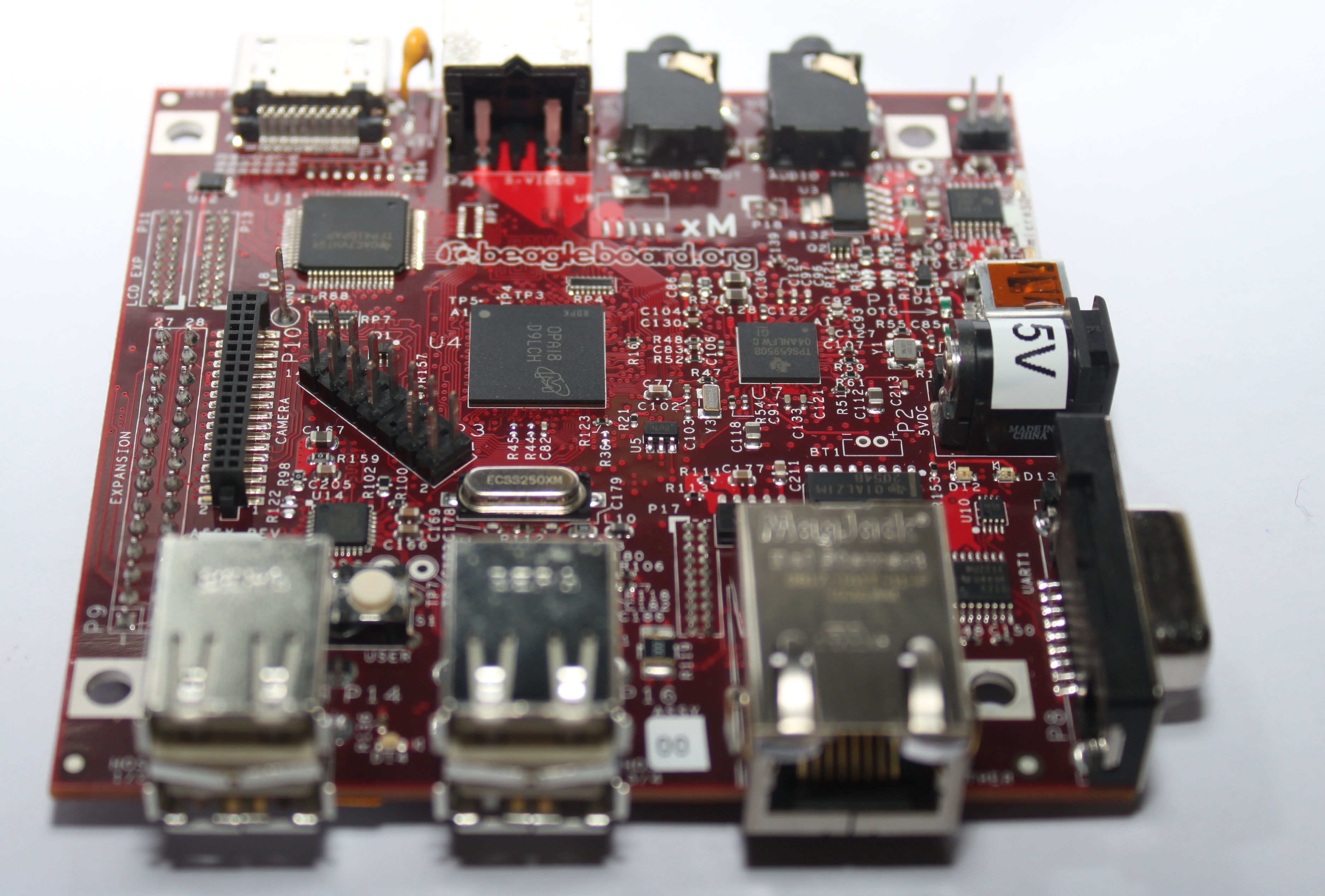
A modified version of the BeagleBoard called the BeagleBoard-xM started shipping on August 27, 2010. The BeagleBoard-xM measures in at 82.55 by 82.55 mm and has a faster CPU core (clocked at 1 GHz compared to the 720 MHz of the BeagleBoard), more RAM (512 MB compared to 256 MB), onboard Ethernet jack, and 4 port USB hub. The BeagleBoard-xM lacks the onboard NAND and therefore requires the OS and other data to be stored on a microSD card. The addition of the Camera port to the -xM provides a simple way of importing video via Leopard Board cameras.
Specifications
- Package on Package POP CPU/memory chip.
- Processor TI DM3730 Processor – 1 GHz ARM Cortex-A8 core
- 'HD capable' TMS320C64x+ core (800 MHz up to 720p @30 fps)
- Imagination Technologies PowerVR SGX 2D/3D graphics processor supporting dual independent displays
- 512 MB LPDDR RAM
- 4 GB microSD card supplied with the BeagleBoard-xM and loaded with The Angstrom Distribution
- Peripheral connections
- DVI-D (HDMI connector chosen for size – maximum resolution is 1400 x 1050)
- S-Video
- USB OTG (mini AB)
- 4 USB ports
- Ethernet
- MicroSD/MMC card
- Stereo in and out jacks
- RS-232 port
- JTAG connector
- Power socket (5 V barrel connector type)
- Camera port
- Expansion port
- Development
- Boot code stored on the uSD card
- Boot from uSD/MMC only
- Alternative Boot source button.
- Has been demonstrated using Android, Angstrom Linux, Fedora, Ubuntu, Gentoo, Arch Linux ARM and Maemo Linux distributions, FreeBSD, the Windows CE operating system, and RISC OS.
BeagleBone

Announced in the end of October 2011, the BeagleBone is a barebone development board. It can fit inside an Altoids tin. The BeagleBone was initially priced at US$89.
The BeagleBone has a Sitara ARM Cortex-A8 processor running at 720 MHz, 256 MB of RAM, two 46-pin expansion connectors, on-chip Ethernet, a microSD slot, and a USB host port and multipurpose device port which includes low-level serial control and JTAG hardware debug connections, so no JTAG emulator is required.
A number of BeagleBone "Capes" have recently been released. These capes are expansion boards which can be stacked onto the BeagleBone Board (up to four at one time). BeagleBone capes include but are not limited to:
- LCD touchscreen capes (7" and 3.5")
- DVI-D cape
- Breakout cape
- Breadboard cape
- CAN bus cape
- RS-232 cape
- Battery cape
BeagleBone Black
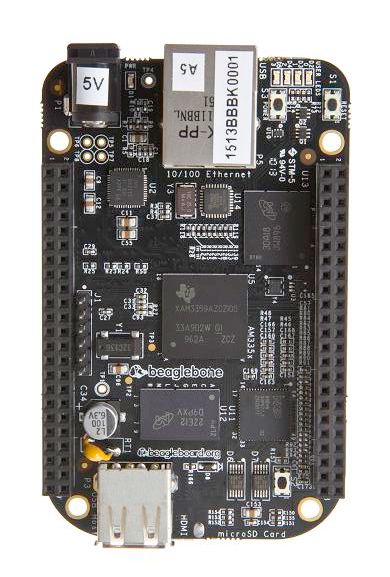
Launched on April 23, 2013, at a price of $45. Among other differences, it increases RAM to 512 MB, it increases the processor clock to 1 GHz, and it adds HDMI and 2 GB of eMMC flash memory. The BeagleBone Black also ships with Linux kernel 3.8, upgraded from the original BeagleBone's Linux kernel 3.2, allowing the BeagleBone Black to take advantage of Direct Rendering Manager (DRM).
BeagleBone Black Revision C (released in 2014) increased the size of the flash memory to 4 GB. This enables it to ship with Debian GNU/Linux installed. Previous revisions shipped with Ångström Linux.
BeagleBoard-X15
The BeagleBoard-X15 is based on the TI Sitara AM5728 processor with two ARM Cortex-A15 cores running at 1.5 GHz, two ARM Cortex-M4 cores running at 212 MHz and two TI C66x DSP cores running at 700 MHz. The processor provides USB 3.0 support and has a PowerVR dual-core SGX544 GPU running at 532 MHz.
PocketBeagle
Launched in September 2017, PocketBeagle offers identical computing performance to BeagleBone Black in a physical form factor that offers over 50% reduction in size and 75% reduction in weight, along with over 40% cheaper purchase price (December 2018 MSRP US$25 vs. US$45 for BeagleBone Black). The miniaturization was made possible by using the Octavo Systems OSD3358-SM that shrinks all major subsystems of the BeagleBone Black into a single ceramic package attached using ball grid array. The advantages of the miniaturization come at the cost of removal of all built-in connectors except for a single micro USB port, the removal of on-board eMMC flash storage, and a reduction of header pins from 92 down to 72 due to space constraints, meaning that most capes will either not work at all or need heavy modifications to work with PocketBeagle. Just as the BeagleBone Black's printed circuit board (PCB) is cut to fit snugly in an Altoids mint tin, PocketBeagle's PCB is cut to fit snugly in an Altoids Smalls mint tin. Recommended use cases for PocketBeagle include embedded devices where size and weight considerations are most critical, such as quadcopter drones and other miniaturized robotics, along with handheld gaming applications.
Specifications
| BeagleV-Ahead | BeaglePlay | BeagleBone AI-64 | BeagleBone AI | PocketBeagle | BeagleBoard-X15 | BeagleBone Black | BeagleBone | BeagleBoard-xM | BeagleBoard | Release date: | SoC | CPU | Frequency (MHz) | GPU | DSP | Onboard storage: | Onboard network: | USB ports: | Memory (SDRAM): | Video outputs: | Audio outputs: | Size: | Weight: | Power ratings: | Power source: | Low-level peripherals: | ||||||||||||
|---|---|---|---|---|---|---|---|---|---|---|---|---|---|---|---|---|---|---|---|---|---|---|---|---|---|---|---|---|---|---|---|---|---|---|---|---|---|---|
| July 12, 2023 | March 8, 2023 | June 14, 2022 | September 19, 2019 | September 21, 2017 | 23 September 2016 | April 23, 2013 | October 31, 2011 | September 14, 2010 | July 28, 2008 | |||||||||||||||||||||||||||||
| title=BeagleV®-Ahead | url=https://www.beagleboard.org/boards/beaglev-ahead | access-date=2023-08-22 | website=BeagleBoard | language=en-US}} | title=BeaglePlay® | url=https://www.beagleboard.org/boards/beagleplay | access-date=2023-08-22 | website=BeagleBoard | language=en-US}} | title=BeagleBone® AI-64 | url=https://www.beagleboard.org/boards/beaglebone-ai-64 | access-date=2023-08-22 | website=BeagleBoard | language=en-US}} | AM5729 | OSD3358-SM | Sitara AM5728 | AM3358/9 | DM3730 | OMAP3530 | ||||||||||||||||||
| Quad C910 (RISC-V RV64GC) | Quad ARM Cortex-A53 + ARM Cortex-M4F (400 MHz) | Dual ARM Cortex-A72 + Quad ARM Cortex-R5F (1000 MHz) + Dual ARM Cortex-R5F (1000 MHz) | AM5729 ARM Cortex-A15 | Sitara AM3358 ARM Cortex-A8 | Dual ARM Cortex-A15 + Dual ARM M4 (212 MHz) + Quad PRU (200 MHz) | Cortex-A8 + Dual PRU (200 MHz) | ||||||||||||||||||||||||||||||||
| 2000 | 1400 | 2000 | 1500 | 1000 | 1500 | 1000 | 720 | 1000 | 720 | |||||||||||||||||||||||||||||
| BXM-4-64 | PowerVR AXE-1-16 | PowerVR 8XE GE8430 | Dual PowerVR SGX544 | PowerVR SGX530 | Dual PowerVR SGX544 | PowerVR SGX530 (200 MHz) | ||||||||||||||||||||||||||||||||
| ? | TMS320C71x (1000 MHz) + Dual TMS320C66x (1000 MHz) + | Dual TMS320C66x | Dual TMS320C66x (700 MHz) | TMS320C64x+ (800 MHz) | TMS320C64x+ (520 MHz) | |||||||||||||||||||||||||||||||||
| 16 GB eMMC, microSD card | 16 GB eMMC, microSD card | 16 GB eMMC, microSD card | 16 GB eMMC | 4KB of EEPROM, microSD card | 8-bit eMMC 4 GB, microSD card | 8-bit eMMC (Rev B: 2 GB Ångström pre-installed, Rev C: 4 GB Debian pre-installed ), microSD card 3.3 V Supported (No Card Supplied) | microSD card 3.3 V Supported (card supplied with Ångström) | microSD card Supported (card supplied with Ångström) | 256MB NAND Flash, SD/MMC card | |||||||||||||||||||||||||||||
| ? | Gigabit Ethernet, single-pair Ethernet, 802.11n 2.4/5 GHz WiFi, Bluetooth LE, IEEE 802.15.4 | ? | Gigabit Ethernet, 802.11AC 2.4/5 GHz WiFi | Dual Gigabit Ethernet | Fast Ethernet (MII based) | Fast Ethernet (MII based) | Fast Ethernet (via USB hub with Ethernet) | |||||||||||||||||||||||||||||||
| ? | 1x USB Type C dual-role, 1x USB Type A host | ? | 1x USB Type C dual-role, 1x USB Type A host | 1x Micro USB Type B | 3x USB 3.0 Type A Host | |||||||||||||||||||||||||||||||||
| 4 x USB 2.0 Host | ||||||||||||||||||||||||||||||||||||||
| 1 x Micro USB Type B | 1x Standard A host port (direct). | |||||||||||||||||||||||||||||||||||||
| 1x mini B device port (direct) | 1x Standard A host port (direct). | |||||||||||||||||||||||||||||||||||||
| 1x mini B device port (via hub) | 4x Standard A host port (via hub with Ethernet). | |||||||||||||||||||||||||||||||||||||
| 1x mini AB OTG port (direct) | 1x Standard A host port (direct). | |||||||||||||||||||||||||||||||||||||
| 1x mini AB OTG port (direct) | ||||||||||||||||||||||||||||||||||||||
| 4096 MiB LPDDR4 | 2048 MiB DDR4 | 4096 MiB LPDDR4 | 1024 MiB DDR3L | 512 MiB DDR3 | 2048 MiB DDR3L | 512 MiB DDR3 | 256 MiB DDR2 | 512 MiB DDR2 | 128 MiB (rev B) DDR | |||||||||||||||||||||||||||||
| 256 MiB (rev C+) DDR | ||||||||||||||||||||||||||||||||||||||
| ? | HDMI | ? | Micro-HDMI | none | HDMI, LCD via Expansion | Micro-HDMI, cape add-ons | cape add-ons | DVI-D, S-Video | ||||||||||||||||||||||||||||||
| ? | HDMI | ? | Micro-HDMI | none | HDMI, AIC3104 (Stereo In/out) | Micro-HDMI, cape add-ons | cape add-ons | 3.5mm audio jack | ||||||||||||||||||||||||||||||
| ? | 80 x | ? | 8.9 cm x 5.4 cm x 1.5 cm | 56mm x 35mm x 5mm | 107 x | 86.40 x | 86.40 x | 78.74 x | 78.74 x | |||||||||||||||||||||||||||||
| ? | 55.3 g | ? | 48 g | 10 g | 39.68 g | 39.68 g | ||||||||||||||||||||||||||||||||
| ? | 3.77 A @ 5 V | ? | 3A @ 5V | 150 mA @ 5 V | 210–460 mA @5 V | 210–460 mA @5 V | 300–500 mA @5 V | 350-1000 mA @5 V | ||||||||||||||||||||||||||||||
| ? | USB C Port | ? | USB C Port | micro USB port or I/O pins | 2.5 mm × 5.5 mm 12 V jack | Mini USB or 2.1 mm x 5.5 mm 5 V jack | ||||||||||||||||||||||||||||||||
| ? | ? | ? | 4+xUART, 16-bit LCD, 2x SPI, 2× I²C | 3xUART, 4× PWM, 2× SPI, 2× I²C, 2x CAN bus | 7xUART, LCD, GPMC, 1× SPI, 1x I²C, 1x CAN bus | 4xUART, 8× PWM, LCD, GPMC, MMC1, 2× SPI, 2× I²C, A/D Converter, 2× CAN bus, 4 Timers | 4xUART, 8× PWM, LCD, GPMC, MMC1, 2× SPI, 2× I²C, A/D Converter, 2× CAN bus, 4 Timers, FTDI USB to serial, JTAG via USB | McBSP, DSS, I²C, UART, LCD, McSPI, PWM, JTAG, camera interface | McBSP, DSS, I²C, UART, McSPI, PWM, JTAG |
The following operating systems are reported to have obtained support for the hardware used on the boards: Fedora, Android (code named rowboat), Ubuntu, Void Linux, openSUSE and Ångström. The board also supports other OSes such as FreeBSD, NetBSD, OpenBSD, QNX, MINIX 3, RISC OS, and Windows Embedded.
Optional expansion boards
- BeagleBoard Zippy – Feature expander daughter card for BeagleBoard
- BeagleBoard Zippy2 – Second-generation Zippy. (UART, EEPROM, 100BASE-T, SD-Slot, RTC, I²C (5 V))
- BeagleTouch Display – Touchscreen 4.3" OLED panel with touchscreen, and drivers for Angstrom Linux built by Liquidware.
- BeagleLCD2 Expansion Board – 4.3" wide aspect LCD panel + touchscreen with interface board. Developed by HY Research.
- BeagleJuice – Lithium-ion battery pack for portability developed and built by Liquidware.
- WLAN adapter – This additional expansion card enables wireless connectivity functionality for the BeagleBoard.
- BeadaFrame – 7" TFT LCD display kit includes a touch panel and a plastic frame, by NAXING Electronics.
- 4DLCD CAPE – 4.3", 480x272 resolution LCD cape with resistive touch or non-touch and seven push buttons
- Vifff-024 – a very sensitive camera allowing capture of video stream at quarter moon illumination. Developed by ViSensi.org.
Optional enclosures
- Beagle Board RevC Clear Acrylic Case – Case for a BeagleBoard alone. (without Zippy2)
- BeagleLCD2 Clear Acrylic Case – Case for BeagleBoard with BeagleLCD2
Clones
- IGEPv2 – a slightly larger board that includes more RAM, built-in Bluetooth and Wi-Fi, a USB host, an Ethernet jack, and use microSD cards instead of regular SD cards.
- ICETEK Mini Board (Chinese)
References
References
- (July 28, 2008). "USB-powered Beagle Board from Digi-Key Unleashes Community Development with Laptop-like Performance and Expansion for $149". [[Digi-Key]].
- (May 13, 2009). "Digi-Key Announces New Open Source BeagleBoard Development Board". [[Digi-Key]].
- Kridner, Jason. (May 4, 2017). "BeagleBoard-xM". [[Texas Instruments]].
- (October 31, 2011). "Meet BeagleBone, the new $89 open source hardware platform, giving electronic enthusiasts a smaller, friendlier and more affordable treat". BeagleBoard.org.
- (April 23, 2013). "Digi-Key Continues Support of Innovative Line of TI-based ARM Development Boards from BeagleBoardorg". [[Digi-Key]].
- Coley , Gerald. (February 24, 2017). "BeagleBoard:BeagleBoard-X15".
- Kridner, Jason. (February 5, 2017). "BeagleBoard:Main Page".
- Coley, Gerald. (August 20, 2009). "Take advantage of open-source hardware". [[EDN (magazine).
- (June 9, 2008). "$150 board sports Cortex-A8".
- lionelsambuc. (November 19, 2014). "MINIX 3.3.0 is Available Now".
- dmarion. "creating_bootable_sd_card".
- "armv7".
- (March 27, 2014). "RISC OS for BeagleBoard". [[Texas Instruments]].
- (September 28, 2014). "BBBAndroid". [[Texas Instruments]].
- Wmat. (November 4, 2013). "BeagleBoard:Android".
- (May 27, 2009). "High performance and numerous expansion options". Digi-Key.
- (May 27, 2009). "Boot Options". Digi-Key.
- (March 27, 2014). "Sitara Android SDK". [[Texas Instruments]].
- (July 29, 2008). "Linux-friendly Beagle fetches $150".
- "Neuvoo Project". Neuvoo Devs.
- "Arch Linux ARM".
- "openSUSE ARM".
- Paul, Ryan. (2008-08-01). "TI launches hackable Beagle Board for hobbyist projects". Arstechnica.com.
- "OMAP3530 Single Board Computer – Beagle Board".
- "Beagle Board gets Windows CE support".
- "The Wild Ducks Project". wildducks.org.
- "Foundry27 BSP for BeagleBoard". community.qnx.com.
- Farrell, Nick. (2009-04-27). "Snaps leak of RISC OS5 on Beagleboard". [[The Inquirer]].
- [https://groups.google.com/group/beagleboard/msg/609bba9be3422b1d Google Groups]. Groups.google.com. Retrieved on 2015-03-25.
- [http://beagleboard.org/hardware-xM hardware-xM] {{Webarchive. link. (2011-06-24 . BeagleBoard.org (2014-11-18). Retrieved on 2015-03-25.)
- "SummerOfCode2012/FreeBSDonBeagleBoardxM – FreeBSD Wiki".
- "And here comes the winner… BEAGLEBONE!".
- [http://www.linuxfordevices.com/c/a/News/BeagleBoardorg-BeagleBone/ $89 dev board includes Cortex-A8 CPU, Ethernet, JTAG] {{webarchive. link. (2012-09-11)
- "BeagleBone Capes". Mouser.
- "BeagleBone Black doubles flash, embraces Debian". DeviceGuru Blog Network.
- "BeagleBoard-X15".
- (7 November 2014). "BeagleBoard-X15 Development Board to feature TI Sitara AM5728 Dual Core Cortex A15 Processor".
- Scheltema, David. (October 14, 2015). "BeagleBoard Officially Reveals the X15 — And it's a Beast".
- Kridner, Jason. (2023-07-12). "BeagleV-Ahead RISC-V computer from BeagleBoard.org available now under $150".
- Kridner, Jason. (2023-03-08). "BeaglePlay® from BeagleBoard.org® brings fun to building with computers".
- Kridner, Jason. (2022-06-14). "BeagleBone® AI-64, our first broadly available 64-bit open hardware single board computer".
- "BeagleBoard.org Launches BeagleBone AI, Offering a Fast Track to Getting Started with Artificial Intelligence at the Edge".
- Greg Sheridan. (September 21, 2017). "PocketBeagle Featuring The OSD335x-SM".
- "Beagleboard:BeagleBoard-X15 – eLinux.org".
- "BeagleV®-Ahead".
- "BeaglePlay®".
- "BeagleBone® AI-64".
- "Sitara AM5728 Series".
- [http://www.ti.com/product/omap3530 OMAP3530 {{! OMAP 3 Processors {{! OMAP Processors {{! Description & parametrics]. Ti.com (2008-02-25). Retrieved on 2015-03-25.
- [http://www.ti.com/product/am3359 AM3359 {{! AM335x Processors {{! ARM Cortex-A8 Core {{! Description & parametrics]. Ti.com. Retrieved on 2015-03-25.
- [http://www.ti.com/product/am3358 AM3358 {{! AM335x Processors {{! ARM Cortex-A8 Core {{! Description & parametrics]. Ti.com. Retrieved on 2015-03-25.
- [http://www.ti.com/product/dm3730 DM3730 {{! DM37x Video SOC {{! ARM Cortex-A8+ Video Core {{! Description & parametrics]. Ti.com. Retrieved on 2015-03-25.
- "BeaglePlay Mechanical Specifications".
- "BeagleBone X15 Specifications".
- "BeagleBone X15 Specifications".
- "BeagleBone Black Specifications".
- "BeaglePlay Power Management".
- "BeagleBone AI FAQ".
- visensi.org
- "Mini Board". eLinux.org.
This article was imported from Wikipedia and is available under the Creative Commons Attribution-ShareAlike 4.0 License. Content has been adapted to SurfDoc format. Original contributors can be found on the article history page.
Ask Mako anything about BeagleBoard — get instant answers, deeper analysis, and related topics.
Research with MakoFree with your Surf account
Create a free account to save articles, ask Mako questions, and organize your research.
Sign up freeThis content may have been generated or modified by AI. CloudSurf Software LLC is not responsible for the accuracy, completeness, or reliability of AI-generated content. Always verify important information from primary sources.
Report