From Surf Wiki (app.surf) — the open knowledge base
Beacon Theatre (New York City)
Entertainment venue in Manhattan, New York

Entertainment venue in Manhattan, New York
| Field | Value |
|---|---|
| name | Beacon Theatre |
| image | Beacon Theatre (49020061512).jpg |
| image_caption | The Beacon Theatre marquee in 2019 |
| architect | Walter W. Ahlschlager |
| location | 2124 Broadway (at 74th Street), Manhattan, New York, U.S. |
| coordinates | |
| type | Indoor theater |
| built | 1929 |
| opened | |
| renovated | 2009 |
| public_transit | Subway: 72nd Street |
| owner | Beacon Broadway Company |
| operator | Madison Square Garden Entertainment |
| seating_type | fixed |
| seating_capacity | 2,894 |
| name | Beacon Theater and Hotel |
| embed | yes |
| nrhp_type | nrhp |
| designated_other2_name | New York City Landmark |
| designated_other2_date | December 11, 1979 |
| designated_other2_abbr | NYCL |
| designated_other2_link | New York City Landmarks Preservation Commission |
| designated_other2_number | 1097 |
| designated_other2_color | #ffe978 |
| added | November 4, 1982 |
| refnum | 82001187 |
The Beacon Theatre is an entertainment venue at 2124 Broadway, adjacent to the Hotel Beacon, on the Upper West Side of Manhattan in New York City. Opened in 1929, the Beacon Theatre was developed by Samuel "Roxy" Rothafel and built as a movie palace, with 2,894 seats across three levels. It was designed by Walter W. Ahlschlager with decorations inspired by the Renaissance, Ancient Roman, Ancient Greek, and Rococo styles. The theater is designated as a New York City interior landmark and is listed on the National Register of Historic Places.
The facade is relatively plain and is made of brick and stone, with a marquee above its entrance on Broadway. The outdoor ticket booth leads to a vestibule and a multi-story rotunda lobby under the hotel, with a mural by Danish artist Valdemar Kjoldgaard in the lobby. The auditorium is in an adjacent structure on the eastern part of the site, near 75th Street and Amsterdam Avenue. The auditorium's side walls have ornate arched doorways and murals, while the multicolored ceiling has a chandelier. The proscenium arch has Greek columns and is flanked by large statues. The orchestra pit has a Wurlitzer organ, one of three in a theater in Manhattan.
The theater was originally proposed in January 1927 as the Roxy Midway Theatre. Roxy severed his involvement and Warner Bros. took over the theater, opening it on December 24, 1929. The Central Amusement Corporation took over the Beacon in 1932, and Brandt Theatres assumed operation in 1944, running it for three decades. The theater started presenting live entertainment in 1966, and Steven Singer and Barry Kerr renovated it into a rock venue in 1974. After Singer's bankruptcy, Kazuko Hillyer turned the theater into a performing arts center in 1976. Following a failed attempt to convert the Beacon into a nightclub and restaurant in 1986, the theater remained in use as a live music and entertainment venue. Madison Square Garden Entertainment took over in 2006 and renovated the Beacon shortly afterward.
Over the years, the Beacon has hosted numerous concerts. Some acts have appeared for extended residencies, including the Allman Brothers Band. It has also hosted other types of live performances, including dance troupes and plays. The Beacon has additionally been used for broadcasts, tapings, films, and ceremonies such as the Tony Awards.
Description
The Beacon Theatre is at 2124 Broadway, on the Upper West Side of Manhattan in New York City, along the east side of the avenue between West 74th and 75th Streets. The theater is part of the Hotel Beacon building and was designed by Walter W. Ahlschlager for Samuel L. "Roxy" Rothafel. The Beacon's auditorium is mostly along the rear of the hotel, facing Amsterdam Avenue to the east and 75th Street to the north, although the main entrance is on Broadway to the west. The theater and hotel are near several other buildings such as The Ansonia apartments to the southwest, The Astor apartments to the northwest, and the Central Savings Bank Building to the south.
The Beacon Theatre had been designed as a miniature version of the earlier Roxy Theatre in Midtown Manhattan, which Ahlschlager also designed. Whereas the Roxy Theatre had been designed with Moorish and Renaissance-inspired elements, the Beacon contains a variety of styles, including Renaissance, Ancient Roman, Ancient Greek, and Rococo-inspired elements. Danish artist Valdemar Kjoldgaard designed numerous murals for the Beacon as well. When the theater opened, Women's Wear Daily described Kjoldgaard's murals as being "themselves worth a king's ransom". A reporter described the theater in general as "a true bit of on Broadway", while another critic called the theater's interior "like walking into an Arab sheik's tent".
Facade
The Beacon Theatre's entrance and lobby are within the hotel building, while the auditorium is in its own structure to the east. The hotel's facade is plain in design, and the theater's entrance is on the southern section of the hotel's Broadway facade. Above the theater's marquee, the hotel building contains arched windows on the second floor and a brick facade on upper stories.
The facade of the auditorium faces 75th Street and Amsterdam Avenue, where the first floor is made of stone and the upper stories are made of brick. Both facades have blind openings without any windows. There are horizontal band courses above the first and fifth floors, corresponding to those on the hotel's facade, as well as an arcade near the auditorium's roof. On 75th Street, there is a large arch at the center of the facade, with a stone frame, along with three blind arches on the fifth-story band course above it. On Amsterdam Avenue, there is a large stone-framed ogee arch at the fifth story, along with four blind arches to the sides. A stepped gable rises atop the auditorium's Amsterdam Avenue facade.
Interior
Lobbies

Under the theater's marquee is a semicircular outdoor ticket lobby with tile flooring, which is recessed from the sidewalk. There is a ticket booth in the middle of the outdoor ticket lobby. The ticket booth was originally gilded and was made of marble, glass, and metal. Prior to its renovation in 2009, the ticket booth had been painted over several times. East of the outdoor ticket booth are glass and metal doors, topped by transom windows, which lead to an indoor vestibule. This vestibule has a low ceiling with lamps and Renaissance-style molded bands. The north wall contains mirrors and signs, while the south wall has another ticket booth and an office. The doors to the west (leading from the street) and to the east (leading to the main lobby) both curve into the vestibule.
East of the vestibule is a circular rotunda with Rococo-inspired decorations. The rotunda ceiling is as high as the auditorium itself; it contains moldings of rosettes and coffers, as well as a large chandelier hanging from its center. The western wall of the rotunda, which leads from the entrance vestibule, contains fluted pilasters on either side. Above the doorways is a landscape mural by Valdemar Kjoldgaard. Some time before a renovation in 2008, the mural had been covered with wallpaper, though the artwork was restored during the renovation. On the eastern wall of the rotunda is a passageway flanked by Ionic-style pilasters, which reach from the floor to the ceiling. Above the passageway is a decorative panel, as well as an archway with full-height colonettes on the mezzanine and balcony levels.
On either side of the passageway on the rotunda's eastern wall are Rococo-style stairways. The lowest flight connects to the mezzanine level. Two more flights provide access to both the bottom and the top rows of the steeply raked balcony.
Auditorium
The auditorium has three levels of seating and a proscenium arch. The space is designed with both sculpted decorations and murals by Kjoldgaard. , the Beacon Theatre has 2,894 seats. The theater's operator, MSG Entertainment, classifies the mezzanine level directly above the orchestra as a loge level. Two stories above the orchestra is the balcony level, which is divided into two sections: a lower balcony in the front and an upper balcony in the back. When the theater opened, there was a smoking-room balcony behind the auditorium, with ventilation ducts in the ceiling. There was also a fireproof projection booth in the rear. The original seats were characterized as "fully upholstered" folding seats with large amounts of legroom.

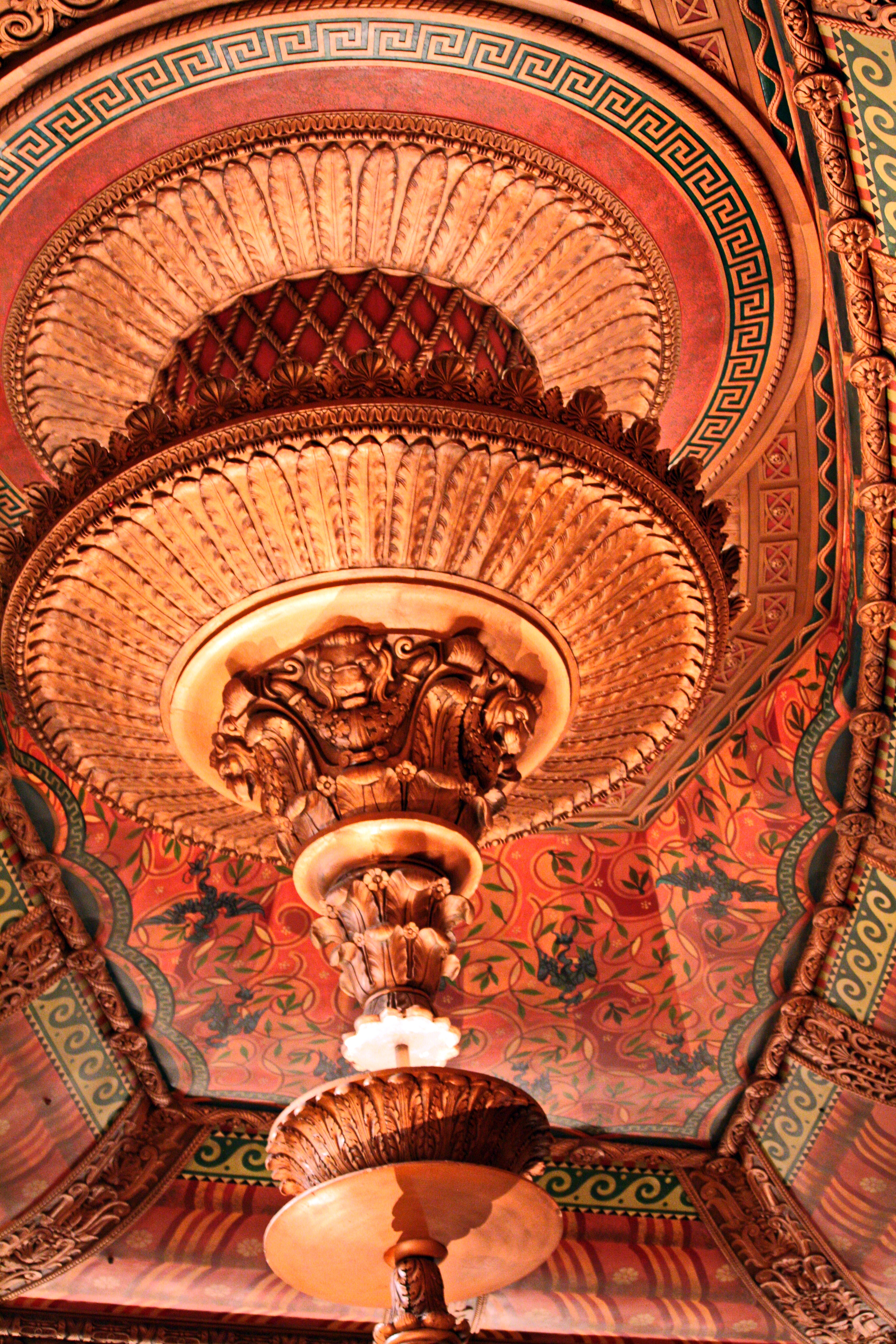
The side walls of the orchestra contain ornate arched doorways. Above each of the arches are theatrical masks, which are flanked by swags and cartouches. Above these arches are the balcony's side walls, which are divided into two bays by fluted pilasters. Each bay contains a piece of a mural by Kjoldgaard; according to the New York City Landmarks Preservation Commission, these represent "oriental scenes with caravans of elephants, camels, and traders". The ceiling above the front of the auditorium contains a red, gold, green, and blue color scheme and is designed to resemble the draped roof of a tent. A Venetian-style chandelier hangs from the center of the ceiling.
The proscenium arch consists of Doric-style columns on either side, supporting the top of the proscenium. The latticework of the proscenium had openings for the sound coming from the theater's organ. Flanking the proscenium are bronze female figures, which measure 30 ft and depict Greek goddesses. Women's Wear Daily described these figures as "heroic-size bronzes of Amazons with spear and shield". Above the proscenium are green and gold plaster draperies. The theater originally had a curtain that contemporary media described as the only "contour curtain" in a movie theater in the United States.
The Beacon also retains its original Wurlitzer organ in its orchestra pit. The organ was manufactured in 1928 and contains four manuals and 19 ranks. The Beacon is one of three theaters in Manhattan that retains its original organ, along with Radio City Music Hall and the United Palace. The organ was abandoned by the early 1960s, but it was not removed because the removal cost was too high for the theater's operators. The organ was restored in 1967 and remained in use at the Beacon until it was sealed in 2009.
History
Movie palaces became common in the 1920s, between the end of World War I and the beginning of the Great Depression. In the New York City area, only a small number of operators were involved in the construction of movie palaces. These theaters' designers included the architects Walter Ahlschlager, Thomas W. Lamb, C. Howard Crane, and John Eberson. Samuel "Roxy" Rothafel was a successful theater operator who was prominent in the city's movie theater industry, having built the 5,920-seat Roxy Theatre on 50th Street in midtown during 1927. The Chanin brothers also had some experience in theatrical development, having built six Broadway theaters in the mid-1920s.
Movie palace
Development and opening
The Chanins acquired a site on 75th Street between Broadway and Amsterdam Avenue in 1925 for the construction of a hotel and an attached theater. Two years later, in January 1927, the Chanins sold the site to the Havemeyer Construction Company. Film producer Herbert Lubin negotiated the sale on behalf of Roxy, who would operate the theater on the site, known as the Roxy Midway Theatre. Roxy retained Ahlschlager to design the new hotel and theater, and the Chanins were hired as the consulting engineers for the project. The sale came one month after Lubin established the Roxy Circuit, which planned to operate numerous movie theaters in New York City, with the midtown Roxy Theatre as its flagship. In April 1928, S. W. Straus & Company underwrote a $4.45 million loan on the Midway project, which at the time was nearly completed. An airway beacon was placed on top of the hotel, and the project was renamed the Midway Beacon, a name that was kept as late as June 1928.
The Roxy Circuit never operated the Midway Theatre because, in July 1928, the company sued to get out of its lease. None of the other planned theaters in the Roxy Circuit were ever built, in part because of the start of the Great Depression shortly afterward. The New York Herald Tribune was using the "Beacon" name exclusively by June 1929. At the time, Warner Theatres was considering acquiring the theater, which had been completed for a year but was unused. After RKO Pictures considered leasing the Beacon, Warner Theatres ultimately bought the theater in November 1929, turning it into a first-run showcase for Warner Bros. films on the Upper West Side. Warner Theatres then conducted changes to the acoustical properties of the auditorium to accommodate sound films. Warner Bros. unsuccessfully attempted to obtain the rights to screen First National Pictures films at the new Beacon. The renamed Warner's Beacon Theatre opened on December 24, 1929, with the talking picture Tiger Rose featuring Lupe Vélez.
Film screenings
Originally, the Beacon played one motion picture per week, which ran continuously from 11:30 a.m. to 11:30 p.m. Among the early films screened at the Beacon were Once a Gentleman (1930), A Soldier's Plaything (1931), and The Lawless Woman (1931). The Chanins took over the Beacon Hotel and Theatre in April 1930, four months after the theater had opened. Amid speculation that the Chanins might redevelop the site (in the past eleven years, the brothers had torn down every structure that they had bought), Irwin Chanin announced that the Beacon Hotel and Theatre would remain operational. The Beacon Enterprise Company, in which Warner Bros. owned 75 percent of the stock, was subsequently recorded as having leased the theater. The Beacon was one of several movie theaters that Warner Bros. operated along Broadway; the others included the Warners, Hollywood, Winter Garden, and Strand.
At the end of January 1932, Warner Bros.' operating lease on the Beacon Theatre expired, and the Central Amusement Corporation took over. The Chanins said the new management allowed the Beacon to show movies from more than one producer. The Beacon largely continued to produce straight pictures, but it also broadened its offerings to radio broadcasts, such as Tru Blu Beer's Broadway Bandwagon in 1935. To recruit soldiers during World War II, the United States Army exhibited a mortar and a machine gun in the Beacon's rotunda lobby while playing a short film in the auditorium. The theater also hosted bond-buying events during the war. Brandt Theatres acquired the Beacon in 1944 as the 120th theater in its chain. Two years later, the Beacon began presenting films and stage performances for children during Saturday matinees.
.jpg)
The Beacon implemented a policy of presenting only first runs at the end of 1948; the British picture Don't Take It to Heart was the first to be screened under this policy. During 1949, the films shown under this policy included double features such as Easy Money/My Brother's Keeper, as well as traditional single features like A Yank Comes Back and Temptation Harbour. The Beacon continued to show double features throughout the 1950s, such as The Frightened Bride/The Caretaker's Daughter in 1953. The Beacon also screened Warner Bros. films. This caused a dispute in 1959, when the owners of the nearby Embassy Theatre filed a lawsuit, alleging that Warner Bros. had shown favoritism by selling distribution rights for three films to the Beacon rather than to the high bidders, the Embassy. Starting in 1962, the Beacon also showed United Artists pictures through the UA's "Premiere Showcase"; the first film shown under this program was Hong Kong.
In January 1966, Brandt announced that the Beacon would present legitimate plays along with films. The first live show under this policy, a Yiddish vaudeville show, was canceled after two days. The next year, members of the American Association of Theatre Organ Enthusiasts restored the Beacon's long-unused organ. The Beacon then screened silent pictures accompanied by organ music, starting with The General. By then, Boxoffice magazine characterized the Beacon as one of the Upper West Side's few movie palaces that remained in theatrical use. The Beacon also continued to screen talking pictures such as Ulysses, as well as live shows including a ballet production in 1968. The Beacon implemented a "first second run" policy in 1971, showing reruns of films that had just premiered (as opposed to reruns that had already been shown at other theaters). Accordingly, the Beacon reduced its ticket prices to $1.00–1.50, even as its competitors retained higher ticket prices. Though the reduced ticket prices increased the theater's income by 15 to 20 percent, the Beacon's owners were looking to sell the theater.
Conversion into live venue
Early live shows
Following the closure of rock venue Fillmore East, Bow Wow Productions proposed hosting rock concerts at the Beacon in 1971. The concert series began later that year, and the theater charged ticket prices of up to $7.50 on these shows. The Beacon's concerts in 1971 tended not to have long runs due to disagreements between promoters and the theater's operators. By the early 1970s, the theater was still showing movies but was dimly lit and deteriorating. In March 1974, the Beacon was leased by Vidicoth Systems,{{Efn|Sometimes spelled Vidicom The operators reupholstered the seats, installed new carpets, and repainted the ceiling and statues. The theater continued to show movies until the renovations were finished.
When the Beacon reopened in October 1974, Stephen Metz took over the theater's bookings, using the Beacon primarily for rock concerts. A writer for Newsday said of the Beacon: "A rock ballroom is not just what Manhattan needs, but that may be what it's getting." By the next year, the Beacon had gained a reputation as a rock venue. A New York Amsterdam News reporter said in 1976 that the Beacon "has transcended a galaxy of live-entertainment theaters" and had become a competitor to the Apollo Theater in Harlem. Some residents raised complaints about the noise and crowds at the rock concerts, though Singer and Metz addressed most of these complaints. Singer and Metz formed a firm in August 1976, Singmet, which produced some of its own shows for the Beacon. The theater was closed in 1976 after Singer and Metz went bankrupt, and it was planned to be replaced by a supermarket.
Kazuko Hillyer announced plans in February 1977 to convert the Beacon into a performing arts center. Hillyer, a Japanese-American, said she wanted to make the theater "a center for the two heritages we all have". Hillyer immediately booked dance shows for the Beacon, and she intended to spend $75,000 on renovations. The same year, Concert Arts Society was recorded as having leased the theater for 15 years. The New York City Landmarks Preservation Commission (LPC) designated the Beacon Theatre as an interior landmark on December 11, 1979, citing the theater's "dramatic effects of rich ornamental details". 50/50 Productions, a company operated by Steve Martin, took over the Beacon's bookings in October 1981 and booked jazz and contemporary musicians for the theater. Martin wanted to stage Broadway shows at the theater, but he faced competition from the Shubert Organization and the Nederlander Organization, the two largest operators of Broadway theaters. The Beacon was renovated in 1982, and it was added to the National Register of Historic Places the same year. The theater was renovated again in 1985.
Failed conversion into nightclub
Andy Feltz became the Beacon's manager in 1986. That February, the theater's owners announced plans to convert the Beacon into a nightclub and restaurant with a discotheque. At the time, the Beacon was the only mid-sized live-concert venue in Manhattan; the two other similarly sized venues in the borough, Avery Fisher Hall and Carnegie Hall, were largely used for classical music. The operator of the planned nightclub, Olivier Coquelin, said he and his architect Charles A. Platt (a former LPC commissioner) had chosen the Beacon Theatre for conversion specifically because of its landmark status. Coquelin's company signed a seven-year lease for the theater that April. The nightclub would be built as a freestanding structure within the auditorium, thus reducing the need to modify the protected interior spaces. Area residents expressed concerns that the renovations would damage the landmarked design features. Preservationists and community groups, including the Committee to Save the Beacon Theatre, organized in opposition to the plans.
The LPC voted to approve the plan in July 1986. Afterward, Coquelin said he would need to spend $3 million to renovate the theater because of its deteriorated condition. The city rejected the conversion proposal that December because the planned dance floor was too large under zoning regulations. The city government approved the plan after the dance floor's size was reduced. Two benefit concerts were hosted to fund the groups that opposed the theater's conversion. In September 1987, a New York Supreme Court judge overturned the LPC's approval of the conversion on the grounds that it would threaten the quality of the theater's architecture. During this time, the Beacon was still hosting concerts;See, for example:
- along with the Apollo, it was one of two venues in Manhattan with frequent rock, pop, and soul concerts. The theater's operators filed an appeal of the Supreme Court's ruling in October 1988. The New York Court of Appeals overturned the Supreme Court decision, sending the plan back to the LPC.
Continued use as live venue
By 1989, the theater's operators no longer intended to turn the theater into a nightclub, having hired MSG Entertainment as the theater's exclusive booking agent for several years. The Committee to Save the Beacon Theatre expressed optimism but continued to monitor the theater's usage. Following the efforts of the Committee to Save the Beacon Theatre, Nanci Callahan founded the West Side Cultural Center, which was to stage children's programming, dances, and operas at the Beacon. In late 1991, the Beacon was temporarily converted into an IMAX theater; the IMAX format's large screen necessitated that most of the seats be closed off due to poor sightlines. The theater was then refurbished again in the early 1990s for rock concerts.
Feltz continued to manage the Beacon until 2006. That November, the theater was leased for 20 years to MSG Entertainment's parent company Cablevision, which also leased Radio City Music Hall and owned Madison Square Garden. Cablevision committed at least $10 million toward a future restoration of the Beacon, which closed for a major renovation in August 2007. Beyer Blinder Belle was hired for the project, fixing longstanding issues such as a leaking roof and damage to original decorations. The restoration also involved replacing the electrical system, upholstering the seats, restoring decorations in the lobby and the auditorium, and upgrading backstage functions. The workers restored features such as the Broadway ticket booth, which had been painted over numerous times, and the chandelier above the auditorium, which had been hanging from a coffee tin. The project involved 1,000 workers and was completed in February 2009 for $16 million.
MSG Entertainment split from Cablevision in mid-2009 but continued to operate the Beacon Theatre and its other venues. The Beacon's lighting system was upgraded in 2014 to accommodate the venue's events, which at the time included concerts, comedy, broadcasts, and film screenings. For over a year, from early 2020 to July 2021, the Beacon Theatre was temporarily closed due to the COVID-19 pandemic. A new sound system was installed at the Beacon in August 2022.
Entertainment
After the Beacon Theatre started presenting live performances, it became one of the most popular concert halls in New York City. In addition, it has hosted other types of live events such as comedy specials. By 2006, the theater hosted about 70 performances a year; box-office figures were available for 52 of these events, which collectively grossed $8 million and had 136,000 total patrons. During the Beacon's 2008 renovation, The New York Times referred to the venue as the "Carnegie Hall of rock rooms".
Concerts

The theater has long hosted R&B, pop, and jam bands and rock concerts. Early in the Beacon's history as a venue for live show, it hosted concert appearances such as those of rock band Steve Miller Band, blues singer Dr. John, soul singer Wilson Pickett, and pop singer Tina Turner. When the theater was briefly used as a rock venue in the mid-1970s, several rock bands had appearances at the Beacon, including Supertramp, Queen (as part of their A Night at the Opera Tour), Grateful Dead, and Return to Forever. Additional concerts in the 1970s included a three-night appearance by singer Carole King in 1976. After Kazuko Hillyer took over in 1977, she moved her Coffee Concerts to the Beacon from Alice Tully Hall. Under Hillyer's operation, the theater also hosted acts such as Canadian Brass and Peter Schickele in 1978.
Among the Beacon's concert bookings in the early 1980s were those by jazz trumpeter Miles Davis, R&B singer Millie Jackson, bluegrass acts Osborne Brothers and Jim & Jesse, and jazz musicians Sarah Vaughan and Zoot Sims. Other acts during the decade included gospel singers Al Green and Shirley Caesar, pop musician Laurie Anderson, pop/jazz guitarist Earl Klugh, juju singer King Sunny Adé, and jazz singer Cab Calloway. In the early 1990s, the Beacon hosted such musical offerings as folk-rock duo Indigo Girls, a rock-and-soul revue, a concert with several country performers, singer Tracy Chapman, pop rock band Crowded House, and gospel singers BeBe Winans and CeCe Winans. The latter half of the decade saw appearances by performers including rock musician Ian Anderson, jazz tenor Sonny Rollins, Italian blues singer Zucchero Fornaciari, as well as a classical music concert.
Concert performances continued in the early 2000s, including those by singer Liza Minnelli, the Wynton Marsalis Septet, singers Norah Jones and Gillian Welch, rock band Radiohead, and blues musician Bonnie Raitt. Paul Simon gave the first performances at the Beacon after it reopened in 2009, and Leonard Cohen performed the same year. Artists who performed at the Beacon in the 2010s included Goldfrapp, Fiona Apple, Cat Stevens, Nick Mason's Saucerful of Secrets, The Tragically Hip, and Coldplay.
Residencies

The rock band the Allman Brothers Band was at one point the most frequent performer at the Beacon, appearing there nearly every year from 1989 to 2014. After their first performance in 1989, the band returned in 1992 1994, and annually after 1996; a New York Times article in 2002 called the band's performances "as sure a sign of spring as the reappearance of robins and bellybuttons". The band recorded a live album at the theater in March 2000, releasing Peakin' at the Beacon that November. In 2009, the Allman Brothers Band celebrated its 40th anniversary at the Beacon with shows dedicated to the band's founder and original frontman, Duane Allman. The band could not perform at the Beacon in 2010 because the theater was hosting an extended run of a Cirque du Soleil production, but the band was invited back in 2011. The band played the final show of its career at the Beacon Theatre on October 28, 2014, after 238 total concerts at the theater.
Other bands and musicians have also had residencies at the Beacon. The band Hot Tuna performed annually through the 1990s and 2000s,See, for example:
- and rock band Steely Dan has also had many residencies at the theater.See, for example:
- From 2014 to 2017, singer Mariah Carey hosted her annual residency All I Want for Christmas Is You: A Night of Joy and Festivity at the Beacon, featuring songs from her Christmas albums Merry Christmas and Merry Christmas II You alongside some of her biggest hits. The first leg of Carey's residency commenced in December 2014, followed by performances in 2015, 2016, and 2017. Bob Dylan has also had numerous annual residencies at the Beacon Theatre,See, for example:
- and guitarist Trey Anastasio performed an eight-week virtual residency called "The Beacon Jams" in late 2020.
Other live appearances
The first live show in the Beacon's modern history was the Yiddish vaudeville Bagels & Yox, which closed after two days in 1967. The Beacon hosted a performance of Erik Satie's symphonic drama Socrate in 1967, in tribute to the mobile artist Alexander Calder, featuring a recreation of Calder's set for a 1936 production of the work. During the early 1970s, the Beacon featured weekly professional wrestling matches. When the Beacon operated as a performing arts center in the late 1970s, it hosted appearances by dance companies such as the Alwin Nikolais Dance Theatre,See, for example:
- the Murray Louis Dance Company, the Grand Kabuki troupe of Japan, and a festival called "Ballet at the Beacon". During that era, the Beacon also hosted another performance of Socrate alongside the opera Four Saints in Three Acts, as well as an Elizabeth Swados musical with a cast composed entirely of children.
In the early 1980s, the Beacon continued to host dance and musical performances, including the National Dance Company of Senegal, an annual Hasidic Song Festival, the Guangdong Yue Opera, and a production of the opera cycle Der Ring des Nibelungen. Michaele Vollbracht held a fashion show at the Beacon in 1982, although the theater's stage was poorly equipped to host such events. Near the end of the decade, the theater also hosted the melodrama 1000 Airplanes on the Roof. Live performances in the 1990s included a production of the musical The Wiz with an all-Black cast in 1993 and a comedy routine by Sandra Bernhard in 1994. The 14th Dalai Lama also gave two series of lectures at the Beacon in 1999 and 2003.
The Beacon continued to host plays, musicals, and other live acts in the 21st century. These included the children's musical Questionable Quest in 2000; Tyler Perry's play Madea Goes to Jail in 2005; and Perry's off-Broadway drama The Marriage Counselor in 2009. Cirque du Soleil staged the short-lived vaudeville-based show Banana Shpeel at the Beacon in 2010, and the musical The Lightning Thief had performances at the Beacon before opening on Broadway in 2019. In addition, comedian Jerry Seinfeld started a residency at the Beacon in 2015, and comedian Ali Wong appeared at the theater in 2021.
Recordings and broadcasts
The theater's stage has hosted a variety of broadcasts and films. For example, VH1 broadcast its popular production Divas Live from there in 1998See:
- and 1999.See:
- Many of George Carlin's HBO comedy specials were broadcast from or filmed at the Beacon, including You Are All Diseased (1999). Conan O'Brien taped his Late Night 10th anniversary special at the theater in 2003, and O'Brien briefly returned in late 2011 to tape shows for his series Conan.
Some of the concerts at the Beacon have been taped as well. Duran Duran recorded a live concert at the Beacon on August 31, 1987, called Live at the Beacon Theatre. The theater was also used in late 2006 for the filming of Shine a Light, a film of a live concert by the Rolling Stones. Joan Baez celebrated her 75th birthday with a concert at the theater on January 27, 2016, which was broadcast on PBS's Great Performances and released on CD and DVD. She also included the theater in her worldwide Fare Thee Well tour with three concerts in September 2018 and in May 2019.
Even after being converted into a live-performance venue in the 1970s, the Beacon still occasionally hosted film screenings. These included a series of Cuban films in 1978, a marathon run of Russian films in 1979, and a "worst-film festival" in 1980. The theater also hosted a silent-film festival in 1985, accompanied by music from the organ, as well as the film Koyaanisqatsi with a live accompaniment in 1988. The Beacon was temporarily converted to an IMAX theater for the screening of the film Stones at the Max in 1991. Some film screenings continued at the Beacon through the 21st century, such as the film Walk the Line in 2005 and a premiere of the film Suicide Squad in 2016. The Beacon has also hosted some films for the annual Tribeca Film Festival, including Love, Gilda in 2018 and Apocalypse Now in 2019.
Other events
The Beacon has hosted several tributes. These included a memorial to actor John Barrymore in 1982; a show in honor of jazz musician Duke Ellington in 1989; and the Zappa Plays Zappa concert in 2006, a tribute to musician Frank Zappa. The Beacon has also been used for parties, such as a 1988 event to celebrate the opening of the Broadway musical The Phantom of the Opera, as well as a birthday party for then-U.S. Senator Hillary Clinton in 2006.
The Beacon has also been used for benefits. For example, in 1975, the theater hosted a jazz concert to fund opposition to Riverside Church's planned sale of its radio station WRVR-FM. A concert was hosted in December 1986 to fund opposition to the Beacon Theatre's proposed conversion into a nightclub, followed by another concert in June 1987 for the same purpose. The biennial autism-awareness benefit "Night of Too Many Stars", hosted by Jon Stewart, has also been hosted at the Beacon several times, including in 2008, 2010, and 2015.
The Beacon Theatre started hosting the New York Music Awards in 1987, the year after the award was founded. The awards were hosted annually at the Beacon until 1992. The Broadway League temporarily relocated the Tony Awards, the annual ceremony for Broadway theatre, to the Beacon in the early 2010s due to prior bookings at the ceremony's traditional home, Radio City Music Hall. The Beacon thus hosted the 65th Tony Awards in 2011; the theater also hosted the 66th Tony Awards in 2012 because the Beacon had a "multi-year contract" with the Tonys, Another extended run at Radio City forced the Tonys to again relocate to the Beacon in 2016, when the latter theater hosted the 70th Tony Awards.
References
Notes
Citations
Sources
References
- {{NRISref. 2008a
- {{cite AIA4
- {{harvnb. National Park Service. 1982
- {{cite NY1930
- {{harvnb. National Park Service. 1982
- {{harvnb. Landmarks Preservation Commission. 1979
- "2126 Broadway, 10023". [[New York City Department of City Planning]].
- Collins, Glenn. (2008-09-09). "A Rock 'n' Roll Survivor Prepares for Its Rebirth". The New York Times.
- (1930). "Exhibitors Herald World". Quigley Publishing Company.
- Theatre Historical Society (U.S.). (2001). "Marquee: The Journal of the Theatre Historical Society". The Society.
- (December 26, 1929). "Warner Bros.' New Beacon Theatre Opens". Women's Wear Daily.
- Albarino, Richard. (17 Jul 1974). "Pictures: Upper Broadway Byzantine Beacon Seeks Future as Live Act Shrine".
- (1976-07-23). "Loews Paradise (and Others) Regained". The New York Times.
- {{harvnb. Landmarks Preservation Commission. 1979
- Collins, Glenn. (February 12, 2009). "Beacon Restored to Glamour of Vaudeville Days". The New York Times.
- {{harvnb. Landmarks Preservation Commission. 1979
- {{harvnb. National Park Service. 1982
- {{harvnb. National Park Service. 1982
- {{harvnb. National Park Service. 1982
- {{harvnb. Landmarks Preservation Commission. 1979
- (November 1, 2018). "Beacon Theatre on Broadway in NYC".
- "The Beacon Theatre".
- (August 2, 2017). "Beacon Theatre Seat Map – Official Site".
- (December 25, 1929). "Warner's Beacon Opens With Holiday Offering: PictureTheater at Broadway and 74th St. Is First-Run House". New York Herald Tribune.
- (December 25, 1929). ""Tiger Rose" Opens the Beacon Theatre; Warner's Cinema at Broadway and 74th Street Opened to Audience of 3,000.". The New York Times.
- (December 24, 1929). "Beacon Theatre".
- (1929-12-24). "Beacon Theatre in New York, NY".
- Carmody, Deirdre. (1974-07-25). "Movie Palace Regains Lost Splendor". The New York Times.
- (1986-04-25). "'The Beast,' Old Theater Organ to Roar". The New York Times.
- Talese, Gay. (1962-05-07). "Organ Fanciers Make Music Here; 100 at Paramount in Brooklyn Extol and Play Wurlitzer". The New York Times.
- (1967-01-28). "Fans Will Revive Music To Watch Keaton By". The New York Times.
- (January 5, 1988). "Mark Hellinger Theater". [[New York City Landmarks Preservation Commission]].
- Hall, Ben M.. (1975). "The Best Remaining Seats: The Story of the Golden Age of the Movie Palace". C. N. Potter.
- Okrent, Daniel. (2003). "Great Fortune: The Epic of Rockefeller Center". Penguin Books.
- (March 6, 1927). "Opening of Roxy Theatre". The New York Times.
- (October 8, 1927). "The Chanins of Broadway". New York Daily News.
- (January 24, 1926). "Who are the Chanins?". The New York Times.
- (November 17, 1987). "Golden Theater". [[New York City Landmarks Preservation Commission]].
- (January 25, 1927). "Hotel, Theatre Site Sold by Chanins: Third Unit in Roxy Circuit On West 75th Street". The New York Times.
- (January 25, 1927). "Real Estate News in City and Suburbs: $10,000,000 Project for 75th Street Third Roxy Theater and 23- Story Hotel Will Be Built on Site Between Broadway and Amsterdam Avenue". New York Herald Tribune.
- (December 17, 1926). "New Firm Announces Control Of Roxy Theater Enterprises". New York Herald Tribune.
- (December 17, 1926). "Roxy Circuit Plans Chain of Theatres; Charter Filed in Delaware Puts Its Capitalization at $150,000,000.". The New York Times.
- (April 14, 1928). "$4,450,000 Loan Placed; Theatre and Hotel at Broadway and 75th Street Financed.". The New York Times.
- (April 14, 1928). "$4,450,000 Lent on West Side Project". New York Herald Tribune.
- (June 9, 1928). "Hotel Beacon to Guide Airplanes". New York Evening Post.
- Barnes, Howard. (June 23, 1929). "The Playbill". New York Herald Tribune.
- (June 5, 1929). "Pictures: Warners Building Four Houses in New York?".
- (November 23, 1929). "Pictures-Presentations: Warners Get New Beacon".
- (December 25, 1929). "Pictures: No F N's in New Beacon".
- (October 4, 1930). "New Film is Farcical; E.E. Horton Amuses in "Once a Gentleman" at the Beacon.". The New York Times.
- Hall, Mordaunt. (May 2, 1931). "The Screen; Racketeers Routed. Romance and Murder. A Murder Mystery. Buffoonery on the Rhine.". The New York Times.
- Hall, Mordaunt. (June 8, 1931). "The Screen; A French Farce. Cub Reporter Takes the Bacon. Movietone News. On Other Screens.". The New York Times.
- (April 6, 1930). "Beacon Hotel Is Taken Over By the Chanins: Deal Also Includes Beacon Theater, Adjoining Hotel on Upper Broadway Block". New York Herald Tribune.
- (April 13, 1930). "25-Story Beacon Hotel Will Stay, Chanins Assert: Big Structure Completed Last Year on Broadway Block Will Not Be Razed Wrecked 200 in 11 Years 148 Buildings Have Been Erected in Their Places". New York Herald Tribune.
- (April 16, 1930). "Leaseholds Listed; Beacon Theatre Rental Recorded --Fourth Avenue Option.". The New York Times.
- (April 16, 1930). "Lease on Beacon Theater Runs for Sixteen Years". New York Herald Tribune.
- Charnas, Harry L.. (June 25, 1930). "Up or Down B'way With Warners' Theatres".
- (February 2, 1932). "Central Amusement Corp. Gains Control of Beacon Theater". New York Herald Tribune.
- (February 2, 1932). "American T. & T. Co. Rounds Out Block". The New York Times.
- (November 27, 1935). "Radio: Beer Show All Set".
- (January 4, 1941). "Games to Balk Tedium During Next Draft Call: Recruits Waiting for Trains to Camps to Use Play Facilities of Armories". New York Herald Tribune.
- (February 4, 1944). "Biggest Bond Sale Day PutsCity At 60% of Quota. State at 59". New York Herald Tribune.
- (September 1, 1944). "Of Local Origin". The New York Times.
- (September 4, 1944). "Hollywood News and New York Screen Notes". New York Herald Tribune.
- (January 12, 1946). "Film House to Run Show for Children; Series of Saturday Matinees Starts at Beacon Theatre-- 15 Programs Planned". The New York Times.
- T.m.p. (December 25, 1948). "British-Made Films Released by Rank Organization Form New Bill at the Beacon". The New York Times.
- Masters, Dorothy. (December 25, 1948). "British Film Proves A Delightful Whimsy". New York Daily News.
- A.W.. (February 14, 1949). "At the Beacon". The New York Times.
- A.W.. (April 21, 1949). "Meredith Documentary, 'A Yank Comes Back,' at Symphony – 'Caravan' at Beacon". The New York Times.
- Crowther, Bosley. (May 11, 1949). "The Screen; Acting Versus Script". The New York Times.
- T, H. H.. (August 20, 1953). "Double Bill of 'The Frightened Bride' and 'The Caretaker's Daughter' Has Premiere". The New York Times.
- (18 Feb 1959). "Pictures: N.Y. Embassy Charges Phoney Bidding; Says Beacon, Cross-Broadway, Had 'In'".
- (1962-05-29). "New System of Premieres". New York Daily News.
- (30 May 1962). "Pictures: United Artists Plot to Overthrow Old N.Y. Playoff Irks Loew RKO; Area Is 7% of World Market'".
- (11 Jun 1962). "June 27 For 'Hong Kong" At 11 New York Spots".
- (1966-01-07). "Beacon Theater to Present Films and Plays Jan. 15". The New York Times.
- (19 Jan 1966). "Vaudeville: Brandt Folds Yiddish Vaude After Tryout".
- Watters, Jim. (27 Feb 1967). "N.Y. Beacon Theatre Stirs Up Past, Brings Back the 'Good Old Days'".
- Crowther, Bosley. (1967-03-14). "Screen: 'Ulysses' Brings a Faithful View of Joyce's Dubliners:Movie Will Open Today for 3 Days' Stay". The New York Times.
- Barnes, Clive. (1968-04-15). "Dance: Ballet Theater Joins a Children's Show; Troupe Does 2 Works at the Beacon". The New York Times.
- (14 Apr 1971). "Pictures: Beacon Test Of $1–$1.50 Pricing; 2,500-Seater Drops Off Showcase".
- Thompson, Howard. (1971-08-17). "Movie Box-Office Star: The $1 Ticket". The New York Times.
- (Jun 23, 1971). "Pictures: Beacon Slowly Reacts To $1 Policy; Sale Of Property By Owners Possible".
- (28 Jul 1971). "Music Records: Beacon Theatres Jazz-Pop Series May Fill Fillmore Void If B.O. Rises".
- Kirby, Fred. (Oct 20, 1971). "Music Records: Deluge Of Pop-Rock Shows Floods N.Y. As New Concert Houses Open".
- (23 Oct 1971). "Bow Wow Productions presents concert series". New York Amsterdam News.
- Kirby, Fred. (Dec 8, 1971). "Music Records: Rock, Other Shows Reap 615G Feast From N.Y. Thanksgiving Holiday Bi".
- Kirby, Fred. (Sep 20, 1972). "Music Records: Village East, N.Y., Never Opens, But Gotham's Oct. Pop Slate Looks Brisk".
- (1974-03-24). "'Musketeers' Open Beacon". New York Daily News.
- (4 Oct 1974). "Metz Books Beacon".
- (4 Oct 1974). "Talent: New Venue In N.Y. for Music Acts".
- Marsh, David. (1974-11-06). "Rock in a gilded cage". Newsday.
- Robins, Wayne. (30 Nov 1975). "The Birth Pangs of a New Rock House". Newsday.
- Collins, Lisa. (17 Apr 1976). "Beacon Competes For Apollo Audience". New York Amsterdam News.
- Kirby, Fred. (30 Jun 1976). "Music Records: Beacon Theatre, N.Y., Mollifies Nabe Beefs Vs. Rock Concerts".
- (Aug 25, 1976). "Music-Records: Beacon Theatre, N.Y., Sets Sept.-Oct. Lineup".
- (Feb 9, 1977). "Music Records: Kazuko Hillyer Takes Over Beacon".
- Fields, Sidney. (1977-04-13). "Only Human: A Talent for Scouting Talent". New York Daily News.
- Barnes, Clive. (1977-02-20). "Dance View". The New York Times.
- Micklin, Bob. (1977-02-01). "From rock to dance". Newsday.
- Barnes, Clive. (1977-02-10). "Dance: The Beacon Shines Again". The New York Times.
- (29 Feb 1984). "Music-Records: Beacon Theatre's Manager, Landlord Are Sued By Tenant".
- (1979-12-12). "The City". The New York Times.
- Terry, Ken. (23 Dec 1981). "Music-Records: New Beacon Mgmt. Lining Up Jazz, Adult Contempo Artists; Possibility Of Leeit Moving In".
- Gold, Richard. (31 Aug 1983). "Miscellany: Radio City Makes Major Dent In Gotham Concert Business".
- (Feb 10, 1982). "Legitimate: Beacon Theatre Being Renovated, Sets Legit Tuner".
- (25 Sep 1985). "Pictures: Silents Are Golden At Beacon Theater Series In October".
- La Gorce, Tammy. (2008-10-31). "1922 Theater Reopens to a Rock Beat". The New York Times.
- Pareles, Jon. (February 5, 1986). "Beacon Theater May Become a Disco-restaurant". The New York Times.
- Shepard, Joan. (January 15, 1987). "Conversion of Beacon advances; How fight got started". New York Daily News.
- Goodman, Adrianne. (1986-04-16). "Nightclub Plan on the Bill for Landmark Theater". Newsday.
- (9 Apr 1986). "Music Records: Disco Backer Secures Lease For Gotham's Beacon Theater".
- Dunlap, David W.. (1986-03-29). "2 Old Film Palaces Confront Modern Times". The New York Times.
- (1986-03-20). "Sour notes over discos". New York Daily News.
- Shepard, Joan. (April 11, 1986). "Protest theater-to-disco plan". New York Daily News.
- (July 16, 1986). "The City; Beacon Theater To Be Nightclub". The New York Times.
- (1986-07-16). "Landmark conversion OK'd". New York Daily News.
- (September 11, 1986). "New York Day by Day; Beacon Renter Finds Flaws in His Building". The New York Times.
- (December 16, 1986). "Metro Datelines; City Rejects Proposal To Convert Theater". The New York Times.
- (17 Dec 1986). "Personal Appearances: Beacon Conversion Slowed".
- (January 14, 1987). "Metro Datelines; Beacon Theater Plan Said to Meet Rules". The New York Times.
- (21 Jan 1987). "Music-Records: Beacon Gets Go-Ahead For A Club Conversion, But Neighbors Fight".
- Williams, Stephen. (1987-06-23). "Stars Come Out to Save the Beacon". Newsday.
- Johnson, Kirk. (September 26, 1987). "Judge Halts Conversion Of Beacon to Dance Hall". The New York Times.
- Shepard, Joan. (September 26, 1987). "Spare Beacon interior: court". New York Daily News.
- Pareles, Jon. (1989-03-23). "Critic's Notebook; The Rockers Discover Broadway". The New York Times.
- (1988-10-14). "Battle Over Beacon Conversion Goes On". Newsday.
- Smith, Dawn. (1989-06-01). "The Battle for the Beacon Takes Yet Another Turn". Newsday.
- Dunlap, David W.. (1989-05-10). "Landmark Panel Vetoes Request to Raze Church". The New York Times.
- Newman, Melinda. (22 Apr 1989). "Madison Square to Book the Beacon".
- (12 Apr 1989). "Live Entertainment & Music: MSGE to become sole consultant to Beacon Theater".
- Hinckley, David. (1989-08-10). "MTV generation censors Woodstock nation". New York Daily News.
- Shepard, Joan. (April 23, 1989). "Ellington show will help Beacon". New York Daily News.
- Gelmis, Joseph. (1991-11-22). "A mega-screen gives movie viewers mega-Stones". Newsday.
- Zimmerman, Kevin. (Nov 18, 1991). "Film: Beacon Being Rejigged for Stones Imax-er".
- Pareles, Jon. (1993-11-19). "Critic's Notebook; The Halls Of Rock: For Fans With Grit". The New York Times.
- Sweeney, Matthew. (November 16, 2006). "Arts, Briefly; Cablevision Leases Beacon Theater". The New York Times.
- Waddell, Ray. (9 Dec 2006). "On The Road".
- (2016-02-03). "NYC's Beacon Theatre is Restored by Beyer Blinder Belle".
- Carlson, Jen. (February 12, 2009). "The Beacon Restored, Unveiled".
- Sandomir, Richard. (2009-07-31). "Madison Square Garden Breaks Away From Cablevision". The New York Times.
- (Sep 2014). "4Wall Provides New Gear for NYC's Ornate Beacon Theatre".
- Simon, Stephanie. (2021-06-24). "Phish frontman Trey Anastasio is back at the Beacon Theatre as it reopens".
- Brown, Eric Renner. (July 24, 2023). "Sphere Executives Detail New Immersive Audio System For Las Vegas Venue".
- Clark, Roger. (August 26, 2022). "A beacon of sound on the Upper West Side".
- (2004). "Cinema Treasures: A New Look at Classic Movie Theaters". MBI.
- Heckman, Don. (1971-09-18). "Steve Miller Show At Beacon Is Stolen By 2 Opening Acts". The New York Times.
- Heckman, Don. (1971-10-25). "Piano Just Part of Dr. John's Act". The New York Times.
- Heckman, Don. (1971-11-07). "Wilson Pickett Sings at Beacon". The New York Times.
- Heckman, Don. (1971-11-30). "Tina Turner Sizzles At Beacon Theater In Shift of Mood". The New York Times.
- Rockwell, John. (1975-04-13). "Supertramp Bows With British Cool". The New York Times.
- Rockwell, John. (1976-02-05). "The Pop Life". The New York Times.
- Edwards, Henry. (1976-06-13). "Pop Notes: A Grateful Reunion For All Dead Heads". The New York Times.
- (1976-05-24). "Return to Forever Band, at Beacon Ends U.S. Tour". The New York Times.
- Rockwell, John. (1976-03-07). "Friends of Carole King Fill the Beacon Theater". The New York Times.
- Rockwell, John. (1977-05-16). "Coffee Concert Draws Crowds To Its New Home at the Beacon". The New York Times.
- (1977-05-10). "People, Places, and Things". New York Daily News.
- Ericson, Raymond. (1978-06-01). "Canadians andSchickele". The New York Times.
- Wilson, John S.. (1981-12-31). "Clubs Are Offering Galaxy of Jazz Stars". The New York Times.
- Holden, Stephen. (1981-05-26). "Pop: Millie Jackson Sings and Says the Unsayable". The New York Times.
- Holden, Stephen. (1981-03-06). "Pop Jazz; Bluegrass Brothers at Beacon". The New York Times.
- Wilson, John S.. (1982-02-01). "Jazz: Sarah Vaughan and Zoot Sims". The New York Times.
- Palmer, Robert. (1984-07-25). "The Pop Life: Al Green and Shirley Caesar Together in Person". The New York Times.
- Holden, Stephen. (1984-05-11). "On the Frontier of New Music". The New York Times.
- Holden, Stephen. (1985-05-01). "Music/Noted in Brief; Earl Klugh, Guitarist, At the Beacon Theater". The New York Times.
- Pareles, Jon. (1987-05-15). "Music: King Sunny Ade and Band, From Nigeria". The New York Times.
- Watrous, Peter. (1989-09-15). "Pop/Jazz; Calloway, Who Says Entertaining Is All". The New York Times.
- Holden, Stephen. (1990-12-10). "Review/Pop; Indigo Girls' Sensibilities". The New York Times.
- Holden, Stephen. (1990-04-08). "Review/Music; Soloists Team Up in the New York Rock and Soul Revue". The New York Times.
- Holden, Stephen. (1991-05-23). "Pop in Review". The New York Times.
- Schoemer, Karen. (1992-06-11). "Pop and Jazz in Review". The New York Times.
- Holden, Stephen. (1991-10-10). "Pop and Jazz in Review". The New York Times.
- Strauss, Neil. (1994-11-19). "In Performance: POP; Updating Gospel Music, Or at Least Trying". The New York Times.
- Pareles, Jon. (1995-06-08). "In Performance; Pop". The New York Times.
- Watrous, Peter. (1995-11-20). "JAZZ REVIEW;For Rollins, The Swing Is Gentle". The New York Times.
- Strauss, Neil. (1996-04-27). "Music in Review". The New York Times.
- (1997-04-04). "Bach Program Changes". The New York Times.
- Holden, Stephen. (2002-06-03). "Pop Review; New Soles and Heels For Vagabond Shoes". The New York Times.
- Ratliff, Ben. (2002-04-24). "JVC Announces June Lineup Of Jazz Concerts". The New York Times.
- Ratliff, Ben. (2003-06-26). "Pop Review; For Norah Jones, Nights Are Made for Sentiment and Slow Dancing". The New York Times.
- Sanneh, Kelefa. (2003-06-07). "Rock Review; Proceed With Caution. Slippery When Heard.". The New York Times.
- Sinagra, Laura. (2005-12-03). "Blues Sass With a Broadway Sheen". The New York Times.
- Caramanica, Jon. (2009-02-15). "Diamonds on the Soles, Paint on the Walls, Nostalgia in the Air". The New York Times.
- (2009-02-20). "Duffy, Leonard Cohen, Rihanna". The New York Times.
- Pareles, Jon. (2013-09-11). "Hush of a Duo and 20-Piece Orchestra". The New York Times.
- Pareles, Jon. (2013-10-23). "A Guitar Opens Up Some Musical Spaces That Only a Voice Can Fill". The New York Times.
- Pareles, Jon. (2016-09-21). "Review: It's a Wild, but Peaceful, World for the Former Cat Stevens". The New York Times.
- Greene, Andy. (2019-06-13). "Why Pink Floyd's Nick Mason Finally Went Solo at 75".
- Holland, Eric. (January 27, 2015). "Sound Advice: Canadian Rock Legends The Tragically Hip Roll Into Beacon Theatre".
- Wete, Brad. (2014-05-06). "Coldplay Hits New York City's Beacon Theatre for 'Intimate' Show".
- Ratliff, Ben. (October 29, 2014). "At the End of the Line, A Hit-Filled Goodbye". The New York Times.
- Watrous, Peter. (1992-03-12). "Pop and Jazz in Review". The New York Times.
- Watrous, Peter. (1994-04-07). "Review/Rock; Allman Band Explores The Realm Of the Guitar". The New York Times.
- Waddell, Ray. (2006-01-21). "Back to the Beacon". Nielsen Business Media, Inc..
- Opprecht, Kurt. (2002-03-10). "Neighborhood Report: Upper West Side; Long-Haired Country Boys Back in the Big City That Loves Them". The New York Times.
- Paul, Alan. (2015). "One Way Out: The Inside History of the Allman Brothers Band". St. Martin's Publishing Group.
- Barry, John. (March 10, 2009). "Allman Brothers Kick Off Beacon Theatre Run With Levon Helm, Taj Mahal".
- Light, Alan. (2009-03-08). "A Tradition for 20 Years: Allman Band at the Beacon". The New York Times.
- Itzkoff, Dave. (2010-01-06). "The Beacon Is Booked, So Allmans Will Move". The New York Times.
- (March 27, 2011). "The Allman Brothers Band Celebrates 200 Nights at the Beacon".
- Prince, Patrick. (March 24, 2011). "Allman Brothers to perform 200th show at Beacon".
- Paul, Alan. (8 Nov 2014). "The Allman Brothers Band Bids A Final Farewell".
- Giannotta, Meghan. (2017-10-04). "Mariah Carey sets dates for Christmas tour at Beacon Theatre".
- Morris, Wesley. (2015-12-22). "Mariah Carey's List Is Short: All She Wants Is Immortality". The New York Times.
- Angermiller, Michele Amabile. (2015-12-20). "Mariah Carey Wraps Christmas Residency in Shiny Bow: Live Review".
- (2016-12-21). "It's Beginning to Sound a Lot Like Christmas". The New York Times.
- (2017-11-24). "Pop, Rock and Jazz in NYC This Week". The New York Times.
- (October 1, 2020). "Phish's Trey Anastasio Plans First Ever Digital Residency at Beacon Theatre".
- Blistein, Jon. (October 1, 2020). "Phish's Trey Anastasio Plans First Ever Digital Residency at Beacon Theatre".
- (October 26, 1977). "Calders Sets in N.Y "Socrate"". The Hour.
- Kirby, Fred. (20 Aug 1975). "Music Records: N.Y. Philharmonic Eyes Beacon Theatre As Site For '76 In Emergency".
- Kisselgoff, Anna. (1977-09-01). "Kabuki Arrives—And It's Grand". The New York Times.
- Kisselgoff, Anna. (1979-10-28). "The Dance: Pas de Deux In 'Ballet at the Beacon'". The New York Times.
- Henahan, Donal. (1977-11-11). "Music: Thomson, Satie And Calder at Beacon". The New York Times.
- (1979-12-13). "Elizabeth Swados Musical To Play at the Beacon". The New York Times.
- Kisselgoff, Anna. (1980-04-04). "Dance: Senegalese Night; Music at St. John Galliard Quintet in Queens". The New York Times.
- Ferretti, Fred. (1980-11-14). "Gordon Marks 45 Years At the Vanguard of Jazz; Party Celebrates Book Opened in Former Stable Makes Room for Guests Three L.I. Concerts Hasidic Song Festival". The New York Times.
- (1982-07-19). "New York Day by Day; Smiles of a Summer Night". The New York Times.
- Rockwell, John. (1983-08-10). "Opera: 'Das Rheingold' at the Beacon". The New York Times.
- Morris, Bernadine. (1982-04-28). "Three Viewpoints for Fall". The New York Times.
- Cloud, Barbara. (1982-05-02). "Fashion Circus Center Stage at N. Y. Shows". The Pittsburgh Press.
- Kozinn, Allan. (1988-11-23). "Hwang to Write Libretto for the Met". The New York Times.
- Holden, Stephen. (1993-03-19). "Review/Theater; Another Excursion To a Hip Land of Oz". The New York Times.
- Stuart, Jan. (1993-03-19). "Oz and the Yellow Brick Road Revisited". Newsday.
- Holden, Stephen. (1994-10-15). "Comedy, Music and Talk Combined in a Fluid Art: Beacon Theater". The New York Times.
- Niebuhr, Gustav. (1999-08-14). "Religion Journal; Dalai Lama to Officiate at Sacred Rite of Initiation". The New York Times.
- Goodstein, Laurie. (2003-09-18). "Dalai Lama Says Terror May Need a Violent Reply". The New York Times.
- Graeber, Laurel. (2000-04-28). "Family Fare; A Heroine Revisited". The New York Times.
- Cole, Marcia A.. (2005-05-05). "That's 'Madea,' Honey, Not 'Medea,' and It's a Long Way From Tragedy". The New York Times.
- Isherwood, Charles. (2009-04-11). "Couples Therapy, for Better or Worse". The New York Times.
- Healy, Patrick. (2010-06-25). "How Cirque Slipped on 'Shpeel'". The New York Times.
- Syckle, Katie Van. (2019-08-12). "'The Lightning Thief' to Open on Broadway in September". The New York Times.
- Itzkoff, Dave. (2015-12-01). "Jerry Seinfeld Gets a Regular Gig at the Beacon Theater". The New York Times.
- Quinn, Dave. (2015-12-01). "Jerry Seinfeld to Play Year-Long Residency at Beacon Theatre".
- Zinoman, Jason. (2021-08-11). "Ali Wong's Raunchy New Stand-Up Set Brings the Laughs We Need". The New York Times.
- (April 26, 1999). "Record News". CMJ Network, Inc..
- Carter, Bill. (2004-04-04). "TELEVISION; Conan's Late Start". The New York Times.
- Frucci, Adam. (2011-09-20). "Conan Coming Home to Tape Shows in NYC".
- (2018). "Rock and Roll Explorer Guide to New York City". Globe Pequot.
- Holden, Stephen. (2008-04-04). "Only Rock 'N' Roll, but They're Still at It". The New York Times.
- [http://www.pbs.org/wnet/gperf/joan-baez-75th-birthday-celebration-concert/4891/ "''Great Performances'': Joan Baez 75th Birthday Celebration"] {{Webarchive. link. (February 27, 2019 , [[PBS]], April 18, 2016)
- [https://www.metropolitanpresents.com/event/1734310-joan-baez-fare-thee-well-new-york/ "Joan Baez: Fare Thee Well... Tour 2019"] {{Webarchive. link. (February 28, 2019 , metropolitanpresents.com)
- Canby, Vincent. (1978-05-14). "Film: 'The Teacher,' From Cuba:The Program". The New York Times.
- Dunning, Jennifer. (1979-12-14). "Beacon Screens a Bolshoi Festival 'Those Fabulous Sightlines'". The New York Times.
- Bayless, Alan. (18 Mar 1980). "'Many Grim Movies' Is Meaning of MGM At This Film Show: Killer Tomatoes and Zombies To Descend on Manhattan For 'Worst-Film Festival'". Wall Street Journal.
- Robertson, Nan. (1985-09-27). "At the Movies". The New York Times.
- (1988-02-21). "Film, 'Koyaanisqatsi,' With Live Music". The New York Times.
- Toumarkine, Doris. (25 Nov 1991). "IMAX fiction features only stones throw away, vp says".
- Sanneh, Kelefa. (2005-11-11). "Critic's Notebook; Country Music? Whose Country?". The New York Times.
- Betker, Ally. (August 5, 2016). "Party Battles: "Suicide Squad" vs Watermill's Squad". W Magazine.
- Tauer, Kristen. (August 2, 2016). "'Suicide Squad' Stages World Premiere in Gotham". WWD.
- Deb, Sopan. (2018-02-06). "Gilda Radner Documentary to Open Tribeca Film Festival". The New York Times.
- Kenigsberg, Ben. (2019-04-25). "4 Film Series to Catch in N.Y.C. This Weekend". The New York Times.
- Blau, Eleanor. (1982-07-08). "The John Barrymore Recalled in Tribute". The New York Times.
- (8 Jun 1982). "Pictures: New York Sound Track".
- Troup, Stuart. (April 27, 1989). "All in the Ellington Family". Newsday.
- Mayshark, Jesse Fox. (2006-06-11). "Frank Zappa's Family Brings His Music to a New Audience". The New York Times.
- Alexander, Ron. (1988-01-27). "After Opening at Majestic, the Gala at the Beacon". The New York Times.
- Healy, Patrick. (2007-10-26). "Clinton Celebrates 60 With a Concert and a Jab at a Certain New Red Sox Fan". The New York Times.
- Goodman, George Jr.. (1975-11-17). "Jazz Concert Will Aid Fight to Block Sale of WRVR". The New York Times.
- Lewis, John. (1986-12-07). "Party set to save Beacon Theatre". New York Daily News.
- (1986-11-28). "A Party to Fight for Landmark Theater". Newsday.
- Steinberg, Jacques. (2008-04-12). "For Families of Autistic, a Measure of Comic Relief". The New York Times.
- Carter, Bill. (2010-10-20). "An Autism Fund-Raiser That's Built on Laughter". The New York Times.
- Weinstein, Shelli. (October 13, 2014). "Jon Stewart's 'Night of Too Many Stars' Telethon Set for March 8 on Comedy Central". Variety.
- Williams, Stephen. (1987-04-03). "Impressive Slate for N.Y. Music Awards". Newsday.
- (1992-10-12). "NY Awards honor C&C and Vanessa". New York Daily News.
- Garbarino, Steve. (1992-10-12). "Top 40, Rap Are Big Winners". Newsday.
- Cohen, Patricia. (2010-11-10). "The Tonys Find a Home. The Bad News? It's Small. The Good News? It's Actually on Broadway.".
- Gans, Andrew. (November 10, 2010). "Theatre Tony Awards to Be Presented Live from the Beacon Theatre". [[Playbill]].
- Healy, Patrick. (2011-06-13). "'Book of Mormon' and 'War Horse' Win Top Tonys". The New York Times.
- Nir, Sarah Maslin. (2012-06-13). "Tonys in Hand, Celebrating Till Dawn". The New York Times.
- Zeitchik, Steven. (2012-06-11). "Tony Awards 2012: Emotional night in the intimate Beacon Theatre".
- Gans, Andrew. (2011-07-26). "2012 Tony Awards Will Again Play the Beacon Theatre".
- Paulson, Michael. (2015-11-24). "Broadway's Tony Awards Move From Radio City to Beacon Theater for 2016".
- Pressley, Nelson. (June 9, 2016). "The tale of the tight Tony ticket". Washington Post.
- Paulson, Michael. (2016-06-12). "Tony Awards Hail 'Hamilton' and Denounce Hate". The New York Times.
This article was imported from Wikipedia and is available under the Creative Commons Attribution-ShareAlike 4.0 License. Content has been adapted to SurfDoc format. Original contributors can be found on the article history page.
Ask Mako anything about Beacon Theatre (New York City) — get instant answers, deeper analysis, and related topics.
Research with MakoFree with your Surf account
Create a free account to save articles, ask Mako questions, and organize your research.
Sign up freeThis content may have been generated or modified by AI. CloudSurf Software LLC is not responsible for the accuracy, completeness, or reliability of AI-generated content. Always verify important information from primary sources.
Report