From Surf Wiki (app.surf) — the open knowledge base
Bayou La Batre, Alabama
City in Alabama, United States

City in Alabama, United States
| Field | Value |
|---|---|
| official_name | Bayou La Batre, Alabama |
| settlement_type | City |
| image_flag | Flag of Bayou La Batre, Alabama.png |
| image_seal | Seal of Bayou La Batre, Alabama.png |
| image_map | File:Mobile County Alabama Incorporated and Unincorporated areas Bayou La Batre Highlighted 0104684.svg |
| mapsize | 250px |
| map_caption | Location of in Mobile County, Alabama |
| subdivision_type | Country |
| subdivision_name | United States |
| subdivision_type1 | State |
| subdivision_name1 | Alabama |
| subdivision_type2 | County |
| subdivision_name2 | Mobile |
| government_type | Mayor-Council |
| leader_title | Mayor |
| leader_name | Henry Barnes |
| unit_pref | Imperial |
| area_footnotes | |
| area_total_km2 | 19.77 |
| area_land_km2 | 19.40 |
| area_water_km2 | 0.37 |
| area_total_sq_mi | 7.63 |
| area_land_sq_mi | 7.49 |
| area_water_sq_mi | 0.14 |
| population_as_of | 2020 |
| population_footnotes | |
| population_total | 2204 |
| population_density_km2 | 113.62 |
| population_density_sq_mi | 294.26 |
| timezone | Central (CST) |
| utc_offset | -6 |
| timezone_DST | CDT |
| utc_offset_DST | -5 |
| elevation_ft | 10 |
| elevation_footnotes | |
| coordinates | |
| coordinates_footnotes | |
| postal_code_type | ZIP code |
| postal_code | 36509 |
| area_code | 251 |
| blank_name | FIPS code |
| blank_info | 01-04684 |
| blank1_name | GNIS feature ID |
| blank1_info | 2403828 |
| website |
Bayou La Batre ( or ) is a city in Mobile County, Alabama, United States. It is part of the Mobile metropolitan area. As of the 2020 census, the population was 2,204, down from 2,558 at the 2010 census.
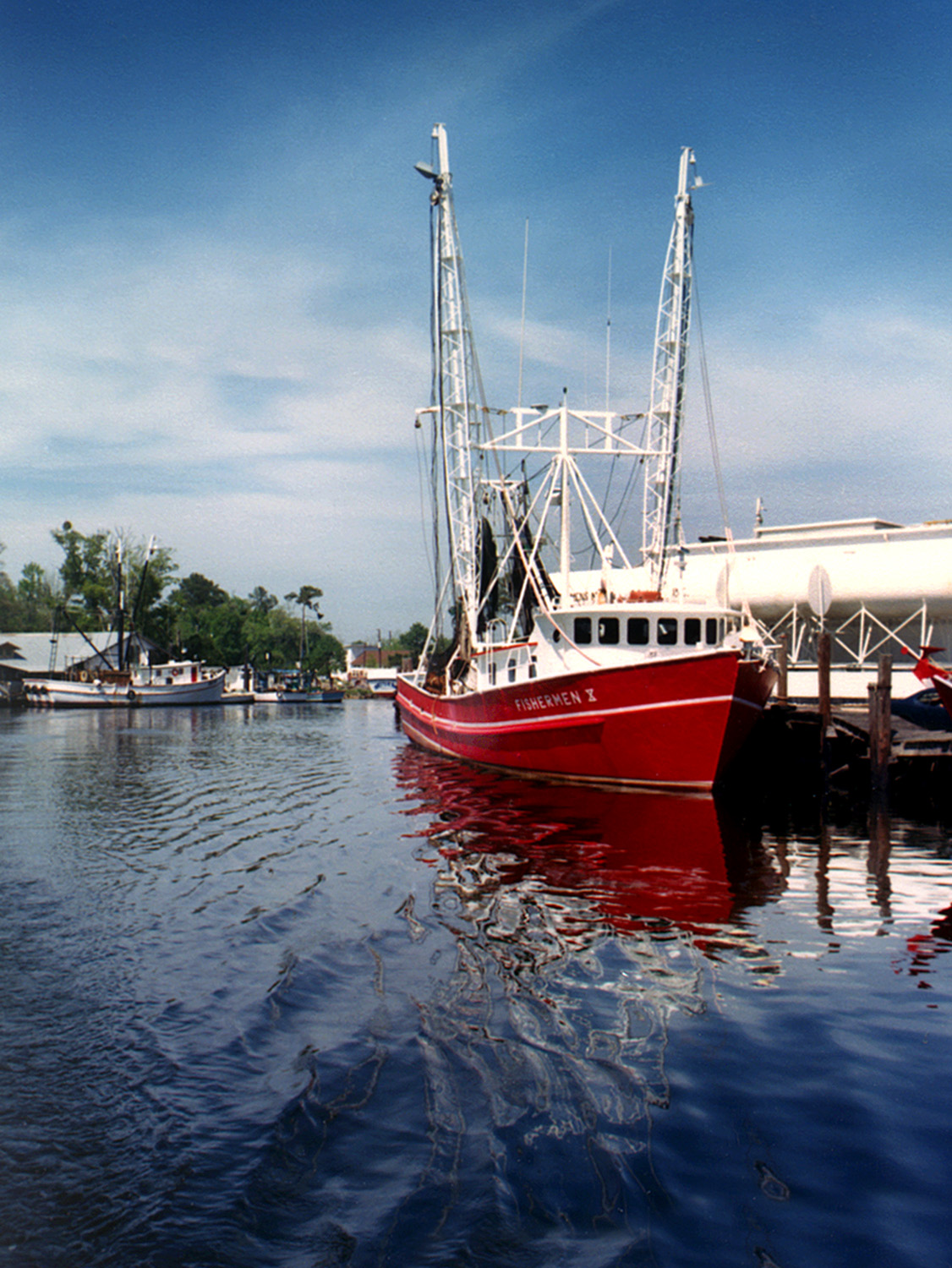
Bayou La Batre is a fishing village with a seafood-processing harbor for fishing boats and shrimp boats. The local chamber of commerce has described the city as the "Seafood Capital of Alabama" for packaging seafood from hundreds of fishing boats.
History
As part of the French settlement of the Gulf Coast, the bayou was originally called "Riviere D'Erbane" and acquired the present name from the French-maintained battery of artillery on the west bank ("bayou of the battery"). Bayou La Batre was the first permanent settlement on the south Mobile County mainland and was founded in 1786, when Joseph Bouzage (Bosarge) [1733-95] moved into the area and was awarded a 1259 acre Spanish land grant on the bayou's west bank.
Born in Poitiers, France, Joseph Bouzage came to the Gulf Coast circa 1760, married Catherine Louise Baudreau (Boudreau) on June 5, 1762, and was the father of seven children, including one son, Jean Baptiste.
Bayou La Batre was founded in 1786, when French-born Joseph Bouzage (or Bosarge) [1733-1795] was awarded a 1259 acre Spanish land grant on the West Bank of the bayou. The modern city of Bayou La Batre was incorporated in 1955.
Hurricane Katrina

On August 29, 2005, the area was devastated by Hurricane Katrina, with a local storm surge of nearly 16 ft and higher waves that engulfed Bayou La Batre and pushed over 23 shrimp boats and the cargo ship M/V Caribbean Clipper onto shore. The captain rode out Katrina on the 179 ft cargo ship, owned by Caribbean Shipping Inc., and the ship was returned to sea six months later, using a large crane.
On September 7, the Hurricane Katrina Update for libraries affected by the storm indicated that the Bayou La Batre Public Library (then known as Mose Hudson Tapia Public Library) had been destroyed.
Students from the Alba Middle School documented the destruction through a series of photos that were exhibited at various venues in Alabama and the Chicago, Illinois, region. Some of these were published in a book titled Eyes of the Storm: A Community Survives after Katrina ().
Immediately following the hurricane a group of high school students from Sierra High School in Truckee, California, adopted the city of Bayou La Batre. They sent roughly $15,000, supplies, and 15 students to help rebuild homes. Students gathered donations, sold raffle tickets, and filled their school's gym with supplies from bedding and clothes to basic household items. The school also set up a pen pal program with the students of the nearby school in Bayou La Batre.
In October 2005, seven weeks after Hurricane Katrina, Bayou La Batre was adopted by the city of Santa Monica, California (see: "Santa Monica Pier") to assist in clean-up activities. "News Release - 10/20/2005 - City of Santa Monica" (help after Hurricane Katrina), Santa Monica, CA, 2005, webpage: SMgov-news-051020: states "location for the Bubba Gump scenes in the movie "Forrest Gump"..." The Santa Monica City Council approved loaning Bayou La Batre 18 vehicles, including six pickups, two trucks with large cranes, utility vehicles with smaller cranes, a dump truck, street sweepers, a riding lawnmower, and six chainsaws. The equipment was used to help remove debris and fishing boats from downtown.
Shipbuilding
Bayou La Batre is a center for shipbuilding. The shipyards are owned and operated mainly by local families such as Gazzier Marine Services, Metal Shark (formerly Horizon Shipbuilding), Steiner Ship Yard, Rodriguez Boat Builders, Master Boat Builders, Williams Fabrication, and Landry Boat Works.
People from all over the world including the United States, South America, and Africa have boats built in Bayou La Batre frequently. In 2005, Steiner Ship Yard was asked by Walt Disney Studios to build a pirate ship, the Black Pearl; the pitch-black ship was actually a huge wooden prop built on top of a modern 96-foot-long steel utility boat. Crews sailed the ship out of the bayou to the Caribbean for the filming of sequels to Disney's 2003 film "Pirates of the Caribbean: The Curse of the Black Pearl".
Another ship, the FV Cornelia Marie from the Deadliest Catch series, was built in Bayou La Batre in 1989.
Geography
Bayou La Batre is located in southern Mobile County. The waterway Bayou La Batre passes through the center of the city and leads southwest 2 mi to Portersville Bay, an arm of Mississippi Sound in the Gulf of Mexico.
The city is 27 mi by road south-southwest of Mobile and 12 mi east of the Mississippi border. According to the U.S. Census Bureau, the city has a total area of 7.6 sqmi, of which 7.5 sqmi are land and 0.1 sqmi, or 1.87%, are water.
Climate
The climate in this area is characterized by hot, humid summers and generally mild to cool winters. According to the Köppen Climate Classification system, Bayou La Batre has a humid subtropical climate, abbreviated "Cfa" on climate maps. Retrieved on November 3, 2013.
Demographics
|align-fn=center 2013 Estimate
2020 census
| Race | Num. | Perc. |
|---|---|---|
| White (non-Hispanic) | 1,306 | 59.26% |
| Black or African American (non-Hispanic) | 273 | 12.39% |
| Native American | 4 | 0.18% |
| Asian | 420 | 19.06% |
| Pacific Islander | 1 | 0.05% |
| Other/Mixed | 101 | 4.58% |
| Hispanic or Latino | 99 | 4.49% |
As of the 2020 United States census, there were 2,204 people, 837 households, and 638 families residing in the city.
2010 census
As of the 2010 Census, Bayou La Batre had a population of 2,558. The racial and ethnic composition of the population was 60.3% white, 12.3% black or African American, 0.4% Native American, 22.8% Asian, 0.1% Pacific Islander, 1.0% from some other race, 3.2% from two or more races and 2.8% Hispanic or Latino of any race.
2000 census
As of the census of 2000, there were 2,313 people, 769 households, and 599 families residing in the city. The population density was 573.9 /mi2. There were 845 housing units at an average density of 209.7 /mi2. The racial makeup of the city was 52.44% White, 10.25% Black or African American, 0.26% Native American, 33.29% Asian, 0.43% Pacific Islander, 0.95% from other races, and 2.38% from two or more races. 1.90% of the population were Hispanic or Latino of any race. The large Asian population is attributable to a large influx of Vietnamese American shrimpers as immigrants following the Vietnam War as well as Cambodian and Laotian refugees and their children. Bayou la Batre was a popular destination for such immigrants because it fostered and continues to foster a similar shrimping industry to that of Vietnam.
There were 769 households, out of which 37.7% had children under the age of 18 living with them, 52.8% were married couples living together, 17.6% had a female householder with no husband present, and 22.0% were non-families. 17.9% of all households were made up of individuals, and 9.4% had someone living alone who was 65 years of age or older. The average household size was 3.01, and the average family size was 3.40.
The age distribution was 29.9% under the age of 18, 11.1% from 18 to 24, 26.8% from 25 to 44, 21.0% from 45 to 64, and 11.2% who were 65 years of age or older. The median age was 31 years. For every 100 females, there were 100.4 males. For every 100 females age 18 and over, there were 98.5 males.
The median income for a household in the city was $24,539, and the median income for a family was $27,580. Males had a median income of $22,847 versus $14,042 for females. The per capita income for the city was $9,928. About 22.9% of families and 28.2% of the population were below the poverty line, including 35.9% of those under age 18 and 17.7% of those age 65 or over.
Education
Bayou La Batre is served by the Mobile County Public School System. The city includes Booth (formerly Alba) Elementary School, Alba Middle School, and Alma Bryant High School, where all the high school students attend. Additionally, a small number of city residents' children attend Dixon Elementary in Irvington.
Both Alma Bryant and Booth Elementary are located on the northernmost edge of the city. Bryant, built in 1998, slightly delayed by Hurricane Georges, and Booth, built in 2006, delayed by Hurricane Katrina, are located on Hurricane Boulevard. Both schools' students were (in part) located in what is now Alba Middle School further south in Bayou La Batre. Alba High School first combined with Grand Bay High School in 1998 in the newly built, centrally located Alma Bryant High School, located on 16th Section land (land dedicated for school purposes). Alba Middle (which was in great part located in portable classrooms and was a part of the high School campus, as was Grand Bay Middle) took over the high school building, greatly relieving overcrowding. Similarly, the Alba Elementary Campus which shared land with the middle school, while being mostly autonomous, also became part of Alba Middle School. Alba and Grand Bay Middle are the focal point of bus routes for all school buses for Bryant High, those buses shared in grades 6-12 as a cost-saving effort to avoid overlapping routes for the separate schools.
In December 2007, a new library was opened to serve the area's Asian-American community. The library is located on Wintzell Avenue in the Bayou La Batre office of Boat People SOS, a national group that assists Vietnamese-Americans. The Mobile County Commission gave $2,500. The library will be used as a place where elderly immigrants can master computer skills, children can practice their Vietnamese after school, and day laborers can surf the Web after work.
Film and book references
Bayou La Batre is mentioned in the 1994 film Forrest Gump and in Winston Groom's book of the same name on which the movie is based as the home of Forrest's army buddy Benjamin Buford "Bubba" Blue, and later as the home of Forrest Gump himself during his time as a shrimp boat captain. Shrimping scenes in the film were filmed in the Lowcountry region of South Carolina, primarily in the communities of Beaufort and Port Royal.
In April 2005, Disney Studios launched a secretly built pirate ship, the Black Pearl, out of Bayou La Batre for filming sequels to Pirates of the Caribbean: The Curse of the Black Pearl. Bayou La Batre's seafood industry also serves as a centerpiece for the History channel's reality documentary series Big Shrimpin'.
Notable people
- Regina Benjamin, former United States Surgeon General
- Antwan Odom, American football player, NFL, Cincinnati Bengals
Footnotes
References
References
- https://www.marinaworld.com/news/bayou-la-batre-alabama-docks-project
- "2021 U.S. Gazetteer Files". United States Census Bureau.
- "Bayou La Batre city, Alabama: 2020 DEC Redistricting Data (PL 94-171)". U.S. Census Bureau.
- {{GNIS. 2403828
- "About Bayou La Batre".
- link. (September 2, 2006 .")
- "Hurricane Katrina Library Update: September 7".
- "CorneliaMarie {{!}} Stats".
- [http://www.weatherbase.com/weather/weather-summary.php3?s=308110&cityname=Bayou+La+Batre%2C+Alabama%2C+United+States+of+America&units= Climate Summary for Bayou La Batre, Alabama]
- "U.S. Decennial Census". Census.gov.
- "Annual Estimates of the Resident Population: April 1, 2010 to July 1, 2013".
- "Explore Census Data".
- "Bayou La Batre city". United States Census Bureau.
- "U.S. Census website". [[United States Census Bureau]].
- "[https://www.dropbox.com/s/wm2200ffn3u3t02/new-zoning-small-draft-2018.jpg?dl=0 Proposed Zoning Districts]." City of Bayou Le Batre. Retrieved on November 27, 2018.
- "[http://images.pcmac.org/Uploads/MCPSS/MobileCounty/Departments/DocumentsCategories/Documents/Booth%20Elementary.pdf Booth Elementary Map] {{Webarchive. link. (July 26, 2020 ." [[Mobile County Public School System]]. Retrieved on November 27, 2018.)
- "[http://images.pcmac.org/Uploads/MCPSS/MobileCounty/Departments/DocumentsCategories/Documents/Alba%20Middle.pdf Alba Middle School Map] {{Webarchive. link. (July 26, 2020 ." [[Mobile County Public School System]]. Retrieved on November 26, 2018.)
- "[http://images.pcmac.org/Uploads/MCPSS/MobileCounty/Departments/DocumentsCategories/Documents/Bryant%20High%20School.pdf Bryant High School Map] {{Webarchive. link. (July 26, 2020 ." [[Mobile County Public School System]]. Retrieved on November 26, 2018.)
- "[http://images.pcmac.org/Uploads/MCPSS/MobileCounty/Departments/DocumentsCategories/Documents/Dixon.pdf Dixon Elementary Map] {{Webarchive. link. (July 26, 2020 ." [[Mobile County Public School System]]. Retrieved on November 27, 2018.)
- "Quotes from Movie Forrest Gump :: Finest Quotes" (dialog), Finest Quotes, 2006, webpage: [http://www.finestquotes.com/movie_quotes/movie/Forrest%20Gump/page/0.htm FQuotes-FGump].
- Henderson, Russ. (January 23, 2005). "Pirates of the Bayou". [[Mobile Register]].
- "Big Shrimpin' — About Big Shrimpin' — History.com".
- Santo, Michael. (July 13, 2009). "Regina Benjamin Picked as Surgeon General".
This article was imported from Wikipedia and is available under the Creative Commons Attribution-ShareAlike 4.0 License. Content has been adapted to SurfDoc format. Original contributors can be found on the article history page.
Ask Mako anything about Bayou La Batre, Alabama — get instant answers, deeper analysis, and related topics.
Research with MakoFree with your Surf account
Create a free account to save articles, ask Mako questions, and organize your research.
Sign up freeThis content may have been generated or modified by AI. CloudSurf Software LLC is not responsible for the accuracy, completeness, or reliability of AI-generated content. Always verify important information from primary sources.
Report